
1. BNB Overview
In July 2017, just before Bitcoin was about to enter a historic bull run, Changpeng Zhao led his team to launch a major crypto exchange. To support the platform’s rollout, BNB (then known as BNB Coin) officially entered the spotlight and was first issued through an ICO as an ERC-20 token on the Ethereum network. At the time, BNB’s primary use case was to give users trading fee discounts on the exchange.
However, BNB’s vision did not stop there. As the exchange grew into one of the world’s largest crypto exchanges, the team recognized that achieving a true DeFi vision required an independent, high-performance base layer that could be developed and governed with greater autonomy. In September 2020, BNB Chain (originally launched as BSC and later rebranded) went live. From that point on, BNB completed its transformation from a “platform utility token” into the core asset of a broader ecosystem, formally becoming the gas token used to pay network fees on BNB Chain. The meaning of BNB also evolved into “Build and Build.”
In just a few years, driven by rapid growth across DeFi and meme ecosystems, plus ongoing platform-level support, BNB Chain became one of the most watched public blockchains, showing strong momentum in both active addresses and transaction volume.
2. BNB Chain: A High-Performance, Broadly Compatible Network
BNB Chain is one of the earlier public blockchains to see large-scale real-world usage, and it handled substantial on-chain demand during the active market cycle in 2021. At that time, Ethereum faced obvious congestion as usage surged, while BNB Chain used a PoSA (Proof of Staked Authority) consensus model and kept block times around 3 seconds, giving it an advantage in confirmation speed.
EVM compatibility
BNB Chain’s core competitive edge is full compatibility with the Ethereum Virtual Machine (EVM). This means developers can port mature Ethereum code to BNB Chain with minimal friction, with little need to relearn tooling or languages. This low barrier helped BNB Chain quickly attract developers and users migrating from Ethereum, allowing it to build a broad ecosystem spanning DeFi, GameFi, and many other applications in a short time.
Efficient consensus design
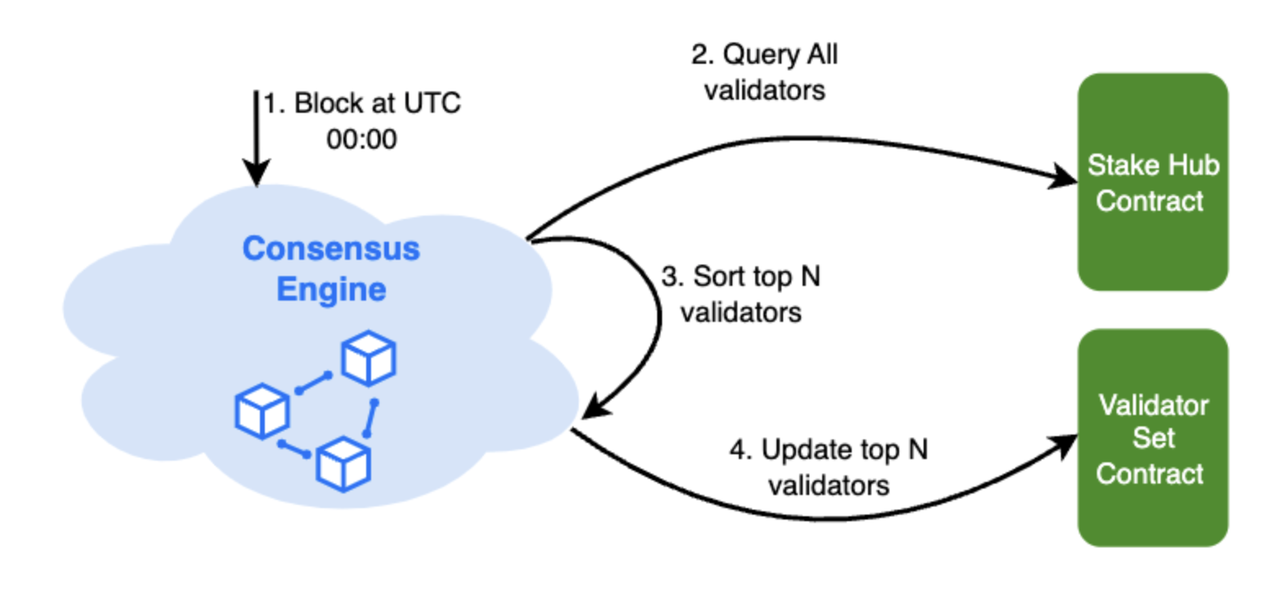
Unlike Ethereum, BNB Chain uses PoSA. In each epoch, only 21 active validators participate in block production and consensus, significantly improving confirmation efficiency. To become a validator, participants must stake at least 10,000 BNB, tightly aligning node behavior with network security. With a streamlined validator set, BNB Chain can still maintain low costs and high throughput in high-concurrency environments.
BNB deflation mechanics
BNB uses a dual burn design that combines a programmatic auto-burn based on on-chain activity and price, plus a real-time BEP-95 burn that processes a portion of gas fees. These mechanisms aim to reduce BNB supply through system-driven rules so that supply can better track actual network usage.
3. BNB’s Core Ecosystem
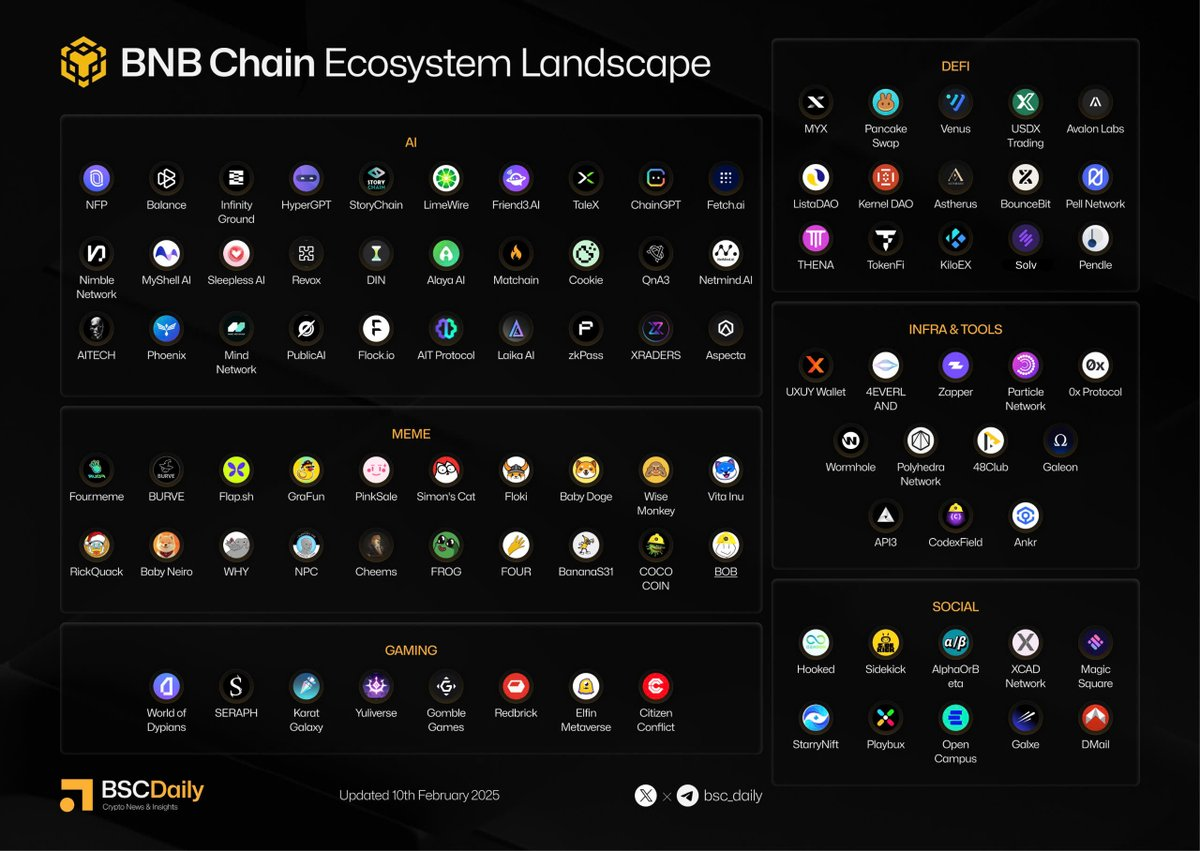
For newer high-performance chains, building meme plus DeFi ecosystems has become a proven path to quickly boost active addresses and on-chain volume. Solana, for example, has seen multiple memecoins with significant price moves, while DeFi protocols like Orca, Raydium, and Jupiter provide liquidity for meme trading. Base follows a similar pattern with popular memecoins and DEX infrastructure supporting trading demand. BNB Chain also follows this established template. The emergence of memecoins such as “Binance Life,” “Hakimi,” and “4” has increased market attention, while DEXs like PancakeSwap and Aster provide liquidity support for on-chain memecoins, further amplifying trading activity and price volatility.
BNB Chain memecoin ecosystem
Backed by a strong community base and low transaction costs, BNB Chain’s meme ecosystem has created a distinct wealth-effect narrative. From early animal-coin waves to newer tokens that deeply integrate with Chinese-language culture, these projects have generated substantial trading volume. For example, “Hakimi” reportedly posted a single-day gain of over 200% after receiving attention from ecosystem funding. This model, fueled by organic community propagation and wealth-effect momentum, has driven rapid user expansion and high-frequency engagement.
BNB Chain DeFi ecosystem
As the foundation of any public chain ecosystem, BNB Chain’s DeFi stack is highly mature and spans trading, derivatives, and lending. PancakeSwap, as the largest on-chain DEX, uses an automated market maker model to provide deep liquidity across many tokens. Aster, positioned as a leading perpetual futures DEX (Perp DEX), offers a high-leverage derivatives experience that is closer to a CEX-style workflow and includes a zero-gas-fee solution. Venus Protocol, as a core lending protocol, allows users to earn interest or access liquidity by posting overcollateralized assets. This infrastructure supports fast capital circulation and gives users multiple paths for capital efficiency and financial services.
4. The Close Link Between BNB and the Exchange Ecosystem
As one of the world’s leading crypto exchanges, the exchange and BNB Chain are closely connected across historical context, technical development, and ecosystem building. Market participants often believe that tokens with high trading heat on BNB Chain may later gain access to broader trading venues, and this expectation has become a key factor behind some memecoin trading behavior. For example, Chinese-community hotspot projects such as “Binance Life” may see capital inflows and price swings when rumors suggest a potential liquidity upgrade. At its core, this reflects developers’ and investors’ pursuit of “liquidity upgrades,” because gaining access to large centralized exchanges can mean broader user reach and deeper order book liquidity.
In addition, the exchange’s Web3 wallet plays a practical role as a bridge between centralized platforms and on-chain ecosystems, lowering the operational barrier for some users entering BNB Chain. Through wallet integration, users can more directly participate in on-chain trading, asset management, and DeFi applications, which can increase BNB Chain usage and activity. However, this convenience is primarily a user-experience benefit and does not imply endorsement of any specific project’s value.
5. How Investors Can Get BNB
After entering the BNB Chain ecosystem, new BNB issuance is primarily associated with validator participation in network governance and maintenance. For individual investors, becoming a BNB Chain validator typically requires staking at least 10,000 BNB and operating professional-grade server infrastructure, which is better suited to institutions or users with strong technical resources and capital scale. For most investors, buying BNB through a trusted centralized exchange is the most efficient and convenient way to participate in the ecosystem.
By purchasing BNB through Bitunix and other centralized exchanges, the platform acts as a trusted intermediary and supports buying crypto directly with fiat or stablecoins such as USDT. Some platforms also support instant credit card purchases, further lowering barriers. Before first use, users typically need to register an account and complete identity verification (KYC) to comply with global AML and counter-terrorist financing requirements. Bitunix has a compliance and risk-control framework that uses hot and cold wallet separation, multi-signature security, and real-time monitoring to provide strong asset protection.
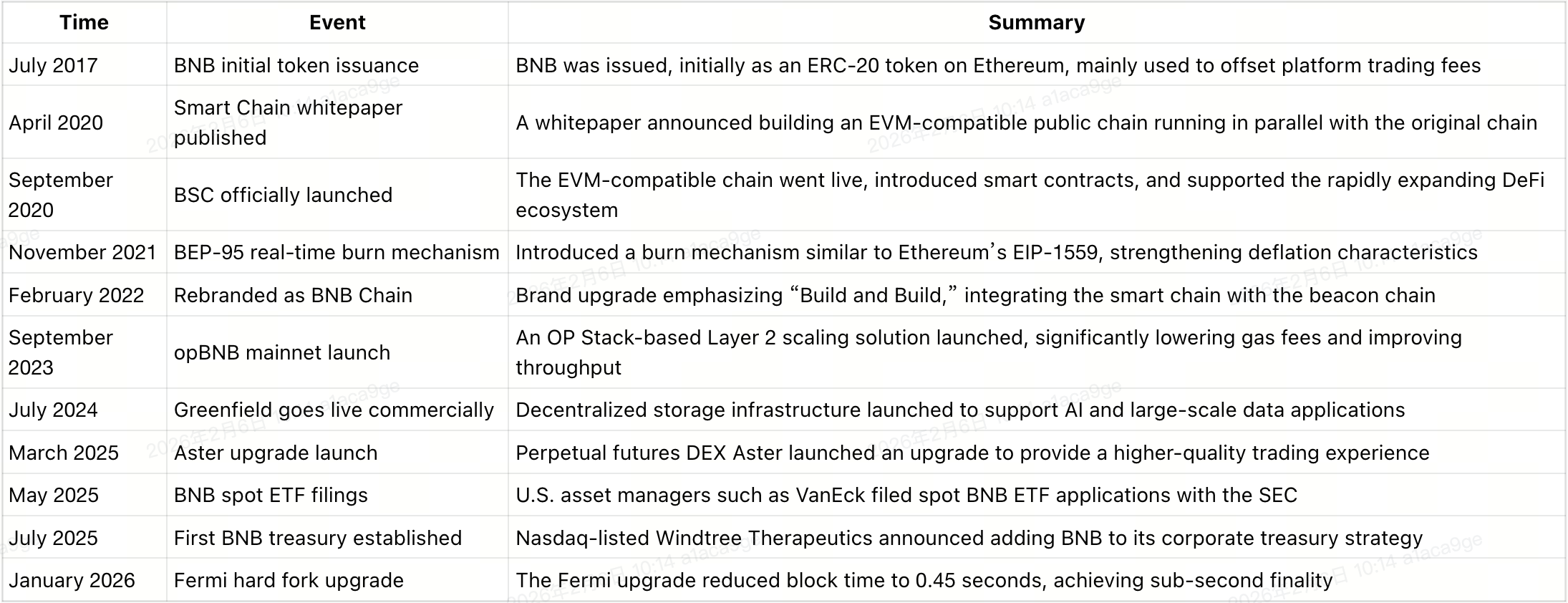
6. BNB Major Milestones Timeline
Disclaimer
This article is not intended to provide: (i) investment advice or investment recommendations; (ii) an offer or solicitation to buy, sell, or hold digital assets; or (iii) financial, accounting, legal, or tax advice. Digital assets (including stablecoins and NFTs) involve high risk and may be highly volatile. You should carefully consider whether trading or holding digital assets is suitable for you based on your financial situation. For your specific circumstances, consult your legal, tax, or investment professionals. You are responsible for understanding and complying with all applicable local laws and regulations.
About Bitunix
Bitunix is a global cryptocurrency derivatives exchange trusted by over 3 million users across more than 100 countries. At Bitunix, we are committed to providing a transparent, compliant, and secure trading environment for every user. Our platform features a fast registration process and a user-friendly verification system supported by mandatory KYC to ensure safety and compliance. With global standards of protection through Proof of Reserves (POR) and the Bitunix Care Fund, we prioritize user trust and fund security. The K-Line Ultra chart system delivers a seamless trading experience for both beginners and advanced traders, while leverage of up to 200x and deep liquidity make Bitunix one of the most dynamic platforms in the market.
Bitunix Global Accounts
X | Telegram Announcements | Telegram Global | CoinMarketCap | Instagram | Facebook | LinkedIn | Reddit | Medium