

Article Summary
- Bitcoin's price is influenced by macroeconomic factors, market sentiment, and on-chain metrics.
- Key support levels, such as previous cycle highs and long-term moving averages, can act as potential price floors.
- Historical Bitcoin cycles show significant drawdowns are normal before a new bull run begins.
- This article analyzes both bearish scenarios for potential lows and bullish cases for a strong recovery.
- Understanding these dynamics is crucial for making informed decisions in a volatile market.
- Bitunix offers powerful tools for traders to navigate volatility, including futures contracts to hedge or speculate on price movements.
With Bitcoin down significantly from its all-time high, every investor is asking the same question: How far will Bitcoin drop? Predicting the future is impossible. But we can look at historical data to identify the key metrics that will impact Bitcoin’s trajectory down the line.
Currently, FUD has spread through the crypto market, limiting investments and causing substantial liquidity outflows. Bitcoin is the most prominent cryptocurrency and the one dictating trends through its dominance. And while it remains under bearish pressure, BTC still receives support from institutional investors and long-term holders.
This article will explore the critical support zones for Bitcoin's price, analyze the macroeconomic headwinds, and present data-backed arguments for both potential bottoms and the eventual recovery. In the end, you will know how to read market indicators and make better decisions when trading on a crypto exchange.
The Bear Case - How Far Will Bitcoin Drop?
BTC is currently showing strong bearish signals, and some analysts believe that Bitcoin will soon nosedive through other support levels.
As of mid-December 2025, Bitcoin is trading just below $90,000 and 29% lower than its all-time high of $126,269 established in October. In fact, BTC dropped below the $100,000 support level nearly a month ago. Over the past three weeks, the bulls have repeatedly failed to push the asset’s price back up.
The 200-Week Simple Moving Average (SMA) is hinting toward a new correction. Generally, this market indicator signals the beginning of a deep downtrend, as evidenced by Bitcoin hitting new ATHs.
In late 2017, Bitcoin set a new ATH at $19,834 amid a speculative frenzy fueled by the ICO boom. Soon after, BTC declined consistently, losing over 62% of its gains in less than two months. It took Bitcoin over 18 months to regain the $10,000 resistance level.
In October 2021, Bitcoin reached an all-time high of $68,742. This time, it was inflation and increasing adoption by institutional investors that drove its surge. However, the pattern repeated, and BTC declined steadily once again, losing over 47% of its value in less than four months. Bitcoin then had to wait almost three years of extreme volatility to set a new ATH.
The 200-Week SMA indicates that Bitcoin's price historically bottoms out around the 200-week moving average in each of its major market cycles. In the graph below, Bitcoin’s decline is marked by blue and purple dots, and the current situation points to an imminent drop as we approach the 200-Week SMA in this cycle.
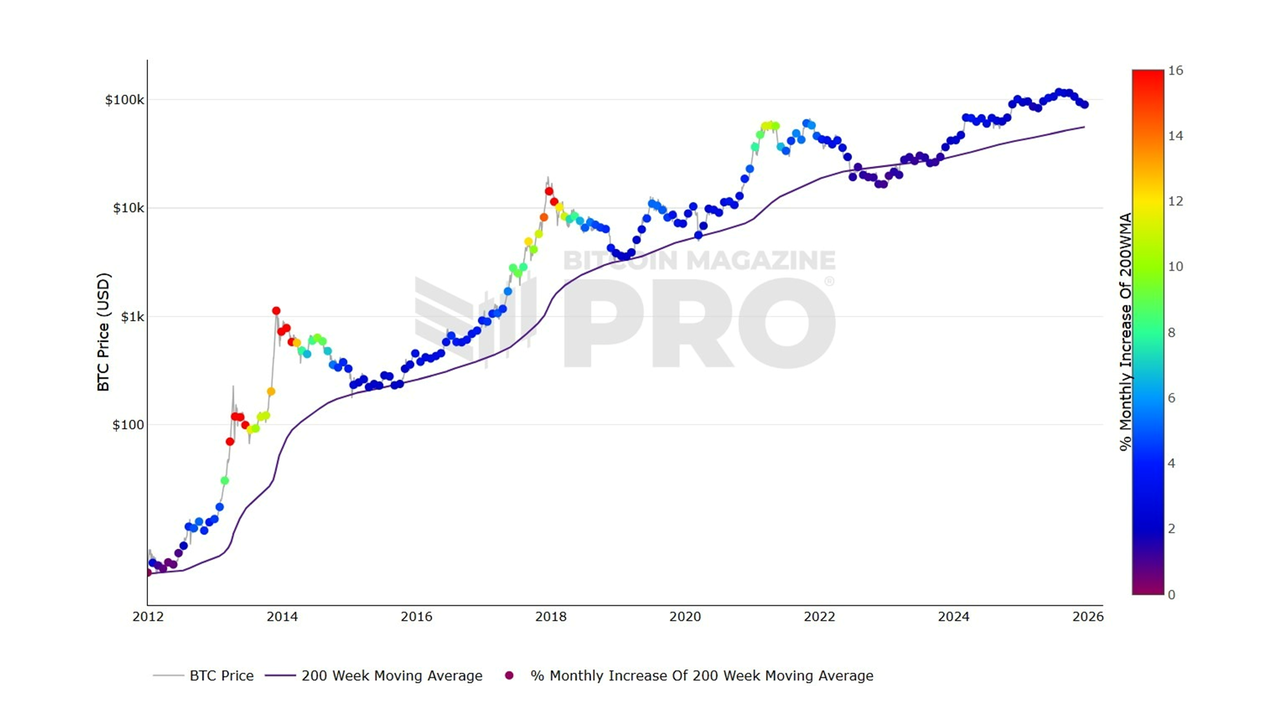
Historical data show that Bitcoin tends to drop over several months before stabilizing in a new comfort zone. This time, analysts forecast that Bitcoin may reach $60,000-$70,000 in mid-2026, which would validate current valuations and historical price trend lines.
The most pessimistic analysts predict Bitcoin will reach lower levels sooner. Glassnode experts believe that long-term BTC holders may still profit by selling now. However, their momentum is weakening and could quickly turn to a losing streak if liquidity deteriorates further.
Moreover, according to the Realized Price metric, Bitcoin's average cost basis is around $56,000. Realized Price represents the value of all BTC at the price they were last transacted on-chain, divided by the number of BTC in circulation. This on-chain metric often acts as a strong support zone.
Other factors that could further impact Bitcoin’s price include massive liquidations, intense market pressure, higher inflation, and the risk of a global recession.
Part 2: The Bull Case - The Path to Recovery
The current bearish trend in the crypto market seems to have engulfed Bitcoin’s hopes of recovery. However, not everything is lost yet, including the psychologically important $100K level. According to some analysts, Bitcoin can look forward to a bright future stretching across the next 5 years and beyond.
Despite its nearly limitless potential, Bitcoin has a pre-programmed journey ahead. The total supply of BTC is capped at 21 million coins. This hard-coded scarcity is enforced through programmed "halving" events that reduce new coin issuance every four years. According to its schedule, the final Bitcoin is expected to be mined around the year 2140.
Each Bitcoin halving cuts the reward for mining new blocks by 50%. Historically, Bitcoin halving events have kicked off new bull markets. The most recent halving occurred in April 2024, halving rewards from 6.25 to 3.125 BTC, and helped Bitcoin reach a new ATH at $71,632.
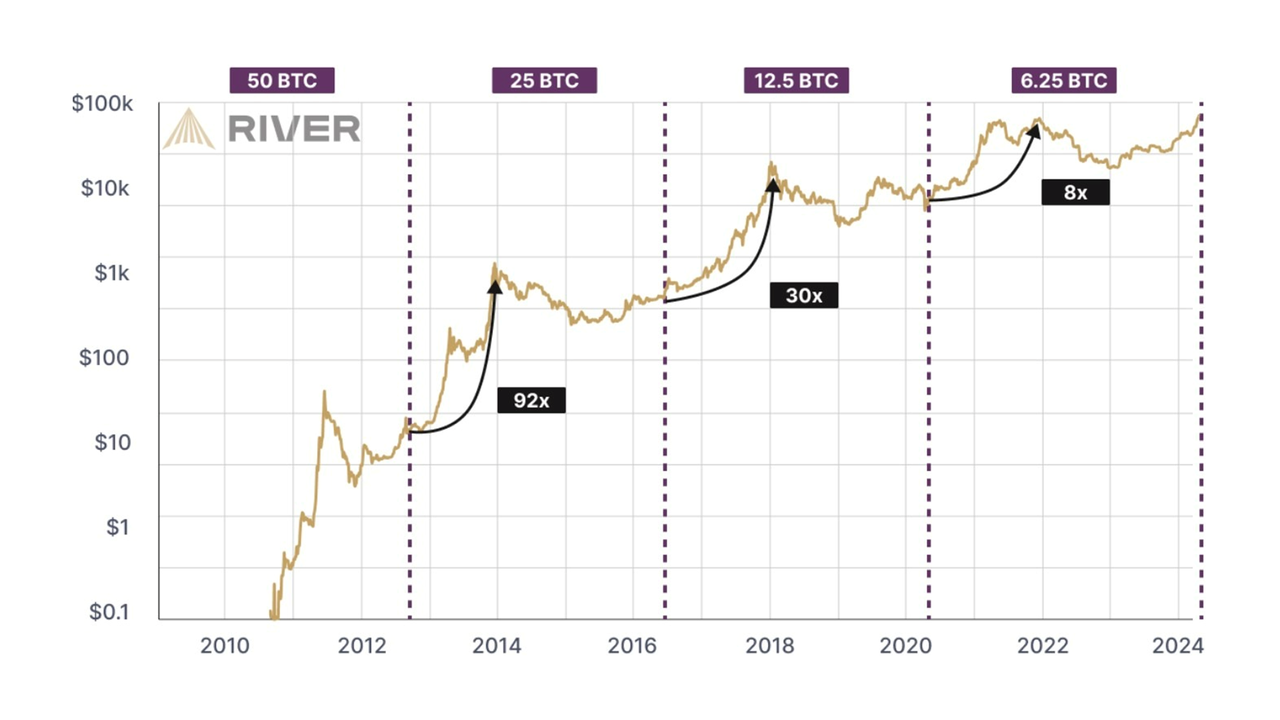
The next Bitcoin halving is scheduled for 2028, drastically reducing the block mining reward from 3.125 BTC to 1.5625 BTC. The event will likely ripple through the market, and prices could increase if demand remains strong. Changelly experts believe Bitcoin could trade at an average of $271,355 in 2028, with a maximum of $360,074.
Reaching those heights would require increased mainstream adoption and higher institutional investments in Bitcoin. Both factors depend heavily on ETFs' role in attracting new inflows.
A BTC exchange-traded fund (ETF) operates as a regulated investment fund giving investors exposure to Bitcoin price movements without owning the digital asset directly. As of late 2025, there are over Bitcoin ETFs worldwide, holding over 1.5 million BTC. The first BTC ETFs in the US were launched after SEC approval in January 2024, and include BlackRock's IBIT, Fidelity's FBTC, and Grayscale's GBTC.
Bitcoin could escape from under the bears’ control in the next five years if long-term holders and BTC whales continue on-chain accumulation. For example, Strategy, the world’s largest corporate holder of Bitcoin, bought another 10,645 BTC at the beginning of December 2025 for nearly $1 billion. The company now holds 671,268 BTC valued at over $50 billion. This kind of acquisition shows that institutional investors are confident that Bitcoin will recover and rally toward new ATHs soon.
How to Trade Bitcoin's Volatility on Bitunix
You can use Bitcoin’s volatility to your advantage and adopt a Dollar-Cost Averaging (DCA) to trade BTC on Bitunix. This strategy averages out your entry price over time, reducing risk from market volatility. It also helps you grow your gains steadily without having to monitor the market nonstop. Here’s how to trade BTC with DCA on Bitunix:
- Go to the Bitunix Sign up page and register using your email or mobile number.
- Deposit crypto or link a fiat method.
- Find Spot then Spot Auto-Invest
- Click the "Create Auto-Invest" button to start a new plan.
- Choose the cryptocurrency you want to buy, e.g., BTC.
- Decide how much you want to invest each time.
- Pick your schedule (daily, weekly, etc.).
- Give your plan a name and adjust other settings if necessary.
- Click "Confirm Auto-Invest" to activate your automated DCA strategy.
Alternatively, you can use Bitunix Futures to short Bitcoin to profit from a potential drop or go long on a bounce. However, this high-risk strategy is best suited for experienced traders.
Lastly, you can use the Earn section to enter the platform’s staking program and access passive income opportunities. All these options are available for both desktop and mobile users. You can download the Bitunix mobile application for iOS or Android on the app download page.
Why Trade on Bitunix?
Bitunix is a high-performance trading platform that provides real-time updates and market analysis, catering to both beginner and expert traders. The exchange complies with global regulations and has a Protection Fund safeguarding the users’ assets. Moreover, it allows new users to join and start trading immediately via a fast registration process and a user-friendly verification system with optional KYC.
More importantly, Bitunix fees are among the lowest in the industry, allowing users to trade confidently across 1,000+ pairs of 700+ cryptocurrencies.
Conclusion: Patience and Perspective are Key
The crypto market remains bearish for now, and Bitcoin is following suit with a steady decline. The most pessimistic price predictions put BTC at half its recent ATH by mid-2026. This trajectory would see Bitcoin burn through several support layers before stabilizing at around $60,000.
On the other hand, institutional investors, long-term holders, and even casual traders hope for a speedy recovery. Several factors could help drive a Bitcoin rally, including more ETF approvals, increased adoption, the 2028 halving, and even enhanced government support worldwide.
So, how far will Bitcoin drop? Should you wait for it to reach rock bottom before buying, or should you buy now before the price rallies again?
In this uncertain scenario, your best choice is to stay informed and trade smart. Join Bitunix to access a professional-grade trading platform for every market condition.
FAQ Section
What is the 200-week moving average, and why is it important for Bitcoin?
The 200-week moving average (200WMA) for Bitcoin is a key long-term indicator showing its average price over the last 200 weeks.
What is the Bitcoin halving, and how does it affect the price?
The Bitcoin halving is a programmed event that occurs roughly every 4 years. It halves the rewards miners receive for validating transactions, reducing the supply of new Bitcoins.
How can I protect my portfolio during a Bitcoin bear market?
Your best choice during a bear market is to monitor the market. Do not make hasty decisions. Invest only what you are willing to lose and diversify your crypto portfolio.
How do interest rates affect Bitcoin's price?
Generally, interest rate cuts lead to increased short-term market volatility. As a result, Bitcoin's price may rise due to increased market liquidity. On the other hand, higher interest rates make investors less willing to increase their portfolio allocations. Therefore, BTC’s price may decrease as demand drops.
Where can I track key Bitcoin metrics and support levels?
Bitcoin provides a wide range of analytic charts, real-time price updates, and advanced trading tools to help you track key Bitcoin metrics and make better decisions.
Glossary
Layer 1: Base blockchain that verifies and records transactions.
Layer 2: A scaling solution that processes transactions off the main chain and posts proofs to L1.
Spot Trading: The immediate purchase and sale of financial assets at their current market price, also known as the "spot price."
Trading Pair: A combination of two different digital or fiat currencies that can be exchanged for one another on a cryptocurrency exchange.
Stable Pair: A pool of assets that track similar values, such as two stablecoins.
Altcoin: Any crypto asset that is not Bitcoin.
DeFi: Decentralized finance applications on public blockchains.
Volatility: Degree of price fluctuation for an asset over time.
About Bitunix
Bitunix is a global cryptocurrency derivatives exchange trusted by over 3 million users across more than 100 countries. At Bitunix, we are committed to providing a transparent, compliant, and secure trading environment for every user. Our platform features a fast registration process and a user-friendly verification system supported by mandatory KYC to ensure safety and compliance. With global standards of protection through Proof of Reserves (POR) and the Bitunix Care Fund, we prioritize user trust and fund security. The K-Line Ultra chart system delivers a seamless trading experience for both beginners and advanced traders. At the same time, leverage of up to 200x and deep liquidity make Bitunix one of the most dynamic platforms in the market.
Bitunix Global Accounts
X |Telegram Announcements |Telegram Global |CoinMarketCap |Instagram |Facebook |LinkedIn |Reddit |Medium