

Article Summary
- This article provides a comprehensive price prediction and fundamental analysis for Berachain (BERA).
- It explains Berachain's unique "Proof of Liquidity" (PoL) consensus mechanism, which aims to solve the liquidity fragmentation problem common in other Layer 1 blockchains.
- The article breaks down Berachain's complex three-token model: BERA (gas), BGT (governance), and HONEY (stablecoin).
- The bull case focuses on the massive cult-like community, the innovative economic design that aligns validators and protocols, and the EVM compatibility.
- The bear case highlights the extreme complexity of the system, the risk of economic death spirals, and intense competition in the Layer 1 space.
- It presents detailed price prediction scenarios (bearish, neutral, bullish) for both 2026 and 2030, based on mainnet launch success and ecosystem adoption.
Berachain started with NFT culture, bear memes, and the kind of internet energy that usually produces chaos before it produces infrastructure. Somehow, it turned into a Layer 1 network.
The project now describes itself as a high-performance, EVM-identical blockchain powered by Proof of Liquidity, and the architecture as being built with BeaconKit, a framework developed using the Cosmos SDK. If you want market access through a centralized venue, Bitunix is a crypto exchange that lists BERA on spot and perpetual markets.
This analysis will decode Berachain's complex economic model, evaluate its massive community momentum, and provide data-driven price predictions for the BERA token for 2026 and 2030.
Decoding Proof of Liquidity
To understand BERA, you have to start with the mechanism. The Berachain mainnet went live on February 6, 2025, and by April 2026, BERA traded around $0.409, with roughly $26.7 million in 24-hour trading volume, a market cap near $100 million, and chain TVL around $91.7 million. DefiLlama also showed Berachain with a stablecoin market cap of about $86.4 million and a 24-hour DEX volume of $3.2 million. So the chain is live, active, and measurable, but it is already far enough from launch that the discussion has to move past pure anticipation.
Berachain's own docs define the model clearly:
"Proof-of-Liquidity enables protocols to encourage validators to direct their BGT emissions to a protocol's Reward Vault using whitelisted Incentive tokens."
1. The Problem With Proof-of-Stake
Traditional proof-of-stake creates a trade-off. You can stake assets to help secure the chain or deploy them into DeFi to chase yield, but doing one usually limits the other. Berachain's docs frame Proof of Liquidity as an extension of proof-of-stake that realigns incentives between validators, applications, and users through a two-token model. The whole point is to stop capital from sitting idle when it could also support trading, lending, and on-chain activity.
2. The PoL Solution
Berachain tries to solve that trade-off with Reward Vaults. Users provide liquidity or take other approved productive actions, receive PoL-eligible receipt tokens, and stake those receipt tokens in a Reward Vault to earn BGT. Validators then direct emissions toward approved vaults, and protocols can offer extra incentive tokens to attract that attention. It is not simple, but the logic is that liquidity becomes part of the chain's incentive engine instead of being treated like a separate side quest.
3. The Three-Token Ecosystem
The three-token design is the core of the system. The BERA token is the native gas and staking asset. The BGT token is the governance and rewards asset that can be redeemed or burned 1:1 for BERA, while BERA cannot be turned back into BGT.
The HONEY stablecoin is the chain's native stable asset, soft-pegged to the US dollar and fully collateralized. This setup separates gas, governance, and stability into distinct instruments rather than forcing a single token to do every job poorly.
4. The Flywheel Effect
Berachain's idea is that users earn BGT by providing useful liquidity or taking other approved actions. They then delegate that BGT to validators. Validators send emissions to approved Reward Vaults, and protocols compete for that support by offering incentives.
The goal is to create a loop where useful liquidity earns rewards, rewards increase governance influence, and that influence pulls in even more liquidity.
The Bull Case: Culture Meets Economics
The positive case starts with the obvious part: there is already a live product, a live token, and published forecasts from mainstream crypto platforms. Kraken's model points to about $0.41 in 2026 and $0.50 in 2030. Bitget's forecast sits in almost the same range, around $0.4105 in 2026 and $0.4990 in 2030. CoinCodex's price prediction is more optimistic, at roughly $0.5265 by the end of 2026 and $1.07 by 2030. Changelly's forecast is the most aggressive of the group, with a December 2026 average of $1.27, a December 2026 maximum of $1.41, and a 2030 average near $0.98 with a $1.81 upper target.
A serious Berachain price prediction has to accept that the published range is wide because the project itself is still proving what kind of chain it wants to be.
1. The Cult Community
Berachain's community is part of the asset. Ledger's March 2025 explainer traced the network's roots back to the Bong Bears NFT collection, and Berachain's own NFT bridge still lists Bong Bears and the related rebases as native collections in the ecosystem.
On top of that, the official airdrop overview on February 5, 2025, said 15.75% of BERA supply would go to community members, applications, liquidity providers, and others, while more than 250 dApps live on the Bartio testnet, and about $3.1 billion in committed TVL at mainnet launch.
2. Aligned Incentives
This is the strongest technical bull argument. Berachain is not just another Layer 1 trying to copy Ethereum fees or Solana speed. It built an incentive marketplace where protocols compete for BGT emissions, and validators capture value by directing them. That creates a native market for liquidity attention.
Then Berachain proposed PoL v2 in July 2025, with the official blog snippet saying that about one-third of future PoL emissions would go into a new BERA Yield Module. That matters for the BERA token because one of the loudest complaints after launch was that BGT captured too much attention while BERA itself needed stronger value capture.
3. Ethereum Virtual Machine (EVM) Compatibility
Berachain's technical barrier for developers is low compared with non-EVM chains. The docs describe it as EVM-identical, and Ledger's 2025 explainer adds that BeaconKit was developed using the Cosmos SDK to keep the architecture modular while preserving Ethereum-style compatibility.
That means developers can port contracts, tooling, and workflows more easily than they can on chains with entirely new execution environments. In a market where every Layer 1 is begging developers to move in, lower migration pain is real leverage.
The Bear Case: Complexity and Competition
The downside case is that the most conservative forecast models barely move from current pricing. Kraken stays near $0.41 in 2026 and $0.50 in 2030. Bitget lands around $0.4105 in 2026 and $0.4990 in 2030. Even CoinCodex, which is meaningfully higher, still only gets to about $1.07 by 2030. That is not the forecast profile of a chain the market already views as a future winner. A cautious Berachain price prediction has to respect how restrained these models still are.
1. Extreme Complexity
Berachain's complexity poses a real risk to BERA price forecasts because the token's value does not depend on a single driver. The network splits core functions across BERA for gas and staking, BGT for governance and emissions, HONEY for stable-value activity, Reward Vaults for BGT distribution, and validator decisions for where emissions go.
Berachain's docs also show that access to emissions depends on approved vaults, commission settings, and incentive-token distribution rules. That gives the system more ways to align users, validators, and apps, but it also creates more points of failure. If incentives weaken, if liquidity leaves, or if users struggle to understand where value really accrues, demand for BERA can fade even while the chain remains live.
That is why complex token systems usually deserve wider price ranges and more cautious upside assumptions than simpler Layer 1 models. Current on-chain data already shows Berachain operating on a much smaller base than its early-launch hype, with about $91.7 million in TVL and roughly $3.2 million in 24-hour DEX volume in early April 2026, underscoring how sensitive adoption can be once the incentive system slows.
2. The Risk of a Death Spiral
The economic model depends on liquidity staying put long enough to keep the machine attractive. That is where the post-launch data gets uncomfortable. Binance Research highlighted about $3.1 billion in committed TVL on the mainnet launch in February 2025, while DefiLlama showed Berachain at about $91.7 million in TVL and $86.4 million in stablecoin market cap in April 2026.
That drop does not prove failure on its own, but it does show how fast mercenary liquidity can leave after incentives cool. If productive yield falls and users withdraw, BGT emissions become less attractive, governance gets quieter, and the whole loop weakens.
3. The Layer 1 Bloodbath
Berachain is fighting in one of the most crowded segments in crypto. Solana alone had about $5.539 billion in TVL, $14.686 billion in stablecoins, and $924.43 million in 24-hour DEX volume in early April 2026. Monad's official site was also pitching a next-generation EVM chain with 10,000 TPS and sub-second finality.
For a more positive price prediction, Berachain needs to be more useful than chains with deeper liquidity, larger communities, or cleaner performance narratives, and that is a hard job.
4. Mainnet Execution Risk
The mainnet risk has changed shape. The question is no longer whether the Berachain mainnet launches, because it already did on February 6, 2025. The real risk now is retention.
Berachain's official blog was already talking about PoL v2 by July 2025, which tells you the team was still tuning the value-capture design only months after launch. By April 2026, the chain still had live DeFi, live stablecoins, and live trading, but the metrics looked much smaller than the launch-era hype. That is normal for crypto, but it is still a warning.
Berachain Price Prediction Scenarios For 2026 and 2030
The best way to build scenarios is to anchor them to published forecast bands rather than pretending that one number will save the day. The ranges below synthesize Kraken, Bitget, CoinCodex, and Changelly.
The conservative cluster sits around $0.41 to $0.50. The middle cluster moves into the low-$0.50 to low-$1 range. The most optimistic mainstream targets come from Changelly, which reaches as high as $1.41 in late 2026 and $1.81 by 2030.
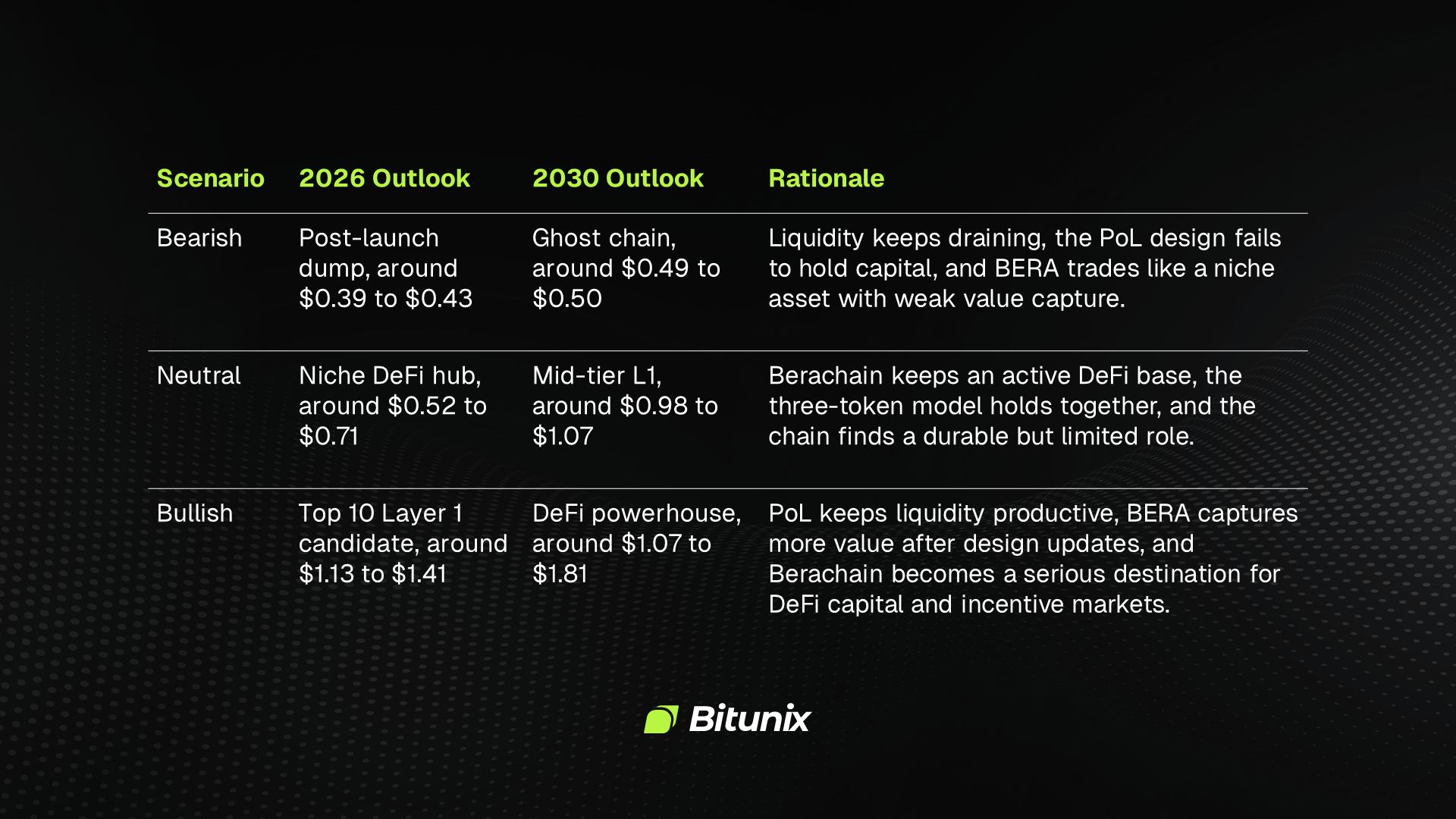
Berachain price scenarios showing how liquidity, adoption, and protocol design could shape outcomes through 2030.
Conclusion: A High-Stakes Economic Experiment
Berachain is one of the strangest serious projects in crypto, and that is part of why people still watch it. It took NFT culture, turned it into a chain, and then built a token model that tries to make liquidity itself part of network security. The question is whether the economics become durable enough to support a higher long-term multiple.
The big picture is that buying BERA is a bet that complex tokenomics, sticky community culture, and incentive markets can beat a brutally competitive Layer 1 field. That can work, but it can also become an expensive lesson in why complicated systems are hard to keep balanced.
For traders who want direct market access, Bitunix offers BERA spot and perpetual markets alongside its other tools, and you can download the Bitunix app and register there if you want to track Berachain and other Layer 1 assets in one place.
FAQ Section
What is Berachain?
Berachain is a live EVM-identical Layer 1 blockchain powered by Proof of Liquidity. It uses BERA for gas and staking, BGT for governance and rewards, and HONEY as the native stable asset. The chain launched its mainnet on February 6, 2025.
What is Proof of Liquidity?
Proof of Liquidity is Berachain's consensus-linked incentive model. It rewards productive on-chain activity, especially liquidity provision, through Reward Vaults and BGT emissions. The goal is to align validators, users, and apps so that chain security and DeFi participation reinforce each other rather than compete.
What is the difference between BERA, BGT, and HONEY?
The BERA token pays gas and supports staking. The BGT token handles governance and rewards, and holders can burn it 1:1 into BERA. The HONEY stablecoin is the native soft-pegged, fully collateralized dollar asset used for stable transactions inside the ecosystem.
How do I earn BGT?
You earn BGT by taking approved productive actions on Berachain, usually by providing liquidity, receiving a PoL-eligible receipt token, and staking that receipt token in a Reward Vault. Validators then direct emissions toward those vaults, and users collect their share of the rewards.
Can I buy BGT on an exchange?
No, not in the normal way. Berachain's docs describe BGT as a governance and rewards token earned through Reward Vault participation, and the token can be burned into BERA on a one-way basis. That structure makes BGT fundamentally different from a normal transferable exchange asset.
What are Bong Bears?
Bong Bears were the NFT collection that gave Berachain its original culture and community. Several later bear-themed rebases followed, and official Berachain materials still recognize those collections in the ecosystem. The chain's identity grew out of that NFT base before becoming a full Layer 1 project.
Is Berachain EVM compatible?
Yes. Berachain's docs call it EVM-identical, and third-party technical explainers from 2025 and 2026 describe the chain as built on top of the Cosmos SDK with BeaconKit. That makes Ethereum-style smart contracts and tooling much easier to port over.
What are the risks of investing in Berachain?
The main risks are system complexity, incentive leakage, falling liquidity, weak BERA value capture, stablecoin and governance design stress, and brutal Layer 1 competition. The post-launch drop from multibillion-dollar launch commitments to sub-$100 million TVL also shows how quickly attention can cool.
How does Berachain compare to Solana?
Solana is much larger today in terms of TVL, stablecoin volume, and DEX volume. Berachain's pitch is incentive design. Solana wins on the current size and throughput narrative, while Berachain tries to win on liquidity alignment and DeFi-native tokenomics. They solve different problems.
Where can I buy the BERA token?
BERA trades on centralized exchanges. CoinGecko lists active BERA markets on exchanges such as OKX, Bybit, and Binance, and Bitunix also offers BERA spot and perpetual markets. So if your goal is simple market access, the token is already broadly tradable.
Glossary
- Proof of Liquidity: Berachain's incentive model that links network security, liquidity provision, validators, and app-level rewards through BGT emissions and Reward Vaults.
- BERA token: Berachain's native gas and staking asset, used to pay transaction fees and participate in chain security.
- BGT token: The governance and rewards token earned through productive on-chain activity and redeemable 1:1 into BERA.
- HONEY stablecoin: Berachain's native soft-pegged, fully collateralized stablecoin used for stable-value activity in the ecosystem.
- Reward Vault: A smart contract where users stake PoL-eligible receipt tokens to earn BGT rewards.
- Incentive Marketplace: The system where protocols offer incentive tokens to attract validator-directed BGT emissions to their Reward Vaults.
- EVM-identical: Berachain's term for Ethereum-level compatibility at the execution environment level.
- Cosmos SDK: A modular blockchain framework used in the broader architecture around BeaconKit and Berachain's chain design.
- BeaconKit: A framework developed using the Cosmos SDK to support EVM-compatible blockchain architecture.
- TVL: Total value locked, or the dollar value of assets deposited in a chain's DeFi applications.
- Stablecoin market cap: The total value of stablecoins circulating on a chain, used as a rough gauge of its DeFi depth and trading utility.
- DEX volume: Trading volume executed on decentralized exchanges over a given time period.
- Whitelisting: The governance process through which Reward Vaults become eligible to receive BGT emissions from validators.
- Validator commission: The share of incentive tokens or rewards captured by validators for directing emissions and participating in PoL.
- Value capture: The extent to which a protocol's token actually benefits from the economic activity generated by the network or app suite.
Disclaimer
This article does not provide:
(i) investment advice or investment recommendations;
(ii) an offer or solicitation to buy, sell, or hold digital assets;
(iii) financial, accounting, legal, or tax advice.
Digital assets, including stablecoins and NFTs, involve high risk and may fluctuate significantly. Consider whether trading or holding digital assets is appropriate for you given your financial situation. Consult a qualified legal, tax, or investment professional when needed. You are responsible for understanding and complying with applicable local laws and regulations.
About Bitunix
Bitunix is a global cryptocurrency derivatives exchange trusted by over 3 million users across more than 100 countries. At Bitunix, we are committed to providing a transparent, compliant, and secure trading environment for every user. Our platform features a fast registration process and a user-friendly verification system supported by mandatory KYC to ensure safety and compliance. With global standards of protection through Proof of Reserves (POR) and the Bitunix Care Fund, we prioritize user trust and fund security. The K-Line Ultra chart system delivers a seamless trading experience for both beginners and advanced traders, while leverage of up to 200x and deep liquidity make Bitunix one of the most dynamic platforms in the market.
Bitunix Global Accounts
X | Telegram Announcements | Telegram Global | CoinMarketCap | Instagram | Facebook | LinkedIn | Reddit | Medium