
What Is Grid Trading?
Grid trading is a strategy that divides a predefined price range into multiple price levels (grids) and automatically executes trades based on price movements.
The core idea is simple: buy low and sell high repeatedly within a price range (or sell high and buy back lower in a downtrend). As long as the market price fluctuates within the selected range, the system will buy when price drops to a grid level, sell when price rises to the next grid level, accumulating small but consistent profits from market volatility.
How to Use Future Grid on Bitunix?
Please refer to this article from the Help Center.
Advantages of Futures Grid Trading
1. Automated Execution Without Emotional Interference
Once a futures grid strategy is launched:
- Manual decision-making is replaced by predefined rules
- Emotional trading is minimized
- The system executes trades consistently, 24/7
- As long as price remains within your set range, the strategy continues to operate automatically.
2. Designed for Volatile and Range-Bound Markets
In markets with frequent price swings:
- Manual traders often chase price or hesitate
- Grid trading systematically captures volatility
- Futures grid strategies are particularly effective in:
- Sideways consolidation
- Wide-range oscillation
- Weak rebounds during downtrends
3. Structured Risk Management
On Bitunix:
- Each futures grid strategy uses independent margin
- Liquidation prices are isolated per strategy
- Multiple strategies can run simultaneously
- This makes futures grid trading a strategy-based tool, not an all-in directional bet.
Futures Grid Trading Strategies for Different Market Conditions
Before setting up any grid strategy, remember:
Futures Grid = Market Bias × Parameter Design × Automated Execution
Below, we break down key parameters and explain how to adjust them based on different market scenarios.
Scenario 1: Highly Volatile Markets
Market Characteristics
- Frequent price swings
- Sharp wicks and pullbacks
- Direction fully confirmed
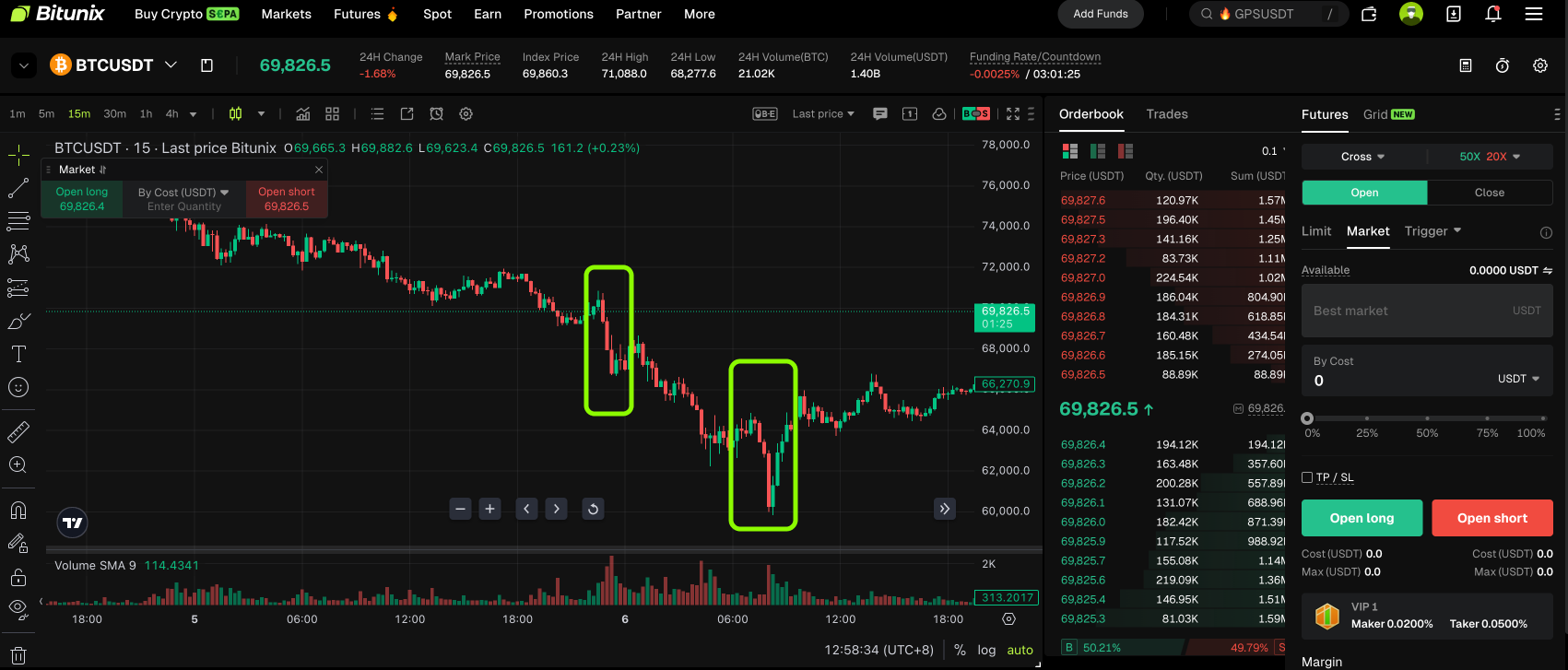
Trade Direction: Long or Short
- Bullish bias with strong fluctuations → Long Grid
- Weak rebounds, downward pressure → Short Grid
- Example:
- BTC fluctuating aggressively between 60,000–74,000 USDT with higher lows → More suitable for a long grid strategy
Price Range Selection
- Use a wider price range
- Allow room for volatility
- Reduce the risk of frequent strategy pauses
- A range that is too narrow may trigger frequent suspensions.
Number of Grids
- Higher grid countSmaller profit per gridHigher trading frequencyBetter utilization of market “noise”
- Best suited for fast-moving, volatile markets.
Leverage Recommendation
- Low to moderate leverage
- Lower liquidation risk
- Higher fault tolerance
Scenario 2: Stable or Low-Volatility Markets
Market Characteristics
- Slow price movement
- Limited price range
- Extended consolidation periods
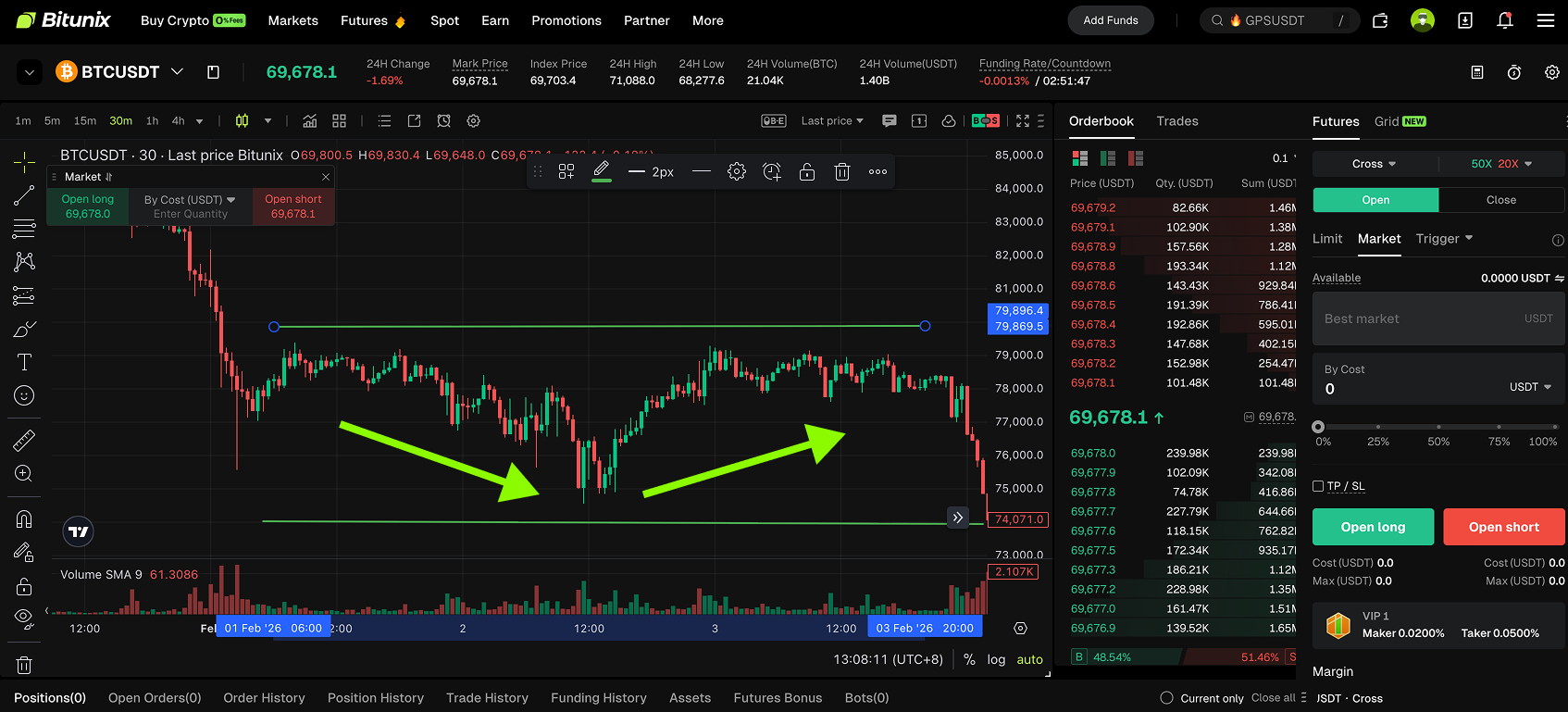
Trade Direction
- Sideways with upward bias → Long Grid
- Sideways with downward bias → Short Grid
Price Range Selection
- Narrower price range
- Improved efficiency per grid
- Higher profit per completed cycle
Number of Grids
- Medium to low grid countHigher profit per tradeLower trading frequencySuitable for longer-term strategies
Leverage Recommendation
- Leverage may be moderately increased if risk is well managed
- Improves capital efficiency in tight ranges
Scenario 3: Capital Allocation & Risk Control (Universal Principles)
Capital Allocation
Futures grid trading is not designed for full-position exposure.
- Each grid uses isolated margin
- Funds can be split across multiple strategies
- Example:
- Total capital: 10,000 USDT → Allocate to 2–3 different grid strategies with varying ranges or directions
Advanced Settings: Take Profit & Stop Loss
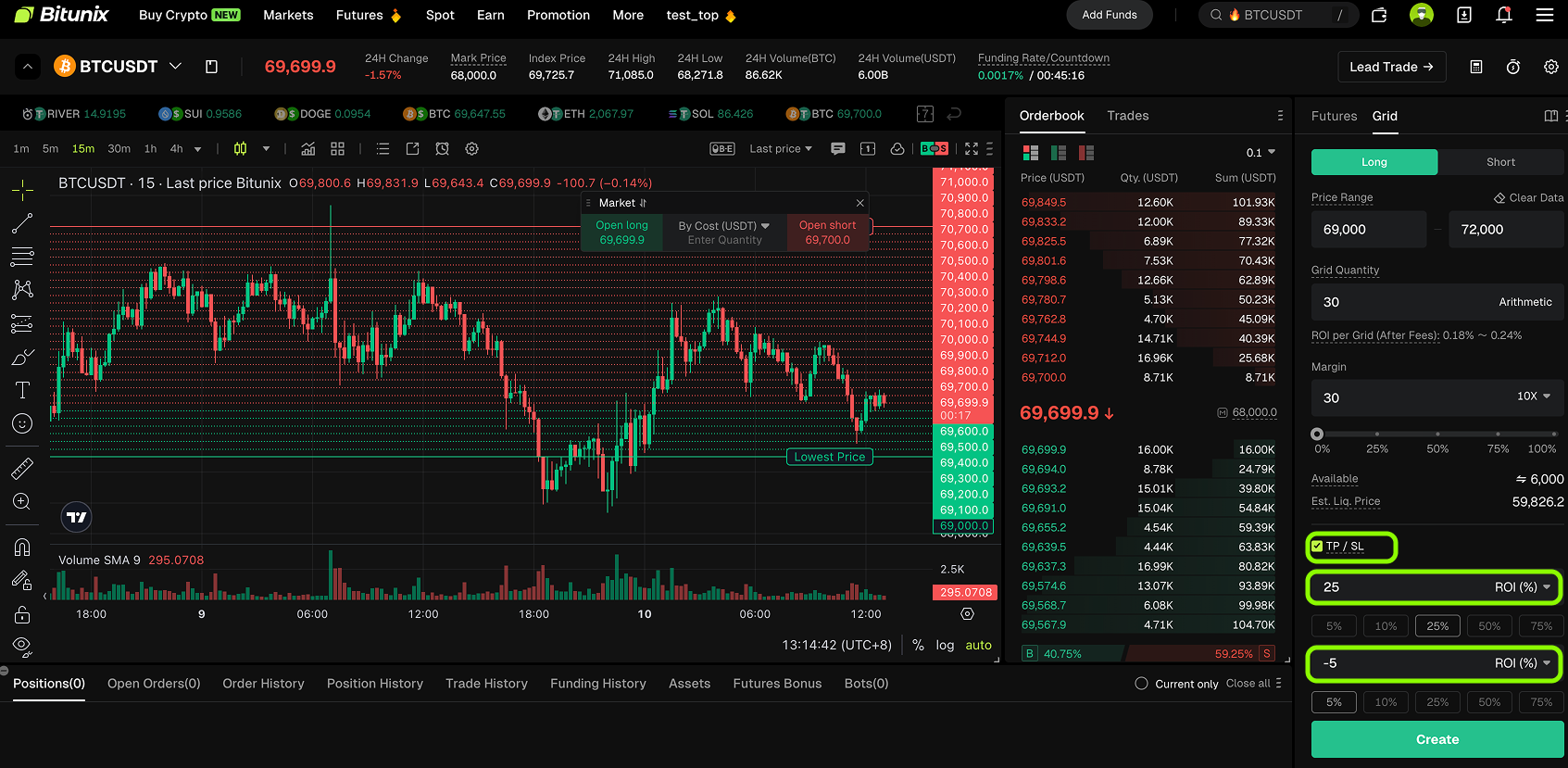
- Take Profit: Lock in gains once a target is reached
- Stop Loss: Ends the strategy when market conditions invalidate the original assumption
- Stop-loss settings are not a lack of confidence — they define the strategy boundary.
Conclusion
Futures grid trading is not about predicting the market with precision. It is about structuring a clear idea of how the market may behave and executing that idea consistently. By combining a directional bias, well-designed parameters, and automated execution, traders can transform market volatility from a source of stress into a systematic opportunity.
On Bitunix, futures grid trading serves as a practical tool for traders who value discipline and structure. When the market environment is understood, parameters are aligned with price behavior, and risk boundaries are respected, grid trading can become a stable and repeatable strategy in both rising and falling markets.
Disclaimer
This article is not intended to provide:
(i) investment advice or investment recommendations;
(ii) an offer, invitation, or solicitation to buy, sell, or hold digital assets;
(iii) financial, accounting, legal, or tax advice.
Digital assets, including stablecoins and NFTs, carry significant risk and price volatility. Evaluate whether trading or holding digital assets is appropriate for your financial situation. Seek guidance from your legal, tax, or investment adviser regarding your specific circumstances.
Bitunix assumes no responsibility for any investment outcomes. You are solely responsible for understanding and complying with all applicable local laws and regulations.
About Bitunix
Bitunix is a global cryptocurrency derivatives exchange trusted by over 3 million users across more than 100 countries. At Bitunix, we are committed to providing a transparent, compliant, and secure trading environment for every user. Our platform features a fast registration process and a user-friendly verification system supported by mandatory KYC to ensure safety and compliance. With global standards of protection through Proof of Reserves (POR) and the Bitunix Care Fund, we prioritize user trust and fund security. The K-Line Ultra chart system delivers a seamless trading experience for both beginners and advanced traders, while leverage of up to 200x and deep liquidity make Bitunix one of the most dynamic platforms in the market.
Bitunix Global Accounts
X | Telegram Announcements | Telegram Global | CoinMarketCap | Instagram | Facebook | LinkedIn | Reddit | Medium