
Article Summary
- Perpetual futures are a special type of derivative contract popular in crypto that, unlike traditional futures, have no expiration date.
- They allow you to speculate on the future price of a cryptocurrency (like Bitcoin) without ever owning the actual asset.
- A key mechanism called the funding rate keeps the perpetual contract price pegged closely to the actual spot price of the crypto.
- Traders use leverage to control a large position with a small amount of capital, which can amplify both profits and losses.
- Understanding the perpetual futures meaning, leverage, and liquidation is the first and most important step before attempting to trade them.
- Bitunix provides a user-friendly platform to practice and trade perpetual futures with low fees.
You see traders talking about going long or short and trading with 10x leverage. Most of the time, they are talking about perpetual futures. It’s the engine room of the crypto market, and it runs inside almost every major crypto exchange.
And yes, the word futures sounds like a finance final exam. That’s normal. The good news is that perpetual futures are built on a few simple rules. Once you get those rules, most of the confusion disappears.
This guide explains the perpetual futures meaning, using real examples and the exact mechanics you will see on trading screens. You will learn the three ideas that matter most for beginners:
- The contract has no expiry date
- The funding rate keeps the price anchored
- Leverage magnifies both gains and losses
Before we start, one honest warning. Perpetuals are a tool. In calm hands, they help you hedge and trade both directions. In emotional hands, they become a fast way to light money on fire.
What Does Perpetual Future Actually Mean?
Futures, But Forever
Imagine a regular futures contract is a ticket for a concert on a specific date. A perpetual future is a ticket for a concert that never ends. You can stay in as long as you keep paying for your seat and you follow the venue rules.
That never-ending part is the point. Many traditional futures contracts have an expiration date. Perpetual futures do not. Some major exchanges describe them as contracts you can hold indefinitely, as long as you meet margin requirements and pay or receive funding.
No Expiration Date
With no expiry, you don’t need to roll your position into a new contract every month. You can hold for minutes, days, or longer if your strategy calls for it. The trade stays open until you close it, or until your margin falls too low and the platform forces a close.
You’re Trading a Contract, Not Buying Bitcoin
When you trade a perpetual on Bitcoin, you are not buying Bitcoin itself. You are trading a contract that tracks Bitcoin’s price. That’s why you can profit when the price rises (a long position) or when the price falls (a short position).
This is also why beginners get tripped up. Spot trading feels like owning something. Perpetuals feel like controlling something. That difference matters when risk shows up.
The Funding Rate: The Magic That Keeps It Honest
What The Funding Rate Is
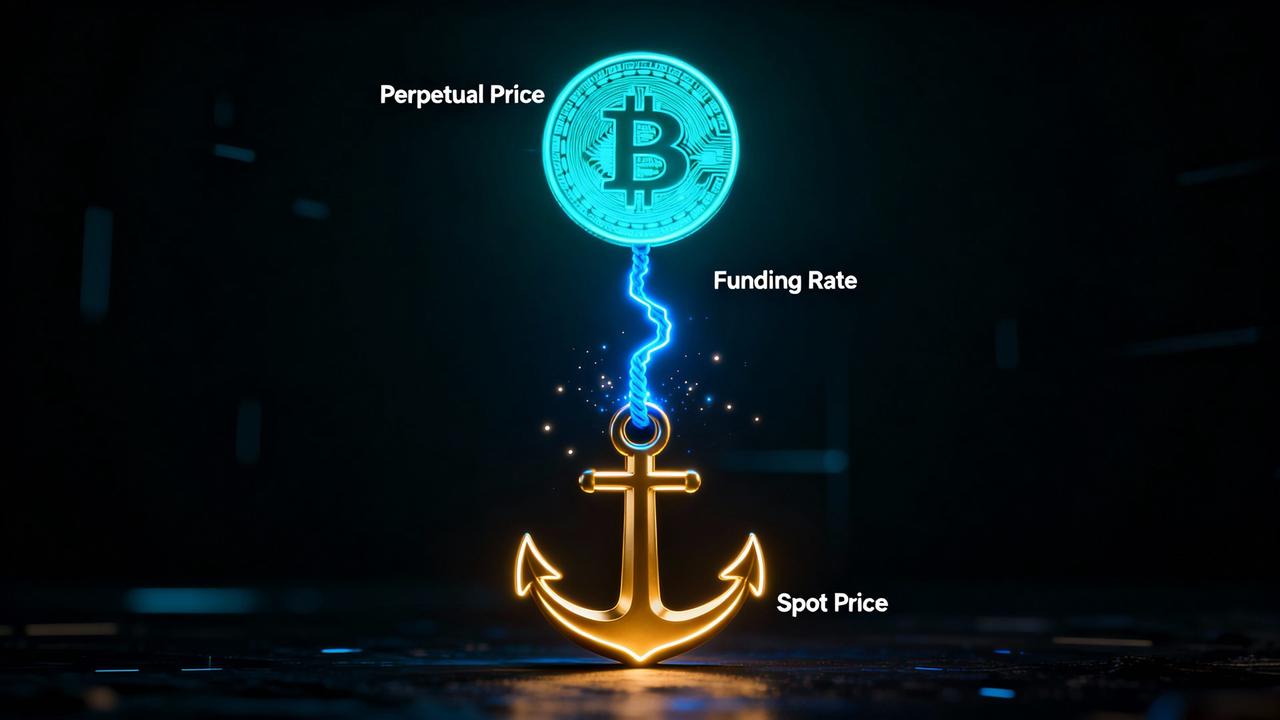
Perpetual futures need a way to stay close to the spot price, since they never expire. That’s where the funding rate comes in. It’s a periodic payment exchanged between traders who hold long and short positions. It’s designed to push the perpetual price back toward the spot market when the contract drifts.
Here’s Kraken’s definition in its own words:
“The perpetual funding rate mechanism involves traders paying or receiving fees at regular intervals. Whether they pay or receive funds depends on whether the price of the contract is trading above or below the spot market price of the asset, as well as whether they have taken a long or short position. Since perpetual contracts have no expiration date, this funding rate keeps the price of the contract anchored to the spot price of the underlying asset over time.”
Who Pays Who
Most platforms explain it the same way:
- If the perpetual price is above spot, longs pay shorts
- If the perpetual price is below spot, shorts pay longs
Two practical notes for beginners:
- Funding is not a trading fee in the usual sense. It’s a transfer between traders.
- Funding happens on a schedule, so holding a position longer can increase its total cost or benefit.
Leverage: The Power and the Danger
What Leverage Is
Leverage means borrowing buying power from the platform, so your position is larger than your deposit. Suppose you use 10x leverage; your $100 controls a $1,000 position. The position is bigger, but your risk is bigger too.
The Good Part
Leverage makes small moves matter. If the price moves 1% in your favor and you are using 10x leverage, your profit on the margin you posted is roughly 10% before fees and funding. That’s why traders like perpetuals.
The Bad Part: Liquidation
Leverage also makes small mistakes expensive. If price moves 1% against you at 10x, you are down roughly 10% on your margin.
If your losses eat into your margin until you fall below the maintenance requirement, the platform closes your position automatically. That process is liquidation. Bitunix describes forced liquidation as being triggered when the mark price reaches the liquidation price, and your margin can’t meet maintenance requirements.
On Bitunix, liquidation checks use the mark price, not the last traded price. That matters because mark price is designed to be more stable and less sensitive to quick wicks. It also means you can be liquidated even if the last trade never touched your estimated liquidation price.
How to Get Started with 200x Perpetual Futures on Bitunix
A Beginner-Friendly Place To Practice The Mechanics
If you’re new, your first goal is not profit. It’s learning the workflow: pick a pair, set leverage, choose cross or isolated margin, place an order, then set take profit and stop loss.
Bitunix’s own tutorials walk through that flow on the web and app, including moving funds to a futures account, selecting a pair, and setting leverage and order type.
Start Small
Start with low leverage, like 2x or 3x, and one position at a time. Add a stop loss before you hit the place where liquidation becomes your plan. Bitunix’s help center lessons on take profit and stop loss explain how these orders help reduce liquidation risk.
If you plan to trade, set up Bitunix, read the futures rules once, then practice with a small size or a futures bonus before scaling up.
How To Start Trading Perpetual Futures on Bitunix
To start trading perpetual futures on the Bitunix crypto exchange, follow these steps:
- Sign up on Bitunix via the website or download the app on your smartphone.
- Create an account using your email or mobile number and log in.
- Deposit crypto or buy USDT using fiat (kyc required for fiat only).
- Navigate to the futures market and select a pair, such as the BTC/USDT trading pair.
- Enter your order details and confirm, and then explore trading tools.
Conclusion
Perpetual futures have no expiry date, so you can hold a position as long as your margin supports it. The funding rate keeps the contract price close to spot by shifting small payments between longs and shorts.
Leverage lets small price moves hit harder, in both directions, and liquidation is what happens when your margin can’t keep up.
If you remember one thing, make it this. Perpetual futures reward preparation more than confidence. Learn the rules, keep leverage low while you learn, and treat risk controls like a seatbelt. You only miss it after it’s too late.
FAQ
What is the difference between perpetual futures and spot trading?
Spot trading means you buy or sell the asset itself. Perpetual futures mean you trade a contract that tracks price, so you can go long or short without owning the coin.
Can I lose more money than I deposit with perpetual futures?
Liquidation is designed to close positions before losses exceed margin, but extreme moves, fees, and cross-margin setups can still create nasty outcomes. Read your platform’s rules and keep size small.
What does it mean to go long?
Going long means you profit if the price goes up.
What does it mean to go short?
Going short means you profit if the price goes down.
How often is the funding rate paid?
It depends on the contract and platform. Exchanges publish the funding schedule per market, and some even adjust settlement frequency for specific pairs.
What is a good leverage for a beginner to use?
Low. Many beginners start around 2x to 3x, so liquidation stays farther away and mistakes cost less.
What is liquidation?
Liquidation is the platform closing your leveraged position when your margin no longer meets maintenance requirements.
Do I have to own crypto to trade perpetual futures?
You usually need collateral, often stablecoins like Tether (USDT) or USD Coin (USDC), but you don’t need to own the underlying coin you’re trading.
Why do people trade perpetual futures instead of just buying crypto?
They want to short, hedge, or use leverage. Perpetuals make those strategies possible in one instrument.
Is trading perpetual futures a form of gambling?
It becomes gambling when you trade without a plan, oversize positions, or rely on hope instead of exits. Used with risk limits, it’s a structured tool. That line is your behavior, not the product.
Glossary
Perpetual futures: A crypto derivatives contract with no expiration date, designed to track an underlying asset’s price.
Spot price: The current market price for buying or selling the actual asset.
Contract: The instrument you trade in futures; it tracks price rather than representing ownership.
Long: A position that benefits when the price rises.
Short: A position that benefits when the price falls.
Leverage: Using borrowed buying power to control a larger position than your deposit.
Margin: The collateral you post to open and maintain a leveraged position.
Initial margin: The amount of margin needed to open a position.
Maintenance margin: The minimum equity required to keep a position open.
Funding rate: Periodic payment exchanged between longs and shorts to keep perp price near spot.
Mark price: A reference price used for profit and loss (P&L) and liquidation checks, designed to reduce manipulation.
P&L (profit and loss): Your gains or losses on a position.
Liquidation price: The mark price level where liquidation occurs.
Stop loss: An order that closes your position if the price moves against you to limit losses.
Take profit: An order that closes your position at a target price to lock in gains.
About Bitunix
Bitunix is a global cryptocurrency derivatives exchange trusted by over 3 million users across more than 100 countries. At Bitunix, we are committed to providing a transparent, compliant, and secure trading environment for every user. Our platform features a fast registration process and a user-friendly verification system supported by mandatory KYC to ensure safety and compliance. With global standards of protection through Proof of Reserves (POR) and the Bitunix Care Fund, we prioritize user trust and fund security. The K-Line Ultra chart system delivers a seamless trading experience for both beginners and advanced traders. At the same time, leverage of up to 200x and deep liquidity make Bitunix one of the most dynamic platforms in the market.
Bitunix Global Accounts
X |Telegram Announcements |Telegram Global |CoinMarketCap |Instagram |Facebook |LinkedIn |Reddit |Medium