
1. Introduction to Bittensor
In 2021, the Opentensor Foundation published the Bittensor Whitepaper, proposing a brand-new decentralized framework. The whitepaper outlined a vision of transforming artificial intelligence into a tradable digital commodity: building a global distributed intelligence network through blockchain incentive mechanisms, allowing AI models to be shared, priced, and coordinated just like computing power or data.
As the core drivers behind Bittensor, Jacob Steeves and Ala Shaabana have long been deeply involved in distributed systems and machine learning. They observed that although AI technology is advancing rapidly, computing resources, training data, and model ownership remain highly concentrated in the hands of a small number of tech giants. This structure limits the boundaries of AI innovation. To break this pattern, Bittensor emerged. It is not only a blockchain protocol, but also a decentralized network that coordinates global machine learning nodes through token incentives. TAO, as Bittensor’s native governance token, plays a central role in driving ecosystem development, incentive distribution, and network governance.
Bittensor’s core goal is to connect AI models and compute nodes around the world through a peer-to-peer (P2P) protocol, forming an open intelligence marketplace. In this network, intelligence is no longer an isolated proprietary asset, but a digital commodity that can be measured, evaluated, and exchanged. Nodes can contribute their own models or inference capabilities and receive token rewards for delivering high-value intelligent output. After several years of development, Bittensor has gradually become one of the key foundational protocols in the AI and cryptocurrency convergence sector (AI+Crypto).

2. Bittensor, Subnets and Proof of Intelligence
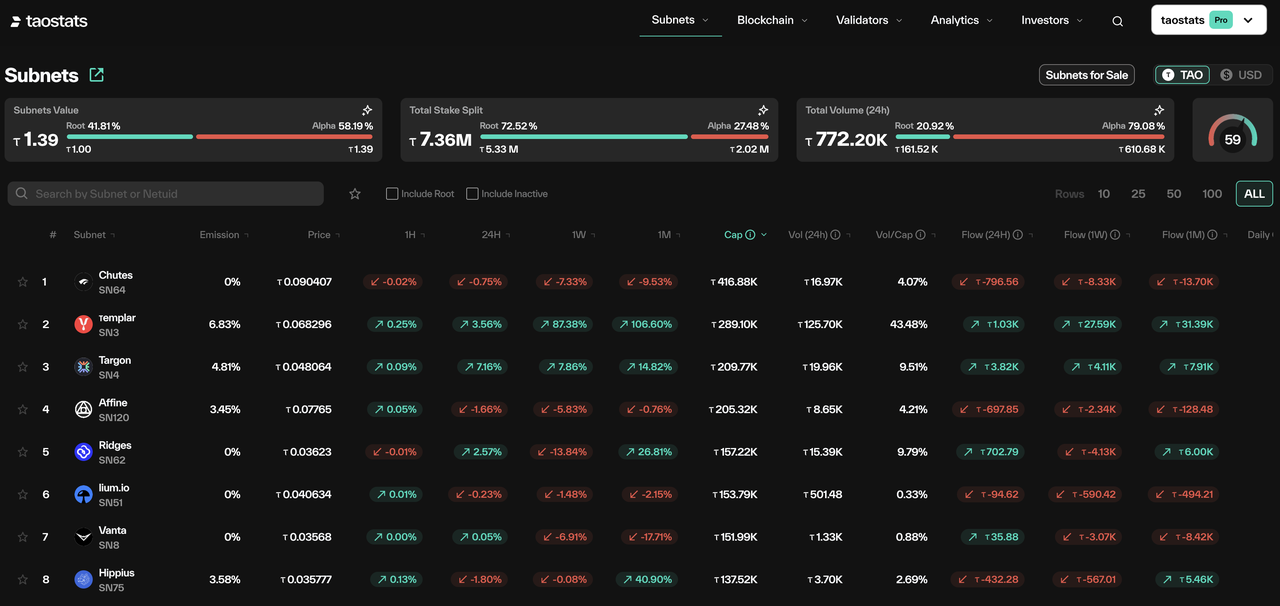
One of Bittensor’s most groundbreaking designs is its Subnets architecture. Unlike traditional blockchains, which mainly process financial transactions, Bittensor’s goal is to produce and evaluate intelligence. Subnets can be understood as specialized AI task marketplaces within the network. Each subnet can establish its own evaluation mechanism and incentive structure for a specific machine learning task.
Through this modular architecture, different types of AI tasks can run on different subnets, such as large language model inference, image recognition, time-series data analysis, or scientific computing. This design enables Bittensor to form a “network of networks,” where each subnet functions like an independent intelligence market, continuously optimizing model performance and information value through competition and collaboration.
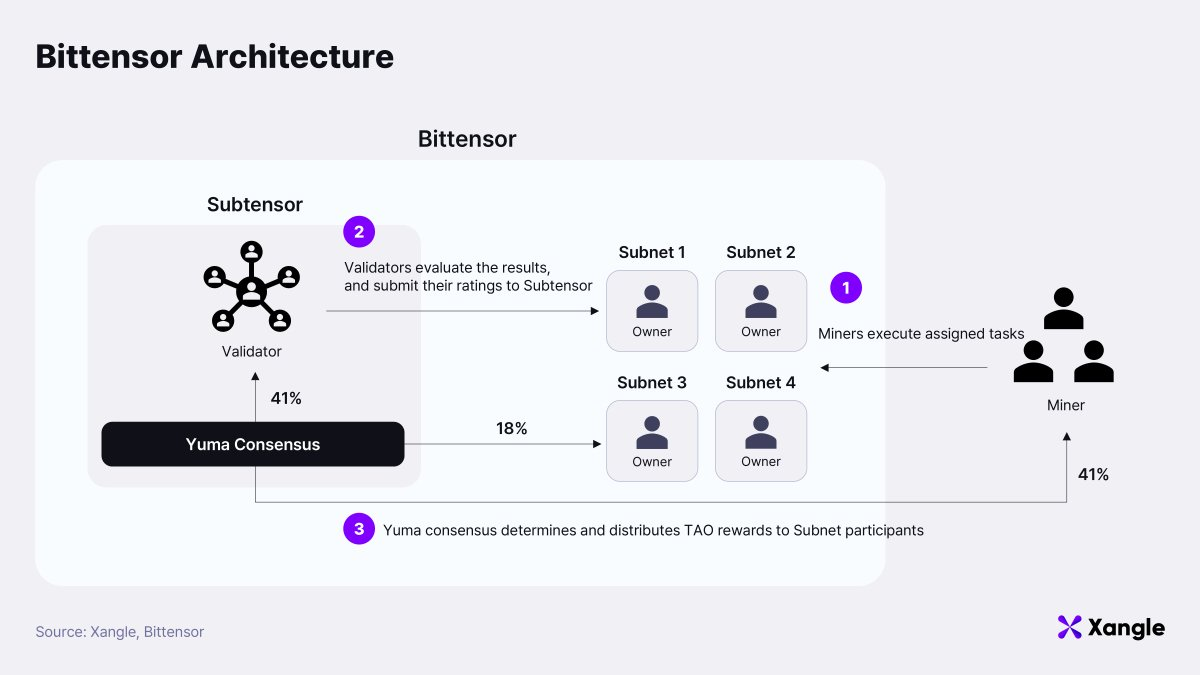
The core operation of subnets relies on the Proof of Intelligence mechanism. Under this mechanism, miners are responsible for running AI models and providing inference results to the network, while validators are responsible for evaluating the quality and effectiveness of model outputs. Validators rank miners based on the accuracy, information value, and consistency of their models, and these rankings directly affect the distribution of TAO tokens. Through this cycle of “generation, evaluation, and incentive,” Bittensor can continuously filter and reward the most valuable intelligence outputs without a centralized administrator.
It is worth noting that the Bittensor network is currently mainly focused on AI inference rather than model training. Models are generally trained off-chain and then deployed onto the network to provide inference services. From a machine learning architecture perspective, the entire Bittensor network can be viewed as a decentralized mixture-of-experts model, where different nodes run different specialized models and validators route requests to obtain the best output.
3. Bittensor, Tokenomics and Yuma Consensus
In terms of tokenomics, Bittensor adopts a fixed supply and halving mechanism similar to Bitcoin. TAO is the native token of the Bittensor network, with its total supply strictly capped at 21 million tokens and released gradually according to a predetermined schedule. Unlike traditional crypto mining, which depends on computing power, Bittensor’s token issuance is directly related to “intelligence contribution,” and the rewards received by nodes depend on the information value they provide to the network.
Bittensor operates through a consensus mechanism called Yuma. This is an algorithm that combines blockchain incentive mechanisms with a machine learning evaluation framework, and its core objective is to allocate resources fairly according to each node’s contribution to the network’s intelligence output. Validators continuously evaluate the output results of miners’ models and submit scores to the network. The system then calculates the weight of each node based on these scores and distributes TAO tokens accordingly.
To ensure fairness in reward distribution, Bittensor’s incentive model draws on the Shapley Value concept from cooperative game theory to measure each node’s marginal contribution to the overall intelligence output. This approach enables providers of high-value information to receive a greater share of rewards while preventing a single node from monopolizing resources.
As the number of subnets increases and demand for AI grows, the use cases of TAO have also gradually expanded, including validator staking, collateral for subnet registration, and as a means of payment for AI services. This design creates a positive feedback loop between TAO demand and the overall network’s intelligence output, providing long-term economic incentives for the Bittensor ecosystem.
4. The Bittensor Ecosystem
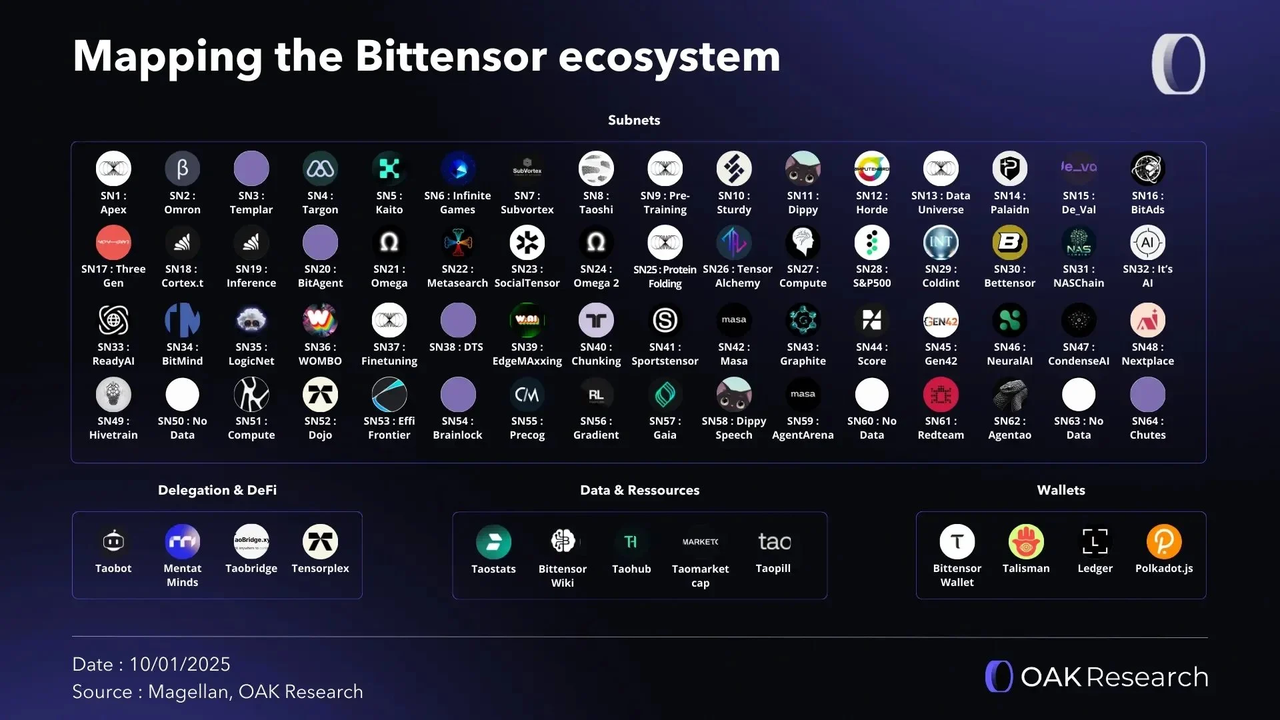
After several years of development, Bittensor has gradually formed a distributed AI marketplace composed of multiple specialized subnets. From the initial experimental test subnets to today’s many specialized subnets covering text generation, visual models, audio processing, and data analysis, the entire ecosystem continues to expand.
From 2024 to 2025, the Bittensor ecosystem entered a phase of rapid growth. More and more developers began migrating AI models previously deployed on centralized clouds to Bittensor subnets in order to leverage its decentralized incentive mechanism. This migration not only allows model developers to directly monetize their technical contributions, but also further enhances the intelligence output capacity of the entire network.
One of Bittensor’s core advantages lies in its task independence. Each subnet can define its own AI tasks, model evaluation standards, and incentive logic, while the underlying Bittensor blockchain is responsible for consensus and settlement. This architecture enables the entire network to function as a decentralized AI market infrastructure in which AI models are treated as tradable digital commodities, and their value is jointly determined by model performance and market demand.
With the launch of the “Dynamic TAO” mechanism, competition among subnets has also become more market-driven. Subnets must attract more resources and attention by providing high-value intelligence services, thereby obtaining a higher emissions weight across the network. This market-based mechanism promotes innovation and improves overall resource allocation efficiency.
5. Opentensor Foundation
Throughout the development of Bittensor, the Opentensor Foundation has consistently played an important role as a technical driver and protocol maintainer. Although Bittensor’s design goal is to achieve decentralized governance, during the network’s early stage the Foundation played a key role in the design of the underlying architecture, optimization of consensus mechanisms, and standardization of subnet frameworks.
To advance the vision of open AI, the Opentensor Foundation continues to support ecosystem development by funding open-source research, organizing developer competitions, and promoting academic collaboration. These initiatives have attracted a large number of AI researchers and developers to participate in the Bittensor network and have provided sustained momentum for its technical evolution.
As the network gradually matures, governance power is also progressively shifting from the Foundation to the community and TAO token holders. Through decentralized governance mechanisms, future network upgrades, subnet management, and resource allocation will increasingly be decided by community voting. This transition from “centralized guidance” to “community self-governance” is an important step toward maturity for the Bittensor ecosystem.
6. How to Obtain TAO
Under the current mechanism, there are two main ways to obtain TAO. One way is to directly participate in the operation of the Bittensor network, such as becoming a miner to provide AI inference services or becoming a validator responsible for evaluating model outputs. By contributing to the network’s intelligence output, these nodes can continuously receive newly issued TAO tokens. The other way is to purchase TAO through the cryptocurrency trading market. For most ordinary participants, acquiring TAO through an exchange is the more convenient option.
By purchasing TAO through centralized cryptocurrency exchanges such as Bitunix, the platform acts as a trusted intermediary, supporting users in directly purchasing crypto assets with fiat currency or stablecoins such as USDT. Some platforms also support instant purchases by credit card, greatly lowering the entry barrier for investing. Before first use, users are required to register an account and complete identity verification (KYC) in order to comply with global anti-money laundering (AML) and counter-terrorism financing regulations.
With its robust risk control system and asset security technology, Bitunix provides users with a stable gateway to participate in the Bittensor ecosystem and is an ideal starting point for exploring decentralized AI investment opportunities.
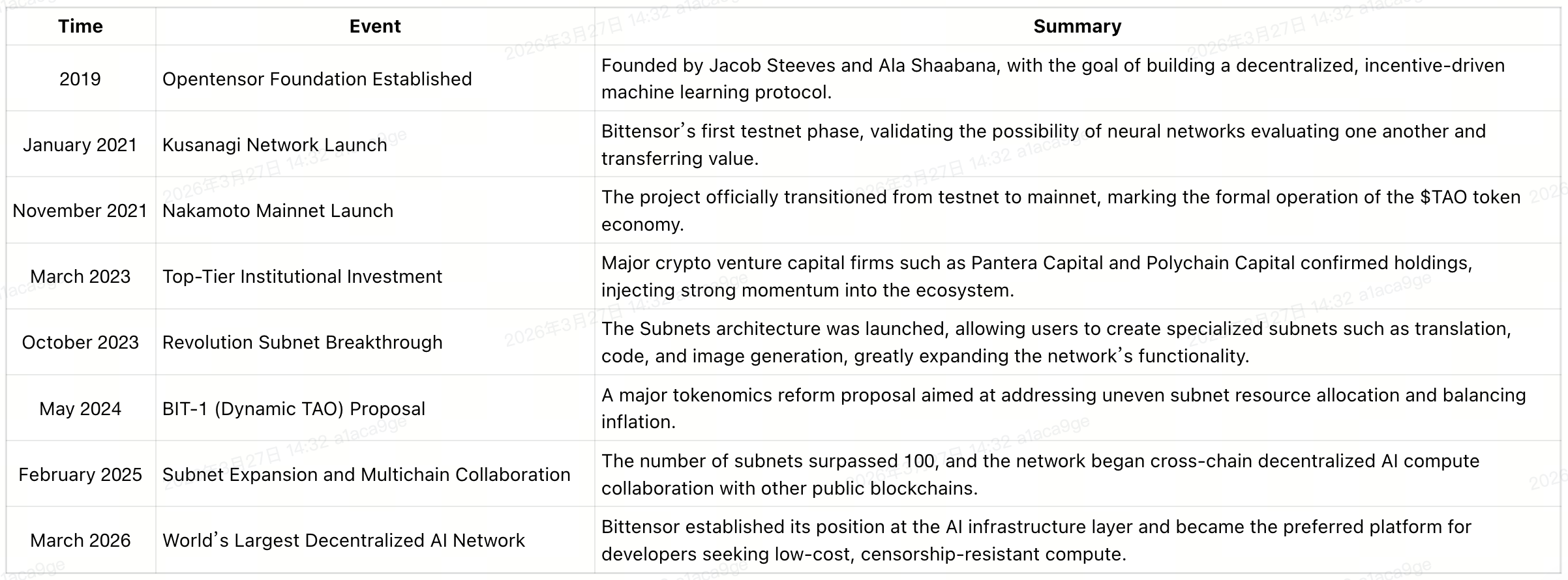
7. Timeline of Major Bittensor Milestones
Disclaimer
This article is not intended to provide:
(i) investment advice or investment recommendations;
(ii) an offer or solicitation to buy, sell, or hold digital assets;
(iii) financial, accounting, legal, or tax advice.
Holding digital assets, including stablecoins and NFTs, involves high risk and may fluctuate significantly. You should carefully consider whether trading or holding digital assets is suitable for you based on your financial situation. For your specific circumstances, please consult your legal, tax, or investment professionals. You are solely responsible for understanding and complying with all applicable local laws and regulations.
About Bitunix
Bitunix is a global cryptocurrency derivatives exchange trusted by over 3 million users across more than 100 countries. At Bitunix, we are committed to providing a transparent, compliant, and secure trading environment for every user. Our platform features a fast registration process and a user-friendly verification system supported by mandatory KYC to ensure safety and compliance. With global standards of protection through Proof of Reserves (POR) and the Bitunix Care Fund, we prioritize user trust and fund security. The K-Line Ultra chart system delivers a seamless trading experience for both beginners and advanced traders, while leverage of up to 200x and deep liquidity make Bitunix one of the most dynamic platforms in the market.
Bitunix Global Accounts
X | Telegram Announcements | Telegram Global | CoinMarketCap | Instagram | Facebook | LinkedIn | Reddit | Medium