
The essence of trading is not to rely on frequent operations to generate profits, but to rely on accurate judgment and rational planning to capture clear opportunities in a chaotic market.
Most traders lose money for two main reasons. Either they enter the market unprepared and blindly follow the trend, or they get carried away by price movements and floating profit and loss after entering, causing them to abandon their original plan. Next, we will break down the key trading logic across the two core stages: before entering the market and after entering the market. Combined with actual cases, we will explain the key operational points so that every trade can be executed steadily and based on evidence.
Before Entering the Market: Focus on the Three Core Factors and Lock In High-Probability Opportunities
Trading is never about blindly trading frequently, but about making precise decisions in high-probability setups. Only by identifying the "safe zone" and risk points in advance can every trade be justified. The core trading principles follow the rule of "three indispensable factors": key levels, trend, and entry signals. These are the essential prerequisites for capturing opportunities and improving your win rate, and they are also the foundation of trading profitability.
Core Trading Principles: Watch the Trend, Watch Key Levels, and Watch Entry Signals
1. Watch the trend
Trading should follow the trend, not go against it. Use the 4-hour and daily trends as the core basis for judging market direction. Do not trade countertrend rebounds during a downtrend, and do not blindly short the top during an uptrend. Trading in the direction of the trend improves the probability of success.
2. Mark key levels
Identify the key support and resistance levels that have been repeatedly confirmed by the market, such as previous highs and lows, moving average levels, and round-number levels. Prioritize entries near key levels, and combine them with pullback or rebound confirmation signals to reduce entry risk and define the trade's "safe zone."
3. Watch entry signals
Wait for triple confirmation and avoid entering blindly.
- On the 4-hour or daily chart, there are strong reversal candlestick patterns such as bearish engulfing and bullish engulfing.
- The price touches the high or low of the range, or key support and resistance levels, and receives valid confirmation.
- Trading volume increases at the same time, confirming market participation and capital support.
- Do not enter based on a single signal. Only act when trend, key level, signal, and volume align.
Case Analysis: The Three Core Trading Principles in the DEGO/USDT Perpetual Futures Market
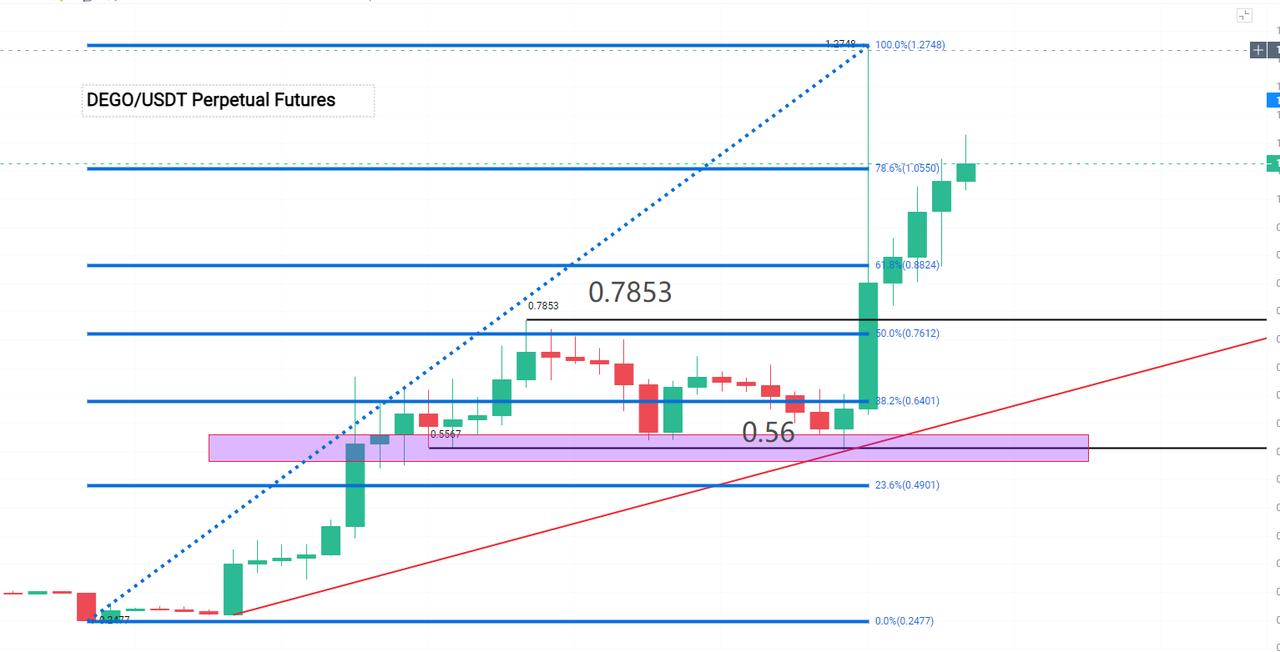
First, watch the trend: identify the uptrend channel and follow the trend
From the DEGO/USDT perpetual futures chart, the market is clearly in an upward trend channel:
- The price continues to rise along the red ascending trendline, with higher lows and higher highs, forming clear bullish momentum.
- On the 4-hour chart, candles remain above the trendline without any effective breakdown, confirming the validity and continuity of the trend.
Second, identify the key level: confirm support and define the safety boundary
The area around 0.56 is a key support level that has been repeatedly confirmed by the market:
- After the 4-hour price touched this level many times, it quickly stabilized and rebounded. It was tested more than three times without an effective breakdown.
- This level also overlaps with the lower boundary of the previous range and an earlier Fibonacci retracement level, giving it strong technical support significance.
Third, watch the entry signal: wait for multiple confirmations and enter precisely
By combining trend and key levels, the entry can be broken down into two precise steps:
1. Initial entry: open a small position after key support is confirmed
At this stage, it is recommended to use Bitunix's price alert feature. When the price pulls back to the rising trendline, you can look for long entries along the trend and capture the opportunity more precisely.
When the price stabilizes multiple times at the 0.56 support level and a bullish engulfing candlestick appears on the 4-hour chart alongside a moderate increase in trading volume, this indicates that buying strength has been confirmed. A small position can then be opened, with the stop loss set below the key support level.
2. Position add-on: add after a breakout to a new high
At this stage, it is also recommended to use Bitunix's price alert feature. When the price breaks to a new high, you can add to the position and continue trading in the direction of the trend.
When the price breaks above the previous high at 0.7853, accompanied by strong volume expansion and consecutive bullish candles on the 4-hour chart, it completes a triple confirmation of "trend continuation + key level breakout + volume confirmation." This is the best time to add to the position and further expand profit potential.
IV. Case Summary
This DEGO/USDT trade fully reflects the three core principles of "watching the trend, watching key levels, and watching entry signals":
- First, the uptrend was confirmed through the rising trendline, establishing the trading direction.
- Then, repeated tests of 0.56 confirmed the key support level and clarified the risk boundary.
- Finally, the trade achieved precise entry and position addition based on the support confirmation signal and the high-breakout volume signal.
- There was no blind trading throughout the process. Every step was supported by both technical analysis and volume confirmation. It is a typical profitable example of trend-following plus key levels plus signal confirmation.
After Entering the Market: Focus on the Three Core Factors and Control Position Rhythm
After entering the market, many traders fall into a common trap. They focus too much on candlestick fluctuations, changing indicators, and real-time profit and loss. Their emotions are driven by short-term outcomes, and eventually anxiety and impatience destroy what was originally a solid plan. The core secret of professional traders is to stop over-focusing on outcomes, concentrate only on the underlying reasons for the trade, and follow three iron rules: logic, rhythm, and self-control. This keeps execution aligned with the original plan.
Core Trading Rules: Watch Logic, Watch Rhythm, Watch Yourself
1、Watch logic
- Confirm whether the original trade thesis is still valid. This is the first core principle after entering the market. Repeatedly verify whether the three original reasons for entry, trend, key level, and entry signal, still exist. The only thing that matters is whether any condition has appeared that invalidates the reason for entering the trade. As long as the trade thesis remains intact, the rest of the price fluctuation is just market noise and does not deserve too much attention.
2、Watch rhythm
Determine whether the market's operating rhythm remains healthy. A healthy market should move smoothly and decisively. If the market suddenly becomes hesitant and swings back and forth between bulls and bears, it signals that the rhythm has deteriorated. At that point, there is no need to wait for the stop loss to be hit. You can proactively reduce the position or exit early to protect profits and maintain a stable mindset, avoiding the situation where a small loss turns into a large one.
3、Watch yourself
Check whether your emotions remain stable. Most trading mistakes are not caused by the market itself, but by emotional loss of control. After entering the market, only three actions should remain available: hold, reduce the position, or close the position. Avoid emotional behavior such as impulsively adding to a trade, holding and hoping without reason, or making dramatic decisions out of fear or greed. Once emotions take over, even if the position is profitable, you should close the trade and calm down in time.
Case Study: RIVER/USDT Perpetual Futures
First, focus on logic and ignore market noise
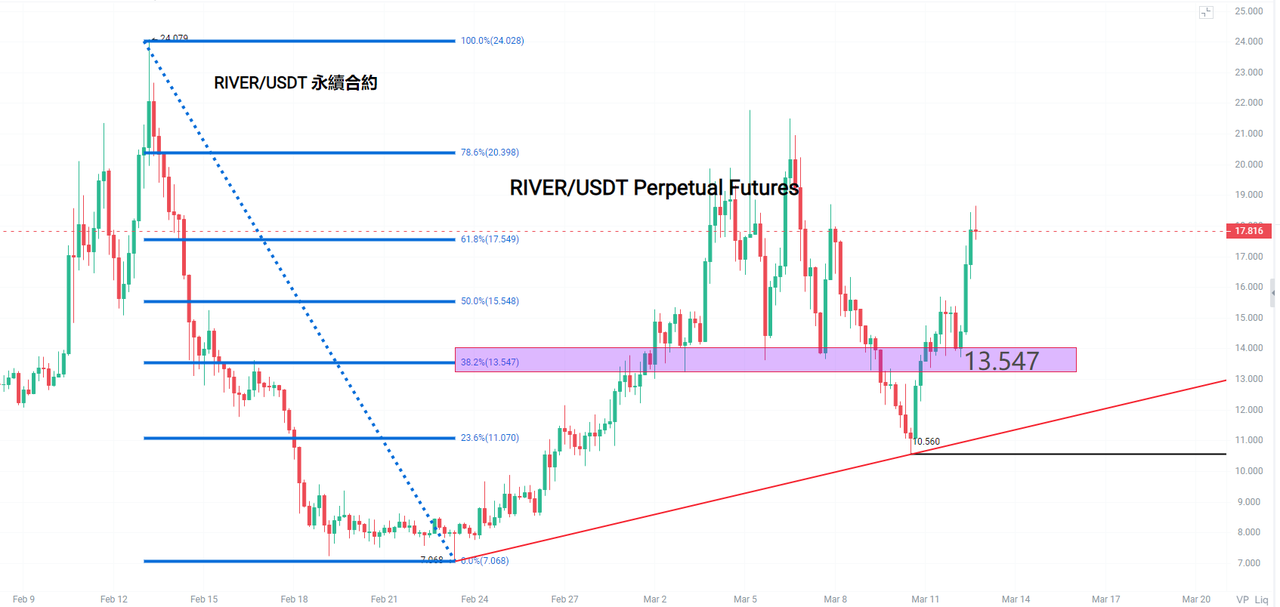
From the actual RIVER/USDT perpetual futures case, our trade thesis relied entirely on Fibonacci retracement support. The 38.2% retracement level at 13.547 served as the core reference point, and it had already been confirmed by the market multiple times as an effective support area.
- Core holding principle: as long as the price does not break effectively below 13.547 and does not invalidate the broader ascending trendline, the trade thesis remains unchanged.
- Holding mindset: after opening the position, there is no need to be disturbed by short-term price fluctuations or floating profit and loss. The only focus should be on whether support remains valid. Every successful retest and stabilization around 13.547 is another confirmation of support strength.
- Follow-up action: while holding the position, only monitor the resistance level of the upper range structure. If the price successfully breaks through resistance, you can continue holding to expand profits. If support or the trendline is broken effectively, then execute a stop loss and exit the market.
Case Study: BTC/USDT Perpetual Futures
Second, watch the rhythm and actively avoid market risk
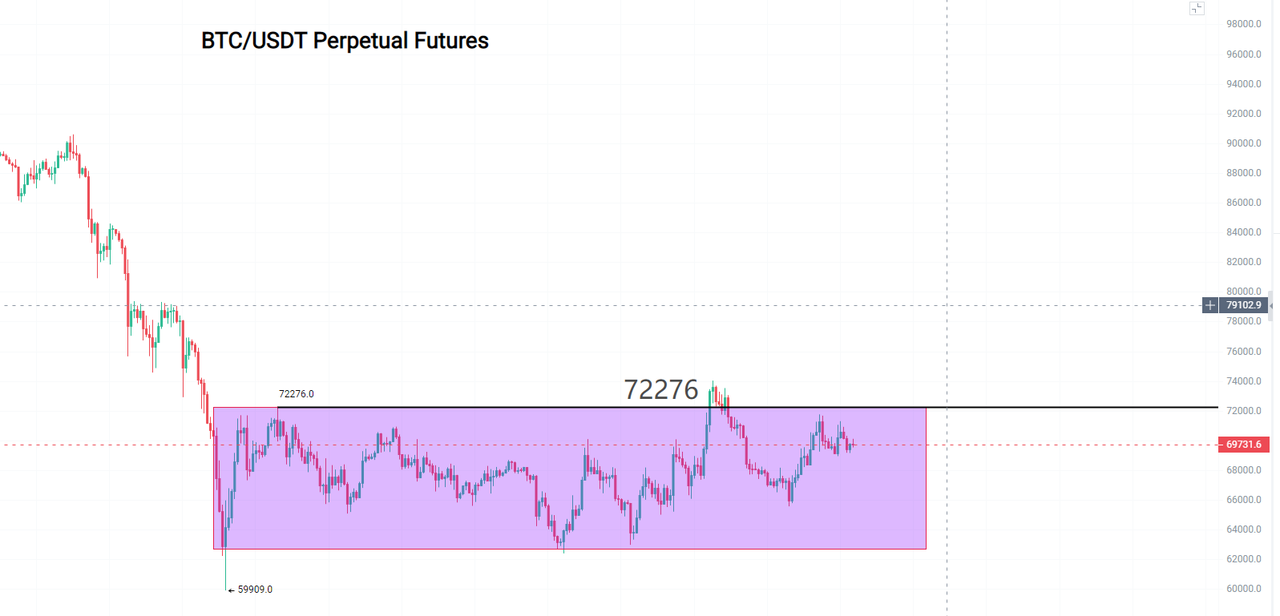
Take the current BTC/USDT perpetual futures trend as an example:
- Core holding principle: the price has been moving within a box range for an extended period. When price breaks above the key boundary of the box at 72276 with volume, the expectation is a strong continuation move with sustained bullish momentum. However, after the breakout, the market failed to produce an orderly increase in volume and instead showed weak momentum and insufficient follow-through. This indicates that the current move does not meet expectations and that the rhythm of the uptrend has clearly weakened.
- Follow-up action: if you are holding long positions at this time, you should decisively take profit and exit to avoid giving back gains. Then shift into a wait-and-see state and wait for the next clear trend signal before making a new decision.
Third, watch yourself: anchor your emotions and reject emotional trading
Watching yourself means constantly monitoring whether your emotions are being dragged around by market fluctuations.
- Stay alert to emotional swings caused by price changes and floating profit and loss. Avoid irrational behavior such as holding losing positions without reason, emotionally adding to positions, or trading repeatedly out of greed or fear.
- Once you notice that your attention is being controlled by every candlestick movement, or that you are becoming impatient, anxious, or impulsive, you should immediately pause trading, step away, calm down, and return only after your emotions have stabilized.
- The essence of this rule is to maintain your "psychological line of defense" in trading and ensure that every action is driven by rational planning rather than emotion.
Disclaimer
This article is not intended to provide:
(I) investment advice or investment recommendations;
(II) an offer or solicitation to buy, sell, or hold digital assets;
(III) financial, accounting, legal, or tax advice.
Digital assets, including stablecoins and NFTs, involve a high level of risk and may fluctuate significantly. You should carefully consider whether trading or holding digital assets is appropriate for you based on your financial situation. Please consult your legal, tax, or investment professional for advice specific to your situation.
About Bitunix
Bitunix is a global cryptocurrency derivatives exchange trusted by more than 3 million users from over 100 countries. Bitunix is committed to providing a transparent, compliant and secure trading environment for every user. The platform has a fast registration process and friendly verification system, and ensures security and compliance through mandatory KYC. Through Proof of Reserve (PoR) and global-level protection standards such as Bitunix Care Fund, Bitunix puts user trust and the safety of funds first.The K-Line Ultra Charting System brings a seamless trading experience to both novice and advanced traders, with up to 200 times leverage and deep liquidity, making Bitunix one of the most dynamic platforms in the market.
Bitunix Global Account
X | Telegram Announcements | Telegram Global | CoinMarketCap | Instagram | Facebook | LinkedIn | Reddit | Medium