
Article Summary
- USDT offers diverse earning opportunities beyond simply holding it, catering to various risk appetites.
- Beginner-friendly strategies on centralized platforms like Bitunix include staking and lending for stable, predictable returns.
- Advanced DeFi strategies like yield farming and liquidity provision offer higher potential yields but come with increased complexity and risks.
- Automated trading strategies, such as grid trading, allow users to profit from USDT's price volatility against other cryptos.
- Choosing the right strategy depends on your risk tolerance, capital, and investment goals.
- Bitunix provides a secure and feature-rich platform to execute many of these USDT earning strategies effectively.
Finding out how to earn USDT in 2026 is critical for crypto traders and investors looking to generate passive rewards while holding stablecoins on a crypto exchange or in a wallet. One of the key advantages of decentralized finance is that it allows users to earn competitive APYs without relying on centralized intermediaries, which, in traditional finance, typically capture most of the returns and pass on minimal yields to users.
The USDT market capitalization has reached approximately $180 billion in 2025, while other stablecoins such as USDC have also performed exceptionally well. Market data clearly shows that the stablecoin economy has evolved into a direct competitor to fiat payment systems. With billions of dollars in USDT circulating globally, demand for interest-bearing crypto accounts has never been higher.
This guide explores multiple ways to earn USDT, ranging from low-risk options to higher-risk strategies and automated trading approaches. Bitunix is positioned as a central platform supporting a wide range of USDT earning methods designed for different risk profiles and experience levels, and the Bitunix fees structure adds to the exchange’s appeal.
How To Earn USDT: Strategy 1- Staking and Earning on Bitunix (Low Risk)
Finding out how to earn USDT on Bitunix does not require a huge amount of research, as the platform has been designed to make stablecoin earnings as simple and accessible as possible. Users can access multiple low-risk earning options directly through the official website or mobile application without navigating complex DeFi tools.
Anyone can use the USDT staking feature through the Easy Earn section on the Bitunix homepage. This area brings together all savings and earning products in one place, allowing users to quickly choose an option that matches their risk tolerance and time horizon.
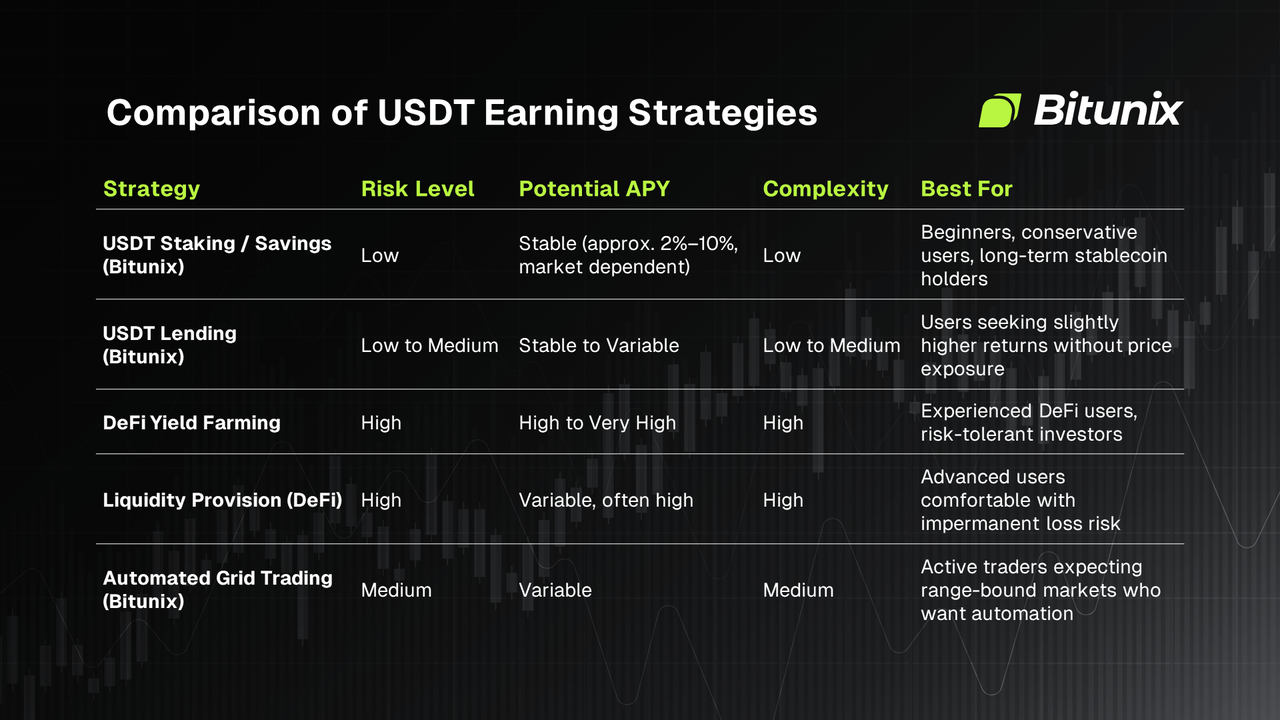
The earning process itself is straightforward. Users deposit USDT into an earning product, select a term if applicable, and begin earning interest automatically. Bitunix offers both flexible and fixed USDT savings products. Flexible products allow withdrawals at any time with lower APYs, while fixed products lock funds for a set period in exchange for higher returns. APYs typically range from around 2 percent up to 10 percent and may adjust based on market conditions.
This approach makes USDT earning on Bitunix an ideal entry point for beginners and conservative users seeking steady, low-risk returns.
Strategy 2: DeFi Yield Farming and Liquidity Provision (High Risk, High Reward)
While relying on Bitunix to earn USDT rewards is arguably the safest and most reliable approach, users who are willing to take on more risks and explore the more complex side of Web3 may find DeFi-based earning strategies more appealing. This is where terms such as yield farming and liquidity provision often appear. Yield farming refers to earning rewards by supplying crypto assets to DeFi protocols, while liquidity provision involves depositing token pairs into decentralized exchanges so traders can swap between them.
Pairs such as USDT and ETH can generate income through trading fees and additional protocol incentives. To participate, users typically connect a wallet like MetaMask to a decentralized application such as Uniswap or PancakeSwap and deposit funds into a liquidity pool.
The potential rewards can be high, but the risks are significant. Impermanent loss occurs when token prices move sharply, reducing the value of the deposited assets compared to holding them outright. Smart contract vulnerabilities and protocol failures also remain real concerns.
Bitunix fits into this strategy as a secure on-ramp, allowing users to acquire assets easily and convert DeFi rewards back into USDT or fiat when needed with spot trading pairs.
Strategy 3: Automated Grid Trading
An automated grid trading strategy is slightly less well-known in the USDT earning market. Arguably, this approach is far less passive than standard USDT lending or staking options. However, when configured correctly, grid trading can do the majority of the work automatically, offering another potential income stream for USDT holders without constant manual trading.
Grid trading works by placing a series of buy and sell orders within a predefined price range, such as BTC and USDT. The bot buys when the price drops to lower grid levels and sells when the price rises to higher levels, capturing small profits repeatedly as the market moves back and forth within that range.
This strategy is best suited for traders who expect relatively range-bound price action rather than strong trends. It appeals to users who want automated execution without monitoring charts all day. That said, grid trading requires a solid understanding of market behavior, careful setup, and practice. Poor configuration or sudden breakouts can lead to losses, making it essential to understand the risks before deploying trading bots.
Why Earn USDT on Bitunix?
Bitunix has simplified earning USDT rewards through its platform. Anyone can take advantage of USDT lending and earning features with just a few clicks. A combination of different options is available, including flexible products and plans with predetermined lock-up periods, allowing users to choose a strategy that fits their risk tolerance and liquidity needs.
Security is a core strength of Bitunix. The exchange operates with proof of reserves, a dedicated protection fund, and a strong security track record, giving users confidence when earning yield on their stablecoins. The interface is designed to be intuitive for beginners while still offering advanced functionality for experienced traders.
How to get started on Bitunix:
- Sign up for a Bitunix account via the website or download the mobile app.
- Log in and deposit USDT, or purchase USDT directly on the platform.
- Navigate to the “Earn” then “Easy Earn” section from the main dashboard.
- Select a USDT-earning product, either flexible or fixed-term.
- Enter the amount, confirm the terms, and start earning rewards immediately.
Following these steps will allow you to start earning USDT today through a secure and trusted USDT earning platform with a direct link to an on and off ramp.
Conclusion: Building Your USDT Earning Portfolio
In periods of market volatility, USDT offers a safe haven. However, leaving USDT funds to sit idle while waiting for volatility to clear is a waste of resources. Using Bitunix, traders can continue to earn rewards even if they step back from active trading by allocating their USDT to earning pools available directly through the website and mobile application.
FAQs
What is the safest way to earn interest on USDT?
The lowest-risk option is centralized USDT staking or savings products on platforms like Bitunix. These offer predictable returns, clear terms, and no exposure to price volatility, making them suitable for conservative users.
Can I lose my USDT while yield farming?
Yes. Yield farming involves real risk. Smart contract bugs, protocol failures, rug pulls, and impermanent loss can all lead to partial or total loss of funds. High APYs usually reflect higher risk.
How much can I realistically earn with USDT staking?
Most centralized platforms offer between 2 and 10 percent annually, depending on lock-up duration and market demand. These returns are modest compared to DeFi but far more stable and predictable.
Is grid trading profitable with a stablecoin like USDT?
Grid trading works best when USDT is paired with a volatile asset such as BTC or ETH. It profits from frequent price fluctuations rather than long-term trends, but it requires proper setup and risk management.
What is impermanent loss, and how can I avoid it?
Impermanent loss happens when one asset in a liquidity pool moves sharply in price relative to the other. You can reduce risk by using low-volatility pairs, shorter exposure periods, or avoiding trending markets.
Do I need to pay taxes on my USDT earnings?
In many countries, yes. Interest earned from staking, lending, or farming is often treated as taxable income. Rules vary widely, so keeping records and checking local regulations is essential.
What's the difference between CeFi and DeFi earning?
CeFi platforms like Bitunix manage custody, risk controls, and payouts for users. DeFi relies on smart contracts and self-custody, offering higher potential returns but requiring more technical knowledge and accepting greater risk.
How do I choose the right liquidity pool for yield farming?
Focus on protocol reputation, audited smart contracts, pool liquidity, and realistic APYs. Extremely high yields often signal unsustainable incentives or hidden risks.
Are the APYs shown for yield farming guaranteed?
No. DeFi APYs change constantly based on demand, emissions, and market activity. They can drop sharply without warning, especially during periods of low volume or declining token incentives.
Why should I use Bitunix as my hub for these strategies?
Bitunix provides a secure, compliant base for earning USDT with proof of reserves, a protection fund, simple earn products, and easy access to higher-risk strategies, all from one platform.
Glossary
USDT (Tether) - A US dollar–pegged stablecoin widely used for trading, payments, and earning yield in crypto markets.
Stablecoin - A cryptocurrency designed to maintain a stable value, typically pegged to a fiat currency like the US dollar.
APY (Annual Percentage Yield) - The annualized return on an investment, including the effect of compounding interest.
Yield Farming - A DeFi strategy where users provide liquidity to protocols in exchange for rewards, often offering high returns with higher risk.
Impermanent Loss - A temporary loss experienced when providing liquidity due to price divergence between paired assets.
Grid Trading - An automated trading strategy that places buy and sell orders within a predefined price range to profit from market volatility.
CeFi (Centralized Finance) - Crypto services operated by centralized platforms like Bitunix that manage custody, compliance, and user funds.
DeFi (Decentralized Finance) - Blockchain-based financial systems that operate without intermediaries using smart contracts.
Proof of Reserves - A transparency mechanism allowing exchanges to verify they hold sufficient assets to cover user balances.
About Bitunix
Bitunix is a global cryptocurrency derivatives exchange trusted by over 3 million users across more than 100 countries. At Bitunix, we are committed to providing a transparent, compliant, and secure trading environment for every user. Our platform features a fast registration process and a user-friendly verification system supported by mandatory KYC to ensure safety and compliance. With global standards of protection through Proof of Reserves (POR) and the Bitunix Care Fund, we prioritize user trust and fund security. The K-Line Ultra chart system delivers a seamless trading experience for both beginners and advanced traders. At the same time, leverage of up to 200x and deep liquidity make Bitunix one of the most dynamic platforms in the market.
Bitunix Global Accounts
X |Telegram Announcements |Telegram Global |CoinMarketCap |Instagram |Facebook |LinkedIn |Reddit |Medium