

As more traders look beyond crypto-only opportunities, we are continuing to expand Bitunix TradFi with markets that reflect major themes in global finance. One of those additions is CLUSDT, which gives users access to crude oil price movement in a USDT-based trading environment.
We added CLUSDT to the Bitunix TradFi lineup because crude oil remains one of the most important and closely watched markets in the world. Oil does not just reflect energy demand. It also reacts to inflation expectations, geopolitical tensions, supply disruptions, economic growth trends, and broader market sentiment. For traders who want more than crypto exposure alone, crude oil is a natural market to watch.
With Bitunix CLUSDT, users can explore crude oil price action through a workflow that already feels familiar. Instead of moving to a separate traditional brokerage setup, they can access oil-linked trading within the broader Bitunix ecosystem and follow a major commodity market from the same exchange-style environment they already use.
In this guide, we explain what CLUSDT is, why we added it to Bitunix TradFi, how crude oil futures work, what moves oil prices, and what beginners should know before trading crude oil on Bitunix.
What Is CLUSDT on Bitunix?
CLUSDT is the crude oil-linked market on Bitunix. It is designed for users who want exposure to crude oil price movement through a USDT-based setup.
This is the first thing traders need to understand. Trading CLUSDT is not the same as buying physical crude oil. Users are not purchasing barrels of oil or taking delivery. They are trading a market linked to oil price movement.
That makes CLUSDT on Bitunix more practical for active traders who want to respond to price action, volatility, and market themes in real time.
In simple terms:
- CLUSDT gives exposure to crude oil price movement
- it is built for trading, not physical ownership
- it works inside a USDT-based environment
- it fits the same chart-driven workflow many users already know
That is exactly why interest in how to trade CLUSDT continues to grow as more traders start exploring commodity-linked opportunities.
Why We Added CLUSDT to Bitunix TradFi
We added CLUSDT to Bitunix TradFi because the way traders approach markets is changing.
Today, many users do not focus on only one asset class. They may trade Bitcoin during a crypto-driven market phase, watch gold when macro uncertainty rises, and follow crude oil when inflation, supply pressure, or geopolitical headlines start driving volatility.
Crude oil was a natural addition because it sits at the center of so many global narratives at once. It reflects energy demand, production changes, international tensions, transportation costs, and broader expectations around growth and inflation.
By bringing CLUSDT into Bitunix TradFi, we are giving users access to a market that adds real depth to their trading options. It is a practical step toward a more complete multi-market experience for traders who want to move across crypto and traditional-market themes more easily.
What Is Bitunix TradFi?
Bitunix TradFi is our broader traditional finance market offering. It includes products linked to traditional-market themes, including commodity-linked and stock-linked markets.
For users, that means Bitunix TradFi is where they can explore markets that go beyond crypto and connect with wider macro and financial narratives.
This matters because traders increasingly want more flexibility. They want to stay ready for whichever market category is attracting the most attention, whether that is crypto, commodities, or stock-linked price action. Bitunix TradFi supports that shift by helping users access more markets through one connected environment.
Why Crude Oil Matters to Traders
Crude oil matters because it is tied to some of the biggest themes in the global economy.
Traders follow oil because:
- Oil prices can influence inflation expectations
- Geopolitical events can affect supply and pricing
- Stronger economic activity can support higher demand
- Recession concerns can weaken market sentiment
- Energy costs influence transportation and production
- Oil often acts as a broader macro signal across markets
For many traders, crude oil is not just another commodity. It is a market that reflects how the world is pricing risk, growth, supply pressure, and uncertainty in real time.
What Does It Mean to Trade Crude Oil With USDT on Bitunix?
To trade crude oil with USDT on Bitunix means accessing oil-linked price movement through a stablecoin-based framework.
For many users, that makes the experience much more practical. They are already used to managing positions, margins, and overall exposure in USDT. Extending that same workflow to Bitunix CLUSDT makes crude oil trading feel more natural and more accessible.
This brings several advantages:
- Position management feels more familiar
- Market comparison becomes easier
- Users can move between categories more smoothly
- The setup is more intuitive for crypto-native traders
That is one reason more users are starting to look into how to trade crude oil on Bitunix.
Crude Oil Futures Explained for Beginners
Crude oil futures are trading products linked to the movement of crude oil prices. They are used for market participation and price exposure, not physical ownership.
That means when users trade CLUSDT, they are not buying physical crude oil. They are trading a market that follows oil price movement.
For beginners, the key points are straightforward:
- Crude oil futures are based on price movement
- They are designed for active trading
- They are not the same as owning physical oil
- They require discipline and risk management
Understanding this difference helps users approach Bitunix crude oil trading with the right expectations from the start.
WTI vs Brent: Why the Difference Matters
One of the first things new oil traders should understand is the difference between WTI and Brent.
WTI, or West Texas Intermediate, is one of the main crude oil benchmarks and is more closely associated with the US oil market.
Brent is another major benchmark that is widely used in international oil pricing.
This matters because not all crude oil headlines refer to the same benchmark, and the two do not always move in exactly the same way.
The difference between WTI and Brent can be influenced by:
- regional supply conditions
- transport and logistics
- storage dynamics
- refinery demand
- global trade flows
- broader market structure
For traders, this means context matters. If users are following oil news or building a trade setup, it helps to know which benchmark is driving the narrative.
What Moves Crude Oil Prices?
A strong crude oil trade starts with understanding what moves the market.
The main drivers of oil price movement include:
- OPEC and OPEC+ production decisions
- US crude inventory data
- geopolitical conflicts
- sanctions and supply disruptions
- global economic growth expectations
- recession fears
- strength or weakness in the US dollar
- seasonal energy demand
- transportation and industrial activity
Because so many factors affect the market at once, crude oil can move quickly and sometimes unexpectedly. That is why traders should avoid treating oil as a simple market. It is global, fast-moving, and highly sensitive to headlines.
For anyone trading CLUSDT on Bitunix, understanding these drivers is essential.
How to Trade Crude Oil (CLUSDT) on Bitunix
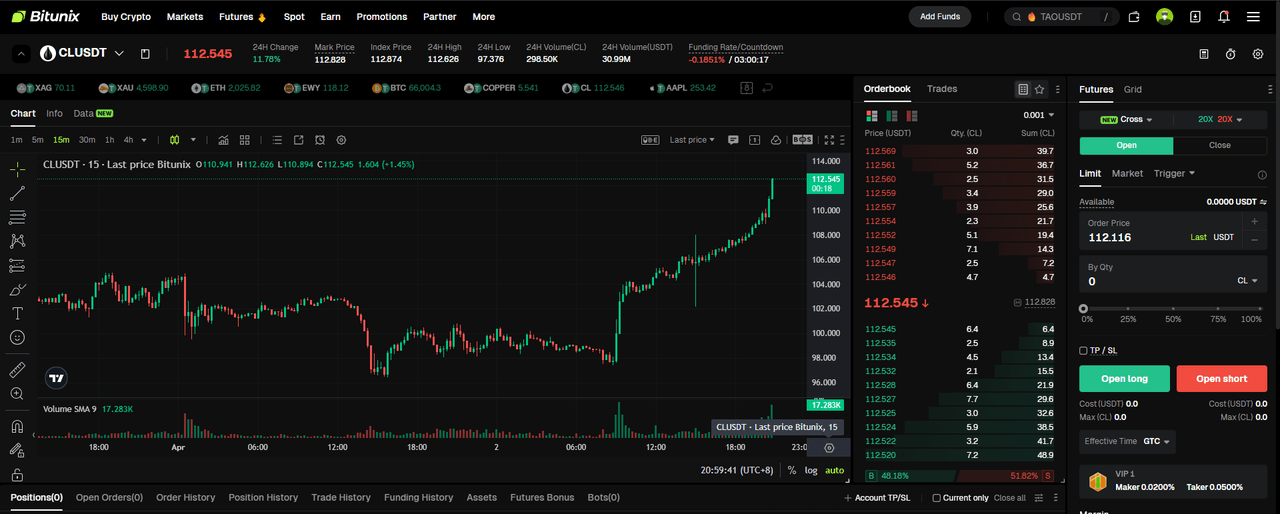
If you want to learn how to trade CLUSDT, the best approach is to keep the process structured.
Understand the product
Know that CLUSDT is a crude oil-linked trading market designed for active price exposure, not physical ownership.
Review the current oil narrative
Before opening a position, identify what is moving the market right now.
Ask questions like:
- is oil reacting to supply news?
- are inventories rising or falling?
- is the move driven by demand expectations?
- is the US dollar affecting commodity sentiment?
- are geopolitical developments changing the market outlook?
Study the chart
Look at:
- trend direction
- support and resistance
- recent volatility
- breakout zones
- reaction to major headlines
Build a setup
Do not enter a trade just because price is moving. Wait for a setup that actually fits your plan.
Examples include:
- trend continuation
- breakout above resistance
- rejection from a key level
- range trading between support and resistance
Understand leverage and margin
Like other futures-style products, Bitunix CLUSDT may involve leverage. That increases both opportunity and risk, so users need to manage position size carefully.
Define risk before entry
Before opening a trade, decide:
- entry point
- stop-loss area
- invalidation level
- position size
- target or exit logic
Monitor the trade actively
Crude oil is not a passive market. It can react quickly to major developments, so active trade management matters.
Crude Oil Trading Strategy Basics
A beginner-friendly crude oil trading strategy should focus on consistency, structure, and risk control.
Common approaches include:
Trend-following strategy
This works best when oil is moving clearly in one direction and the broader market narrative supports that move.
Range trading strategy
This works best when oil respects support and resistance without a strong breakout.
Breakout strategy
This works best when price is compressing near a major level and traders expect a larger move after a catalyst.
No matter which setup users prefer, every strong crude oil trading strategy should include:
- clear entry logic
- controlled position size
- realistic expectations
- strong risk management
- no emotional chasing
Key Risks Beginners Should Understand when Trading Crude Oil (CLUSDT)
Before trading CLUSDT, beginners should understand the risks clearly.
The main risks include:
- volatility risk: crude oil can move sharply on unexpected headlines
- leverage risk: small price changes can create outsized gains or losses
- headline risk: OPEC updates, inventory reports, and geopolitical news can move the market fast
- false familiarity: a famous market is not automatically an easy one
- strategy mismatch: crude oil futures are active trading products, not passive holdings
For traders learning how to trade crude oil on Bitunix, risk control matters just as much as market direction.
Why CLUSDT Matters in the Current Market
We added CLUSDT because traders are paying more attention to markets that reflect real-world macro conditions.
Crude oil stands out because it sits right at the intersection of inflation, growth, energy pricing, and geopolitical risk. It is a market that often becomes more relevant when global conditions are uncertain or when major economic themes begin driving cross-market volatility.
Inside Bitunix TradFi, CLUSDT gives users another way to respond to those shifts. It adds energy-linked price action to the broader mix and makes it easier for traders to follow where attention and opportunity are moving.
Conclusion
CLUSDT on Bitunix gives users a practical way to trade crude oil price movement through a familiar USDT-based environment.
We added CLUSDT to Bitunix TradFi because crude oil is one of the most important and widely followed markets in the world. It gives traders access to a commodity that reflects inflation, supply changes, macro sentiment, and geopolitical developments all at once.
The key point is simple. CLUSDT is built for trading price action, not owning physical crude oil. Anyone exploring how to trade CLUSDT should understand the difference between WTI and Brent, follow the main drivers behind crude oil prices, and use a disciplined trading strategy based on structure and risk control.
As Bitunix TradFi continues to expand, Bitunix CLUSDT gives users a more flexible way to connect traditional-market themes with a modern exchange-style trading experience.
FAQ
What is CLUSDT on Bitunix?
CLUSDT on Bitunix is the crude oil-linked trading market that gives users exposure to crude oil price movement in a USDT-based format.
Why did we add CLUSDT to Bitunix TradFi?
We added CLUSDT to Bitunix TradFi because crude oil is one of the most important macro markets in the world and gives traders broader exposure beyond crypto-only opportunities.
What is Bitunix TradFi?
Bitunix TradFi is our traditional finance market offering, which includes products linked to traditional-market themes such as commodities and stock-linked markets.
How do I trade CLUSDT?
To trade CLUSDT, users review the crude oil narrative, analyze the chart, define risk, understand leverage, and place trades through the Bitunix trading interface.
Is CLUSDT the same as owning crude oil?
No. CLUSDT is a trading product linked to crude oil price movement. It is not physical oil ownership.
What affects crude oil prices?
Crude oil prices are influenced by supply decisions, inventory data, demand expectations, geopolitics, economic growth, and the US dollar.
What is the difference between WTI and Brent?
WTI and Brent are two major crude oil benchmarks. They can price differently because of regional conditions, logistics, and broader global market structure.
Is Bitunix CLUSDT suitable for beginners?
Bitunix CLUSDT can be suitable for beginners if they first understand volatility, leverage, position sizing, and active risk management.
Glossary
- Bitunix CLUSDT: The crude oil-linked market on Bitunix that gives users exposure to oil price movement in a USDT-based format.
- Bitunix crude oil trading: The process of trading crude oil-linked products through the Bitunix platform.
- Bitunix TradFi: Our broader traditional finance market offering, including commodity-linked and stock-linked products.
- Brent: A major international crude oil benchmark widely used in global oil pricing.
- CLUSDT: The crude oil-linked USDT trading market on Bitunix.
- Crude oil futures: Trading products linked to crude oil price movement rather than physical ownership.
- Crude oil trading strategy: A structured approach to entering, managing, and exiting oil trades.
- Leverage: A feature that allows traders to control a larger position with a smaller amount of capital.
- Margin: The capital required to open and maintain a leveraged position.
- USDT: A stablecoin pegged to the US dollar and commonly used for trading, settlement, and margin.
- WTI: West Texas Intermediate, one of the main crude oil benchmarks.
Disclaimer
This article does not provide:
(i) investment advice or investment recommendations;
(ii) an offer or solicitation to buy, sell, or hold digital assets;
(iii) financial, accounting, legal, or tax advice.
Digital assets, including stablecoins and NFTs, involve high risk and may fluctuate significantly. Consider whether trading or holding digital assets is appropriate for you given your financial situation. Consult a qualified legal, tax, or investment professional when needed. You are responsible for understanding and complying with applicable local laws and regulations.
About Bitunix
Bitunix is a global cryptocurrency derivatives exchange trusted by over 3 million users across more than 100 countries. The platform is committed to providing a transparent, compliant, and secure trading environment for every user. Bitunix offers a fast registration process and a user-friendly verification system supported by mandatory KYC to ensure safety and compliance. With global standards of protection through Proof of Reserves (POR) and the Bitunix Care Fund, Bitunix prioritizes user trust and fund security. The K-Line Ultra chart system delivers a seamless trading experience for both beginners and advanced traders, while leverage of up to 200x and deep liquidity make Bitunix one of the most dynamic platforms in the market.
Bitunix Global Accounts
X | Telegram Announcements | Telegram Global | CoinMarketCap | Instagram | Facebook | LinkedIn | Reddit | Medium