
Article Summary
- This article provides a comprehensive explanation of a transaction hash in the context of cryptocurrency and blockchain technology.
- It breaks down the technical aspects of a transaction hash and how it functions within the cryptocurrency ecosystem.
- The guide explores best practices for managing and protecting a transaction hash to ensure the security of your digital assets.
- It highlights common mistakes users make and how to avoid them.
- The article concludes with actionable advice for implementing proper security practices.
- One of the most critical aspects of owning cryptocurrency is understanding how to keep your assets secure. Central to this is understanding the transaction hash. The term sounds technical, but the core idea is that it is the unique record that helps you check what happened after you sent or received crypto.
- Crypto does not work like a bank transfer, where you can call someone and ask them to reverse a mistake. In most cases, once an on-chain transaction is confirmed, it is final. That is why users need to understand the clues that wallets, explorers, and exchanges provide. A transaction hash helps you check the status, network, amount, sender, receiver, fee, and confirmation history of a transaction.
- This also applies when you move funds through a crypto exchange like Bitunix. On-chain deposits and withdrawals depend on the correct network, address, amount, and transaction record, while internal transfers follow a different process inside the platform.
This guide explains how transaction hashes work, how they relate to crypto security, and how you should use them to improve wallet management.
What Is a Transaction Hash and How Does It Work?
A transaction hash, also called a TXID, is a unique string of letters and numbers linked to one blockchain transaction. Think of it as a receipt number, but unlike a paper receipt, it points to public blockchain data that anyone can check with the right explorer.
The hash identifies the transaction, but it does not store your private key, unlock your wallet, or prove that the person sharing it owns the assets. It simply points to a public blockchain record.
When people ask what is a transaction hash, sometimes they want to know whether it is safe to share. In most normal support cases, sharing the hash is safe. The dangerous part is what you share with it. Never share seed phrases, private keys, passwords, one-time codes, or full account screenshots that show personal details.
Technical Definition
A transaction hash is generated through cryptographic hashing, in which a blockchain turns transaction data into a fixed identifier. The exact process depends on the network, since Bitcoin, Ethereum, Solana, and other chains format transactions differently. Still, the purpose is similar across networks: the hash gives each transaction a unique label.
Ethereum's 2026 documentation explains the base idea behind blockchain transactions:
"Transactions are cryptographically signed instructions from accounts. An account will initiate a transaction to update the state of the Ethereum network."
That sentence shows what happens before a hash becomes useful. A user signs a transaction, the network processes it, and the transaction becomes part of the blockchain record if accepted.
How It Works
After you send crypto, your wallet or exchange broadcasts the transaction to the network. The network checks whether the transaction follows its rules. Does the sender have enough funds? Is the signature valid? Is the fee acceptable? Is the transaction formatted correctly?
Once a validator or miner includes the transaction in a block, it becomes part of the public blockchain. The hash then lets you search for that specific transaction on a blockchain explorer.
A confirmation means the transaction has been included in a block. More confirmations usually make the transaction harder to reverse. For everyday users, confirmations are why a deposit can show as pending even after the transfer appears on-chain.
Importance in Crypto
The transaction hash is critical because it provides proof of activity without relying solely on your wallet screen. Wallet apps can lag, exchanges can take time to credit deposits, and networks can get congested, so the hash gives you a second place to check what is happening.
Recent security data shows why users need better habits. Chainalysis found that North Korean hackers stole at least $2.02 billion in cryptocurrency in 2025, a 51% increase from 2024. Chainalysis also noted that these attacks often involved sophisticated impersonation tactics and IT worker infiltration at crypto services.
That does not mean your transaction hash is the weak point. It means crypto security depends on clear records, careful verification, and fewer blind spots. The hash helps you track what happened, but it does not protect you if you approve a malicious transaction or send funds to the wrong address.
Common Misconceptions
A transaction hash is often misunderstood as a security credential, but it does not work like a password, private key, or wallet login. It cannot move funds, unlock a wallet, or prove that the person sharing it owns the assets. It only helps you find a specific public transaction record on the blockchain, including fields like status, block, timestamp, sender, receiver, and confirmations.
Another common mistake is assuming every crypto-related payment has a public hash. On-chain transfers do, but internal transfers within an exchange often use the platform's own records rather than creating a new blockchain transaction. Also, a hash cannot fix a wrong address, a wrong network, or a missing memo on its own. It helps support teams investigate what happened, but it cannot rewrite the blockchain record.
Safer Ways to Track and Protect Transaction Data
Transaction hashes are public, but you should still manage them carefully because good crypto security depends on clear records, correct links, and basic privacy habits. You need a reliable way to check where each transaction went, which network it used, and where to find the record later.
Keep Transaction Records Organized
You can store transaction hashes in a spreadsheet, password manager note, tax folder, or wallet export file, as long as the system is easy to search later. For each transfer, include the date, asset, network, amount, sending platform, receiving platform, and hash, so you can match the transaction to your own records without digging through different apps.
Keep these records separate from your seed phrase or private keys. A transaction hash is public, but a seed phrase gives full access to a wallet, so storing both in the same place creates unnecessary risk. For larger transfers, save both the explorer link and the raw hash. Screenshots can help as backup, but they are not enough on their own because they can crop out important details.
Avoid Errors That Create Bigger Problems
The most common mistake is checking the hash on the wrong explorer. A transaction sent to Tron, Base, Arbitrum, or any other chain needs to be checked on an explorer that supports that network. If you search in the wrong place, the transaction can look missing even when it was processed correctly. Blockchain explorers display the network, sender, receiver, token contract, and confirmations, helping you verify where the funds actually went.
Another common error is copying the wrong string from a wallet or exchange screen. Wallets often display addresses, order IDs, internal reference IDs, and transaction hashes close together, so it is easy to paste the wrong field when you are in a rush. Always copy the full hash, verify that the explorer matches the network, and avoid posting transaction hashes publicly, as they can connect your wallet activity to your identity.
Use the Right Security Tools
Blockchain explorers are the main tool for checking a transaction hash. They let you review status, block number, timestamp, sender, receiver, amount, network fee, and confirmations.
For individual users, the best security tools are to:
- Use a hardware wallet for larger balances
- Turn on app-based two-factor authentication
- Bookmark official explorers
- Avoid explorer links sent by random accounts
- Review token approvals on smart contract networks
- Scam risk is still rising, and Chainalysis estimated that crypto scams and fraud stole up to $17 billion in 2025. The same report found that impersonation scams grew 1,400% year over year, while AI-enabled scams were 4.5 times more profitable than traditional scams. That data should change how you react to support messages: if someone contacts you first and asks for wallet access, seed words, or a verification deposit, stop. Real support does not need your seed phrase.
Review Your Wallet Security Regularly
Every few months, review your wallet and exchange security settings. Check recovery email addresses, two-factor authentication, withdrawal allowlists, connected apps, browser extensions, and saved seed phrase storage.
You should also review old wallet activity. Look for unknown approvals, strange token movements, or transactions you do not remember. On smart contract networks, token approvals can stay active long after you stop using an app.
Practical Uses for Transaction Hashes in Daily Crypto Activity
Most users first care about a transaction hash when something feels slow. A withdrawal has not arrived, a deposit is pending, or a friend says they paid you, but your wallet still shows nothing. Here are the main uses for transaction hashes in everyday trading.
Track Everyday Crypto Transfers
In a normal transfer, you send funds from a wallet or exchange, wait for the network to process the transaction, then check the hash on a blockchain explorer. If the status is successful and the recipient address is correct, the blockchain side of the transfer is complete.
If the receiving exchange still has not credited the funds, the issue can be internal processing, minimum deposit rules, missing memo or tag information, unsupported network use, or required confirmations. The transaction hash helps support teams see the same blockchain record you see, making it much easier to explain the issue clearly.
Improve Wallet Management
Transaction hashes help you match wallet activity to your own records and separate real transactions from fake wallet notifications. They are especially useful when you manage several wallets, move funds between exchanges, or track deposits and withdrawals for tax or accounting purposes.
Good wallet management starts before you confirm a transfer. Check the network, asset, recipient address, and any required memo, tag, or note. This is especially important with assets like USDT, which exist on several blockchains. The token name can look the same across Ethereum, Tron, Solana, and other networks, but each network follows a different transfer path.
Handle Delays, Failed Transfers, and Lost Records
If funds are delayed, start with the transaction hash and check whether the transaction is pending, failed, or successful. A failed transaction usually means the asset did not leave the sending wallet, although the network fee can still be spent, depending on the blockchain. If the transaction succeeded, check the recipient address, network, amount, and any memo or tag requirement before assuming the funds are missing.
When the address is wrong, recovery is often impossible unless the receiving address belongs to a platform that can help. If you used the wrong network for an exchange deposit, contact support and provide the hash, asset, network, amount, and destination address. Do not send more funds to test the same path, because one mistake is easier to investigate than two.
Work With Exchanges More Efficiently
Exchanges use transaction hashes to match deposits and withdrawals with blockchain records. When you withdraw crypto, the platform can provide a TXID once the transaction has been broadcast. When you deposit, the receiving platform watches the blockchain until the transaction reaches enough confirmations.
The hash helps prove that an on-chain event happened, but the exchange still applies its own crediting rules. Minimum deposits, wrong memo tags, unsupported assets, and network mismatch can still delay or block credit.
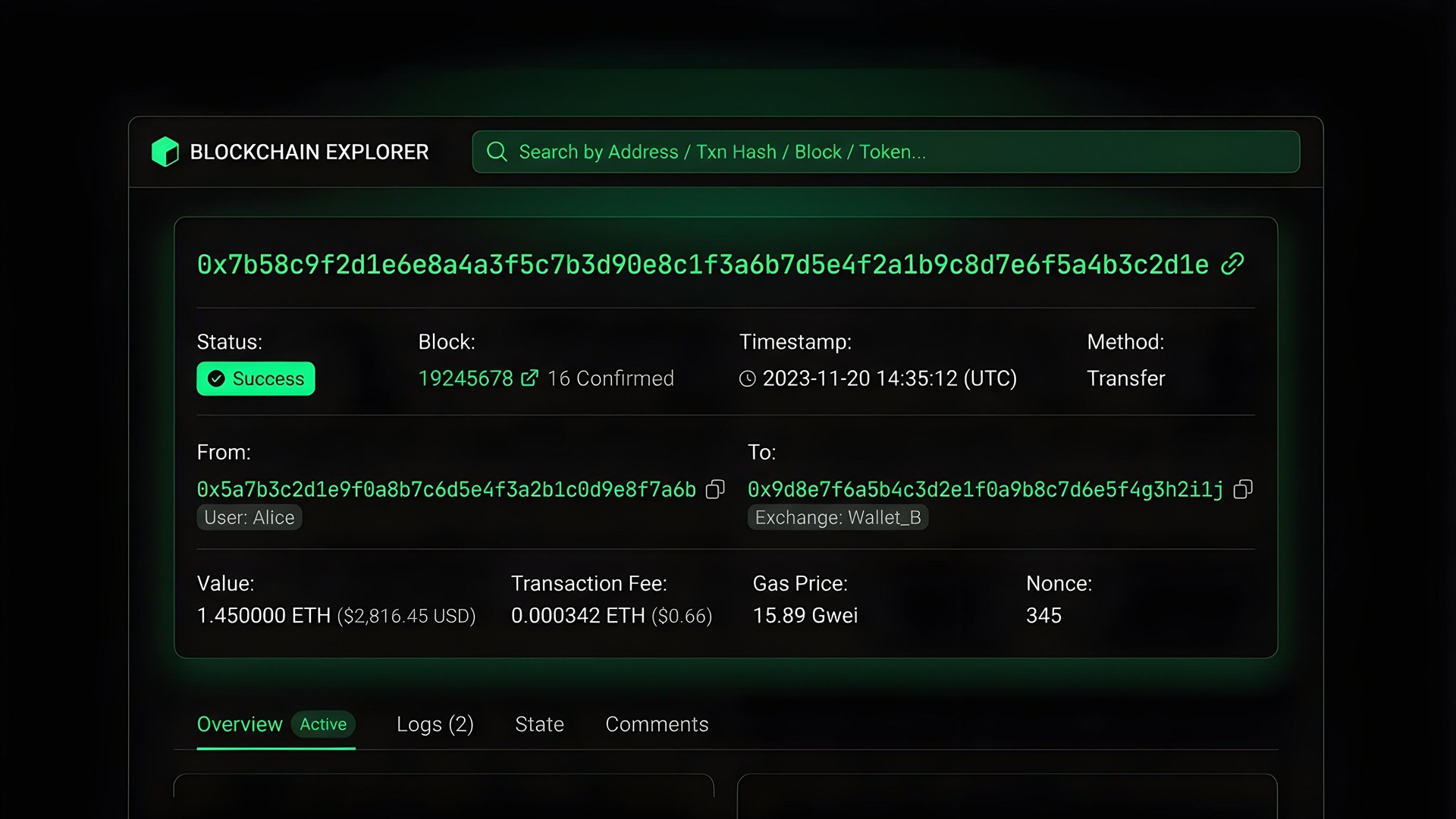
A blockchain explorer lets users verify a transaction hash, check its confirmation status, and review key details such as sender, receiver, value, fee, and block number.
Key Risks, Compliance Rules, and Future Changes
A transaction hash makes blockchain activity easier to verify, but it sits inside a wider risk environment. The biggest risks come from scams, user errors, surveillance concerns, compliance requirements, and changes to wallet design.
Security Threats
The hash itself is rarely the weak point. The weak points are phishing links, fake support accounts, clipboard malware, malicious wallet extensions, fake explorers, and approval-draining scams.
A scammer may ask for your transaction hash to sound legitimate, then ask for your seed phrase to verify the wallet. No real exchange, wallet provider, or support team will ever need your seed phrase.
TRM Labs estimated that illicit cryptocurrency wallets received $158 billion in incoming value in 2025, up from $64.5 billion in 2024. It also found that illicit activity fell slightly as a share of total attributed on-chain volume, from 1.3% in 2024 to 1.2% in 2025.
Human Error
Many crypto losses come from simple mistakes. Users copy the wrong address, choose the wrong network, ignore memo requirements, approve malicious contracts, or trust a support account that found them first.
Before sending a large amount, send a small test transaction when fees allow, check the hash, confirm the address and network, and then send the rest. This adds a step, but it also reduces the chance that one rushed click turns into a very expensive mistake.
Regulatory Considerations
Transaction hashes matter in compliance because they help trace on-chain activity. However, they do not replace identity checks, sanctions screening, tax records, or exchange compliance duties.
In the EU, MiCA created a central framework for crypto-asset service providers, white papers, authorized providers, and non-compliant entities. ESMA's interim MiCA register is being updated regularly and is expected to remain in CSV form until mid-2026 before formal integration into ESMA systems.
Crypto reporting rules are also expanding. Under DAC8, crypto service providers in the EU must collect, verify, and share certain user data annually with tax authorities from January 1, 2026.
The FATF also continued pushing global Travel Rule implementation in 2025. FATF warned that virtual assets are borderless and that regulatory failures in one jurisdiction can have global consequences. It also noted that jurisdictions representing about 98% of the global virtual asset market are central to reducing overall risk when FATF standards are fully implemented. For users, the practical takeaway is that a transaction hash helps verify blockchain activity, but regulated platforms can still request additional information when required by law.
Future Developments
Transaction hash security will improve through better wallet design, clearer transaction previews, and stronger scam detection before users sign anything. The biggest change is that wallets are moving away from blind confirmation screens and toward previews that show what a transaction will actually do, including which tokens leave the wallet, which approvals are granted, and which contract is being used. Revoke.cash, for example, added transaction simulation to its browser extension in 2026 so users can see token movements and approvals before signing.
Ethereum's Pectra upgrade also points to a more flexible wallet future. EIP-7702 lets externally owned accounts, the normal wallet type most users rely on, temporarily use smart account features through a new transaction type. That can support features such as transaction batching, gas sponsorship, delegated actions, and better account recovery design, although users still need to understand what they are approving.
Security tools will also become more proactive as scams get harder to spot. That means future transaction hash security will depend more on wallets, exchanges, and explorers warning users before they sign a risky transaction.
Conclusion: Protecting Your Cryptocurrency Assets
The transaction hash is a fundamental aspect of cryptocurrency security that every user must understand, as it helps verify transfers, track deposits, troubleshoot delays, and maintain cleaner records.
By using proper security practices and understanding transaction hashes, you reduce the risk of losing digital assets through confusion, scams, or poor wallet management. You still need to check addresses, networks, memo tags, and app permissions, but the hash gives you a reliable place to start.
Ready to manage your cryptocurrency with better habits? Download the Bitunix app and register to access wallet tools, transaction records, and security features that help keep crypto use safer.
FAQ
What exactly is a transaction hash?
A transaction hash is a unique string of letters and numbers that identifies a specific on-chain crypto transaction. You can search it on a blockchain explorer to check the transaction status, sender, receiver, amount, fee, timestamp, block number, and confirmations.
Why is the transaction hash important in cryptocurrency?
A transaction hash helps you verify that a transfer was submitted, confirmed, failed, or delayed. It also helps wallets, exchanges, and support teams investigate deposits and withdrawals. Without it, tracking a blockchain transaction becomes harder and less precise.
How is a transaction hash generated?
A blockchain creates a transaction hash by applying a cryptographic hash function to transaction data. The exact method depends on the network. The result is a unique identifier that wallets and explorers use to locate that transaction on the blockchain.
What are the risks associated with a transaction hash?
The hash itself does not expose your private key, but it can reveal wallet activity. If you post it publicly, people can connect your wallet to your identity. Scammers can also use fake support conversations around hashes to ask for sensitive details.
How should I securely store the transaction hash?
Store transaction hashes with basic transfer notes, such as date, network, asset, amount, and platform. Keep them separate from seed phrases and private keys. A password manager note, accounting spreadsheet, or tax folder works well for most users.
What should I do if my transaction hash is compromised?
If someone sees your transaction hash, do not panic. Check whether you shared anything else, such as your seed phrase, login details, or screenshots with personal information. If you exposed sensitive data, secure your accounts and move funds if needed.
Can the transaction hash be recovered if lost?
Yes, in most cases. You can find it in your wallet history, the exchange withdrawal page, the deposit page, the email confirmation, or a blockchain explorer. Search by wallet address, date, asset, amount, and network if you no longer have the original hash.
How does a transaction hash relate to wallet security?
A transaction hash helps you audit wallet activity. You can use it to confirm transfers, review suspicious movements, and check whether an approval or transaction actually happened. It supports wallet security, but it does not replace strong passwords or seed phrase protection.
Are there different types of transaction hashes?
Different blockchains format transaction hashes differently, but the purpose is similar. Bitcoin, Ethereum, Solana, Tron, and other networks each have their own transaction structures and explorers. Always check the hash on the correct network explorer.
Where can I learn more about the security of transaction hashes?
Start with your wallet's official help center, reputable exchange education pages, and blockchain explorer documentation. You can also review security reports from Chainalysis, TRM Labs, FATF, and regulators to understand current scam and compliance risks.
Glossary
- Transaction Hash: A unique blockchain identifier used to find and verify a specific crypto transaction.
- TXID: A shorter name for transaction hash, often used in wallets, exchanges, and explorers.
- Blockchain: A public or permissioned ledger that records transactions in linked blocks.
- Blockchain Explorer: A search tool that lets users inspect transactions, addresses, blocks, fees, and confirmations.
- Wallet: Software or hardware used to manage crypto addresses, balances, and transaction signing.
- Private Key: A secret cryptographic key that controls access to crypto funds.
- Seed Phrase: A group of recovery words used to restore a crypto wallet.
- Confirmation: A sign that a transaction has been included in a block and further secured by later blocks.
- Network Fee: The amount paid to process a blockchain transaction.
- Sender Address: The blockchain address that sends funds in a transaction.
- Receiver Address: The blockchain address that receives funds in a transaction.
- Smart Contract: Blockchain code that runs programmed actions, such as swaps, approvals, or lending transactions.
- Token Approval: Permission granted to a smart contract to access or move specific tokens.
- Travel Rule: A compliance rule requiring crypto service providers to share certain sender and recipient information.
- Crypto Security: The habits, tools, and systems used to protect digital assets from theft, mistakes, and scams.
Disclaimer
This article does not provide:
(i) investment advice or investment recommendations;
(ii) an offer or solicitation to buy, sell, or hold digital assets;
(iii) financial, accounting, legal, or tax advice.
Digital assets, including stablecoins and NFTs, involve high risk and may fluctuate significantly. Consider whether trading or holding digital assets is appropriate for you given your financial situation. Consult a qualified legal, tax, or investment professional when needed. You are responsible for understanding and complying with applicable local laws and regulations.
About Bitunix
Bitunix is a global cryptocurrency derivatives exchange trusted by over 3 million users across more than 100 countries. At Bitunix, we are committed to providing a transparent, compliant, and secure trading environment for every user. Our platform features a fast registration process and a user-friendly verification system supported by mandatory KYC to ensure safety and compliance. With global standards of protection through Proof of Reserves (POR) and the Bitunix Care Fund, we prioritize user trust and fund security. The K-Line Ultra chart system delivers a seamless trading experience for both beginners and advanced traders, while leverage of up to 200x and deep liquidity make Bitunix one of the most dynamic platforms in the market.
Bitunix Global Accounts
X | Telegram Announcements | Telegram Global | CoinMarketCap | Instagram | Facebook | LinkedIn | Reddit | Medium