

Statistical Period: May 23, 2026 – May 29, 2026
Data Cutoff: May 29, 2026
1. Market Overview: Renewed U.S.-Iran Conflict Triggers Global Asset Volatility
This week, global financial markets broadly came under pressure, with price volatility intensifying. The key focus was the renewed escalation of U.S.-Iran geopolitical tensions, particularly around the Strait of Hormuz, which raised concerns over global energy supply disruptions and significantly boosted risk-off sentiment. International crude oil prices rose sharply, while equities and major crypto assets generally declined.
Market participants continue to monitor further geopolitical developments and their potential impact on supply chains and energy prices. Overall, asset prices showed a volatile but weaker trend throughout the week. The Bitunix Token Pulse Weekly Report will continue tracking the top 300 tokens by market capitalization on the Bitunix exchange, while also monitoring trending U.S. stock contracts to provide investors with strategic references and short-term trading insights.
2. Crypto Asset Performance Review: BTC, ETH, and SOL Decline While XLM and NEAR Rise Against the Trend
Several analysts have assessed the outlook for U.S.-Iran negotiations. Commonwealth Bank of Australia analyst Madison Cartwright stated that the prospects for negotiations remain fragile. Key uncertainties remain regarding the reopening of the Strait of Hormuz, including shipping insurance costs and whether Iran may impose transit fees. Meanwhile, BNY Mellon analyst Bob Savage noted that market weakness is becoming increasingly evident. Escalating U.S.-Iran tensions, rising bond yields, and hawkish guidance from global central banks are putting pressure on equities and fixed-income markets, while investors are reassessing the sustainability of the recent rebound in global risk assets.
This week, the median return of the top 300 tokens by market capitalization recorded -5.56%, with approximately 20% of crypto assets posting gains. The crypto market continued the downward and volatile trend seen in the previous week. This week, the median return of the top 300 tokens by market capitalization recorded -5.56%, with approximately 20% of crypto assets posting gains. The crypto market continued the volatile downward trend seen in the previous week. Among major assets, Bitcoin (BTC) posted a weekly return of -4.80%, with its price testing the critical $72,000 support level. Ethereum (ETH) recorded a weekly return of -5.56%, briefly falling below the $2,000 mark. In terms of individual asset performance, XLM led the market with a 34% gain, followed by NEAR with a 27% increase and DEXE with a 23% rise. On the downside, SKYAI recorded the largest decline of more than 35%, while PENDLE, COMP, RAVE, and BCH each fell by over 20%.
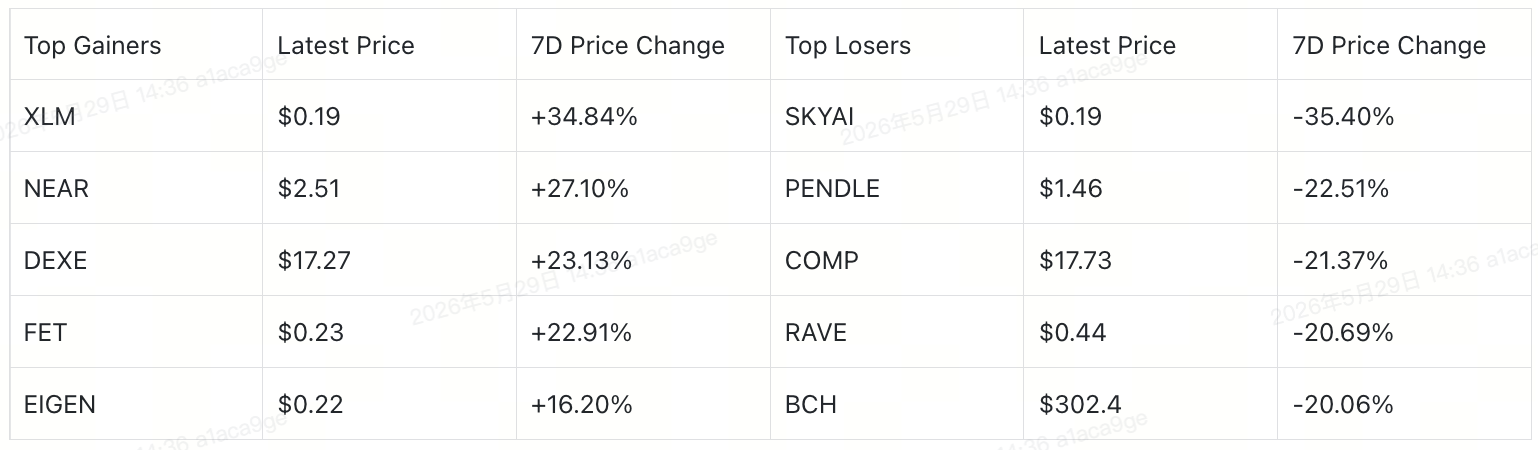
Data Source: Bitunix Note: Price and performance data were collected at 1:00 AM UK time (UTC+0).
3. Hot Token Analysis: Why Did XLM Surge 34% Against the Market Trend This Week?
XLM is the governance token of the Stellar blockchain. The Stellar project was founded by Jed McCaleb with the goal of building an open and global financial network. XLM is primarily used to pay network transaction fees and serves as a bridge asset for exchanging different assets across the network. Unlike Ethereum, which focuses on building a complex decentralized application ecosystem, Stellar has maintained a relatively streamlined functional design for much of its history. Although its original codebase was derived from Ripple, it was later completely rewritten, resulting in a fundamentally different consensus mechanism.
3.1 XLM Technical Analysis Over the Past Week: Strong Momentum Breaks Above $0.20
Stellar is one of the longest-standing projects in the crypto market, with its governance token XLM already listed on multiple cryptocurrency exchanges as early as 2017. At the beginning of this week, XLM showed little upward momentum, with prices trading sideways within a narrow range from May 22 to May 26. On May 27, trading volume began expanding significantly, and after breaking above $0.15, XLM entered a short consolidation phase. On May 28, XLM resumed its upward breakout as the MACD formed a “golden cross” signal, driving the price rapidly from around $0.15 to $0.20. However, XLM has not yet fully stabilized above the $0.20 level, and prices continue to fluctuate around this range.
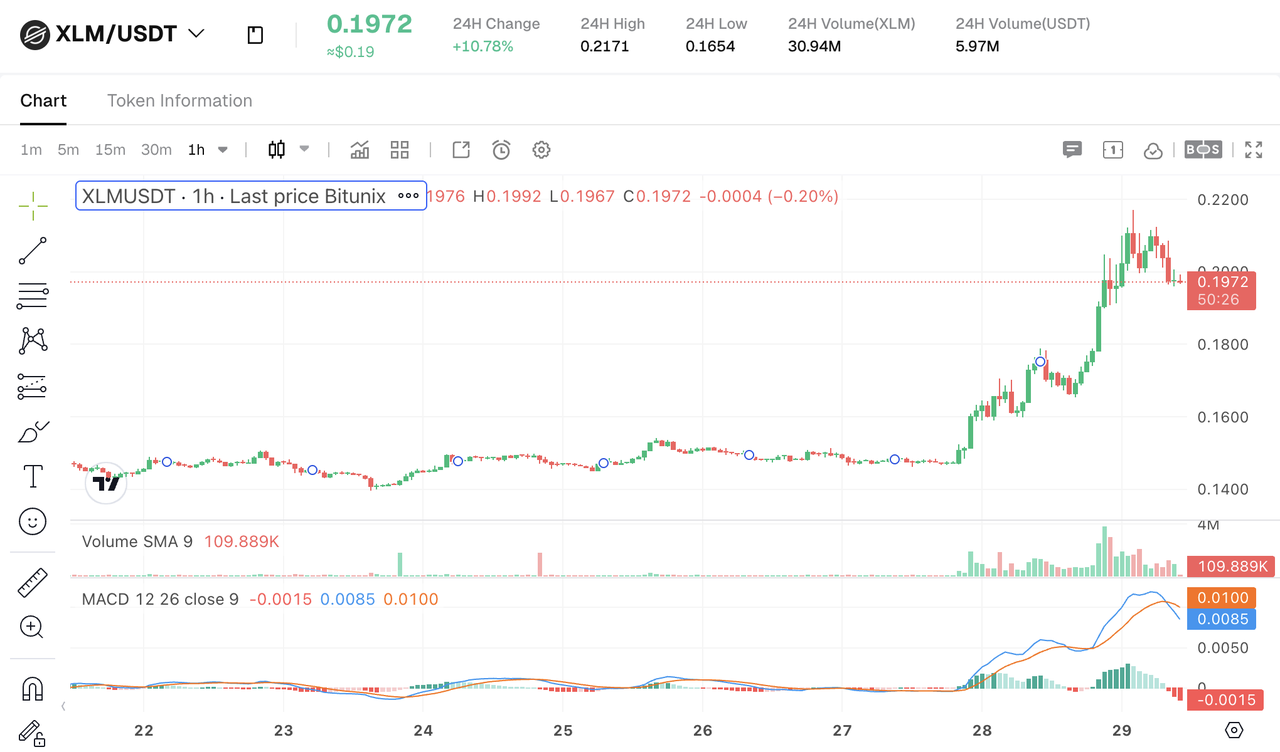
Data Source: Bitunix
3.2 Stellar Fundamental Analysis Over the Past Week: Trading Volume and Gas Fees Recovering
As a legacy blockchain project, Stellar has gradually faded from mainstream attention. Compared with newer blockchains such as Solana, BNB Chain, and Base, Stellar no longer operates on the same scale in terms of trading volume, fees, or stablecoin inflows. However, compared with its own historical performance, Stellar’s operational data has improved since May 2026. Daily transaction volume has stabilized at around 4 million transactions, while daily gas fees fluctuate between $700 and $900, sufficient to maintain the blockchain’s basic operations.
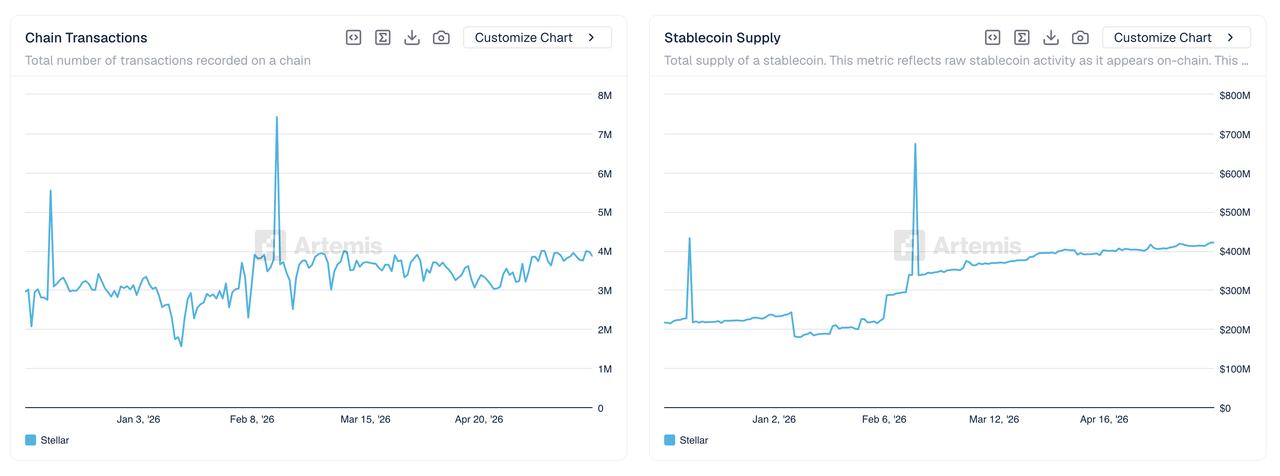
Data Source: Artemis
3.3 Stellar’s Key Partnership: DTCC to Launch DTC Custodied Asset Tokenization Services on Stellar
On May 27, the Depository Trust & Clearing Corporation (DTCC) and the Stellar Development Foundation announced a partnership to launch DTC custodied asset tokenization services on the Stellar network, with related assets expected to go live in the first half of 2027. According to the announcement, DTCC had already received a “no-action letter” from the U.S. SEC in December 2025, allowing it to proceed with real-world asset (RWA) tokenization initiatives. The two parties will focus on bringing Russell 1000 constituent stocks, major index ETFs, U.S. Treasuries, and various high-liquidity bonds onto the blockchain for digital settlement.
This news has been viewed by the market as one of the key catalysts behind XLM’s strong rally. For Stellar, this not only marks its first deep integration into core U.S. financial infrastructure, but also signals that traditional financial institutions are formally incorporating public blockchains into compliant asset settlement systems. If the initiative is successfully implemented, Stellar may evolve from a payment and cross-border transfer-focused blockchain into a major institutional-grade infrastructure for RWA circulation and settlement.
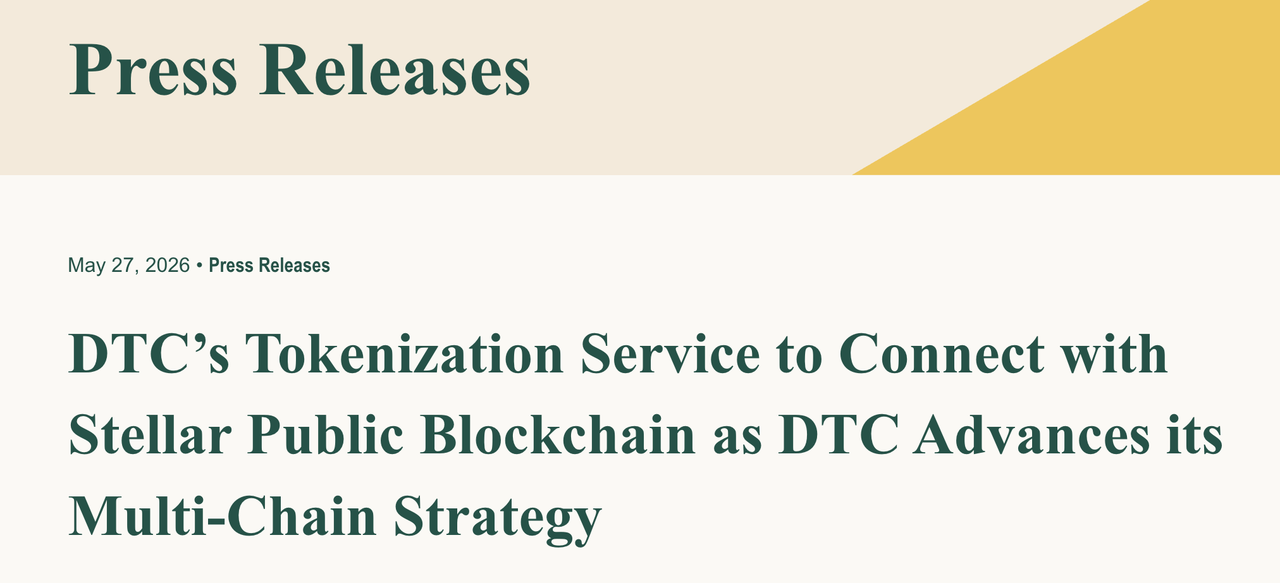
Data Source: DTCC
3.4 On-Chain and Off-Chain Trading Structure Analysis
As the native token of the Stellar blockchain, XLM is not an ERC-20 or SPL-standard smart contract token, but rather a native asset operating directly on the Stellar protocol. Unlike mainstream public chains such as Solana and Ethereum, the Stellar network includes a built-in decentralized exchange system (SDEX), allowing users to trade and exchange XLM and other assets directly through Stellar wallets on-chain. However, due to Stellar’s relatively limited ecosystem activity, on-chain liquidity and trading volume remain significantly lower than those of centralized exchanges. Currently, most XLM trading volume is concentrated on platforms such as Bitunix, OKX, and Binance.
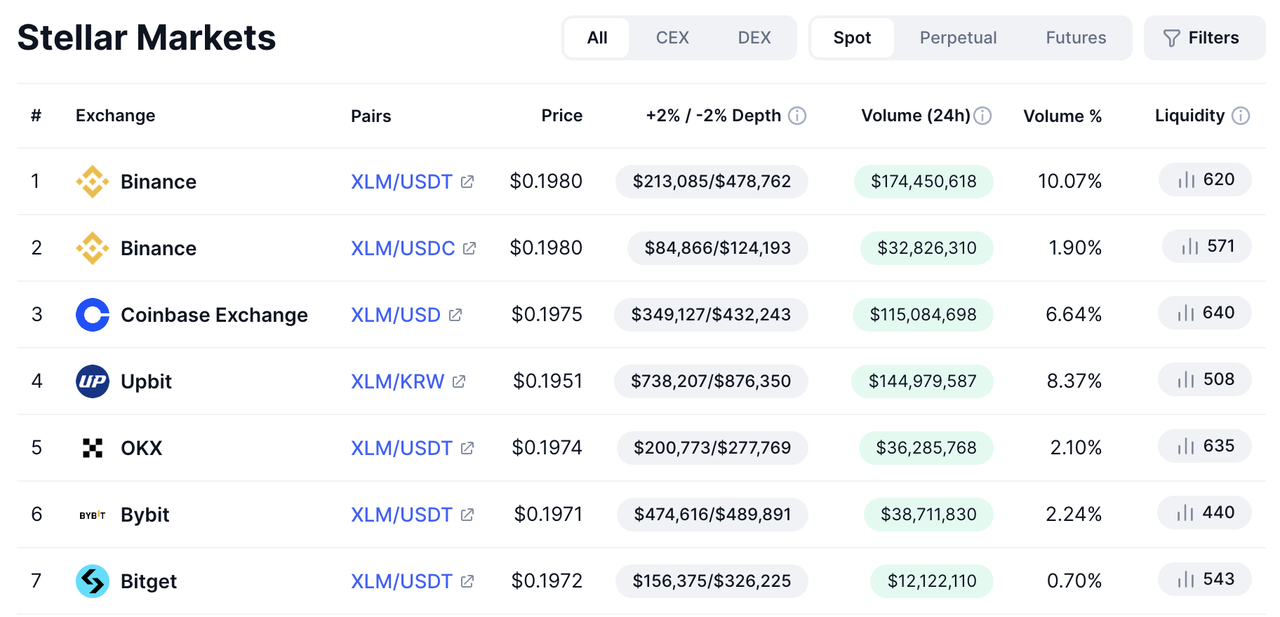
Data Source: Coinmarketcap
3.5 Is XLM Still Worth Buying Now?
From the 1-hour candlestick chart perspective, the MACD indicator formed a “death cross” on the morning of May 29, suggesting that XLM may remain in a short-term consolidation range around the $0.20 level. From a fundamental perspective, the current rally has been primarily driven by the positive news surrounding DTCC’s plan to launch DTC custodied asset tokenization services on Stellar. Looking ahead, investors should closely monitor the progress of Stellar’s cooperation with traditional financial institutions, as this will likely serve as the core catalyst for any new upward price cycle.
3.6 Recent XLM Trend Summary
Stellar (XLM) has recently benefited from the announcement of its partnership with financial giant DTCC to advance RWA tokenization services, driving a significant recovery in on-chain transaction volume and fundamental metrics since May. Fueled by this positive catalyst, XLM recorded a sharp rally this week and successfully broke above the $0.20 level. Although the 1-hour chart has now formed a “death cross,” indicating short-term consolidation, most trading volume remains concentrated on centralized exchanges such as Bitunix. Looking ahead, whether Stellar can successfully transform into an institutional-grade financial infrastructure platform will be the key factor determining whether XLM can enter a new bullish cycle.
4. Weekly Stock Contract Performance: U.S. Equities Show Greater Resilience
Although there is still no clear resolution to the U.S.-Iran conflict and geopolitical risks remain elevated, market risk appetite has started to diverge. Compared with crypto assets, which continue to face pressure amid rising risk-off sentiment, the U.S. stock market has demonstrated stronger resilience and capital absorption capacity. Not only have pullbacks been relatively limited, but rebounds have also occurred at a noticeably faster pace. Bitunix provides trading tools with up to 50x leverage, supporting both long and short strategies, with the goal of helping users improve capital efficiency in low-volatility environments while capturing structural trading opportunities to amplify potential investment returns.
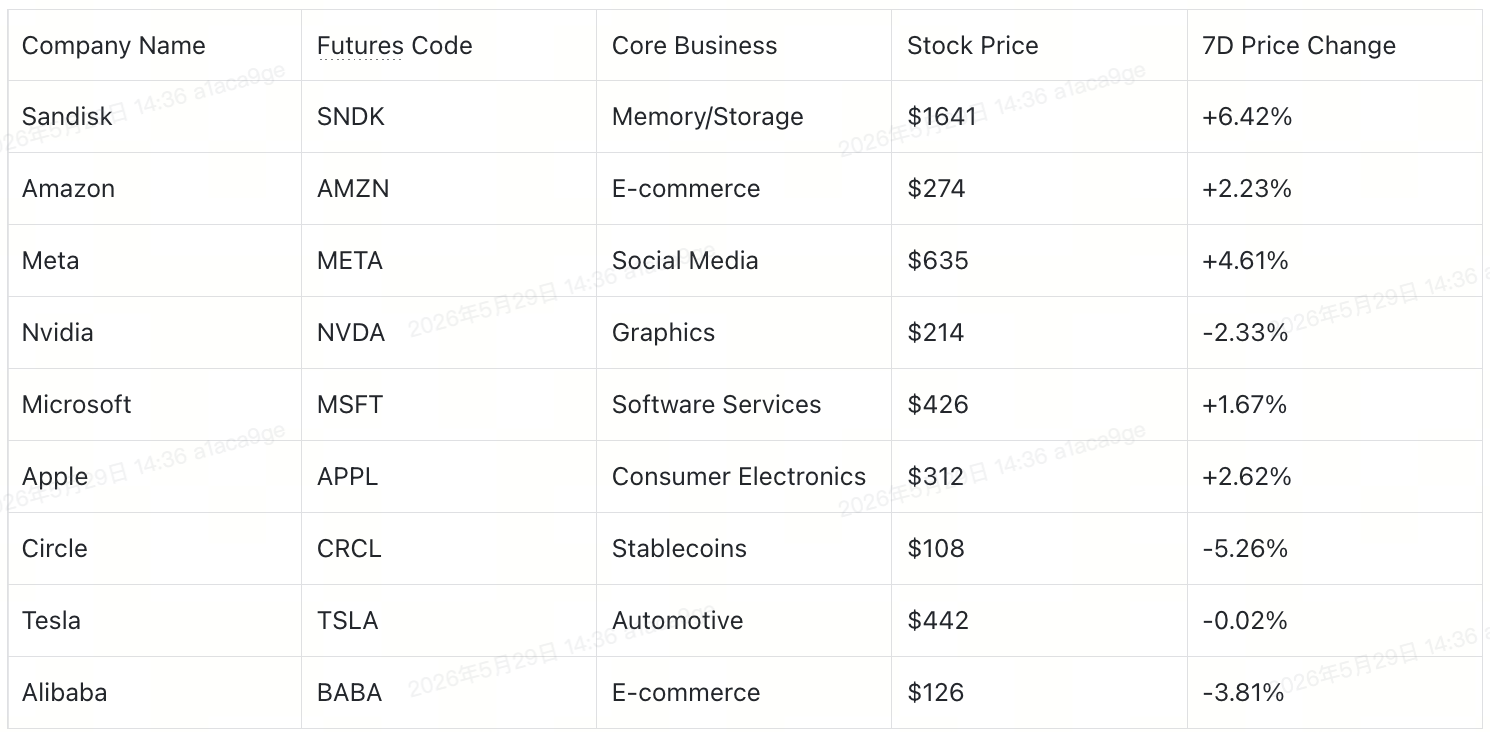
5. Popular Stock Contract Analysis — META
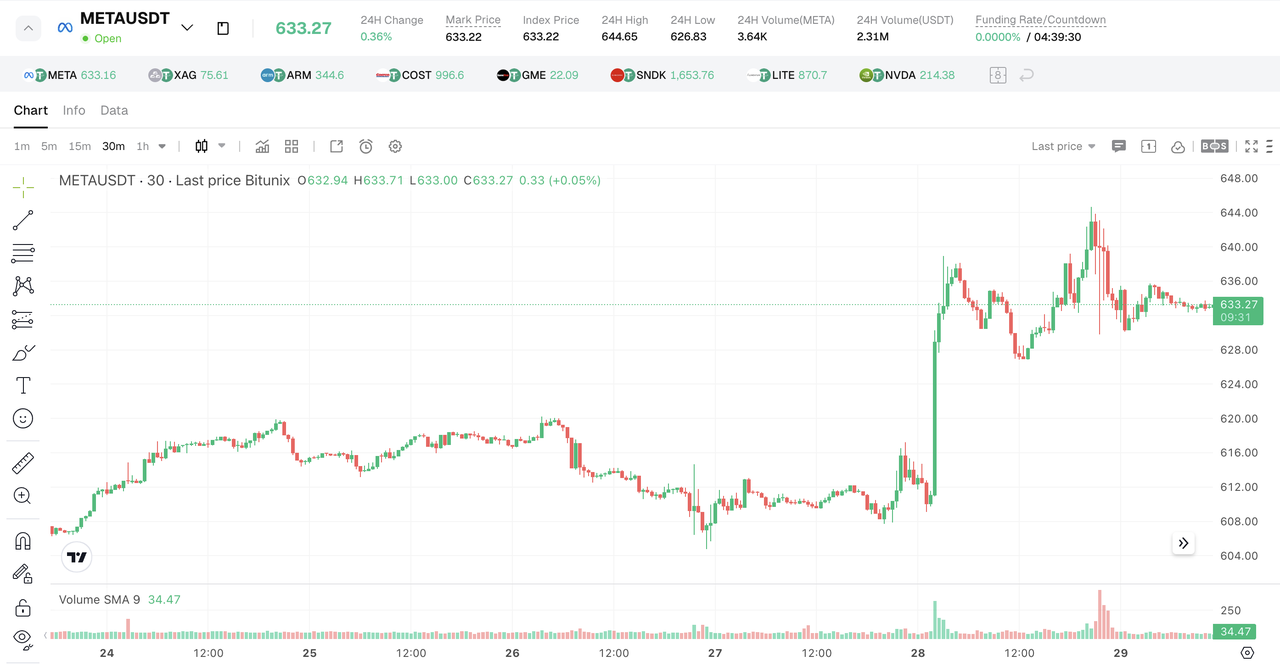
Meta is one of the world’s largest technology companies, operating multiple global social platforms including Facebook, Instagram, WhatsApp, and Threads. Its core businesses span social media, digital advertising, artificial intelligence (AI), and virtual reality. On May 27, Meta announced the full rollout of its paid subscription ecosystem, covering the Meta AI chatbot as well as premium subscription services across Facebook, Instagram, and WhatsApp. This also marked the first time Meta officially launched a paid consumer subscription service for its Meta AI chatbot, signaling that its massive AI investments are gradually entering the commercialization and revenue generation phase.
Driven by this positive development, market confidence in Meta’s AI business model strengthened further. Investors generally remain optimistic about its future subscription revenue and AI monetization capabilities, helping META stock trend higher this week and outperform most technology stocks overall.
6. Commodity Contract Analysis: Natural Gas Prices Surge 7%
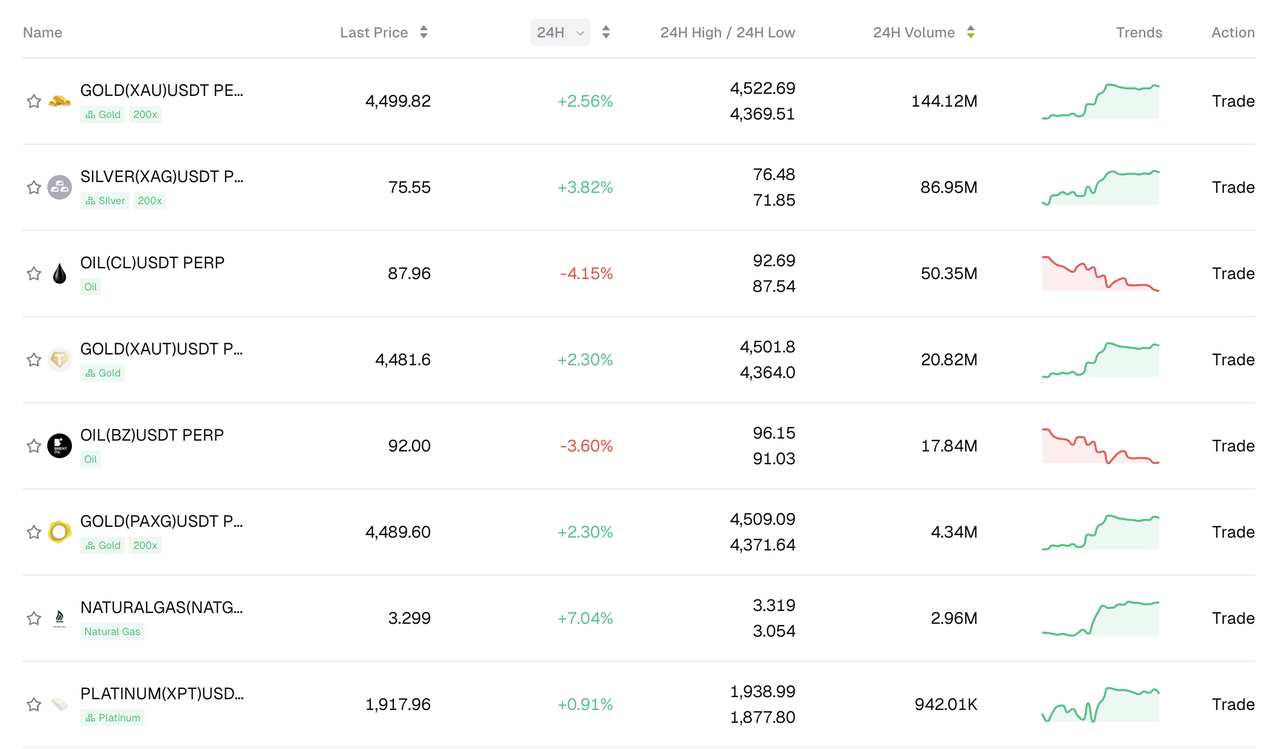
The Bitunix platform now offers a wide range of commodity contracts, including gold, silver, crude oil, and natural gas. Compared with crypto assets, commodity markets are generally more sensitive to international politics, geopolitical conflicts, inflation expectations, and global supply chain disruptions. As a result, commodities often exhibit stronger volatility and trading flexibility during special market conditions.
This week, amid continued U.S.-Iran tensions and rising concerns over Middle East energy supply risks, crude oil prices remained elevated while natural gas prices surged sharply. Markets remained highly focused on transportation risks in the Strait of Hormuz and uncertainty surrounding global energy supply. At the same time, safe-haven assets such as gold and silver also rebounded, as capital rotated back into commodities with inflation-resistant and defensive characteristics.
Conclusion
Based on this week’s market performance, global assets continue to be driven by U.S.-Iran geopolitical tensions, energy supply risks, and broader macro risk-off sentiment. The crypto market overall maintained a weak and volatile trend, but certain assets tied to RWA, AI, and traditional finance partnerships still demonstrated clear structural opportunities. Among them, XLM surged against the trend following news of its DTCC partnership, while META gained momentum due to the commercialization of its AI subscription services. This suggests that market capital is gradually rotating back toward core assets with real-world adoption potential and long-term growth expectations.
Disclaimer
This article is not intended to provide:
(i) investment advice or investment recommendations;
(ii) an offer or solicitation to buy, sell, or hold digital assets; or
(iii) financial, accounting, legal, or tax advice.
Digital assets (including stablecoins and NFTs) involve high risk and may be highly volatile. You should carefully consider whether trading or holding digital assets is suitable for you based on your financial situation. For your specific circumstances, consult your legal, tax, or investment professionals. You are responsible for understanding and complying with all applicable local laws and regulations.
About Bitunix
Bitunix is a global cryptocurrency derivatives exchange trusted by over 3 million users across more than 100 countries. At Bitunix, we are committed to providing a transparent, compliant, and secure trading environment for every user. Our platform features a fast registration process and a user-friendly verification system supported by mandatory KYC to ensure safety and compliance. With global standards of protection through Proof of Reserves (POR) and the Bitunix Care Fund, we prioritize user trust and fund security. The K-Line Ultra chart system delivers a seamless trading experience for both beginners and advanced traders, while leverage of up to 200x and deep liquidity make Bitunix one of the most dynamic platforms in the market.
Bitunix Global Accounts
X | Telegram Announcements | Telegram Global | CoinMarketCap | Instagram | Facebook | LinkedIn | Reddit | Medium