Article Summary
- The funding rate is a core mechanism of perpetual futures, designed to keep the contract price aligned with the underlying asset's spot price.
- It is not a fee paid to the exchange, but a periodic payment exchanged directly between long and short traders.
- Positive Funding Rate: Longs pay shorts. This happens when the futures price is higher than the spot price (contango).
- Negative Funding Rate: Shorts pay longs. This happens when the futures price is lower than the spot price (backwardation).
- Understanding the funding rate is crucial as it can either add to your profits or eat into them over time.
- This guide explains how to interpret the funding rate and use it as a tool for making better trading decisions on platforms like Bitunix.
Funding rates might not sound like the most exciting aspect of crypto trading, but if you are interested in futures trading, it is critical that you understand how they work and how they impact profits.
In simple terms, funding rates are periodic payments exchanged between traders in perpetual futures markets. They exist to keep the futures price closely aligned with the spot price. Depending on market sentiment, traders either pay or receive funding at regular intervals.
For example, anyone trading BTC-USDT perpetual futures on Bitunix is directly exposed to funding rates. Whether you are holding a long or short position, funding payments can either reduce your returns or provide an additional source of income, regardless of price direction.
This guide will provide a detailed explanation of futures funding rates, how they work, and why they play a crucial role in futures trading profitability.
Part 1: What Is the Funding Rate and Why Does It Exist?
Funding rates are at the core of futures trading in crypto. Unfortunately, many newcomers enter the futures market without taking the time to understand what is happening behind the scenes. As a result, they are often surprised when profits are reduced or positions underperform despite correct market direction.
In perpetual futures, the funding rate is a recurring payment exchanged between traders holding long and short positions. Unlike traditional futures contracts, perpetual contracts do not expire, so funding acts as an ongoing adjustment mechanism rather than a settlement event.
Perpetual contracts need this price-balancing mechanism to function properly. For example, if BTC futures trade significantly above the spot price of Bitcoin, funding encourages traders to open short positions, reducing the gap.
By incentivizing traders to counter market imbalances, funding rates help keep futures prices closely aligned with spot prices over time.
Part 2: How the Funding Rate Works – Who Pays Who?
Funding rates go two ways, either positive or negative. It is important to understand the difference between them and how each scenario can affect your futures positions.
Positive funding occurs when the futures price trades above the spot price, which usually reflects bullish market sentiment. In this case, traders holding long positions pay funding fees to traders holding short positions. For example, if Bitcoin perpetual futures are trading higher than the spot price, long traders on Bitunix will periodically pay shorts. This encourages more traders to open short positions, helping bring the futures price back toward the spot price.
Bitunix offers dozens of futures contracts, including Bitcoin and a wide range of altcoins, all of which are subject to funding.
Negative funding works in the opposite way. When futures trade below the spot price, short traders pay funding fees to long traders. Using the same Bitcoin example, shorts would cover the funding cost, incentivizing long positions and pushing futures prices back up toward spot levels.
So, essentially, funding rates create a balance between futures and spot prices. They can be an opportunity to earn returns or result in losses. The important thing is to understand them before opening a position.
Part 3: How the Funding Rate Impacts Your Profits
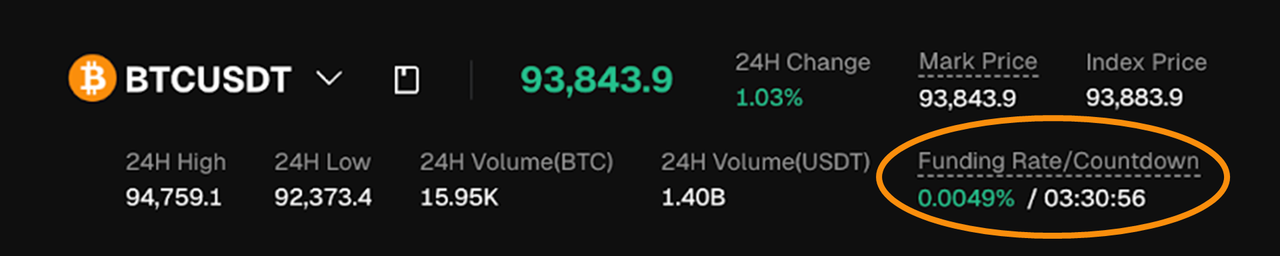
Holding a futures position means constant exposure to the funding rate. The pendulum swings both ways. Funding can result in additional profits, but it can also quietly eat into returns. On Bitunix, funding rate history is visible directly within the trading interface and is updated every eight hours. It is clearly displayed at the top of the page, alongside a countdown timer showing when the next funding payment will occur.
When holding a long position during periods of high positive funding, profits can be reduced even if the market moves in your favor. Rising prices may be partially offset by repeated funding payments made to short traders.
Conversely, holding a short position in a high positive funding environment can generate a steady income stream. In this case, traders are effectively paid to maintain their position, adding funding payments on top of trading PnL.
Over time, funding rates can have a material impact on performance. For example, a position held for several days during elevated funding can accumulate high costs or gains, making funding awareness essential.
Bitunix makes this process transparent by displaying funding rates and payment timing clearly, allowing traders to factor funding directly into their strategy.
Part 4: Advanced Strategy – The “Funding Rate Arbitrage”
Funding rate arbitrage is an advanced crypto futures trading strategy. It is not suitable for beginners, but for traders with extensive experience in futures markets, it can be a highly profitable approach. While the risks are significant, the potential returns can be a strong incentive for experienced participants.
The core concept is a delta-neutral setup. A trader opens a short position on a perpetual futures contract while simultaneously buying the same amount of the asset on the spot market. For example, a trader might short BTC-USDT perpetual futures while holding an equivalent amount of Bitcoin in spot.
The goal is to earn funding payments while minimizing exposure to price movement. If funding is positive, the trader collects funding from the short position regardless of the BTC price direction.
This strategy carries risks, including execution delays, liquidity constraints, funding rate changes, and platform-specific factors. Careful monitoring and risk management are essential.
How to Trade Futures on Bitunix
To start trading futures on the Bitunix crypto exchange, follow these steps:
- Sign up on Bitunix via the website or download the app on your smartphone.
- Create an account using your email or mobile number and log in.
- Deposit crypto or buy USDT using fiat (kyc required for fiat only).
- Navigate to the futures market and select the trading pair you want.
- Enter your order details and confirm, then explore trading tools and the earn features.
Final Thoughts
Understanding how funding rates work in crypto futures is essential to becoming a profitable futures trader. Funding rates can swing both ways. At times, they will benefit your position, while in other cases, they can result in losses. The most important factor is knowing how to monitor them and how to take advantage of their shifts.
FAQs
How often is the funding rate paid?
On most exchanges, funding is paid every eight hours.
Is the funding rate the same on all exchanges?
No. Funding rates differ between exchanges because each platform has its own trader positioning, liquidity conditions, and pricing mechanisms used to keep futures aligned with spot markets.
Can the funding rate make me lose more than my margin?
Funding payments alone will not exceed your margin, but when combined with leverage, price movement, and liquidation mechanics, they can contribute to losing your entire position.
What is a good or bad funding rate?
A low or near-zero funding rate is generally healthy. Extremely high positive or negative funding often signals overcrowded positions and increased risk of sharp reversals.
How is the funding rate calculated?
The funding rate is calculated using the difference between the perpetual futures price and the spot price, combined with an interest rate component, and is adjusted periodically to correct market imbalances.
What does it mean when the funding rate is negative?
A negative funding rate means futures are trading below spot prices, and short traders must pay funding fees to long traders, encouraging buying pressure and upward price alignment.
Can I avoid paying the funding rate?
Yes. You can avoid funding by closing positions before the funding timestamp, trading spot instead of futures, or positioning yourself on the side that receives funding.
How can I see the history of the funding rate?
On platforms like Bitunix, the funding rate history is shown directly on the futures trading interface, including past rates, current funding, and a countdown timer to the next payment.
Does the funding rate apply to spot trading?
No. Funding rates only apply to perpetual futures contracts, not spot trades.
What is the difference between the funding rate and a trading fee?
A trading fee is paid to the exchange when you enter or exit a trade, while the funding rate is exchanged directly between traders to balance futures pricing.
Glossary
Funding Rate: Periodic payment exchanged between futures traders.
Perpetual Futures: Futures contracts with no expiration date.
Positive Funding: Long traders pay short traders.
Negative Funding: Short traders pay long traders.
Delta-Neutral: Strategy with minimal price exposure.
Liquidation: Forced position closure due to losses.
About Bitunix
Bitunix is a global cryptocurrency derivatives exchange trusted by over 3 million users across more than 100 countries. At Bitunix, we are committed to providing a transparent, compliant, and secure trading environment for every user. Our platform features a fast registration process and a user-friendly verification system supported by mandatory KYC to ensure safety and compliance. With global standards of protection through Proof of Reserves (POR) and the Bitunix Care Fund, we prioritize user trust and fund security. The K-Line Ultra chart system delivers a seamless trading experience for both beginners and advanced traders. At the same time, leverage of up to 200x and deep liquidity make Bitunix one of the most dynamic platforms in the market.
Bitunix Global Accounts
X |Telegram Announcements |Telegram Global |CoinMarketCap |Instagram |Facebook |LinkedIn |Reddit |Medium