

Article Summary
- This article provides a long-term price prediction for the Internet Computer (ICP) for 2026 and 2030.
- It explains ICP's ambitious vision to be a "World Computer"—a decentralized cloud platform that can host websites, dApps, and enterprise systems entirely on-chain.
- The bull case focuses on its superior technology (Chain Key Cryptography, canister smart contracts), the growing developer ecosystem, and its potential to disrupt the traditional cloud computing market dominated by Amazon Web Services and Google Cloud.
- The bear case centers on its controversial tokenomics and initial launch, intense competition from other Layer 1 blockchains, and concerns about the centralization of its node infrastructure.
- It presents three detailed price prediction scenarios (bearish, neutral, bullish) for both 2026 and 2030, based on different levels of adoption and market share capture.
Internet Computer came to market with a huge promise. It wanted to turn the public internet itself into a decentralized compute layer where apps, data, and services run on-chain. If you follow ICP on a crypto exchange, including Bitunix, you are tracking a bet on a different model for the internet.
That idea still makes ICP one of the strangest assets in crypto. Official ICP documentation describes it as a network built to host serverless software on a public network. At the same time, canister smart contracts bundle code and state so applications can run as self-contained software units. In other words, ICP tries to be a blockchain, cloud platform, and app host in one stack.
This guide looks past the old hype cycle and focuses on what actually drives value now. That means technology, tokenomics, adoption, and competition. Any serious Internet Computer price prediction has to start there, because by 2030, the token price will mostly reflect whether developers and users treat ICP as useful infrastructure or as an interesting science project.
The Bull Case: Why ICP Could Succeed
Bullish forecasts for ICP vary a lot, including bullish and bearish scenarios. First, we are going to focus on the best outcomes for this token. A late-2025 MEXC research note floated a 2026 range of $11.15 to $31.89 and a possible 2030 target near $88.88, while Coinfomania's 2026-2030 model projected roughly $6.17 to $15.17 for 2026 and as high as $79.12 in 2030. A January 2026 Binance Square analysis set $25 by 2030 as a plausible critical-path outcome. None of these numbers is a guarantee, but they show that serious upside still sits on the table if adoption improves.
1. Superior Technology
The best bull argument starts with the improvement of ICP's tech. Its chain-key cryptography lets the network verify content with a single public key, add or recover nodes, and sign transactions on other chains. Official performance material also points to median update latency around 1.75 seconds and notes that the network operated with 42 subnets and 636 nodes assigned to subnets in 2025.
Canisters are another big differentiator on ICP, they bundle code and state together and can communicate asynchronously with other ones. That sounds technical because it is technical, but the practical result is that developers can build applications that feel more like full software systems than tiny scripts attached to a ledger. For long-term investors, that is the real engine behind an ICP price prediction 2030 thesis. Better software infrastructure creates a better chance of sticky demand.
2. The World Computer Narrative
The competition present on the market ICP wants to attack is significant, with Gartner forecasting global public cloud end-user spending at $723.4 billion in 2025, and IDC saying public cloud spending should pass $1 trillion in 2026. At the same time, Synergy Research estimated Q3 2025 cloud infrastructure spending at $106.9 billion, with AWS, Microsoft, and Google taking 63% of that market together.
DFINITY's 2026 Mission 70 paper tries to connect that narrative to token value more directly. It argues that more on-chain cloud usage would mean more ICP burned through cycles, and it explicitly ties future demand to cloud engines and self-writing app tooling such as Caffeine. If that model works, ICP stops being just a governance token and starts behaving more like a usage-linked infrastructure asset.
3. Growing Ecosystem
OpenChat, a new addition to the ICP's ecosystem, is officially presented by Internet Computer as a fully on-chain social and messaging service governed by an SNS DAO. Caffeine shows another lane, with AI-assisted app creation on ICP. And Dragginz exists as an SNS-governed, 100% on-chain game, giving ICP a live example in gaming.
There is also measurable on-chain activity: DefiLlama currently shows ICP chain metrics around $1.88 million in 7-day DEX volume, roughly $4,664 in 24-hour chain fees, and a market cap near $1.25 billion. On the app side, WaterNeuron alone shows about $5.63 million in TVL and more than $46,000 in 30-day fees, while ICPSwap and Kinic governance proposals from late 2025 and early 2026 show active product and treasury management. It is still a niche ecosystem, but it is moving.
4. Reverse Gas Model
ICP's reverse gas model is one of its most user-friendly ideas. Instead of asking end users to pay for gas for every action, developers load canisters with cycles and cover compute costs themselves. ICP's Internal Docs say this gives users a Web2-like experience, since they do not need tokens, wallet setup, or constant approval prompts just to use an app.
That same design also helps ICP stand apart from Ethereum-style user friction. Chain Fusion docs argue that ICP frontends can make multichain apps feel closer to normal web apps while still keeping blockchain functions under the hood. For users, that is cleaner. For developers, it creates another reason to experiment with ICP crypto when consumer usability actually matters.
The Bear Case: Why ICP Could Fail
The bearish side is not hard to find. Forecasts that sound optimistic also reveal a lot of caution. Coinfomania's 2026 model still centers on an average price just above $10. Cryptorank's March 2026 analysis described a conservative case of roughly $8 to $18 through 2026-2027, while the Binance Square critical-path piece treated $25 by 2030 as something ICP must earn through execution.
1. Controversial Tokenomics and Launch
ICP still carries scars from launch, with CoinGecko listing its all-time high at $700.65, and current pricing sits around $2.26, which leaves the token roughly 99.7% below peak. That kind of collapse wrecks trust, fuels cynicism, and makes every new promise sound like another sales deck.
The tokenomics issue is not fully solved either. DFINITY's own 2026 Mission 70 paper says gross ICP minting was about 9.72% in January 2026 and estimates a drop to 5.42% by January 2027 after proposed supply-side changes. The same paper openly argues that a further demand impact is needed to achieve a 70% reduction in inflation.
2. Intense Competition
ICP is competing on two fronts at once, in crypto, it fights for developers against Ethereum, Solana, and every other chain that promises speed, better UX, and lower costs. Outside of crypto, it faces hyperscalers that already dominate cloud spending, including AWS, Microsoft, and Google, which controlled 63% of enterprise cloud infrastructure spending in Q3 2025.
And the cloud market is still getting bigger, which helps incumbents too. Gartner sees $723.4 billion in public cloud spending in 2025, while IDC sees more than $1 trillion in 2026. So the opportunity is huge, but so is the moat around today's leaders.
3. Centralization Concerns
ICP's Internal Docs say node machines are high-end bare-metal servers run by independent node providers in professional data centers, and security assumptions rely on a supermajority of subnet nodes being honest. That is a valid design, but it is also very far from the anyone-can-run-a-validator ethos that many investors associate with crypto decentralization.
The network structure reflects that trade-off. ICP's Internal Docs points to 42 subnets and 636 nodes assigned to subnets, with the dashboard also referencing 721 of 1,600 node machines. That looks more distributed than a single company cloud, but more permitted than truly open participation. If you care a lot about censorship resistance in the purest sense, this remains a weak spot.
4. Complexity
ICP is powerful, but it is not simple. Developers need to understand canisters, cycles, neurons, the NNS, chain-key cryptography, and often Motoko or ICP-specific tooling. ICP's Internal Docs do support Rust, TypeScript, C++, and more, which helps. Still, the mental model is very different from just shipping Solidity to an EVM chain and calling it a day.
That learning curve has an investment consequence. A project can have elegant architecture and still lose if builders choose simpler rails. So when people ask is ICP a good investment, the right answer is not yes or no. The right answer is that adoption has to beat complexity fast enough to matter.
ICP Price Prediction Scenarios (2026 & 2030)
The scenarios below are stricter than the most bullish forecast outlets and more generous than the most pessimistic takes. They assume ICP's price by 2030 will follow one basic rule. Usage has to rise enough to justify the World Computer story.
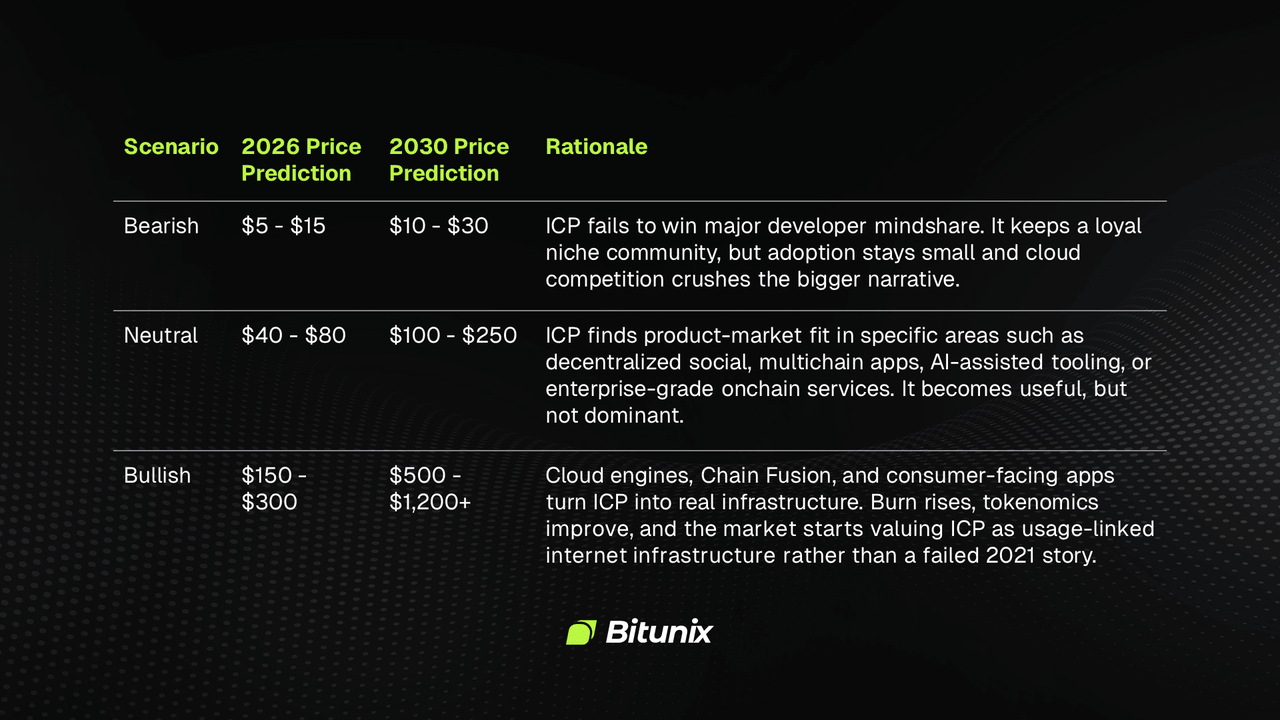
ICP’s long-term outlook depends on adoption, developer traction, and whether its cloud-based blockchain model becomes useful at scale.
Conclusion: A High-Risk, High-Reward Bet on the Future of the Internet
Internet Computer remains a moonshot. The bull case rests on genuine technical differentiation, better user experience, multichain execution, and a credible attempt to tie token value to real network usage. The bear case rests on harsh reality: ugly launch history, tough tokenomics, real centralization concerns, and brutal competition from both Web3 and Web2 giants.
So where does that leave investors? ICP is one of the clearest high-risk, high-reward infrastructure bets in crypto. If the network becomes useful at scale, today's price could look tiny. If it stays niche, the upside story weakens fast. And if you want exposure, keep your sizing controlled, and watch developer traction closely. You can track ICP on Bitunix, and if you want to take a position, download the Bitunix app and register.
FAQ
Who is behind the Internet Computer?
The DFINITY Foundation, the main research and development organization behind the protocol, created the Internet Computer. It built the network, maintains major technical documentation, and has played a central role in upgrades, grants, roadmap work, and recent tokenomics proposals.
What is the purpose of the ICP token?
ICP has two main jobs. It powers governance through staking in neurons and voting in the NNS, and it can be converted into cycles that pay for computation, storage, and bandwidth on the network. That makes it both a governance asset and a utility asset.
What are cycles on the Internet Computer?
Cycles are the resource unit used to pay for compute, storage, and network bandwidth on ICP. Developers load canisters with cycles, and those canisters spend them as they run. Users usually do not see this directly, which is part of ICP's Web2-style design.
What is the Network Nervous System (NNS)?
The NNS is ICP's on-chain governance system. It controls protocol upgrades, subnet creation, economic settings, and other core network decisions. Token holders participate by staking ICP in neurons and voting directly or by following other neurons in a liquid-democracy style system.
How is ICP different from Ethereum?
ICP aims to host full web applications on-chain, including frontend content, whereas Ethereum primarily focuses on smart contract execution and external app layers. ICP also uses canisters, cycles, and a reverse gas model, so developers pay resource costs and users get a smoother app experience.
Was the ICP launch a scam?
There is no court ruling that proved the launch was a scam. But the launch was deeply controversial, the token collapsed hard, and lawsuits followed. In 2025, a California federal judge dismissed a class action against Dfinity as time-barred, ending the case without validating the worst accusations.
Can you stake ICP?
Yes. You can stake ICP by locking it into a neuron in the NNS. Your voting power and rewards depend on factors such as stake size, neuron age, and dissolve delay. The current docs say the minimum stake to create a neuron is 1 ICP.
What is a canister smart contract?
A canister is ICP's version of a smart contract, but it behaves more like a self-contained software unit. It bundles code and state, can serve web content, and can communicate asynchronously with other canisters, which makes it suitable for full applications.
Is the Internet Computer truly decentralized?
It is decentralized, but not in the most open-ended sense that some crypto users prefer. The network uses independent node providers and distributed data centers, yet node participation is permissioned and hardware-heavy. So the honest answer is yes, but with a more managed model than Ethereum-style open validation.
What are some of the top projects building on ICP?
Some of the clearest names are OpenChat in decentralized messaging, Caffeine in AI-assisted app creation, Dragginz in on-chain gaming, ICPSwap in DeFi infrastructure, and Kinic in AI search and memory tooling. Together, they show ICP's spread across social, finance, gaming, and developer tools.
Glossary
- Internet Computer Protocol (ICP): A blockchain-based compute network designed to host apps, services, and data fully on-chain.
- Chain-key cryptography: ICP's cryptographic system that gives the network one public key and enables threshold signing.
- Canister: ICP's smart contract model that bundles executable code and persistent state in one unit.
- Cycles: The resource unit used to pay for processing, storage, and bandwidth on ICP.
- Reverse gas model: A design where developers fund app computation, so end users avoid direct gas payments.
- Network Nervous System (NNS): ICP's on-chain governance system that manages upgrades, economics, and core protocol decisions.
- Neuron: A staking and governance unit created by locking ICP inside the NNS.
- Dissolve delay: The lock period attached to a neuron before staked ICP can be unlocked.
- Chain Fusion: ICP's framework for interacting with other blockchains without a traditional bridge.
- Threshold signatures: Cryptographic signatures produced collectively by multiple nodes without exposing one private key.
- Subnet: A coordinated group of ICP nodes that runs consensus and hosts a subset of canisters.
- Node provider: An approved operator that runs ICP hardware in professional data centers.
- SNS DAO: A Service Nervous System DAO used to decentralize governance of an application on ICP.
- ckBTC: A chain-key token on ICP that represents native Bitcoin with protocol-level integration.
- HTTPs outcalls: A feature that lets canisters call external web services in a replicated way.
Disclaimer
This article does not provide:
(i) investment advice or investment recommendations;
(ii) an offer or solicitation to buy, sell, or hold digital assets;
(iii) financial, accounting, legal, or tax advice.
Digital assets, including stablecoins and NFTs, involve high risk and may fluctuate significantly. Consider whether trading or holding digital assets is appropriate for you given your financial situation. Consult a qualified legal, tax, or investment professional when needed. You are responsible for understanding and complying with applicable local laws and regulations.
About Bitunix
Bitunix is a global cryptocurrency derivatives exchange trusted by over 4 million users across more than 100 countries. At Bitunix, we are committed to providing a transparent, compliant, and secure trading environment for every user. Our platform features a fast registration process and a user-friendly verification system supported by mandatory KYC to ensure safety and compliance. With global standards of protection through Proof of Reserves (POR) and the Bitunix Care Fund, we prioritize user trust and fund security. The K-Line Ultra chart system delivers a seamless trading experience for both beginners and advanced traders. At the same time, leverage of up to 200x and deep liquidity make Bitunix one of the most dynamic platforms in the market.
Bitunix Global Accounts
X | Telegram Announcements | Telegram Global | CoinMarketCap | Instagram | Facebook | LinkedIn | Reddit | Medium