1. Introduction to Hedera (HBAR)
In 2018, computer scientist Dr. Leemon Baird and entrepreneur Mance Harmon jointly released the Hedera Hashgraph whitepaper and officially launched the network in the same year. Unlike traditional blockchains based on chain-like structures, Dr. Leemon Baird invented a distributed ledger technology called “Hashgraph.” As an authority in computer science, Dr. Baird realized that for decentralized technology to truly support global business operations, the system must have extremely high throughput, second-level transaction finality, and the highest level of security, asynchronous Byzantine Fault Tolerance, or aBFT.
Hedera was not created to replace Bitcoin, but to build a “trust layer of the internet.” It abandoned the high-energy-consumption model of traditional mining and instead adopted a stake-weighted Hashgraph consensus mechanism. This innovation enables Hedera to process more than 10,000 transactions per second, or TPS, without sacrificing security. Hedera’s vision is very clear: to provide global enterprises, governments, and developers with infrastructure that delivers stable performance, predictable costs, and potential for legal compliance, pushing blockchain technology from the “laboratory stage” fully toward “large-scale commercial adoption.”
2. How Hashgraph Consensus Breaks Through Blockchain Performance Bottlenecks
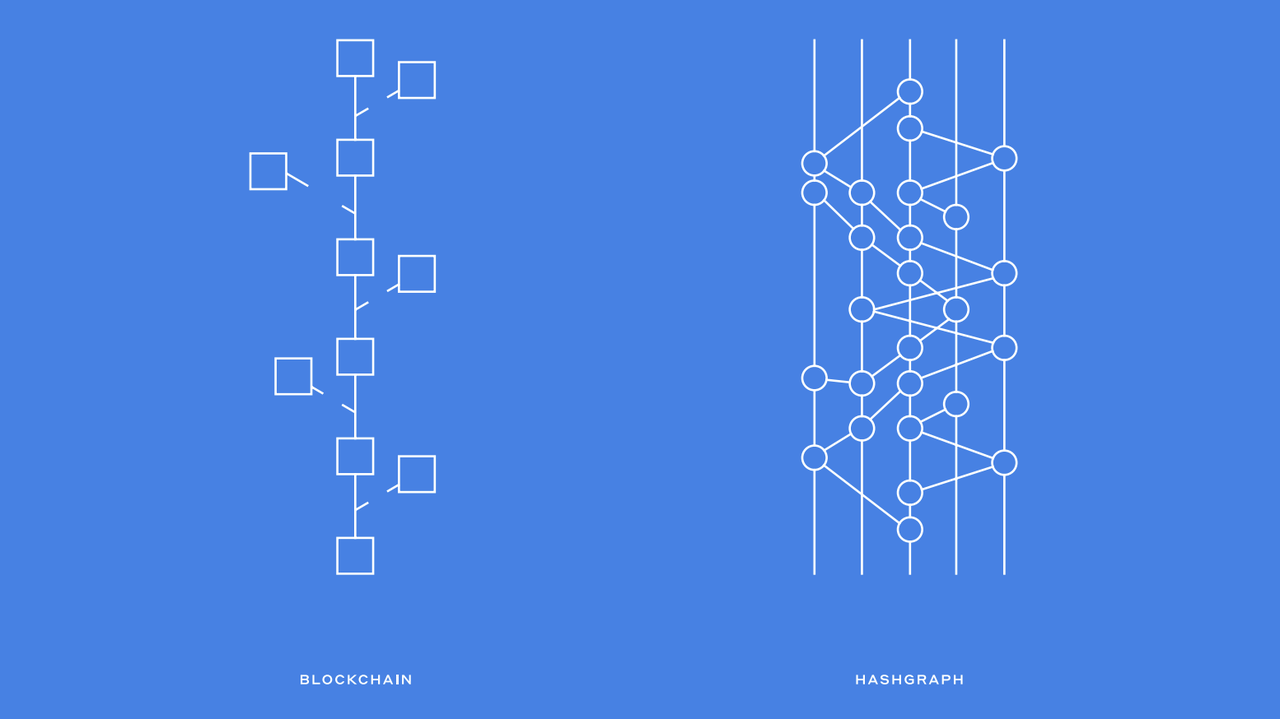
In the competitive landscape of mainstream public chains, Ethereum is known for its high degree of decentralization and security. However, due to its blockchain structure and gas mechanism, its throughput and costs have long faced bottlenecks. Solana improves performance through high-frequency block production and parallel processing, but it has higher hardware requirements and has previously raised market concerns regarding network stability. By comparison, Hedera adopts the Hashgraph consensus algorithm, breaking away from the linear design of traditional blockchains at the underlying data structure level and providing a completely new path for performance scaling.
When multiple blocks are produced at the same time in traditional blockchains, the network must use a fork choice mechanism to “keep one and discard the others.” This “pruning” process not only wastes resources, but also limits network efficiency. Hashgraph, through “gossip about gossip” and virtual voting mechanisms, allows all transaction information to be fully retained and woven into the same ledger without discarding branches, thereby significantly improving consensus efficiency and data propagation speed.
More importantly, Hashgraph achieves asynchronous Byzantine Fault Tolerance, or aBFT, at the mathematical level and has the feature of “fair ordering,” ensuring that transaction order is not manipulated by a small number of nodes. Without relying on mining or intentional speed limits, its architecture can still maintain low latency, high throughput, and attack resistance, while also providing ACID data consistency. Overall, Hedera is not simply optimizing blockchain. It is reconstructing distributed consensus logic, providing a more stable and efficient technical foundation for enterprise-grade applications and large-scale RWA adoption.
3. A Global Settlement Center for Real-World Asset Tokenization
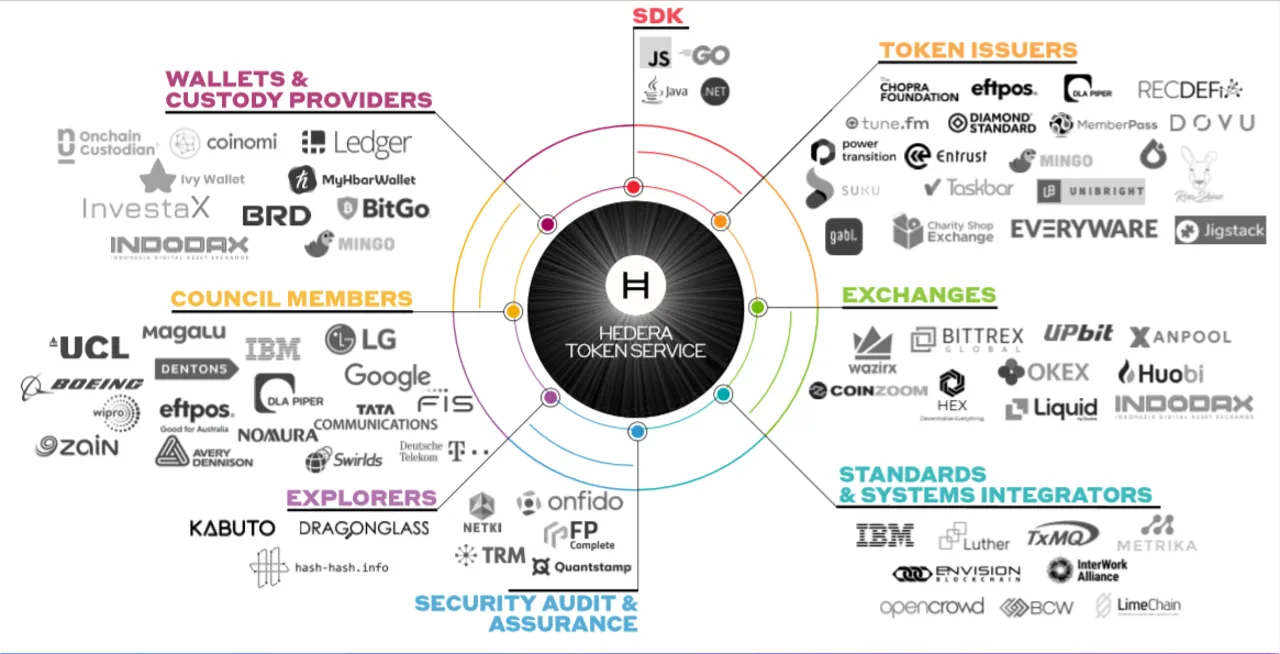
Unlike most public chains that pursue retail-driven decentralization, the Hedera ecosystem has chosen an elite route driven by top-tier institutions and has established a strong position in the RWA sector. Its core competitiveness comes from its unique Governing Council structure. Members include global corporate giants such as Google, IBM, Boeing, Deutsche Telekom, and LG Electronics. The council adopts a distributed and equal-vote collective decision-making mechanism, allowing the network to maintain decentralization while achieving governance stability close to that of the traditional financial system. In 2022, Hedera open-sourced its core code under the Apache 2.0 license, further improving transparency and compliance, and providing a key trust foundation for traditional capital to enter.
Under this architecture, Hedera provides an extremely deterministic operating environment for RWA businesses. Enterprises do not need to worry about confusion in asset ownership caused by on-chain forks. At the same time, its “fixed fee” mechanism, with transfers costing around USD 0.0001, ensures that costs can be accurately predicted during large-scale asset tokenization. Combined with deep ties to global listed companies and regulation-oriented institutions, Hedera is gradually building a digital credit system jointly maintained by institutions. It continues to achieve implementation in scenarios such as money market fund tokenization and digital identity, becoming a “highway” for the global circulation of RWA assets.
4. Uses of HBAR: The Economic Core Supporting Global RWA Settlement
As the native asset of the Hedera network, HBAR is the economic lifeblood that maintains the operation of the entire RWA ecosystem. Its functions are deeply integrated into the network’s daily operations and long-term security:
- Network Fuel and RWA Transaction Payments: When users call the Hedera Token Service, or HTS, to issue or transfer RWA assets, they must pay HBAR as transaction fees. Since fees are pegged to U.S. dollar values, this provides institutions handling high-value assets with stable financial expectations.
- Node Staking and Security Consensus: HBAR holders can stake their tokens to Governing Council nodes. This not only strengthens the security of the Hashgraph algorithm and prevents malicious attacks, but also allows stakers to share in the revenue generated by the network’s processing of RWA transactions. This mechanism makes HBAR a productive asset whose value rises as the scale of RWA transactions within the ecosystem expands.
5. How to Obtain HBAR
To participate deeply in Hedera’s RWA ecosystem, the core method of obtaining HBAR is through staking, which contributes to network security in exchange for rewards. Users can deposit their HBAR into supported decentralized wallets and delegate it to top-tier nodes. While helping maintain network consensus, they can achieve steady asset growth. For investors who are optimistic about the long-term development of the RWA sector, this is the most central and long-term-yield-oriented way to participate in the construction of the Hedera ecosystem.
For users who prioritize efficiency and convenience, purchasing through regulated cryptocurrency exchanges is a more direct method. Taking global cryptocurrency exchanges such as Bitunix as an example, the platform provides an extremely smooth trading experience and highly liquid HBAR trading pairs, allowing users to easily complete asset allocation using stablecoins such as USDT. Under Bitunix’s strict defense mechanisms, such as cold wallet storage and around-the-clock monitoring, users can safely and compliantly hold HBAR, ensuring that their assets remain highly protected while they explore the RWA and enterprise-grade DeFi ecosystem and accurately capture the next wave of growth opportunities from institutional adoption.
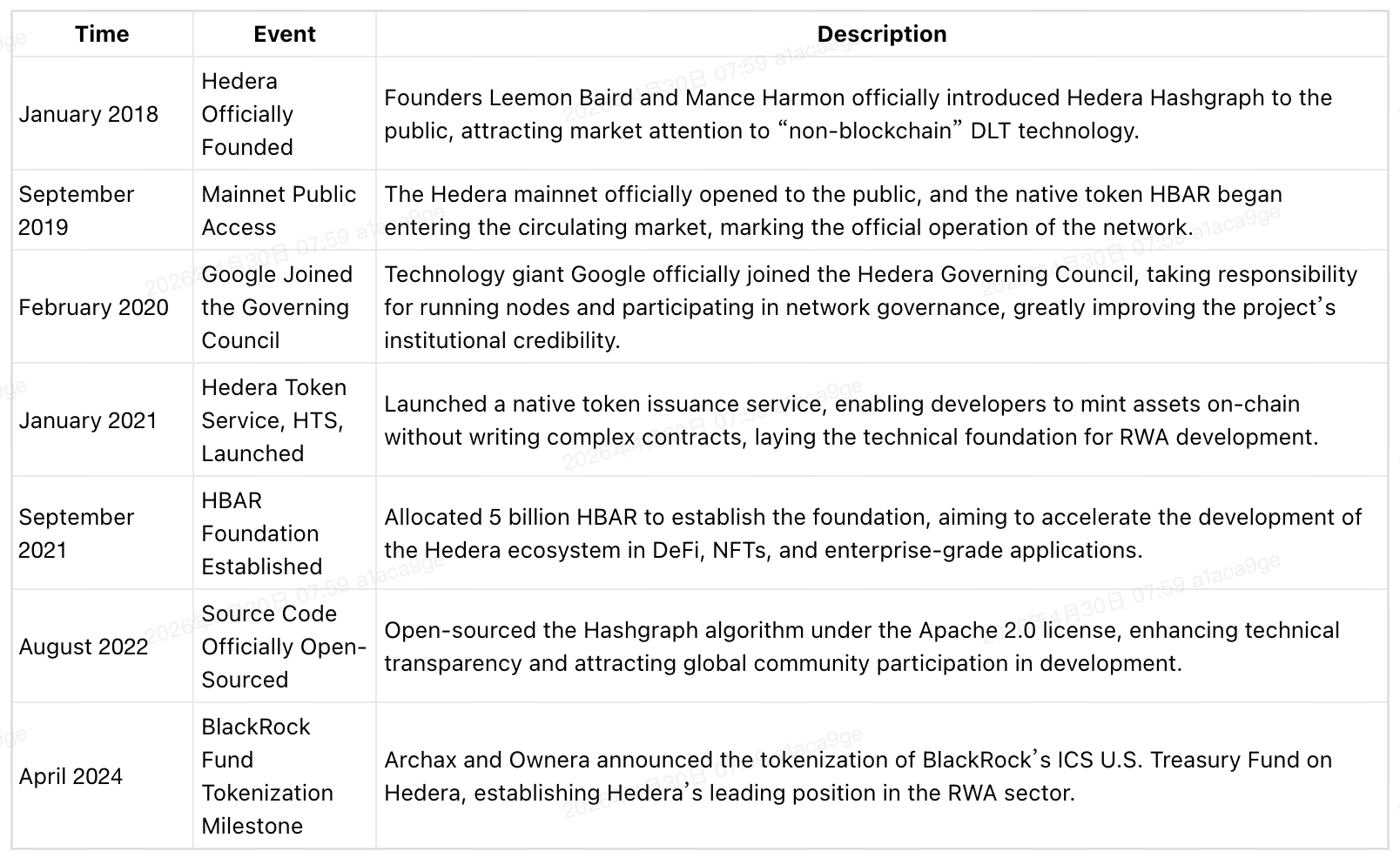
6. Hedera Major Events Timeline
Disclaimer
This article is not intended to provide:
(i) investment advice or investment recommendations;
(ii) an offer or solicitation to buy, sell, or hold digital assets;
(iii) financial, accounting, legal, or tax advice.
Digital assets held, including stablecoins and NFTs, involve a high level of risk and may fluctuate significantly in value. You should carefully consider whether trading or holding digital assets is suitable for you based on your financial situation. For your specific circumstances, please consult your legal, tax, investment, or other professional adviser. You are responsible for understanding and complying with all applicable local laws and regulations.
About Bitunix
Bitunix is a global cryptocurrency derivatives exchange trusted by over 5 million users across more than 100 countries. The platform is committed to providing a transparent, compliant, and secure trading environment for every user. Bitunix offers a fast registration process and a user-friendly verification system supported by mandatory KYC to ensure safety and compliance. With global standards of protection through Proof of Reserves (POR) and the Bitunix Care Fund, Bitunix prioritizes user trust and fund security. The K-Line Ultra chart system delivers a seamless trading experience for both beginners and advanced traders, while leverage of up to 200x and deep liquidity make Bitunix one of the most dynamic platforms in the market.
Bitunix Global Accounts
X | Telegram Announcements | Telegram Global | CoinMarketCap | Instagram | Facebook | LinkedIn | Reddit | Medium