
Article Summary
- This guide provides a comprehensive introduction to the Avalanche (AVAX) blockchain and the AVAX/USDT spot trading pair on Bitunix.
- It explains Avalanche's unique three-chain architecture (X-Chain, C-Chain, P-Chain) and its key innovation: Subnets.
- The article breaks down the three main market drivers for the AVAX token: Subnet Adoption, Real-World Asset (RWA) Tokenization, and Gaming.
- It outlines three effective strategies for trading AVAX: Fundamental Long-Term Holding, Narrative-Based Trading (focused on RWA and Gaming), and Technical Swing Trading.
- The guide highlights Bitunix as a premier platform for trading AVAX, emphasizing its fast execution and secure environment.
You’ve probably noticed a pattern in crypto. When a chain gets popular, it gets crowded. Fees rise, apps slow down, and everyone starts arguing on social media.
Avalanche built its Layer-1 around a different idea, splitting the workload so the network can scale without turning into a traffic jam. On the official site, Avalanche describes itself like this: "Avalanche is an ultra-fast, low-latency blockchain platform designed for builders who need high performance at scale."
For you as a trader, that tech story matters because it shapes liquidity, narratives, and volatility. In this guide, you’ll learn how Avalanche works, what usually moves the Avalanche price, and how to approach trading AVAX/USDT on a crypto exchange.
What is Avalanche (AVAX)
Avalanche is not one chain. It’s a network with a built-in multi-chain structure called the Primary Network.
More than one chain
Avalanche’s Primary Network runs three specialized blockchains:
- X-Chain (Exchange Chain): Used for creating and moving assets called Avalanche Native Tokens.
- C-Chain (Contract Chain): Runs the Ethereum Virtual Machine, so you can deploy Solidity smart contracts and use EVM-style tooling.
- P-Chain (Platform Chain): Coordinates validators and staking, and handles network-level operations like validator management.
That split is why Avalanche often comes up in conversations about speed and customization.
The key innovation
Avalanche uses application-specific networks commonly referred to as Subnets, now often described as Avalanche L1s. In short, teams can run their own chain with their own rules, while staying connected to the broader ecosystem. The Builder Hub emphasizes that these networks are isolated, so heavy activity on one won’t slow down another.
Think of the main network as a city’s central highway. A Subnet is a dedicated express lane built for one big use case, like a game or an institution. You get separation and control, without forcing everyone to share the same road.
What Drives the AVAX/USDT Price
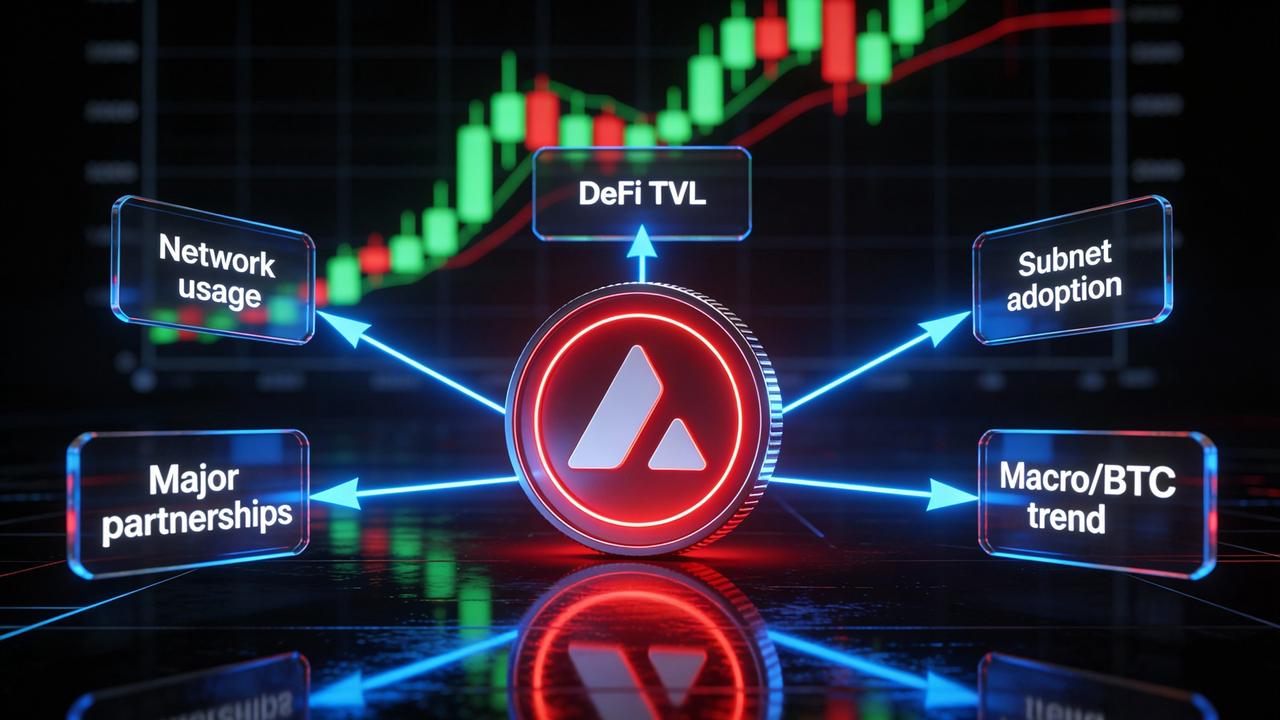
No single factor explains every move, but three themes show up again and again.
- Subnet adoption: When well-known teams launch custom Avalanche L1s, the market often reads it as product-market fit for the tech. Also, validators on Avalanche stake AVAX on the Primary Network, which ties network security participation back to demand for the asset.
- Real-world assets and institutional pilots: Avalanche has leaned hard into tokenization and institutional experiments. For example, Avalanche’s own blog notes that Citi and J.P. Morgan have participated in initiatives leveraging Avalanche L1s under Project Guardian.
- Gaming launches: Games want throughput and predictable fees, and dedicated chains can help. Avalanche’s subnet explorer lists gaming-focused networks like Shrapnel, and ecosystem pages highlight games using custom networks. When a highly anticipated game ramps up users, the narrative can spill into price.
Three Strategies for Trading
These are not magic tricks. There are three common approaches that match different personalities and time horizons.
Strategy 1
If you believe Avalanche’s architecture will keep attracting RWAs and gaming, you can treat AVAX as a long-term position.
A practical way to do this is dollar-cost averaging, buying a fixed amount on a schedule instead of trying to time the perfect entry. This dollar-cost averaging guide explains the logic and how recurring buys reduce timing stress.
What to watch: Big adoption announcements, ecosystem growth, and whether builders keep shipping.
Strategy 2
This approach is more active. You trade the story, not just the chart. If you see credible news about financial institutions testing tokenized settlement, or a major game rolling out on a dedicated Avalanche L1, you decide whether to trade the momentum. This is where AVAX trading can feel like reading the room. You’re watching narratives, but you still need rules for entries and exits.
What to watch: Official ecosystem updates, major partnership announcements, and whether activity actually follows the headline.
Strategy 3
Swing traders use technical analysis to capture multi-day moves. Pick a timeframe, mark support and resistance, and use momentum tools like RSI and MACD to avoid chasing late entries. Your goal is to act on a plan, not on adrenaline.
This strategy works well when the market chops around and gives repeated swings. It also helps when the pair trends and then pulls back, which happens often in altcoin cycles.
Why Trade AVAX on Bitunix
First, the pair AVAX/USDT is available on the spot market. Second, you can verify fees before you build a strategy around them. According to our official fee table, VIP 0 spot trading fees are 0.0800% maker and 0.1000% taker, and higher VIP tiers reduce that.
If you want a refresher on order types and the basics, use this spot trading guide. It’s written for beginners, but it’s still useful when you want to double-check the fundamentals.
Also, don’t ignore account security. Bitunix publishes a Proof of Reserve page explaining 1:1 reserves and Merkle-tree verification, and the help center walks you through enabling 2FA.
Conclusion
Avalanche’s multi-chain design and custom network model made it a serious Layer-1 alternative for teams that want speed, control, and room to grow. The tech does not guarantee that the price goes up, but it creates clear narratives that traders watch.
Before you place your next trade, zoom out and pick your approach. If you trade actively, treat risk like a seatbelt, boring until the moment it saves you. This risk management guide is a good starting point for thinking in rules instead of vibes.
Position yourself for the future. Download the app, log in to Bitunix, and start trading the AVAX/USDT pair today.
FAQ
What is the difference between Avalanche and Ethereum?
Avalanche splits core functions across multiple chains and supports custom Avalanche L1s for app-specific needs. Ethereum uses a more unified base-layer approach, often relying on Layer-2s for scaling.
How do Subnets work, and why are they important?
They let teams run their own chain with their own rules, while staying interoperable. The Builder Hub highlights performance isolation, so high activity on one chain does not slow others.
What are some of the biggest projects using Avalanche Subnets?
Examples include gaming-focused networks like DFK and Shrapnel, listed in the Avalanche ecosystem tooling.
What is RWA tokenization, and why is Avalanche a leader in this space?
RWA tokenization puts ownership or claims on real-world assets into on-chain tokens. Avalanche highlights institutional experiments and tokenized settlement projects involving major financial names.
Can I stake my AVAX on Bitunix?
Some exchanges offer staking or earn products, but availability changes by region and product. Check the Earn or staking section in your account for the current options.
Is AVAX an inflationary token?
AVAX supply and issuance rules are defined by the protocol and can evolve via governance. For the latest tokenomics details, use the official Avalanche resources.
What is the C-Chain, and why is it EVM-compatible?
The C-Chain runs an implementation of the Ethereum Virtual Machine, enabling Solidity smart contracts and EVM tooling.
Where can I track the growth of the Avalanche ecosystem?
Use Avalanche’s official ecosystem pages, the Builder Hub documentation, and subnet explorers that list live networks and activity.
What are the risks associated with investing in AVAX?
Market volatility, narrative reversals, regulatory headlines, and smart-contract risks across the ecosystem. Treat leverage carefully and use position sizing.
How does Avalanche achieve its fast transaction finality?
Avalanche cites its consensus mechanism and architecture as enabling high throughput and near-instant finality.
Glossary
- Layer-1 (L1): A base blockchain network that processes transactions and secures consensus without relying on another chain.
- Avalanche Consensus: A family of consensus protocols Avalanche uses to confirm transactions quickly while maintaining decentralization.
- Finality: The point when a transaction is considered permanent and extremely unlikely to be reversed.
- Primary Network: Avalanche’s core network that runs the X-Chain, C-Chain, and P-Chain.
- X-Chain: Avalanche’s chain focused on creating and transferring Avalanche Native Tokens.
- C-Chain: Avalanche’s smart contract chain that runs the EVM and supports Solidity contracts.
- P-Chain: Avalanche’s platform chain that manages validators, staking, and network-level operations.
- EVM (Ethereum Virtual Machine): The execution environment used by Ethereum and EVM-compatible chains to run smart contracts.
- Smart contract: Self-executing code deployed on a blockchain that runs when conditions are met.
- dApp: A decentralized application that runs using smart contracts and blockchain infrastructure instead of a single centralized server.
- Subnet (Avalanche L1): An application-specific network on Avalanche with its own rules and validator configuration, designed for scalability and customization.
- Validator: A network participant that verifies transactions and helps secure the blockchain.
- Staking: Locking tokens to help secure a network and potentially earn rewards. Avalanche’s Primary Network validators stake AVAX.
- Support and resistance: Price zones where buying or selling pressure often increases, used to plan entries and exits.
- Momentum indicators (RSI and MACD): Technical tools used to estimate trend strength and turning points. RSI tracks relative strength over a period, and MACD compares moving averages to spot momentum shifts.
About Bitunix
Bitunix is a global cryptocurrency derivatives exchange trusted by over 3 million users across more than 100 countries. The platform is committed to providing a transparent, compliant, and secure trading environment for every user. Bitunix offers a fast registration process and a user-friendly verification system supported by mandatory KYC to ensure safety and compliance. With global standards of protection through Proof of Reserves (POR) and the Bitunix Care Fund, Bitunix prioritizes user trust and fund security. The K-Line Ultra chart system delivers a seamless trading experience for both beginners and advanced traders, while leverage of up to 200x and deep liquidity make Bitunix one of the most dynamic platforms in the market.
Bitunix Global Accounts
X | Telegram Announcements | Telegram Global | CoinMarketCap | Instagram | Facebook | LinkedIn | Reddit | Medium
Disclaimer: Trading digital assets involves risk and may result in the loss of capital. Always do your own research. Terms, conditions, and regional restrictions may apply.