

Article Summary
- This article directly addresses the speculative question of whether Ethereum Classic (ETC) can reach a price of $10,000.
- It immediately grounds the discussion in reality by calculating the required market capitalization for a $10,000 ETC, revealing it would need to be larger than the entire crypto market today.
- The analysis outlines the bullish case for ETC, focusing on its identity as a fixed-supply, Proof-of-Work smart contract platform—a "digital oil" to Bitcoin's "digital gold."
- It then presents the significant bearish hurdles, including a lack of developer and user adoption compared to Ethereum (ETH), potential security vulnerabilities (51% attacks), and a weak ecosystem.
- The conclusion provides a realistic verdict, stating that while not mathematically impossible, a $10,000 price is extremely unlikely without a fundamental paradigm shift in ETC's adoption and utility.
For early crypto investors, finding the next Bitcoin is the ultimate goal. Ethereum Classic, with its fixed supply and original chain ethos, has often been a candidate for this kind of speculation. But can it realistically reach the monumental price of $10,000?
That $10,000 target is appealing because it suggests life-changing gains from a relatively small starting position. Even if you first notice ETC/USDT while browsing prices on a crypto exchange like Bitunix, you still need to step away from narratives and start with what the market must price ETC at for that number to happen.
We will move beyond hype and conduct a sober, realistic analysis. By examining the market capitalization required, the bullish narratives, and the significant hurdles, we can determine just how feasible a $10,000 ETC truly is.
The Simple Math: What a $10,000 ETC Really Means
Before you think about catalysts, adoption, or headlines, you need the baseline math. Crypto prices do not rise in isolation. They rise when the market values the network more highly, or when supply changes. ETC has a capped supply, so the real question becomes market cap: how much total value would the market need to assign to Ethereum Classic for each coin to trade at $10,000?
The core equation is simple:
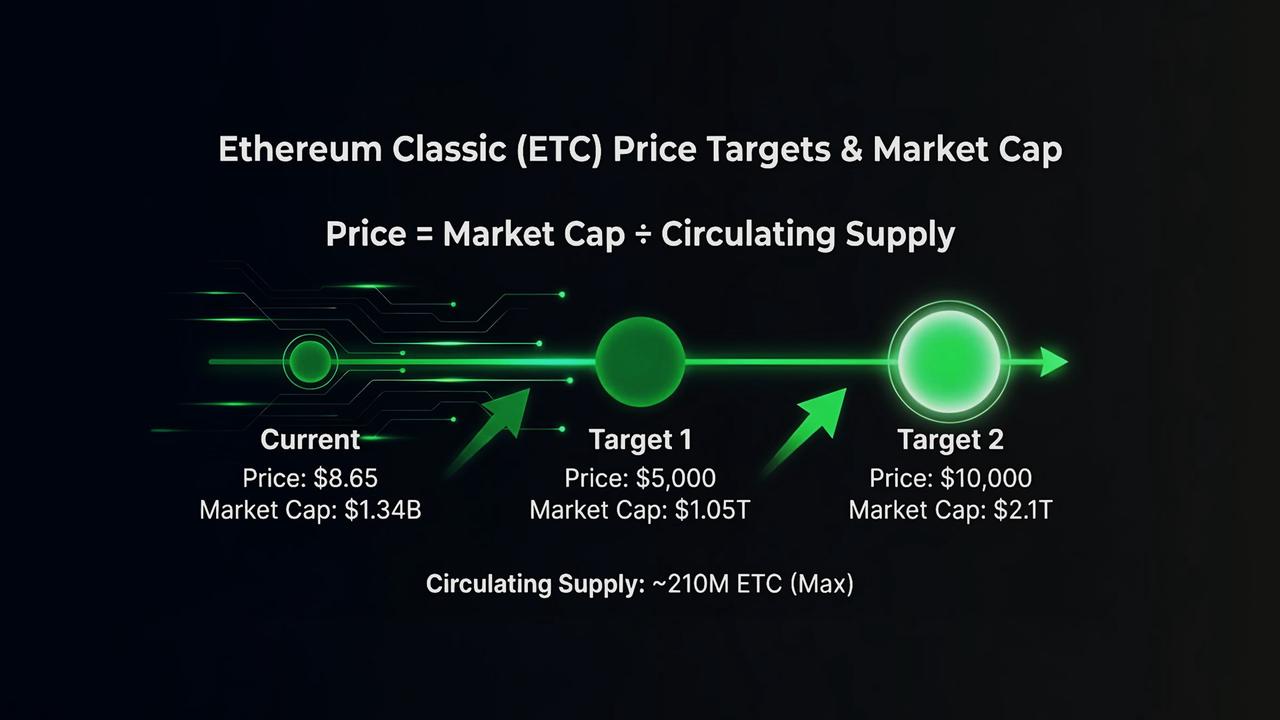
Price = Market Cap ÷ Circulating Supply
Market cap is the total value of the network in dollars. Circulating supply is how many coins the market can actually buy and sell today. Change either one, and the price moves.
Step 1: Use The Supply That Matters For a Long-Term Target
ETC has a capped max supply of about 210.7 million coins. If ETC trades at $10,000 and supply reaches the cap, the implied market cap is:
- 210.7 million × 10,000 = $2,107,000,000,000 = about $2.1 trillion
That number is the real hurdle. It is not about whether ETC can pump for a week. It is about whether the market values the entire ETC network at a multi-trillion-dollar scale.
Step 2: Double-Check The Circulating vs Max Difference
Right now, ETC’s circulating supply sits around 155.6 million coins (and the max supply remains 210.7 million). If you use today’s circulating supply instead, $10,000 ETC implies about $1.56 trillion. That is still enormous, and it assumes supply never increases again, which is not how capped networks work during their issuance phase.
Step 3: Put $2.1T Next To Real-World Benchmarks
To see how big $2.1T is, compare it to major assets:
- Bitcoin’s market cap sits around $1.36T. ETC at $2.1T would be about 1.5x Bitcoin’s size today.
- Ethereum’s market cap sits around $237B. ETC at $2.1T would be roughly 9x Ethereum’s size today.
- Apple’s market cap is around $3.76T, and Microsoft’s is around $2.98T. A $2.1T ETC would land in mega-cap tech giant territory.
This frames the challenge: ETC does not just need a good year. It needs a world where it becomes one of the most valuable networks on the planet.
The Bullish Case: The Path to an Unlikely Victory
ETC’s bullish thesis leans on a few if this, then that ideas. The problem is that each one requires real adoption.
One supportive data point is security in the narrow mining sense. ETC’s hash rate has grown over time, and recent snapshots show it around 200 TH/s (values move day to day). A higher hash rate makes attacks more expensive.
Another bullish angle is monetary policy. ETC follows a fixed schedule that reduces issuance over time. The so-called Fifthening cuts the block reward again around May 2026 (from 2.048 ETC to 1.92 ETC per block, per countdown trackers and schedule summaries). That reduces the new supply hitting the market each day.
Then there’s the regulatory narrative. Some traders argue that Proof-of-Work networks face fewer securities-style arguments than staking-based networks. If U.S. policy keeps targeting staking programs, ETC gets a cleaner commodity-like pitch. The SEC’s staking enforcement against centralized programs is part of what fuels this view.
This is also where topics discussing whether Ethereum is a security show up in ETC discussions, because people treat ETC as a hedge if regulation hits ETH harder. Finally, if Ethereum faced a major technical failure or a major regulatory restriction, some capital can rotate into alternatives. But this is still a thin thesis unless developers and users actually move.
The Bearish Reality: The Mountain ETC Must Climb
The biggest ETC risk is not supply. It is in demand. Here is a clean on-chain snapshot from BitInfoCharts:
- Ethereum Classic Active Addresses were 7,343.
- Ethereum Classic Transactions Per Day was 12,648.
Those numbers change daily, but the point stays the same. ETC’s current activity level is modest, and in ETC vs ETH comparisons, Ethereum’s usage metrics tend to be in a different league.
For example, DeFi Llama shows Ethereum with roughly 681,774 active addresses in 24h and meaningfully higher fees and stablecoin activity. DeFi footprint tells a similar story. DeFiLlama’s chain dashboard shows Ethereum Classic with a tiny stablecoin market cap and tiny daily fees, which usually means low DeFi demand and low user willingness to pay for blockspace.
In mid-2020, Ethereum Classic went through a rough stretch of repeated 51% attacks. Coinbase documented a July 31, 2020, attack that enabled about 800,000 ETC (around $5.8M) in double-spend transactions, followed by another attack on August 5 involving about 460,000 ETC (around $3.2M). These incidents involved large chain reorganizations that can erase recent deposits after a victim credits them.
Later in August, a third attack reorganized over 7,000 blocks (about two days of mining). Exchanges paused payouts, and some discussed delisting due to security risk, while Coinbase said it raised confirmation requirements as a protective response.
And then there is the branding problem. New users often treat ETC as the abandoned version of Ethereum. That confusion makes it harder to attract builders, liquidity, and long-term mindshare.
A More Realistic Ethereum Classic Price Prediction
Forecasts are all over the place, so the best use of them is range comparison. Here are three well-known forecasting sources, side by side:
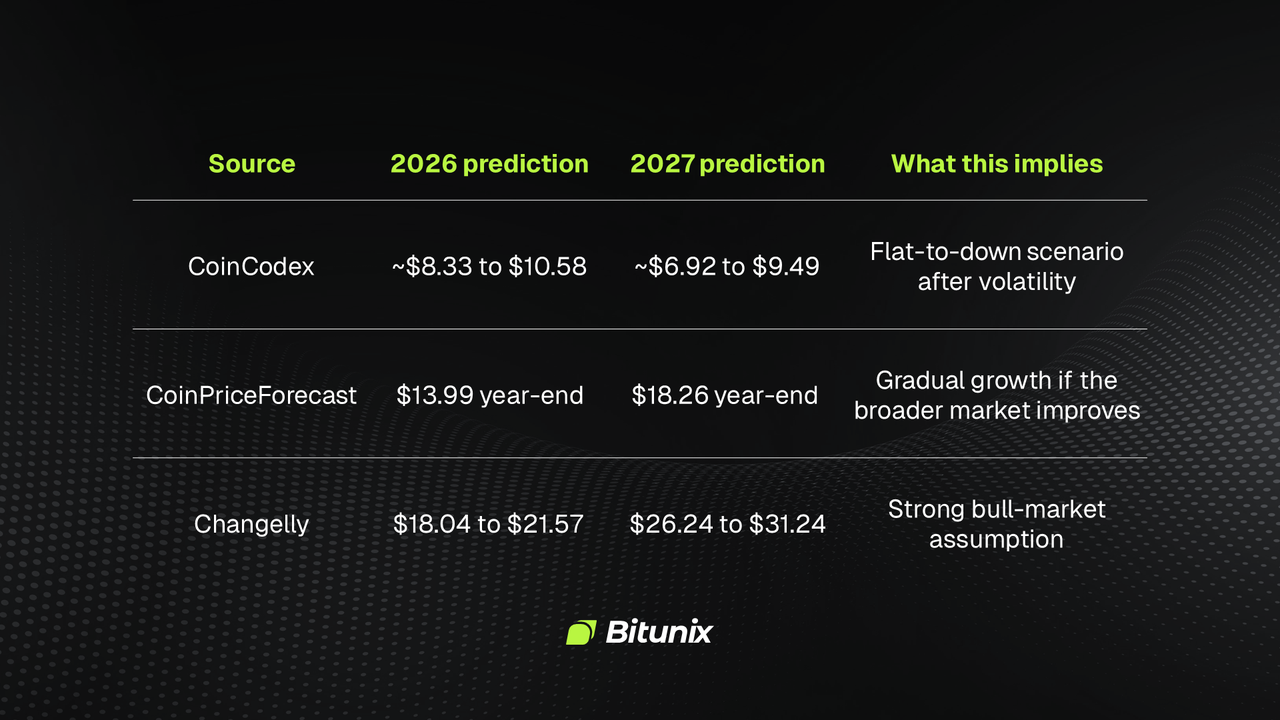
Even the optimistic forecasts above stay far below $10,000, showing what mainstream forecasting models expect in the medium term. Also note that these forecasts are usually based on historical price patterns and trend indicators, not on a sudden explosion in real usage. If ETC does not grow activity, forecasts tend to stay anchored.
And if you track spot pricing on ETC/USDT, remember that exchange liquidity and spreads can matter as much as the headline price during high-volatility periods.
Conclusion: A Matter of Faith, Not Fundamentals
A $10,000 ETC requires a market cap of around $2.1T if supply reaches its cap. That is the main obstacle. It demands that ETC become one of the most valuable networks in the world, while competing against ecosystems with far more users and builders today.
You can still speculate on ETC. Just treat it as a high-risk bet on narrative shifts, regulatory pressure elsewhere, and a meaningful adoption rebound. If you decide to trade, platforms like Bitunix can become one of the top choices. And to be clear, can Ethereum classic reach $10,000 is a different question from can it rally. Rallies happen. A multi-trillion valuation requires a new reality.
For those who believe in the long-shot potential of Ethereum Classic, Bitunix offers a secure and liquid market to trade ETC/USDT. Download the app, sign up, and trade with caution and a clear understanding of the risks involved.
FAQ
Why did Ethereum and Ethereum Classic split?
They split after the 2016 DAO hack. Ethereum changed the chain history via a hard fork to reverse hack-related effects. Ethereum Classic kept the original chain, arguing that chain history should remain immutable. That choice created two separate networks and communities.
What is a 51% attack?
A 51% attack happens when one miner or group controls most of the network’s hash power. They can reorder blocks and rewrite recent history, which can enable double-spending on exchanges. ETC has a history of reorg-related incidents, which still affects risk perception.
Does Ethereum Classic have a limited supply like Bitcoin?
Yes, ETC has a capped max supply of around 210.7 million coins.
Unlike Ethereum, which can change issuance policy through upgrades, ETC follows a scheduled issuance reduction model that cuts block rewards over time.
Who is currently developing on Ethereum Classic?
ETC has active teams and community groups, including work around upgrades and client support. But its developer footprint is smaller than Ethereum’s in practice, based on ecosystem indicators like DeFi activity and user metrics. Low fees and low stablecoin presence often signal low builder demand.
Is ETC more decentralized than ETH?
ETC is Proof-of-Work, so it decentralizes security through miners. ETH decentralizes security through validators. Decentralization depends on real concentration metrics, such as how many entities control hash rate or stake, plus client diversity and governance influence.
What was the all-time high price for Ethereum Classic?
Ethereum Classic’s all-time high was $167.09 on May 6, 2021. It happened during the 2021 bull market, when DeFi hype and early talk about Ethereum’s future changes boosted related assets.
How does ETC’s energy use compare to ETH’s?
ETC uses mining, so it consumes energy similar to other PoW networks. ETH moved away from mining, so its direct network energy use dropped substantially after the merge.
Can I stake Ethereum Classic?
No. ETC uses Proof-of-Work, so it does not have protocol staking like PoS chains. You can earn yield through third-party products, but that yield comes from lending, derivatives, or platform programs, not from ETC consensus.
What are the most popular dApps on the ETC network?
On Ethereum Classic, the busiest dApps are simple DeFi basics, such as Thundercore DEX/Orion and ClassicSwap for swaps and liquidity, plus a few low-volume NFT marketplaces. Overall usage stays small, with roughly $60–$100M TVL and about 1k–5k daily users.
Is ETC a good long-term investment?
ETC is a speculative bet. The upside thesis depends on scarcity narratives, PoW demand, and a meaningful rebound in usage. The downside risk comes from weak ecosystem growth and historic security concerns.
Glossary
- Market Cap: Price multiplied by circulating supply.
- Circulating Supply: Coins currently available in the market.
- Maximum Supply: The supply cap a protocol targets over time.
- Proof-of-Work (PoW): Consensus where miners secure the chain using computation.
- Proof-of-Stake (PoS): Consensus where validators secure the chain by staking coins.
- Hash Rate: Total computational power securing a PoW network.
- 51% Attack: When one party controls enough hash power to reorganize the chain.
- Chain Reorganization: A rewrite of recent blocks due to competing histories.
- Double-spend: Spending the same coins twice by reversing a prior transaction.
- Finality: Confidence that a transaction will not be reversed.
- Smart Contract: Code that executes on-chain under set rules.
- dApp: Decentralized application built on a blockchain.
- Liquidity: How easily you can trade without moving the price too much.
- Spread: The gap between best buy and sell prices.
- Technical Indicators: Quantitative signals used in chart-based analysis.
About Bitunix
Bitunix is a global cryptocurrency derivatives exchange trusted by over 3 million users across more than 100 countries. The platform is committed to providing a transparent, compliant, and secure trading environment for every user. Bitunix offers a fast registration process and a user-friendly verification system supported by mandatory KYC to ensure safety and compliance. With global standards of protection through Proof of Reserves (POR) and the Bitunix Care Fund, Bitunix prioritizes user trust and fund security. The K-Line Ultra chart system delivers a seamless trading experience for both beginners and advanced traders, while leverage of up to 200x and deep liquidity make Bitunix one of the most dynamic platforms in the market.
Bitunix Global Accounts
X | Telegram Announcements | Telegram Global | CoinMarketCap | Instagram | Facebook | LinkedIn | Reddit | Medium
Disclaimer: Trading digital assets involves risk and may result in the loss of capital. Always do your own research. Terms, conditions, and regional restrictions may apply.