
Article Summary
- This article provides a detailed price prediction and fundamental analysis for the The Graph (GRT) token.
- It explains the core technology and use cases of the The Graph (GRT) ecosystem.
- The bull case focuses on network adoption, technological upgrades, and broader market trends.
- The bear case highlights potential regulatory challenges, competition, and market volatility.
- It presents detailed price prediction scenarios (bearish, neutral, bullish) for both 2026 and 2030.
- The Graph (GRT) sits in one of the less flashy but more practical corners of crypto: blockchain data. Every DeFi app, NFT marketplace, DAO dashboard, wallet, and analytics tool needs reliable access to on-chain information. Without clean indexing and query infrastructure, blockchain data is hard to organize, search, and use at scale.
- The Graph is a decentralized indexing protocol that enables applications to retrieve blockchain data via subgraphs, APIs, and newer data services. Since GRT is actively traded and used within the protocol, market access also matters to investors tracking price movements.
- On Bitunix, users can trade GRT/USDT through its crypto exchange interface built for active crypto markets. This analysis examines The Graph's technology, market position, token utility, and data-based price scenarios for 2026 and 2030.
The Technology and Ecosystem of The Graph
The Graph ecosystem works as a data layer for Web3 because most applications need more than raw blockchain records. Blockchains store large amounts of public information, but that data is hard to search, organize, and display directly inside apps. The Graph solves this by enabling developers to create and use subgraphs that index blockchain data and convert it into structured information that applications can query quickly.
Web3 Data Indexing and Subgraphs
The project's roadmap describes The Graph as an indexing protocol for organizing blockchain data and making it easily accessible with GraphQL. That sounds technical, but the use case is that applications need clean data to show token balances, historical trades, DAO votes, NFT activity, lending positions, and other on-chain events.
Indexers, Curators, and Delegators keep The Graph network running by sharing different responsibilities. Indexers operate nodes, serve queries, and stake GRT to provide indexing and query processing services. Curators signal which subgraphs are useful, while Delegators support Indexers by staking GRT with them without running infrastructure themselves. In return, these network participants can earn fees or rewards based on their role.
The Graph's technical value is easy to underestimate because most users do not see it directly. Nobody opens a DeFi app and says, wow, what a lovely indexing layer. But when a dashboard loads quickly, a wallet shows accurate history, or an analytics tool tracks protocol activity, data infrastructure is doing the heavy lifting.
Horizon, Substreams, and Multi-Service Growth
The Graph is expanding beyond traditional subgraphs. Its 2026 roadmap lists specialized data products, including JSON-RPC, Substreams, Subgraphs, Amp, and Tycho, with Horizon acting as the protocol layer that supports these services. The roadmap also includes agentic subgraph support, x402 and A2A support, verifiable raw data, and a Horizon-based data service across 2026.
The official 2026 roadmap connects this expansion directly to the GRT utility:
"More query volume means more fees flowing through the network. More fees can drive token burns. More data services require more staked GRT. And, as the product suite expands and adoption grows across these various users and use cases, this economic flywheel is expected to accelerate."
That quote explains why The Graph's product expansion matters for investors. If more data services attract more users, the network can generate more query fees and require more staked GRT to support those services. The key test is whether that economic loop shows up in real usage.
Messari's Q4 2025 report showed mixed but useful evidence. Substreams revenue rose more than fourfold quarter over quarter to 6.08 million GRT, the highest quarterly Substreams revenue on record. At the same time, subgraph query fees fell 8.7% quarter over quarter to $98,667, showing that growth is shifting across product lines rather than moving evenly across the whole protocol.
GRT Tokenomics and Network Roles
The Graph (GRT) token helps secure and coordinate the protocol by giving each network participant an economic role. Indexers stake GRT to serve data, Delegators assign GRT to Indexers and receive a share of fees and rewards, and Curators use GRT to signal which subgraphs deserve indexing attention. Together, these roles create an incentive system around data quality, network security, and reliable query service.
Current market data shows the gap between The Graph's infrastructure role and GRT's token price. CoinGecko recently listed The Graph with a market cap around $271 million and about 11 billion GRT tokens tradable in the market. It also lists GRT's all-time high at $2.84 and all-time low at $0.02317. That puts the token near cycle lows despite the protocol still being active infrastructure.
For traders, the gap between protocol relevance and token performance is the key issue. The Graph can remain a useful infrastructure even as GRT struggles if token demand remains weak. Stronger staking activity, data service adoption, query fees, burns, delegation, and network usage would all help the token case.
The Bull Case: Drivers of Growth
The upside case for GRT depends on The Graph becoming more than a subgraph indexing protocol. The strongest version of the story involves multi-service blockchain data, AI agent access, enterprise analytics, and more direct value moving through GRT. Any The Graph price prediction with real upside depends on usage turning into token demand.
Data Demand From Developers, AI, and Institutions
Blockchain data demand grows as more applications need accurate on-chain information. DeFi protocols need market data, wallets need transaction histories, analysts need structured metrics, and AI agents need reliable data access before they can make useful on-chain decisions. The Graph's 2026 roadmap targets all of those users by expanding its product set beyond traditional subgraphs.
The 2025 data shows The Graph still has strong infrastructure relevance. Messari's Q3 2025 report described a period of recalibration and forward acceleration, with deeper multichain presence, a growing subgraph ecosystem, and new infrastructure that expands what developers and data consumers can do. That language is measured, which is good, and it shows where the protocol is trying to improve.
CoinPedia's February 2026 forecast reflects the high-upside version of this thesis. Its 2026 GRT estimate ranges from $0.05 in weak demand to $1.75 in strong demand, with an average near $1.20. Its 2030 view places GRT between $3.15 and $3.55 if adoption continues and The Graph becomes a core data layer for Web3.
Product Expansion Through Horizon
The Graph's product expansion is not just a new label on the same protocol. Horizon is designed to support more specialized data services, including subgraphs, Substreams, SQL-style analytics, AI-ready data services, and verifiable raw data. That gives The Graph a wider market than developer subgraph hosting alone.
Substreams is the clearest 2025 proof point. Messari's Q4 report showed record Substreams revenue, with more than fourfold growth in GRT terms from the prior quarter. That suggests developers are using high-performance data pipelines where traditional subgraphs may not be enough.
If Horizon works as planned, GRT can become tied to several data markets instead of one product category. That improves the long-term case for The Graph (ecosystem. It also raises the bar, since investors need to see whether new services bring recurring demand.
Market Recovery and Infrastructure Repricing
GRT still trades like a smaller infrastructure token, so market sentiment matters. When traders rotate into AI, data, DePIN, and Web3 infrastructure themes, GRT can benefit from its recognizable brand and long history. When liquidity tightens, the token can fall even if protocol development continues.
Conservative models show one side of the market. Kraken's 5% annual growth table places GRT near $0.025 in 2026 and $0.030 in 2030. CoinCodex's price prediction is also cautious, with a 2026 range of $0.01913 to $0.02568 and a 2030 end-of-year estimate near $0.0074 in one current model.
A stronger market recovery creates a very different outlook. CoinPedia's high-end 2026 and 2030 estimates assume The Graph turns data demand into meaningful network usage and token demand. Those numbers should be treated as bullish scenario markers, and the spread between forecasts tells you that GRT is still a debate.
The Bear Case: Potential Risks
The downside case for GRT comes from the distance between infrastructure usefulness and token price performance. The Graph can remain valuable to developers while GRT underperforms if fees, staking demand, burns, and tokenholder alignment do not grow enough.
Regulatory Pressure Around Staking and Token Utility
Regulatory risk for GRT comes from how The Graph turns data work into token-based incentives. Indexers stake GRT to serve blockchain data, Delegators assign GRT to Indexers, and Curators use GRT to signal which subgraphs deserve attention. That design gives the token real network utility, but it also means exchanges, staking interfaces, and third-party platforms need to describe rewards, fees, and risks carefully. The Graph's documentation says Delegators can earn a share of query fees and indexing rewards from Indexers, with each Indexer setting its own reward cut.
Regulators are also paying closer attention to how crypto services explain regulated and unregulated products. In the EU, MiCA establishes a framework for crypto-asset issuers and service providers, while 2025 guidance and warnings focused on disclosure, supervision, and clarity around customer protections. For GRT, the practical issue is how platforms present delegation, staking-style access, query-fee economics, and token burns to users across different jurisdictions.
The risk is most relevant when GRT is packaged as a passive-earning product rather than presented as participation in a decentralized data network. A cleaner framing focuses on the token's role in indexing, curation, delegation, and query services. That helps investors understand GRT as an infrastructure utility, while still making clear that rewards vary, token prices move, and network activity does not guarantee investment returns.
Competition From Data Providers and Native Indexing
The Graph faces competition from centralized blockchain data providers, RPC companies, analytics platforms, chain-native data tools, data warehouses, and other decentralized infrastructure projects. Developers often choose whatever gives them fast results, low cost, reliable uptime, and easy integration.
Native chain infrastructure also creates pressure. Some Layer 1 and Layer 2 ecosystems build their own indexing tools, dashboards, APIs, and data partnerships. That can reduce the need for developers to depend on an external protocol for every use case. The Graph needs to keep winning through reliability, multichain support, better data services, and enough economic incentives to keep Indexers active.
Cryptopolitan's April 2026 forecast reflects a more cautious recovery view. It projects a 2026 high of $0.0435, then a 2032 range between $0.173999 and $0.188499. That is more positive than the lowest algorithmic forecasts, but it is still far below GRT's all-time high.
Macro Pressure and Liquidity Risk
GRT's macro risk comes from the way infrastructure tokens depend on future network demand. When market liquidity is strong, traders often place greater value on long-term themes such as data infrastructure, AI agents, and Web3 indexing. When conditions tighten, those same narratives can lose momentum quickly because investors focus more on cash, Bitcoin, Ethereum, or stablecoins.
Current market data shows why liquidity deserves close attention. CoinGecko listed GRT near $0.025, with a market cap of around $271.5 million and 24-hour trading volume of about $12.7 million. It also shows the token still trading about 99% below its $2.84 all-time high, while sitting only slightly above its March 2026 all-time low of $0.02317. That creates a difficult setup: the token is liquid enough to trade, but still far from proving a strong recovery trend.
A more useful way to read GRT is to compare price action with network economics. If Substreams revenue, subgraph query fees, staked GRT, and data service usage keep growing, the token has a stronger recovery case. If usage remains uneven, GRT can remain stuck even as The Graph continues to build useful infrastructure. For investors, that means liquidity risk is not only about daily volume. It is also about whether real network demand can support the token when market sentiment weakens.
The Graph Price Prediction Scenarios 2026 and 2030
GRT forecasts vary because each model weighs the network's growth drivers differently. The main variables are query demand, Horizon adoption, Substreams usage, AI-agent access, token burns, staking demand, and broader market sentiment. The Graph's 2026 roadmap links higher query volume to more fees, potential burns, and more required staked GRT, while bullish forecasts assume those mechanics scale over time.
This The Graph price prediction uses those forecasts as reference points, then groups the possible outcomes into bearish, neutral, and bullish scenarios.
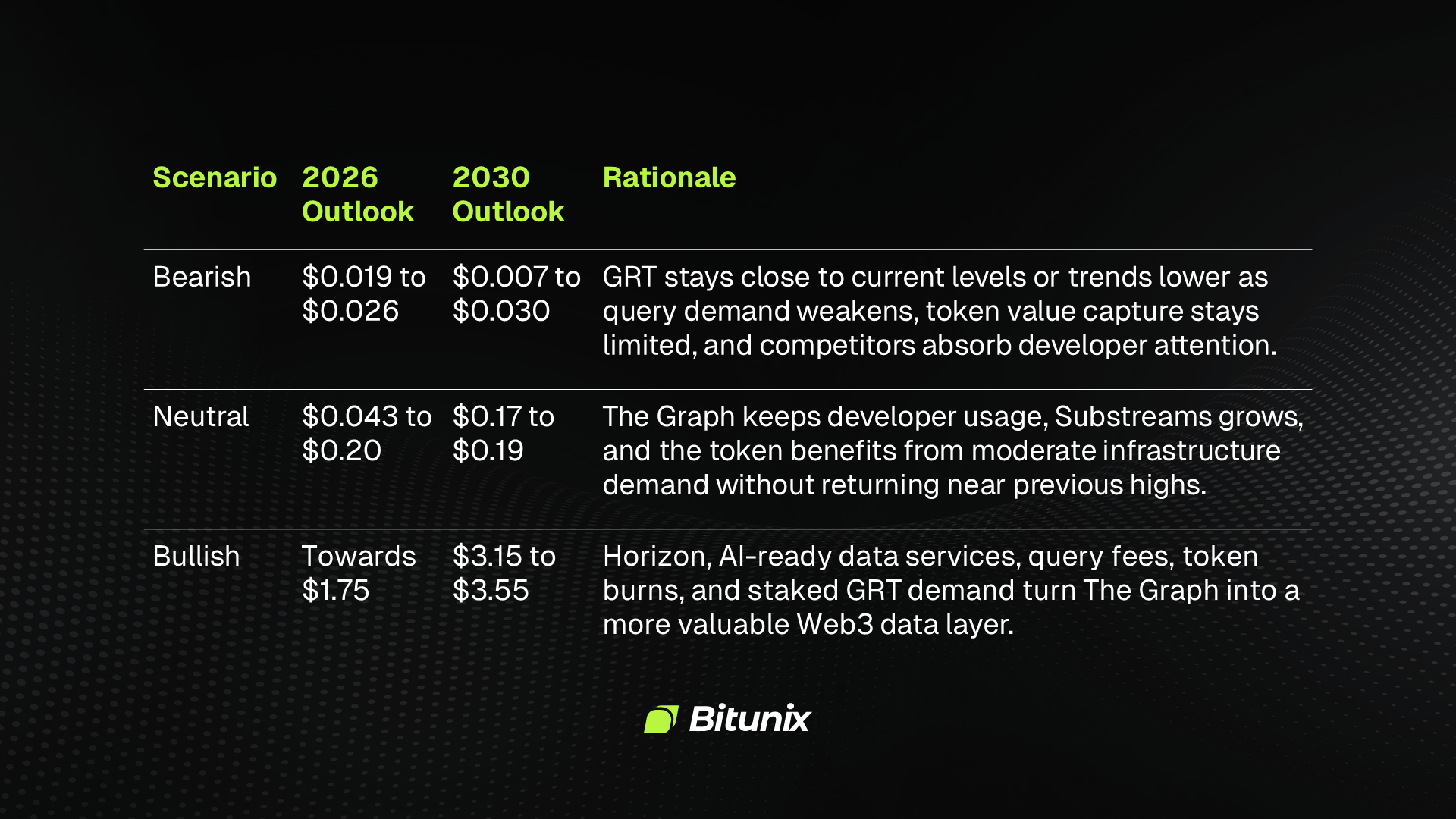
The Graph (GRT) price prediction scenarios compare potential outcomes based on query demand, Horizon adoption, Substreams growth, token value capture, and broader market sentiment.
Conclusion: The Future of The Graph (GRT)
The Graph has a clear role in Web3 because applications need fast, structured access to blockchain data. Subgraphs, Substreams, Horizon, and newer data services give the protocol a practical use case across DeFi, wallets, analytics, AI agents, and developer tools. The stronger long-term case is that more data services can drive greater query activity, higher fees, potential token burns, and higher demand for staked GRT.
For investors, GRT should be judged by network economics rather than the data-infrastructure narrative alone. The protocol can keep building useful tools, but the token may still struggle if query fees, staking demand, burns, and delegation activity do not grow enough. A stronger GRT outlook depends on whether The Graph can turn developer usage into measurable token demand.
Before trading GRT, compare the chart with what is happening inside the network. Track Horizon adoption, Substreams revenue, query fees, staked GRT, AI-agent data usage, and broader crypto sentiment. To trade the market directly, download the Bitunix app, register, and access the GRT/USDT trading pair, while keeping leverage risk and position size under control.
FAQ
What is The Graph (GRT)?
The Graph is a decentralized indexing protocol that organizes blockchain data and makes it easier for applications to query. GRT is the network token used for staking, delegation, curation, rewards, and fees across The Graph's data infrastructure.
How does The Graph (GRT) work?
The Graph works through subgraphs and other data services that organize blockchain information for applications. Indexers run nodes and serve data, Curators signal useful subgraphs, and Delegators support Indexers by staking GRT without running infrastructure themselves.
What is the utility of The Graph (GRT) token?
The Graph (GRT) token supports staking, delegation, curation, indexing rewards, query fees, and network security. Its long-term value depends on how rapidly data demand grows and whether fees, burns, and staking requirements drive stronger token demand.
Who are the main competitors to The Graph (GRT)?
The Graph competes with centralized blockchain data providers, RPC infrastructure companies, analytics platforms, chain-native indexing tools, data warehouses, and other decentralized data protocols. Developers compare these options based on cost, speed, reliability, coverage, and ease of integration.
Is The Graph (GRT) a good investment for the long term?
GRT is a high-risk long-term investment. The Graph has strong infrastructure relevance, but token performance depends on usage fees, staking demand, burns, and market sentiment. Investors should track real protocol metrics rather than rely solely on the data infrastructure narrative.
What factors could drive the price of The Graph (GRT) up?
GRT can rise if Horizon adoption grows, Substreams revenue increases, more developers use The Graph, and AI agents need reliable blockchain data. Stronger query fees, token burns, higher staked GRT demand, and a broader crypto recovery can also support price growth.
What are the main risks associated with The Graph (GRT)?
The main risks include weak token value capture, competition from other data providers, regulatory pressure around staking and rewards, lower query demand, and macro weakness. GRT can underperform even if The Graph remains a useful infrastructure for developers.
How does The Graph (GRT) differ from Bitcoin or Ethereum?
Bitcoin mainly acts as a decentralized monetary network, Ethereum supports smart contracts and decentralized applications, and The Graph is a data infrastructure protocol that helps applications index, organize, and retrieve blockchain data across networks.
What is the all-time high of The Graph (GRT)?
The Graph (GRT) reached an all-time high of $2.84. By early May 2026, GRT traded roughly 99% below that level, showing how deeply the token corrected after its previous cycle and why recovery forecasts vary widely.
Where can I buy The Graph (GRT)?
You can buy or trade GRT on centralized exchanges that list the token and through supported decentralized venues. Bitunix offers the GRT/USDT trading pair for users who want market access. Always check liquidity, fees, leverage risk, and regional availability first.
Glossary
- The Graph: A decentralized protocol that indexes blockchain data and makes it easier for applications to retrieve and use.
- GRT: The Graph's native token, used for staking, delegation, curation, rewards, and query-related network incentives.
- Subgraph: An open API that defines how blockchain data is indexed and made available to applications.
- Substreams: A high-performance data pipeline product for processing large-scale blockchain data more efficiently.
- Horizon: The Graph's protocol upgrade designed to support multiple data services through a unified network layer.
- Indexer: A node operator that stakes GRT to index blockchain data and serve queries.
- Curator: A network participant that signals which subgraphs are useful by using GRT.
- Delegator: A token holder who delegates GRT to Indexers and earns a share of rewards.
- Query Fee: A fee paid for accessing indexed data through The Graph's network.
- Token Burn: The permanent removal of tokens from circulation, often linked to network activity or fee mechanisms.
- Blockchain Technology: A distributed ledger system that records transactions and supports crypto assets, smart contracts, and decentralized applications.
- Data Service: A product that provides structured blockchain data for developers, analysts, apps, or automated systems.
- Market Cap: A token's total market value, calculated by multiplying price by circulating supply.
- Crypto Price Prediction: An estimate of future token value based on market data, usage trends, technical models, and sentiment.
- Value Capture: The process by which protocol usage creates economic demand or benefits for a token.
Disclaimer
This article does not provide:
(i) investment advice or investment recommendations;
(ii) an offer or solicitation to buy, sell, or hold digital assets;
(iii) financial, accounting, legal, or tax advice.
Digital assets, including stablecoins and NFTs, involve high risk and may fluctuate significantly. Consider whether trading or holding digital assets is appropriate for you given your financial situation. Consult a qualified legal, tax, or investment professional when needed. You are responsible for understanding and complying with applicable local laws and regulations.
About Bitunix
Bitunix is a global cryptocurrency derivatives exchange trusted by over 3 million users across more than 100 countries. At Bitunix, we are committed to providing a transparent, compliant, and secure trading environment for every user. Our platform features a fast registration process and a user-friendly verification system supported by mandatory KYC to ensure safety and compliance. With global standards of protection through Proof of Reserves (POR) and the Bitunix Care Fund, we prioritize user trust and fund security. The K-Line Ultra chart system delivers a seamless trading experience for both beginners and advanced traders, while leverage of up to 200x and deep liquidity make Bitunix one of the most dynamic platforms in the market.
Bitunix Global Accounts
X | Telegram Announcements | Telegram Global | CoinMarketCap | Instagram | Facebook | LinkedIn | Reddit | Medium