1. Uniswap Overview
UNI is the governance token of Uniswap, a decentralized trading protocol. Uniswap is not only one of the highest volume decentralized exchanges on Ethereum, but also core infrastructure for the broader DeFi industry and a symbolic standard bearer for DeFi.
Uniswap’s origin story is widely known. In 2018, Hayden Adams, a mechanical engineer at Siemens, was laid off. Encouraged by Ethereum cofounder Vitalik Buterin, he began learning Solidity and tried to turn a theoretical idea from Vitalik’s blog about an automated market maker into working code. Early on, Hayden and his team realized that DEXs at the time were trying to replicate traditional finance’s order book model on chain, but the user experience was poor and liquidity was thin because of blockchain confirmation speed limits and high gas fees.
So the Uniswap team decided to abandon the traditional order book and build a trading model from scratch based on a mathematical formula. This innovation fundamentally changed the logic of on chain trading, and the UNI token was launched in 2020 to respond to competitor challenges and enable community governance. UNI was designed to return control of the protocol to the community. It is the core engine that drives this DeFi unicorn’s ongoing evolution and represents one of the highest standards of decentralized governance in the DeFi world.

2. The AMM Mechanism: A Liquidity Revolution From 0 to 1
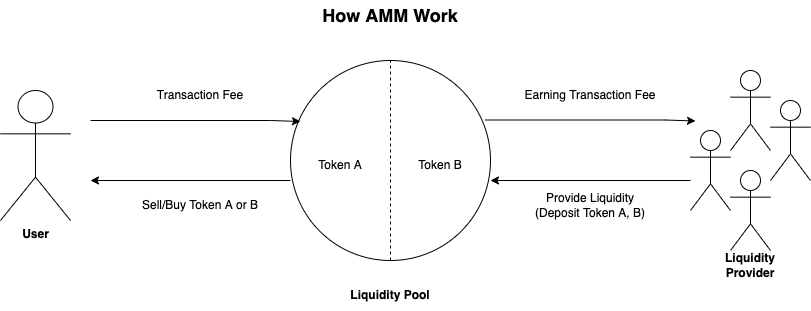
Before Uniswap, many believed trading was impossible without an order book. Uniswap was the first to successfully popularize the AMM (automated market maker) mechanism, turning it into a widely accepted trading model that later became a DEX standard.
At the core of AMMs is a simple mathematical formula: x*y = k.
In this model, there are no longer order placing “buyers” and “sellers,” only liquidity pools. Anyone can become a liquidity provider (LP) by depositing two assets of equal value into a pool. When traders swap, they are effectively swapping against the pool rather than trading with a specific counterparty. Using an ARB and OP pool as an example, the asset price is dynamically determined by the ratio of the two token balances. When you deposit ARB into the pool to receive OP, the OP balance change triggers the formula to automatically adjust the ARB inventory, pushing ARB’s unit price up and enabling automatic pricing. If the external market price moves, arbitrageurs quickly swap with the pool until the pool ratio realigns with the market price. This means traders are swapping against a mathematical formula rather than waiting for a specific counterparty to appear.
What makes this mechanism significant is that it enables permissionless market making. In traditional finance, market making is dominated by firms like Goldman Sachs and JPMorgan. Under Uniswap’s AMM model, any ordinary user with idle assets can provide liquidity and earn trading fees. This democratization of liquidity directly fueled DeFi Summer in 2020, giving on chain trading depth comparable to centralized exchanges.
3. Uniswap’s Ongoing Evolution: From V1 to V4
Uniswap did not stop at x*y = k. It went through four major iterations, and each one helped set the technical direction for the industry.
Uniswap V1 (Proof of Concept)
Launched in November 2018, it only supported swaps between ERC-20 tokens and ETH. The functionality was simple, but it proved that AMMs were viable on Ethereum.
Uniswap V2 (A DeFi Cornerstone)
Released in May 2020, it introduced direct ERC-20 to ERC-20 pools and launched Flash Swaps. V2’s codebase was extremely concise and powerful, becoming the model that many later DEXs learned from, such as SushiSwap and PancakeSwap.
Uniswap V3 (A Capital Efficiency Revolution)
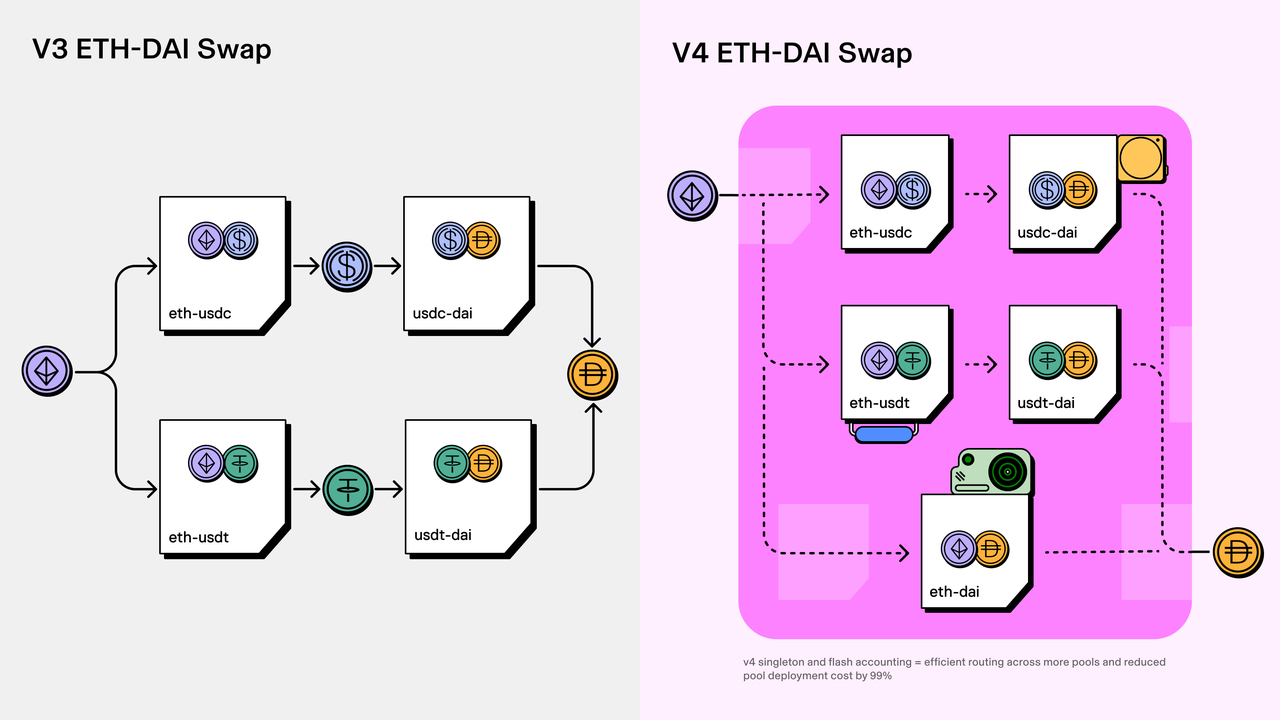
Launched in May 2021, it introduced concentrated liquidity. LPs no longer had to spread capital across the full price range from 0 to infinity, but could choose a custom price range to provide liquidity. This increased capital efficiency by orders of magnitude compared with V2 and cemented Uniswap’s dominant position in spot trading.
Uniswap V4 (A Modular Future)
V4, introduced in 2024, added Hooks, allowing developers to customize functions on top of liquidity pools, such as limit orders, dynamic fees, and oracle integrations. V4 attempts to transform Uniswap from a single application into a programmable liquidity platform.
4. UNI Tokenomics
UNI was officially launched on September 16, 2020, against the backdrop of the well known “vampire attack,” where SushiSwap attempted to use token incentives to siphon Uniswap’s liquidity. To counter the attack and reward the community, Uniswap executed one of the most famous airdrops in crypto history: any address that had used Uniswap before the snapshot received at least 400 UNI, which at peak was worth more than 16,000 USD.
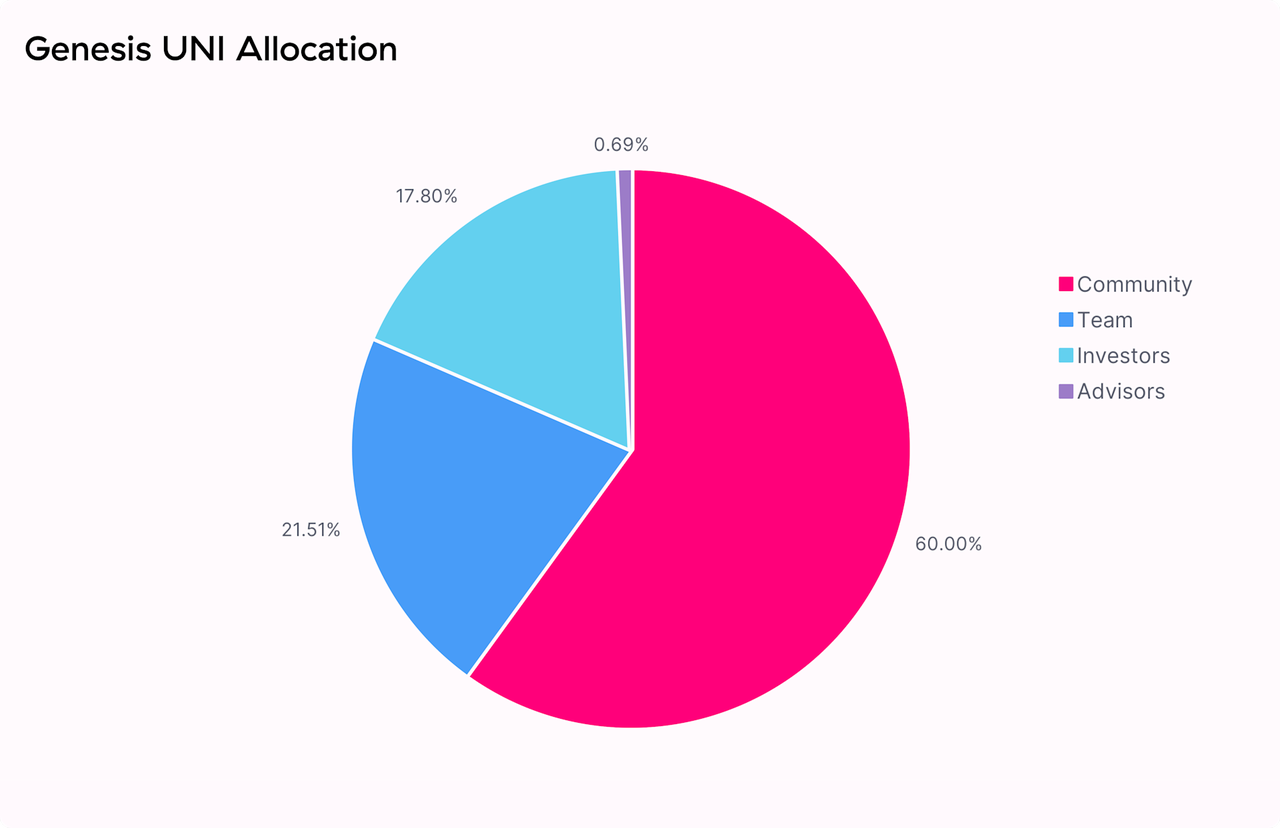
UNI has a total supply of 1 billion tokens, with the initial allocation as follows:
- 60.00% allocated to the Uniswap community, including the historical user airdrop, liquidity mining incentives, and the community treasury.
- 21.51% allocated to team members and future employees (4 year vesting).
- 17.80% allocated to investors (4 year vesting).
- 0.69% allocated to advisors (4 year vesting).
UNI’s core value lies in governance rights and the potential fee switch. UNI holders can propose and vote on the protocol’s development direction, how treasury funds are used, and whether to enable the protocol fee switch. If the fee switch is turned on, Uniswap would take a portion of trading fees and distribute it to UNI holders or the treasury, which is widely viewed as the “holy grail” of value capture for the UNI token.
5. How to Get UNI
Early users mainly received UNI through the airdrop. Today, users can still earn trading fees by providing liquidity (LP) on Uniswap, and some incentive programs may reward UNI, but this also comes with impermanent loss risk. For everyday investors, earning tokens this way has a higher barrier and is more suitable for experienced traders with years of DeFi hands on practice.
Buying UNI through a centralized crypto exchange such as Bitunix is a more accessible option. As a trusted intermediary, the platform supports users in purchasing crypto assets directly using fiat or stablecoins such as USDT, and some platforms also support instant credit card purchases, significantly lowering the entry barrier. Before first use, users must register an account and complete identity verification (KYC) to comply with global anti money laundering (AML) and counter terrorism financing regulations.
Bitunix has industry leading compliance and risk control systems. Through measures such as cold and hot wallet separation, multisignature controls, and real time monitoring, it provides users with asset security protection above the market average.
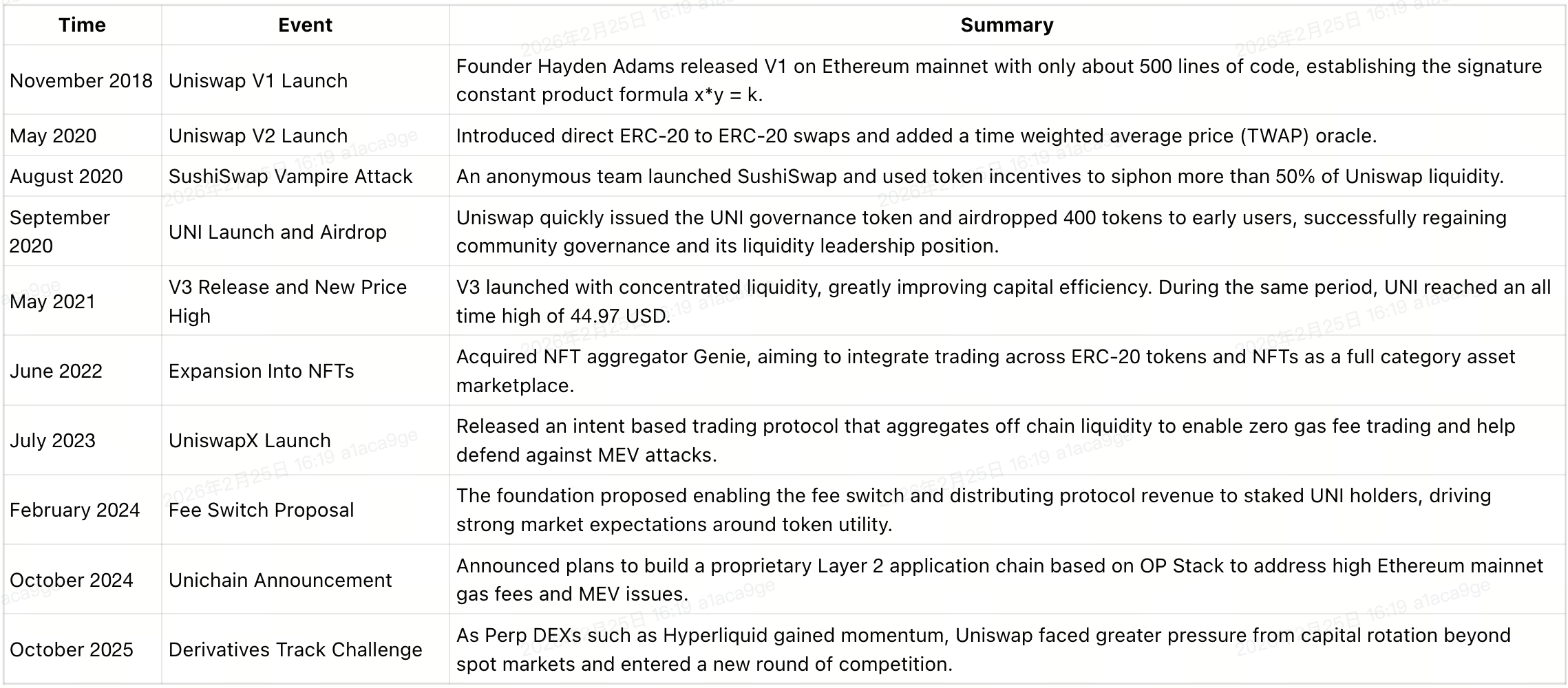
6. Uniswap Major Events Timeline
Disclaimer
This article is not intended to provide: (i) investment advice or investment recommendations; (ii) an offer or solicitation to buy, sell, or hold digital assets; or (iii) financial, accounting, legal, or tax advice. Digital assets (including stablecoins and NFTs) involve high risk and may be highly volatile. You should carefully consider whether trading or holding digital assets is suitable for you based on your financial situation. For your specific circumstances, consult your legal, tax, or investment professionals. You are responsible for understanding and complying with all applicable local laws and regulations.
About Bitunix
Bitunix is a global cryptocurrency derivatives exchange trusted by over 3 million users across more than 100 countries. At Bitunix, we are committed to providing a transparent, compliant, and secure trading environment for every user. Our platform features a fast registration process and a user-friendly verification system supported by mandatory KYC to ensure safety and compliance. With global standards of protection through Proof of Reserves (POR) and the Bitunix Care Fund, we prioritize user trust and fund security. The K-Line Ultra chart system delivers a seamless trading experience for both beginners and advanced traders, while leverage of up to 200x and deep liquidity make Bitunix one of the most dynamic platforms in the market.
Bitunix Global Accounts
X | Telegram Announcements | Telegram Global | CoinMarketCap | Instagram | Facebook | LinkedIn | Reddit | Medium