

Article Summary
- This guide provides a comprehensive overview of five distinct and profitable crypto trading strategies suitable for the 2026 market.
- The strategies covered are Scalping, Day Trading, Swing Trading, Position Trading, and Arbitrage.
- Each strategy is broken down by its core methodology, typical holding period, required skill level, and ideal market conditions.
- A comparison table is included to help traders quickly identify which strategy best aligns with their personality, time commitment, and risk tolerance.
- The article emphasizes that profitability comes from mastering one strategy, not jumping between them, and highlights how Bitunix’s low fees and fast platform are essential for execution.
Buying and holding is a decent start. It is also the point where a lot of people get stuck. You buy, you wait, you refresh the chart, you promise yourself you will sell next time. Then the next time comes, and you do the same thing again.
If you want to trade instead of just holding, you need rules you can repeat. Not rules that sound good on a calm day, but rules you can follow when the market is moving, and your group chat is screaming.
A crypto trading strategy does one job: it turns random decisions into a process. That process helps you pick setups, size positions, manage risk, and stop trading when you are not thinking straight.
This guide breaks down five trading styles that work well in 2026. You will see what each one looks like in real life, how much time it needs, and what tools make it easier to execute.
Strategy 1: Crypto Scalping (The Game of Seconds)
Scalping is about taking many small trades in one session and profiting from tiny price moves, with positions usually held for seconds to minutes. It fits traders who can focus hard and follow the same rules all day, and what matters most is cost and execution, because fees and slippage can erase your edge, so you need to know your maker and taker fees before you start.
If your order tools are limited, scalping becomes guesswork. Start by learning the main order types, then practice with specific tools like a stop-limit and a trailing stop.
For risk control, you want fast protection. Here is a step-by-step walkthrough for setting take profit and stop loss. Crypto scalping can be profitable, but it rewards routine more than excitement. If you like structure, it fits. If you like improvising, it hurts.
Strategy 2: Day Trading Crypto (The 9-to-5 Trader)
Day trading is taking a few intraday trades and closing everything before you sleep, with positions typically held from minutes to hours. It fits traders who can dedicate a solid block of time to analysis and execution, and what matters most is a repeatable routine plus fast risk controls, because one impulsive “just one more trade” moment can undo a clean day.
If you use indicators, keep them simple. Start with a few technical indicators and learn what they actually measure before stacking five of them. The platform requirements are clean charts, reliable execution, and quick risk controls. If you trade futures, learn the basics first, and keep your leverage settings conservative while you learn.
In the short-term trading overview by Investopedia, day trading is described like this: "In day trading, positions are open and closed during the same day with no positions held overnight."
Day trading crypto works best when you treat it like a routine, not a thrill. You show up, you take your best setups, you stop.
Strategy 3: Swing Trading Crypto (The Game of Weeks)
Swing trading targets bigger moves that play out over days to weeks, usually by entering near strong levels in a trend or range and letting the trade develop. It fits part-time traders who prefer fewer decisions, and what matters most is picking good locations and managing exits well, because the “edge” often comes from disciplined stop placement and taking profits the same way every time.
If you want cleaner execution, set your exits the same way every time. For the chart workflow, chart customization helps if you want multi-window layouts and cleaner templates. And if you want to get better at reading the story inside each candle, start with candlestick charts.
Strategy 4: Position Trading (The Investor Mindset)
Position trading is a long-term approach driven by fundamentals, where you build a thesis on an asset and hold for weeks, months, or even years while managing entries and exits intentionally. It fits traders who want fewer trades and less screen time, and what matters most is research quality and risk settings, because your results depend on the thesis staying true and your leverage and margin choices not forcing a bad exit.
Security matters, and so does understanding your risk settings. If you use futures to hedge, learn margin mode before you use leverage. If you want extra clarity on how liquidation is handled, read the details on the liquidation mechanism.
Strategy 5: Arbitrage (The Risk-Free Profit?)
Arbitrage is capturing a price difference for the same asset across exchanges by buying and selling nearly at the same time, often with a holding period measured in seconds. It fits technical traders who can automate and monitor systems, and what matters most is operational speed, because spreads are small, fees add up, and slow transfers can trap capital when the price gap disappears.
You need strong APIs and stable market data. Start with the API documentation and, if you are building scanners, look at endpoints like futures tickers.
Crypto Trading Strategy Comparison Table: Which Strategy is for You?
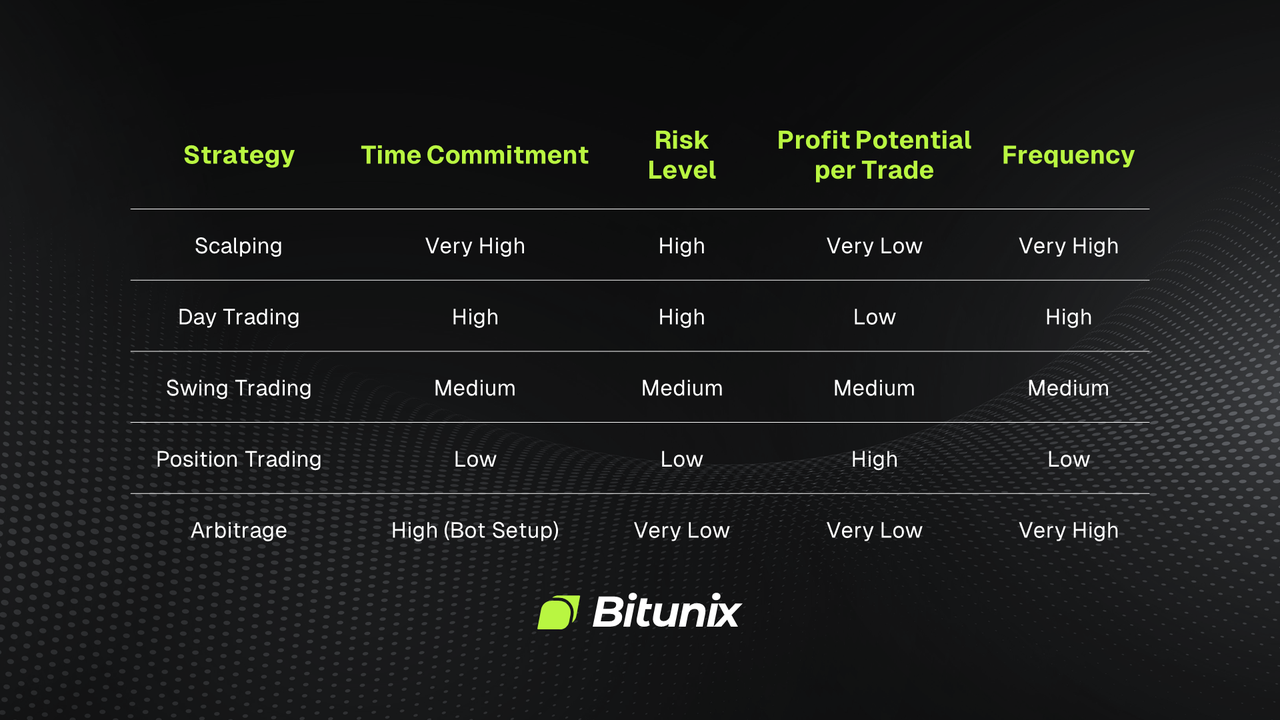
Here are the main strategies compared, so you can choose the one that best fits your style.
Conclusion: Master One, Not All
There is no single best strategy. The one that pays is the one you can execute the same way, over and over, without adding new rules every time the market gets weird. Pick one style. Track 30 trades. Review your entries, exits, and mistakes. Change one variable at a time. That is how skill builds.
Also, do the boring math. Fees matter most when your average win is small and frequent. Keep your fee tiers in mind when you choose a style.
The key is to choose one crypto trading strategy, learn it inside and out, and master execution. A fast, low-fee platform like Bitunix gives you the tools to run any of these styles with less friction.
Ready to define your trading edge? Choose your strategy, open a Bitunix account, and start practicing with a small portion of your portfolio today.
FAQ
What is the most profitable crypto trading strategy for beginners?
Most beginners do best with swing trading or position trading because you make fewer decisions and you have more time to learn. Start small and focus on risk rules.
Can I do swing trading and day trading at the same time?
You can, but separate the rules and sizing so you do not mix signals. If you want to do swing trading crypto alongside an intraday approach, track them as two different systems.
How much money do I need to start day trading crypto?
Start with an amount you can afford to lose. More capital helps, but clean execution and position sizing matter more.
Is scalping really profitable after fees?
It can be, but you need low costs and fast execution. If you want to try crypto scalping, make sure you understand your fees and use protective exits.
What is the difference between position trading and just holding?
Holding is passive. Position trading is planned. You define the thesis, the invalidation point, and the exit plan before you enter.
Is crypto arbitrage still possible in 2026?
Yes, but it is competitive. Most opportunities are small and short-lived, so automation, monitoring, and fast execution matter.
Which strategy has the lowest risk?
Arbitrage can have low market risk, but it has operational risk. Position trading often has lower decision stress, assuming you size responsibly and avoid excessive leverage.
Do I need to use technical analysis for all these strategies?
You need it for scalping, day trading, and swing trading. Position trading leans more on fundamentals, but charts still help with timing.
How do I practice these strategies without risking real money?
Paper trade first, then trade tiny. The goal is to prove you can follow rules, not to prove you can get lucky.
Why are low fees important for scalping and day trading?
Because your average profit per trade is smaller and your trade count is higher. Fees can quietly turn a good system into a losing one.
Glossary
Arbitrage: Capturing price differences for the same asset across venues.
Ask: The lowest price a seller is willing to accept.
Bid: The highest price a buyer is willing to pay.
Candlestick: A chart unit showing open, high, low, and close for a time period.
Liquidity: How easily you can buy or sell without moving price too much.
Maker Fee: Cost often tied to adding liquidity with limit orders.
Taker Fee: Cost often tied to removing liquidity with immediate execution.
Limit Order: An order to buy or sell at a set price or better.
Market Order: An order that executes immediately at the best available price.
Slippage: The difference between expected and actual execution price.
Stop Order: An order that triggers when price hits a defined level.
Stop-Limit Order: A stop that triggers a limit order at a set price.
Take Profit: An order that closes a position at a target to lock gains.
Stop Loss: An order that closes a position at a set level to cap losses.
API: A system that lets software place orders and pull market data automatically.
About Bitunix
Bitunix is a global cryptocurrency derivatives exchange trusted by over 3 million users across more than 100 countries. The platform is committed to providing a transparent, compliant, and secure trading environment for every user. Bitunix offers a fast registration process and a user-friendly verification system supported by mandatory KYC to ensure safety and compliance. With global standards of protection through Proof of Reserves (POR) and the Bitunix Care Fund, Bitunix prioritizes user trust and fund security. The K-Line Ultra chart system delivers a seamless trading experience for both beginners and advanced traders, while leverage of up to 200x and deep liquidity make Bitunix one of the most dynamic platforms in the market.
Bitunix Global Accounts
X | Telegram Announcements | Telegram Global | CoinMarketCap | Instagram | Facebook | LinkedIn | Reddit | Medium