

Article Summary
- This article provides a long-term price prediction for ZBCN, the token for the Zebec Network, a real-time finance and payment protocol.
- It explains Zebec's core innovation: a continuous, second-by-second money streaming protocol. This allows for novel applications like real-time payroll, continuous investment (dollar-cost averaging by the second), and on-demand micropayments.
- The bullish case is built on Zebec's first-mover advantage in the real-time payments space, its expansion into a Layer 1 blockchain for real-world assets (RWAs), and its growing ecosystem of dApps and partnerships.
- The bearish case centers on the significant challenge of changing entrenched payroll and payment behaviors, competition from both traditional fintech (like Stripe) and other crypto payment solutions, and the regulatory hurdles of operating in the financial services space.
Why do people still wait two weeks for money they already earned? That question sits at the center of Zebec Network. The project started with streaming payroll on Solana and now presents itself as a multi-chain PayFi network for payroll, cards, and consumer finance.
For readers asking what Zebec Network is, the short answer is that it is an infrastructure for programmable payments that updates continuously rather than settling in a single batch. If you first come across ZBCN/USDT on a crypto exchange, including Bitunix, it helps to know you are looking at a token tied to a real payments business, not a meme in a payroll costume.
That idea sounds futuristic, but it solves a real problem. Businesses pay in batches because old payroll systems were built that way. Zebec argues that digital money should update as work happens. This analysis will explore the technology and use cases of the Zebec Network, evaluate the long-term growth drivers and risks, and project potential price scenarios for its native token, ZBCN, for 2026 and 2030.
The Bullish Case for Zebec
The bullish case starts with traction. Zebec's homepage says the network now handles about $500 million in annual payroll volume, serves 250-plus enterprise clients, reaches more than 50,000 monthly users on- and off-chain, and supports 18-plus chains plus more than 150 tokens. Those are still small numbers compared to Stripe or PayPal, but they are large enough to show that Zebec has already moved beyond a demo-stage product.
A New Payment Primitive
Zebec's best argument is that continuous settlement unlocks use cases that batch payroll cannot handle cleanly. Workers can access wages as they accrue. DAOs can pay contributors by the minute or second. Platforms can support micropayments without waiting for weekly reconciliation. And consumers can direct income into spending, savings, or investing tools with much finer control than a monthly paycheck allows. That is the practical case for real-time finance crypto. It is less about magic and more about programmable cash management.
The broader payments market also keeps moving in Zebec's direction. A 2025 real-time payments market report summarized the opportunity in one line:
"The Real-Time Payments Market, valued at USD 48.97B in 2025, is projected to reach USD 169.32B by 2029."
That does not prove Zebec wins. It does show the market Zebec wants to serve is expanding quickly. And regulation is pushing traditional finance the same way. The European Commission said new euro instant-payment rules that took effect on October 9, 2025, allow people and businesses to transfer euro payments within seconds, day or night, across the eurozone. In other words, speed is becoming standard. Zebec's edge has to come from programmability, crypto-native distribution, and cross-product integration.
Expansion Beyond a Single dApp
The project has also broadened its scope. Official 2026 tokenomics no longer describe ZBCN as a simple protocol token for one payment app. They frame Zebec as a multi-chain, multi-product financial network spanning payroll, cards, governance, incentives, and SuperApp features. That matters for valuation. A token tied to one narrow payment widget has limited upside. A token tied to a wider network of payroll, cards, treasury tools, and partner integrations has more room to grow, provided users actually adopt those products.
There is one nuance worth stating clearly. Phemex 2026 market coverage talks about Nautilus L3, Zebec Chain, or dedicated chain infrastructure around Zebec’s payment stack. Official Zebec material, though, puts more emphasis on product usage than on gas fees from a standalone base layer. So the stronger bull argument is not that Zebec becomes a dominant blockchain in the usual sense. It is that Zebec owns a larger share of the payment experience, from payroll rails to cards and embedded wallets.
Partnerships and Ecosystem Growth
Recent partnerships make the bull case stronger. In December 2025, Zebec said it integrated Privy’s wallet infrastructure into its payroll SuperApp, creating a path to connect Zebec's stablecoin payroll rails to Privy's broader ecosystem.
Other deals point in the same direction. Zebec's 2025 blog announced a partnership with AllUnity to deliver real-time payroll with EURAU, a MiCA-compliant euro stablecoin. Another December 2025 announcement tied Zebec to NatPay and PayBridge, whose payroll platform processes over $300 million in annual payroll for enterprise and mid-market employers. And in June 2025, Zebec acquired Science Card, a UK university payments platform used by more than 50,000 students across 10 universities, including Cambridge and Aston.
ZBCN Token Utility
The token story also improved in 2026. Official tokenomics state that ZBCN is used for governance, payroll, product fees, staking, SuperApp incentives, card rewards, DeFi collateral, and ecosystem participation. The same update says final unlocks are scheduled for March 2026, buybacks are linked to product revenues, supply contraction now outpaces expansion, and buyback volume has grown at an annualized rate of more than 70% since the program began.
Current market data shows why bulls still care. CoinMarketCap lists ZBCN at around $0.0020, with a market cap of nearly $199 million, a 24-hour volume of around $4.7 million, a circulating supply of just under 99 billion, and a max supply of 100 billion. If payroll fees, card activity, and SuperApp usage rise together, even modest improvements in token demand can move the price meaningfully because the supply schedule is close to maturity.
The Bearish Case and Challenges
The bearish case is not hard to find. Zebec sells a better payment model, but better models do not always win. People still use checks, clunky bank portals, and spreadsheet-heavy payroll systems since they already work well enough. Convincing finance teams to switch is expensive, slow, and full of legal paperwork.
The Challenge of Changing Behavior
Streaming payroll sounds sensible for contractors, DAOs, and global teams paid in stablecoins. It is a much harder sell for mainstream employers with existing HR systems, tax workflows, benefits providers, and banking partners. Traditional payroll is deeply wired into compliance, reporting, and employer habits. Even in places that already require real-time reporting, such as Ireland's PAYE modernization system, that does not automatically mean businesses want wages to settle continuously.
Intense Competition
Zebec also competes with giants. Stripe said businesses running on its platform generated $1.9 trillion in total volume in 2025. PayPal said it processed $1.79 trillion of total payment volume in 2025 and ended the year with 439 million active accounts. Those numbers dwarf Zebec's current scale. So the main question is not whether Zebec has a clever product. It does. The question is whether it can carve out a defendable niche before larger fintechs copy the useful parts.
And crypto competition is real, too. Zebec now shares the stage with stablecoin payment rails, account-to-account networks, instant-payment regulation in Europe, and chain ecosystems that already support cheap, fast settlement. If speed keeps becoming a standard feature, Zebec has to win on product depth, partner distribution, compliance tooling, and user experience.
Regulatory Hurdles
Regulation is another cost center. Zebec is trying to meet that challenge head-on. Its compliance page highlights access to a SOC II report, Vanta monitoring, and a MiCA whitepaper. In July 2025, market coverage also reported that Zebec acquired Gatenox to integrate KYC, KYB, and AML tools as it prepared for MiCA and FCA requirements.
Technical and Security Risks
Technical risk stays high because Zebec now touches payroll, cards, wallets, treasury tools, and multi-chain payment infrastructure. A glitch in a yield farm can annoy traders. A glitch in payroll can make people miss rent. That raises the standard.
In December 2025, Hypernative said Zebec chose its platform to monitor security, technical, financial, and governance risks, and Hypernative said its system detected 99.5% of hacks last year with less than 0.001% false positives. That is a sensible move, but it also underlines the challenge. Zebec has to operate more like a fintech utility than a casual DeFi app.
ZBCN Price Prediction: 2026 & 2030 Scenarios
A grounded ZBCN price prediction should start with current numbers and outside forecasts, then work backward from adoption. CoinMarketCap currently puts ZBCN near $0.0020. CoinCodex forecasts about $0.00527 by the end of 2026 and about $0.00602 by the end of 2030. Changelly is more aggressive, with average 2026 and 2030 estimates of around $0.00378 and $0.0163, respectively. Those forecasts are useful, but they are all over the place. So the better approach is to build scenarios based on adoption and token demand.
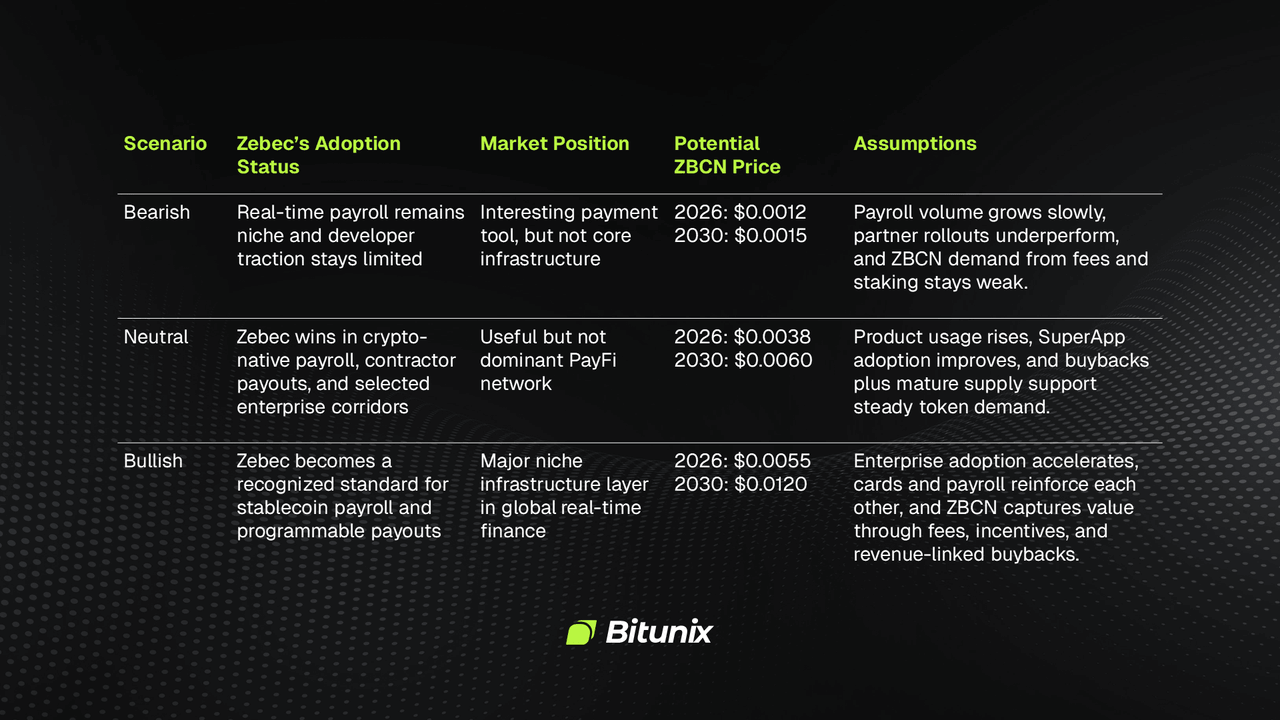
ZBCN price outlook for 2026 and 2030, comparing bearish, neutral, and bullish scenarios based on payroll adoption, product usage, and long-term network growth.
These levels stay realistic relative to supply. At roughly 99 billion circulating tokens, a 2030 neutral case around $0.006 implies a market cap near $594 million. A bullish 2030 case around $0.012 implies about $1.19 billion in value. That is a big jump from today's roughly $199 million, but not impossible if Zebec proves that payroll, cards, and compliance can work as one revenue engine.
Conclusion: A Long-Term Bet on the Future of Payments
Zebec's appeal is easy to understand. The network is trying to make payroll, payouts, and spending more programmable, more continuous, and more useful across crypto and traditional rails. It already has measurable payroll volume, enterprise clients, card products, recent partnerships, and a token model that ties demand to real product usage. That is the good news.
The hard part is just as clear. Payments is one of the toughest businesses in the world. Behavior changes slowly, compliance never gets cheaper, and giants like Stripe and PayPal already sit on enormous distribution. So, is ZBCN a good investment? For most readers, it fits a high-risk, long-duration position better than a core holding. It offers real upside if Zebec turns product traction into durable network effects. It also carries very real execution risk.
Bitunix offers a secure platform to invest in the future of finance. Download the app,register, and trade ZBCN and other innovative payment protocols on our trusted exchange.
FAQ
What is the difference between ZBC and ZBCN?
ZBC was the original Zebec token. ZBCN is the updated network token introduced as Zebec expanded from a Solana payments protocol into a broader multi-chain financial network. Official 2026 tokenomics say the original supply framework stayed in place while utility expanded across payroll, cards, governance, and incentives.
What is a money stream?
A money stream is a programmed payment that updates continuously over time instead of arriving in one batch. In Zebec's model, wages or payouts accrue second by second, which lets users access earned value immediately and gives businesses more flexible payout controls.
Is the Zebec Network its own blockchain?
The answer is a bit nuanced. Official Zebec material describes the project as a multi-chain financial network. Some 2026 crypto coverage also describes Nautilus L3 or Zebec Chain as dedicated chain infrastructure around Zebec's payment stack. So yes, chain infrastructure exists, but Zebec is broader than a single gas-first blockchain.
Who are the main competitors of Zebec?
In traditional finance, Stripe and PayPal are the obvious comparison points because both already move trillions in annual payment volume. In crypto, Zebec also competes with stablecoin payment rails, fast settlement chains, and other PayFi products that offer cheap transfers, card access, or programmable payouts.
How can the Zebec protocol be used?
Users and businesses can use Zebec for stablecoin payroll, contractor payouts, crypto cards, treasury tools, and consumer finance inside the SuperApp. Official business pages also position it for multi-chain enterprise payroll and branded card programs, while the card product supports spending across global merchant networks.
What is the total supply of ZBCN?
CoinMarketCap lists a max supply of 100 billion ZBCN and a circulating supply just under 99 billion. Official 2026 tokenomics state that final unlocks are scheduled for March 2026, indicating the token is approaching a more mature supply profile than many younger crypto assets.
Is Zebec compliant with financial regulations?
Zebec is clearly investing in compliance. Its compliance page offers a SOC II report, Vanta monitoring, and a MiCA whitepaper. Market coverage in 2025 also said the Gatenox acquisition added KYC, KYB, and AML tools to help Zebec prepare for MiCA and FCA requirements. That is progress, but compliance remains ongoing work.
What are some of the projects building on or around Zebec?
Recent official ecosystem and partnership updates highlight AllUnity, NatPay, Privy, Science Card, OctaSpace, XDB, Boba Network, and Zano. Some are infrastructure partners, some are product integrations, and some are ecosystem collaborators. Together, they show Zebec is building a wider payments stack rather than one isolated application.
How does the ZBCN token accrue value?
Official tokenomics tie ZBCN demand to payroll and product fees, staking, governance, card spending, SuperApp incentives, and ecosystem participation. Zebec also links recurring buybacks to product revenues. If payroll volume and product usage rise together, token demand can strengthen in several ways rather than relying on pure speculation.
What was the original blockchain for Zebec?
Official 2026 tokenomics state that Zebec began as a payments-focused protocol on Solana before evolving into a multi-chain, multi-product financial network. Solana still matters to Zebec's history, but the company now positions itself as broader infrastructure spanning payroll, cards, governance, and partner integrations across several environments.
Glossary
- Zebec Network: A multi-chain PayFi network for payroll, cards, and programmable payments.
- ZBCN: The governance and utility token used across Zebec's products and incentives.
- ZBC: The original Zebec token before the network expanded and rebranded to ZBCN.
- PayFi: Payment-focused crypto infrastructure that combines programmable payments, cards, and on-chain settlement.
- Real-time payroll: Wage delivery that updates continuously instead of waiting for weekly or monthly batches.
- Money stream: A programmed payment that accrues over time rather than settling in one lump sum.
- Stablecoin payroll: Payroll paid in stablecoins, often across borders and outside traditional banking hours.
- SuperApp: Zebec's consumer app combining payroll, spending, staking, and rewards features.
- Governance token: A token that lets holders vote on proposals affecting network decisions.
- Staking: Locking tokens to earn rewards and unlock product benefits inside the ecosystem.
- Buyback: Token repurchases funded by product revenue to reduce circulating supply pressure.
- MiCA: The European Union's crypto regulatory framework for issuers and service providers.
- KYC: Customer identity checks used to meet anti-fraud and regulatory requirements.
- KYB: Business verification checks used for corporate onboarding and compliance reviews.
- AML: Anti-money laundering controls used to monitor and reduce illicit financial activity.
Disclaimer
This article does not provide:
(i) investment advice or investment recommendations;
(ii) an offer or solicitation to buy, sell, or hold digital assets;
(iii) financial, accounting, legal, or tax advice.
Digital assets, including stablecoins and NFTs, involve high risk and may fluctuate significantly. Consider whether trading or holding digital assets is appropriate for you given your financial situation. Consult a qualified legal, tax, or investment professional when needed. You are responsible for understanding and complying with applicable local laws and regulations.
About Bitunix
Bitunix is a global cryptocurrency derivatives exchange trusted by over 3 million users across more than 100 countries. At Bitunix, we are committed to providing a transparent, compliant, and secure trading environment for every user. Our platform features a fast registration process and a user-friendly verification system supported by mandatory KYC to ensure safety and compliance. With global standards of protection through Proof of Reserves (POR) and the Bitunix Care Fund, we prioritize user trust and fund security. The K-Line Ultra chart system delivers a seamless trading experience for both beginners and advanced traders. At the same time, leverage of up to 200x and deep liquidity make Bitunix one of the most dynamic platforms in the market.
Bitunix Global Accounts
X | Telegram Announcements | Telegram Global | CoinMarketCap | Instagram | Facebook | LinkedIn | Reddit | Medium