
Article Summary
- This article provides a detailed price prediction and fundamental analysis for the zkSync (ZK) token.
- It explains zkSync's position as a leading Zero-Knowledge (ZK) Rollup, designed to scale Ethereum by processing transactions off-chain and proving their validity on-chain using cryptographic proofs.
- The bull case focuses on its technological superiority (ZK-SNARKs), native Account Abstraction for seamless user experiences, and the "ZK Stack" framework for building interconnected "Hyperchains."
- The bear case highlights the intense competition in the Layer 2 space (especially from Optimistic Rollups like Arbitrum and Base), the complexity of ZK technology, and the controversial ZK token airdrop.
- It presents detailed price prediction scenarios (bearish, neutral, bullish) for both 2026 and 2030, based on ecosystem adoption and the success of the ZK Stack.
A lot of Ethereum scaling talk still revolves around Optimistic Rollups because that is where the biggest usage sits today. But many developers still see Zero-Knowledge proofs as the cleaner long-term answer. zkSync Era sits right in the middle of that argument. It is an Ethereum Layer 2 built as a ZK-Rollup, so it compresses activity off-chain and posts cryptographic validity proofs back to Ethereum. If you track ZK on a crypto exchange like Bitunix, that larger technical story matters more than a random green day on the chart.
zkSync's pitch is that instead of assuming transactions are valid unless someone challenges them later, the network proves batches are valid before final settlement. That design aims to cut costs, improve security guarantees, and reduce the long withdrawal friction that has annoyed users on older rollup models.
This analysis looks at zkSync's technical edge, its ZK Stack ecosystem, and the real strengths and weaknesses behind the ZK token through 2026 and 2030.
The Technology: ZK-Rollups and the ZK Stack
The easiest way to understand zkSync is to compare it with its biggest Layer 2 rivals, especially Optimistic Rollups such as Arbitrum and Optimism. Those networks process transactions first and rely on a challenge period to catch fraud later. ZK-Rollups work differently. They generate validity proofs that mathematically confirm state changes, providing faster finality and tighter security assumptions.
One of zkSync Era's strongest product advantages is native Account Abstraction. The current docs describe smart accounts and paymasters as first-class features, which means wallets can be programmable instead of acting like fixed key pairs. In practice, that opens the door to gas payments in different tokens, social recovery, passkeys, spending rules, batched transactions, and better onboarding for normal users.
The developer side improved in 2025 as well. zkSync's April 2025 EVM Interpreter upgrade added support for Ethereum Virtual Machine (EVM) contracts and standard EVM tooling, and the official site now markets Era as EVM-native with Hardhat and Foundry support and no rewrites required. That matters because developers usually follow the path with the least friction. If deploying on zkSync feels close to deploying on Ethereum, the barrier to entry drops sharply.
Then there is the ZK Stack, which is Matter Labs' bigger play. The current ZK Stack page says the framework powers 18 chains in the network, secures more than $4 billion in TVL, and has processed more than 700 million transactions. It also claims 15,000-plus TPS per chain, native sub-second interoperability, and modular options for gas tokens, permissions, data availability, and MEV policy. In October 2025, L2Beat’s monthly update noted that the V29 upgrade brought native interop messaging through ZK Gateway and cut block times to 200ms on upgraded ZK Chains like Era, Abstract, and Sophon.
That is the part of zkSync that deserves attention if you are trying to value the network rather than just trade the ticker. zkSync Era is the chain most people know, but the ZK Stack is the broader thesis. If that framework becomes a serious home for app-specific chains, institutional chains, and shared-proof infrastructure, the network will start to look more like a platform layer. And yes, if you are trading ZK on Bitunix, those infrastructure upgrades matter a lot more.
The Bull Case: Technological Superiority
Any zkSync price prediction that ignores the gap between the quality of its infrastructure and current token pricing misses the main tension in the story.
The outside forecasts already show that split. CoinCodex's forecast sees ZK at about $0.01767 by the end of 2026 and $0.03860 by 2030, while Kraken's prediction tool remains much more conservative, at roughly $0.015 in 2026 and $0.018 in 2030, and MEXC's price prediction lands in nearly the same area, with $0.01506 for 2026 and $0.018307 for 2030. At the other extreme, Bitget's scenario article sketches a far more aggressive path, with $4.00 to $6.00 by 2030 if zkSync becomes one of the dominant scaling layers. That spread is huge, and it exists because zkSync sits on powerful technology but still lacks clear leadership in actual market share.
1. The Endgame Narrative
The long-term bull argument still starts with proof-based scaling. In March 2025, CryptoSlate summarized Vitalik Buterin's proposed roadmap for faster Layer 2 finality and stronger trust guarantees around hybrid proof systems, while in August 2025, Blockworks noted that Buterin saw Ethereum's ZK proving stack as turning a corner. He also pointed directly at the user pain caused by long optimistic withdrawal windows. So while his recent writing is more nuanced than a simple one-team-wins slogan, the broad direction still favors proof-heavy systems with faster finality and fewer trust compromises.
That is where zkSync gets its strongest narrative support. If Ethereum continues pushing toward proof aggregation, faster finality, and better cross-rollup UX, zkSync benefits from being early, credible, and already live with a mature ZK-Rollup stack.
2. Developer Experience
A good ZK chain still needs developers, and zkSync has made real progress in this area. L2BEAT describes zkSync Era as a general-purpose ZK Rollup with full EVM compatibility. The April 2025 interpreter upgrade added support for EVM contracts, and the current zkSync site highlights Solidity, Hardhat, Foundry, smart accounts, paymasters, and session keys as built-in features.
This is also where Account Abstraction helps the bull case. Native wallet programmability makes it easier to ship better consumer apps, and better UX often decides who wins more than a whitepaper ever does. A network that makes onboarding less painful has a real advantage in gaming, consumer finance, and app-layer growth.
3. The Hyperchain Ecosystem
The ZK Stack thesis becomes much stronger if chain launches keep compounding. Official zkSync material now lists 18 chains in the network, more than $4 billion in TVL secured, and more than 700 million processed transactions. L2Beat's October 2025 update added something more important than a vanity metric: native interoperability via the ZK Gateway and faster finality for upgraded ZK Chains. If enough projects decide they want their own chain without losing shared liquidity and proof infrastructure, that starts to look like a real ecosystem.
In March 2026, zkSync's own site highlighted a tokenized deposit effort involving five U.S. regional banks with more than $600 billion in deposits, alongside BitGo integration for institutional custody and settlement infrastructure. That means that zkSync is trying to move from DeFi theory to financial plumbing.
There is also a token angle here. The ZK token serves governance, network fees, and future validator staking. In contrast, a November 2025 governance proposal went further by arguing for a structure that channels value into buybacks, burns, staking rewards, and ecosystem funding. If the network economy expands and governance turns utility into a real capture mechanism, the ZK token starts looking more like infrastructure equity.
The Bear Case: The L2 Bloodbath and Airdrop Drama
The market is still pricing zkSync like an underdog. On April 9, 2026, CoinGecko showed ZK around $0.01507, with a market cap of $144.7 million, 24-hour volume near $9.6 million, and a price still 95.3% below the June 2024 all-time high of $0.3210. That is the kind of chart that reminds you that technology and token performance do not always travel together.
1. The Optimistic Dominance
zkSync still has a real market-share problem, and the gap is easy to see in the latest Layer 2 data. On April 9, 2026, L2BEAT listed zkSync Era at about $314.02 million in total value secured and 0.20 past-day UOPS. That looked much smaller than Arbitrum One at $15.53 billion TVS and 22.39 UOPS, and even further behind Base at $11.27 billion TVS and 102.87 UOPS.
That gap matters for more than optics. Liquidity, developer attention, and user habits tend to cluster around networks that already have scale, and right now, zkSync is still outside that top tier. L2Beat also continues to classify zkSync Era as Stage 0, while both Arbitrum One and Base are listed as Stage 1, which adds another reminder that zkSync is still trying to prove both adoption and maturity at the same time.
2. The Airdrop Controversy
The ZK token launch did not help sentiment as much as bulls had hoped. An OKX guide published in May 2025 noted that the airdrop distributed 17.5% of the total supply, but it also highlighted the 2025 breach tied to the airdrop contracts. Meanwhile, Cointelegraph reporting carried by TradingView in December 2025 said nearly 700,000 wallets were eligible, criticism over Sybil filtering persisted, and more than 40% of the top airdrop wallets sold their allocations immediately. The same report said zkSync's on-chain metrics were among the weakest decliners of 2025 as airdrop-driven activity faded.
The April 2025 exploit made it worse. OKX described a compromised admin key that minted about 111 million unclaimed ZK tokens, worth around $5 million at the time. The core protocol and user funds stayed safe, but the incident still fed the perception that the rollout was messy.
3. Technological Complexity
The technical risk around zkSync comes from the same place as its biggest strength. Zero-Knowledge systems are powerful, but they are also hard to build, test, and maintain safely at scale. Proof generation is computationally intensive, the infrastructure behind it is highly specialized, and a serious bug in the proving stack or related contracts would have severe consequences for the network. Even recent Ethereum scaling discussions have acknowledged that advanced ZK systems still carry meaningful implementation risk. zkSync has invested heavily in audits, contests, and broader security work, but that does not change the core issue. When a system depends on complex cryptography and intricate engineering, the margin for error stays small.
zkSync Price Prediction Scenarios (2026 & 2030)
A realistic zkSync price prediction must start with the fact that the gap between conservative models and aggressive, narrative-driven forecasts is enormous. Most model-based forecast tools keep ZK close to current price levels, while more speculative scenario articles push the upside case into multi-dollar territory.
That is why the table below separates restrained forecast engines from more ambitious long-term narratives instead of treating them as if they carry the same weight.
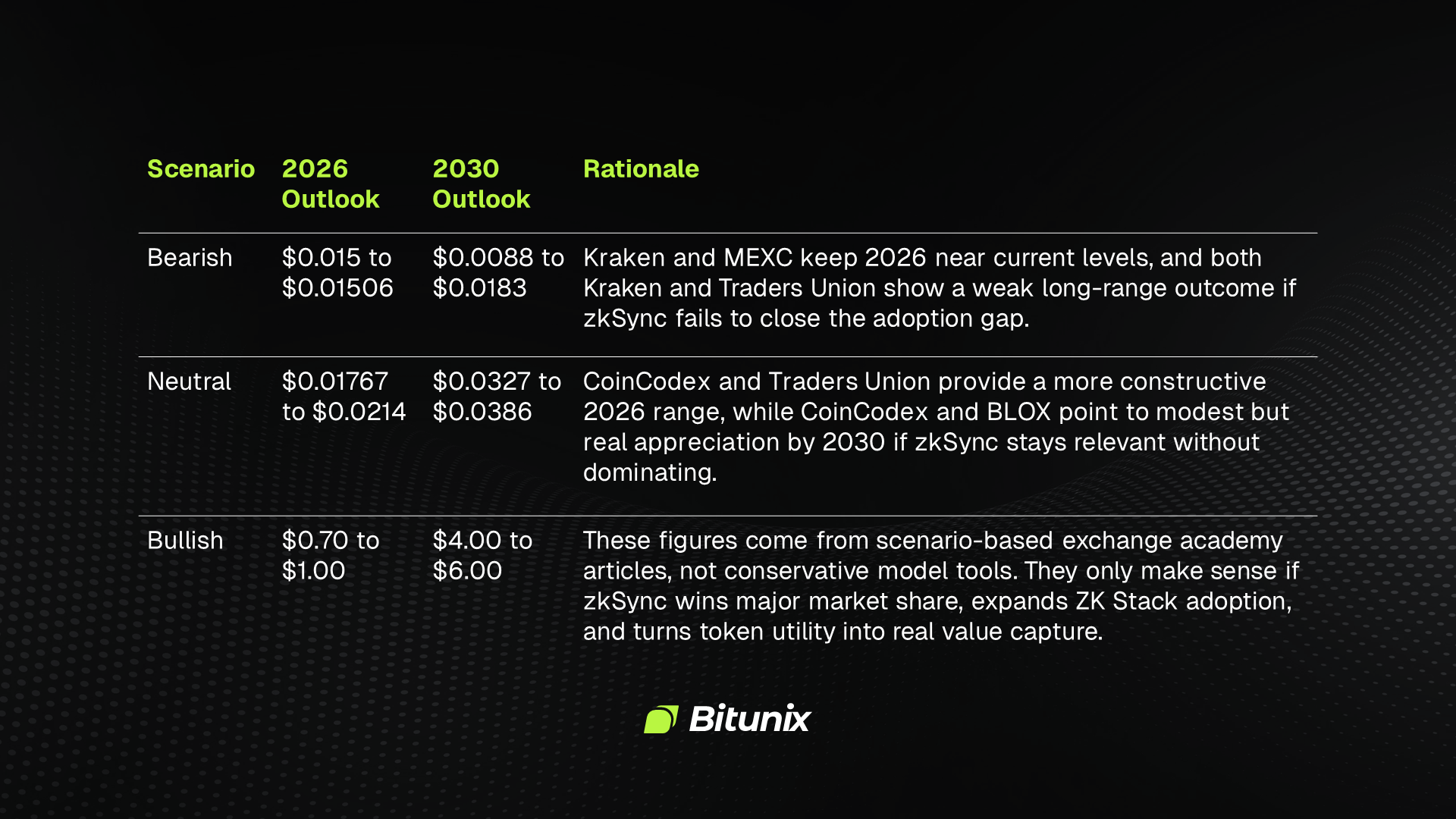
zkSync price prediction scenarios for 2026 and 2030, comparing conservative, moderate, and aggressive outcomes based on adoption, competition, and ZK Stack growth.
Conclusion: A Bet on the Future of Cryptography
zkSync remains one of the strongest technical bets in the Ethereum scaling race. Native Account Abstraction, EVM-native tooling, shared-proof infrastructure, and the ZK Stack vision give it a real reason to exist beyond short-lived token excitement. On the technology side, it has substance.
Buying ZK is a long-term bet that proof-based scaling, faster finality, and interoperable ZK chains eventually beat the current dominance of Optimistic Rollups. It is also a bet that zkSync can convert technical quality into durable market share and then convert market share into token value. You can buy ZK on Bitunix through the ZK/USDT pair if you want direct market exposure. You can download the Bitunix app, register an account, and track the market closely before taking any position. Keep your sizing sensible, since zkSync has strong tech, but the market still wants stronger evidence.
FAQ Section
What is zkSync (ZK)?
zkSync is an Ethereum Layer 2 network that uses Zero-Knowledge proofs to process transactions off-chain and settle them back to Ethereum more efficiently. ZK is the network's token and is tied to governance, network fees, and future staking-related functions.
What is the difference between zkSync Lite and zkSync Era?
zkSync Lite was the early proof-of-concept rollup and did not support arbitrary smart contracts. zkSync Era is the newer zkEVM-based network with broader smart contract functionality. Matter Labs stopped Lite development after Era launched and scheduled Lite's retirement for 2026.
What is a ZK-Rollup?
A ZK-Rollup is a Layer 2 design that batches transactions off-chain and submits a cryptographic proof showing the batch is valid. That proof replaces long fraud windows and gives faster finality and tighter security assumptions than optimistic systems.
How does zkSync compare to Arbitrum and Optimism?
zkSync offers proof-based validation and better finality characteristics, while Arbitrum and Optimism still dominate in scale, liquidity, and user activity. As of April 2026, L2Beat showed zkSync Era far behind both Base and Arbitrum in value secured and daily activity.
What is Account Abstraction?
Account Abstraction lets smart contracts act as wallets. On zkSync, that supports smart accounts, paymasters, passkeys, batching, spending controls, and more flexible recovery options. It makes crypto apps easier to use because wallet behavior becomes programmable instead of rigid.
What is the ZK Stack?
The ZK Stack is zkSync's modular framework for building custom ZK-powered chains. It supports configurable gas tokens, permissions, data availability choices, and native interoperability, while still inheriting Ethereum settlement and cryptographic security through the broader zkSync architecture.
What are Hyperchains?
Hyperchains are application-specific or custom chains built with the ZK Stack. The idea is to let many chains operate independently while still sharing proof infrastructure, interoperability, and Ethereum anchoring. The current zkSync site now frames this as a broader connected network of chains.
What is the utility of the ZK token?
The ZK token currently supports governance and network-fee functions, and the official site also points to future validator staking. A November 2025 governance proposal pushed further, linking future value capture to buybacks, burns, staking rewards, and ecosystem funding.
What are the risks of investing in zkSync?
The main risks are losing the market-share battle to bigger Layer 2s, weak token value capture, community damage from the airdrop saga, and the engineering complexity of maintaining secure proving systems. Strong technology does not automatically translate into a strong token.
Where can I buy the ZK token?
ZK is available on major centralized exchanges. CoinGecko lists active ZK markets on venues such as Bitunix, Binance, Bybit, and Coinbase Exchange.
Glossary
- zkSync Era: The main zkSync Ethereum Layer 2 network, described by L2Beat as a general-purpose ZK Rollup with full EVM compatibility.
- ZK token: The native zkSync token used for governance, network fees, and future validator staking functions.
- ZK-Rollup: A scaling design that proves batched transactions are valid with cryptographic proofs before settlement.
- Ethereum Layer 2: A network built on top of Ethereum to improve cost, speed, or throughput while still relying on Ethereum for settlement or security.
- Validity proof: A cryptographic proof showing that a transaction batch or state transition is correct.
- Account Abstraction: A wallet model where programmable smart accounts replace rigid externally owned accounts.
- Smart account: A programmable account on zkSync that can enforce custom wallet logic such as spending limits or multisig rules.
- Paymaster: A system that helps cover gas costs or supports flexible fee payment models in Account Abstraction.
- EVM compatibility: The ability to support Ethereum-style contracts and tooling with minimal or no changes.
- zkEVM: A ZK-based execution environment compatible with Ethereum smart contract development patterns.
- ZK Stack: zkSync's modular framework for launching customizable ZK-powered chains.
- Hyperchain: A chain built with the ZK Stack that participates in zkSync's broader interoperable network design.
- ZK Gateway: Shared proof and interoperability infrastructure that supports communication across upgraded ZK Chains.
- TVS: Total Value Secured, L2Beat's measure of value secured on a Layer 2.
- UOPS: User operations per second, an L2Beat activity metric that helps compare network usage across scaling projects.
Disclaimer
This article does not provide:
(i) investment advice or investment recommendations;
(ii) an offer or solicitation to buy, sell, or hold digital assets;
(iii) financial, accounting, legal, or tax advice.
Digital assets, including stablecoins and NFTs, involve high risk and may fluctuate significantly. Consider whether trading or holding digital assets is appropriate for you given your financial situation. Consult a qualified legal, tax, or investment professional when needed. You are responsible for understanding and complying with applicable local laws and regulations.
About Bitunix
Bitunix is a global cryptocurrency derivatives exchange trusted by over 3 million users across more than 100 countries. At Bitunix, we are committed to providing a transparent, compliant, and secure trading environment for every user. Our platform features a fast registration process and a user-friendly verification system supported by mandatory KYC to ensure safety and compliance. With global standards of protection through Proof of Reserves (POR) and the Bitunix Care Fund, we prioritize user trust and fund security. The K-Line Ultra chart system delivers a seamless trading experience for both beginners and advanced traders, while leverage of up to 200x and deep liquidity make Bitunix one of the most dynamic platforms in the market.
Bitunix Global Accounts
X | Telegram Announcements | Telegram Global | CoinMarketCap | Instagram | Facebook | LinkedIn | Reddit | Medium