Article Summary
- This article provides a detailed price prediction and fundamental analysis for the API3 token.
- It explains API3 as a project that connects traditional APIs directly to smart contracts without relying on third-party middlemen, using its proprietary Airnode technology.
- The bull case focuses on the superior security and cost-efficiency of first-party oracles, the growing demand for reliable off-chain data in DeFi, and the DAO-governed structure of API3.
- The bear case highlights the immense challenge of unseating Chainlink's dominant market share, the difficulty of onboarding traditional API providers to Web3, and the complexity of its insurance mechanism.
- It presents detailed price prediction scenarios (bearish, neutral, bullish) for both 2026 and 2030, based on oracle market adoption and the success of its first-party model.
Once a lending market, derivatives protocol, or synthetic asset platform starts depending on off-chain information, the oracle layer becomes part of the product itself. That is the problem API3 is trying to solve. Its core argument is that if data already comes from API providers, the cleanest design is to let those providers deliver it directly on-chain rather than routing it through additional intermediaries. And for readers already familiar with a crypto exchange like Bitunix, API3/USDT fits into the market segment focused on infrastructure that helps smart contracts access trustworthy external data.
That design puts API3 in a hard but important category. It is trying to improve how blockchains access real-world information through Airnode, decentralized APIs, and on-chain data feeds sourced directly from the source. The upside is better data integrity, fewer trust assumptions, and potentially lower development costs. The harder part is market share, since API3 is still fighting in a field where Chainlink remains the default oracle standard for much of DeFi.
This analysis will examine API3's unique Airnode technology and its first-party oracle model, and will provide data-driven price predictions for 2026 and 2030.
The Technology and Ecosystem
The core problem API3 is attacking is the structure of third-party oracles. In a conventional oracle design, data flows from the original source to an external node operator before reaching the blockchain. Every extra hop adds cost, latency, and another place where the system can fail or be manipulated. The current API3 documentation still presents that as the central security issue behind older oracle designs, and the protocol's market positioning in 2025 and 2026 has stayed consistent with that view.
API3's own documentation puts the point clearly:
"all oracle data comes from API providers in practice, and the trust-minimized way to receive data is for there to be no third-party intermediaries."
Airnode is API3's serverless oracle framework, built to bridge off-chain APIs and on-chain applications with maximum security and minimal latency. Its set-and-forget design makes it easier for API providers to deploy. In other words, Airnode is supposed to make first-party oracle infrastructure realistic for data businesses that do not want to become full crypto-native node operators.
API3's blog shows deployments on Ink, Berachain, Soneium, Unichain, Ronin, and Katana during the first half of 2025, with more than 190 data feeds made available through API3 Market on several of those chains. The official homepage also says API3 now offers 100-plus data feeds on every chain it supports, while its Oracle Extractable Value (OEV) rewards dashboard shows $408,552 already paid back to integrated protocols.
The API3 token ties that system together through staking, governance, and economic backstopping. Staked API3 tokens make holders eligible for rewards and governance rights, while DefiLlama's protocol page shows about $19.8 million staked, around 44.06% of the market cap, and a treasury of nearly $11.09 million. DefiLlama also describes API3 as a first-party oracle provider and risk curator, which reflects how closely the token is now tied to OEV-enabled products and risk-managed oracle services.
The Bull Case: Security and Efficiency
Current price models already reflect the upside investors see remaining if API3's architecture gains real traction. CoinGecko currently places API3 near $0.33, with a market cap of around $45.9 million, roughly 140 million tokens in circulation, and about $33.5 million in 24-hour trading volume.
Price forecasts for API3 already show a market with very different expectations for the project's growth. CoinCodex's price prediction places API3 around $0.30 to $0.34 in 2026 and about $0.13 by 2030, while Kraken's model, MEXC's forecast, and Coinbase's price prediction stay in a more conservative band near $0.32 to $0.33 for 2026 and roughly $0.39 to $0.40 by 2030. CoinLore's model is much more optimistic, with a 2026 range of $0.1934 to $1.22 and a 2030 target near $4.77. That gap shows why any serious API3 price prediction has to account for very different assumptions about adoption, market share, and execution.
1. Superior Security
Security is the strongest bull argument because API3's design directly removes one layer of trust from the oracle chain. If the data provider signs and serves its own data on-chain, there is less room for an outside node operator to tamper with or mishandle that payload. API3's live-on-Katana announcement from June 2025 framed this as source-level integrity, and the current docs keep emphasizing that first-party oracles minimize intermediary risk. For DeFi protocols that care about liquidation accuracy, collateral safety, or stable pricing, that is a meaningful design difference.
The broader oracle-risk discussion in 2026 also supports that concern. CertiK's February 2026 report on enterprise DLT oracles argued that smart contracts can execute flawlessly yet still produce the wrong outcome if the underlying data is incorrect. That is especially relevant for any first-party oracle pitch, because API3 is effectively saying that the best way to reduce oracle failure risk is to shorten the path between the source and the chain as much as possible.
2. Cost Efficiency
Cost is the next major advantage. Traditional third-party oracle networks make developers pay for extra node operators, extra coordination, and extra infrastructure between the source and the chain. API3's first-party oracle documentation explicitly calls third-party oracles insecure and expensive, while Airnode's design was built to reduce deployment and maintenance complexity for providers.
The homepage markets it as oracles that pay you, because OEV recapture can return value to dApps rather than letting searchers or liquidators keep all of it. Those auctions can convert oracle-linked liquidation opportunities into protocol-native revenue without changing app logic, meaning that API3 is arguing that the oracle layer can become a source of revenue.
3. The Insurance Model
API3's insurance-style mechanism is the most unusual part of the token's value proposition. Beyond governance, the API3 token also serves as collateral within the DAO's broader trust model, where stakers back the protocol and align with feed performance. In the Aragon case study and the current staking docs, the token is described as both a governance tool and an economic mechanism that provides coverage and trust for dApps that rely on API3 feeds.
DefiLlama currently shows API3 with about $42.14 million in oracle TVS on its oracle ranking pages, while the protocol page shows annualized earnings of around $40,382 and meaningful staking participation. Those numbers are not huge, but they do suggest that API3 is operating as a live oracle business.
The Bear Case: The Chainlink Monopoly
Price models still lean cautiously overall, and that caution makes sense. CoinCodex's 2030 estimate sits far below current levels, while Kraken, MEXC, and Coinbase only suggest mild appreciation even under steady-growth assumptions. That is not the profile of a market that already expects API3 to overthrow the incumbent. It is the profile of a market that sees technical merit, but still wants proof that the project can turn design advantages into large-scale usage.
1. The Chainlink Moat
The first obstacle is that Chainlink already owns the category in practice. DefiLlama's oracle ranking page currently shows Chainlink securing about $33.606 billion in total value, while API3's comparable figure is around $42.14 million. That is a gap of roughly three orders of magnitude. A protocol does not close that kind of distance just by having a cleaner architecture. It needs stronger distribution, more integrations, more trust from developers, and a compelling reason for established dApps to switch.
2. Onboarding Friction
Getting traditional API providers on board is the second big challenge for API3, because a system that feels simple by crypto standards can still look unnecessary or unattractive to a Web2 data business. Even with Airnode designed as a serverless first-party oracle node for API providers, API3 is still asking companies that may have little interest in token governance, DAO processes, or on-chain markets to participate in a blockchain-based system they were not originally trying to join.
That friction becomes more visible when you compare API3's distribution style with Chainlink's. Chainlink lets dApps plug into a network they already know, while API3 often needs the data provider side to become more involved. The project can solve that with enough product polish and enough clear economic upside, but until that happens at scale, its rollout will naturally be slower.
3. Insurance Complexity
The insurance-style design and collateral layer also create their own risks, because a system that looks robust under normal conditions can still face real strain during a serious oracle malfunction or a broader market shock. API3's own DAO documentation says staked tokens are used as collateral for on-chain service coverage, which is exactly what gives the model its appeal but also what makes it harder to manage at scale when multiple important feeds fail at once.
Once a protocol depends on staked collateral to absorb losses, the economic and operational pressure rises quickly in stressed conditions, especially if several claims hit at the same time or confidence in the oracle system weakens more broadly.
The broader 2026 oracle-risk discussion reinforces that concern. CertiK's enterprise oracle report argued that when oracle data is incorrect, the contract can still produce a correct outcome, and still result in a legally or financially costly outcome. A report from S&P Global Ratings made a related point about crypto oracles and noted that their security controls can lack transparency. API3's insurance model is meant to reduce that trust gap, but it also creates a part of the protocol that has to prove itself under stress.
API3 Price Prediction Scenarios (2026 & 2030)
The forecast ranges below reflect a market that recognizes API3's design strengths but still prices in serious execution risk. The conservative edge comes from CoinCodex, Kraken, MEXC, and Coinbase. The more ambitious upside comes from CoinLore. Those ranges are wide because API3 is still being valued as a challenger. Another API3 price prediction cycle will likely keep looking like this until the protocol proves it can scale beyond niche first-party use cases.
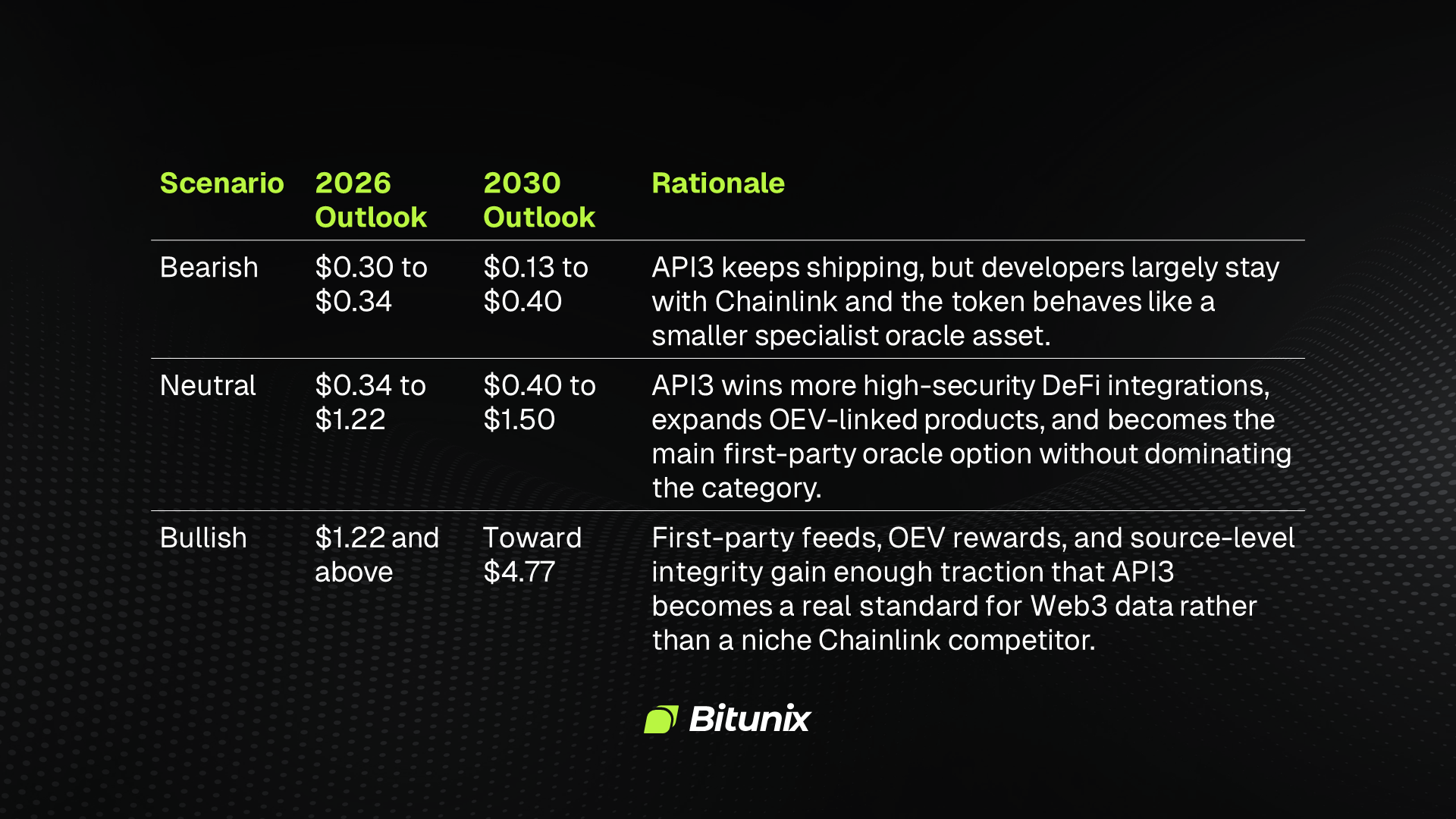
API3 price prediction scenarios for 2026 and 2030, comparing bearish, neutral, and bullish outcomes based on first-party oracle adoption, DeFi integrations, and competition with larger oracle networks.
Conclusion: A Bet on Direct Data
API3 represents a genuine architectural challenge to the third-party oracle model. It is not trying to out-market Chainlink with the same design, but rather to change the design itself through Airnode, first-party oracle delivery, OEV recapture, and token-backed governance and coverage. The project already has live deployments across multiple chains, more than 100 feeds on supported environments, and over $408,000 in OEV rewards paid back to integrated protocols.
Investing in API3 is still a long-term bet on direct data delivery, decentralized APIs, and the idea that a cleaner oracle design can eventually win meaningful market share. That upside is real, but so are the constraints: Chainlink's moat, provider onboarding friction, and the complexity of running a token-backed insurance model. If you want exposure, Bitunix offers the API3/USDT trading pair, so you can download the Bitunix app, register, and decide whether the current valuation looks like a cheap entry into Web3 data infrastructure or just the right price for a difficult fight.
FAQ
What is API3?
API3 is an oracle project that enables API providers to deliver data directly on-chain via first-party oracle nodes called Airnodes. The goal is to reduce intermediaries, improve source-level integrity, and support decentralized smart contract APIs.
How does API3 differ from Chainlink?
API3 centers on first-party oracles, where data providers run their own nodes, while Chainlink is known for its broader third-party oracle network. API3 argues that its structure reduces trust assumptions and intermediary risk, but Chainlink still dominates market share and TVS.
What is a first-party oracle?
A first-party oracle is an oracle operated by the actual data provider rather than an external node operator. In API3's framework, this means the source signs and delivers its own data, reducing intermediary risk and improving transparency.
What is an Airnode?
Airnode is API3's serverless oracle framework. It is designed to let traditional API providers deploy oracle infrastructure more easily and deliver signed data directly to smart contracts without relying on a third-party relay operator.
Why are third-party oracles considered less secure?
Third-party oracles add more hops between the source and the chain. That means more cost, more complexity, and more points where data can fail or be mishandled.
What is the utility of the API3 token?
The API3 token is used for staking, DAO governance, and economic backstopping inside the protocol's trust model. Stakers can earn rewards and participate in governance, while the token also helps collateralize the protocol's insurance-style coverage approach.
How does the API3 DAO work?
The API3 DAO lets token holders stake tokens, earn rewards, and participate in governance decisions. The token is tied to both voting rights and the protocol's economic trust model, which is meant to align feed users, stakers, and the network itself.
What is the API3 insurance mechanism?
API3's insurance-style model uses staked API3 tokens as economic backing for oracle services. The idea is to provide quantifiable trust and accountability for dApps using feeds, though the model remains harder to evaluate at a very large scale than simple price-feed delivery.
What are the risks of investing in API3?
The main risks are Chainlink's entrenched market position, the difficulty of getting traditional API providers to run Airnodes, and the complexity of scaling a token-backed insurance model.
Where can I buy API3 tokens?
API3 tokens trade on major centralized exchanges, with CoinGecko listing Binance, Bitunix, OKX, and Gate among the more active venues.
Glossary
- API3 token: The native token used for staking, governance, and economic backing inside the API3 ecosystem.
- First-party oracle: An oracle run by the actual data provider rather than an external node operator.
- Airnode: API3's serverless oracle framework for connecting API providers directly to smart contracts.
- Decentralized APIs: API-driven data services delivered to Web3 applications with minimized intermediary trust.
- Chainlink competitor: A project trying to take oracle market share from Chainlink through a different architecture or economics.
- Web3 data: Off-chain information, such as prices or external events, that smart contracts need to operate.
- OEV: Oracle Extractable Value, or value that can be recaptured around oracle updates instead of leaking to outside actors.
- API3 DAO: The on-chain governance system through which stakers help steer API3.
- Oracle TVS: Total value secured by an oracle, representing the value exposed if the oracle fails.
- Source-level integrity: The idea that data reaches the chain directly from the original provider.
- Third-party oracle: An oracle design where outside node operators relay source data to the blockchain.
- Staking pool: The pool where API3 holders lock tokens to earn rewards and participate in governance.
- Insurance-style collateral: Staked token backing meant to support trust and coverage around oracle services.
- Data feed: A stream of off-chain information delivered on-chain for smart contract use.
- On-chain median: An aggregation method where multiple first-party feeds are combined on-chain to improve robustness.