
Article Summary
- This article provides a detailed price prediction and fundamental analysis for the Horizen (ZEN) token.
- It explains the core technology and use cases of the Horizen (ZEN) ecosystem.
- The bull case focuses on network adoption, technological upgrades, and broader market trends.
- The bear case highlights potential regulatory challenges, competition, and market volatility.
- It presents detailed price prediction scenarios (bearish, neutral, bullish) for both 2026 and 2030.
Horizen has changed a lot from its earlier privacy-coin identity, and that shift makes ZEN worth a fresh look for long-term crypto investors. The project now centers on Base, a privacy-focused application infrastructure, and a more DeFi-connected version of the Horizen (ZEN) token. Instead of operating mainly as a standalone Layer 1, Horizen has moved toward a model built around Ethereum-aligned infrastructure, compliance-aware privacy, and appchain development.
Horizen is a blockchain ecosystem designed to support private, verifiable, and scalable Web3 applications. For traders following ZEN markets, Bitunix is a crypto exchange that provides access to ZEN/USDT trading pairs, giving active users another way to track price movement and market sentiment.
This analysis examines Horizen's technology, current market position, token utility, and data-based price scenarios for 2026 and 2030.
The Technology and Ecosystem
Horizen's investment case now depends on how well its 2025 migration changes the project's role in Web3. The old version of Horizen focused heavily on privacy, nodes, sidechains, and its own network structure. The new direction positions ZEN on Base as an ERC-20 token and lays the groundwork for a programmable privacy layer for applications that need both confidentiality and auditability.
From Legacy Chain to Base-Based Privacy Infrastructure
Horizen completed its ZEN migration to Base on July 23, 2025. That move turned ZEN into an ERC-20 token and moved the project closer to Base's liquidity, developer ecosystem, and DeFi infrastructure. Horizen's official ZEN page says the migration gives ZEN access to Base's scalability, liquidity, and institutional reach while preserving its mission of building a secure and verifiable privacy layer for Web3.
Horizen's shift to Base changes what investors need to evaluate. ZEN now belongs to a broader Base-centered ecosystem where DeFi access, smart contract compatibility, and application development carry more weight than its legacy privacy-chain identity. That gives the Horizen (ZEN) ecosystem a clearer market path, but it also creates new expectations around liquidity, utility, and real app usage.
The project's roadmap describes the move in direct terms:
"With updated tokenomics and reallocation of unmined ZEN to ecosystem growth, this move strengthens ZEN's role as the engine of private, compliant dApps."
Ecosystem Growth, Base Liquidity, and Appchain Plans
Horizen's 2025 roadmap included several major steps: the DAO vote to move to Base, token claim development, security audits, ZEN migration, ZEND and EON deprecation, the Horizen L3 testnet, and the first projects funded by the Horizen x Thrive Ecosystem Fund. The roadmap also listed Q4 2025 goals, including the Horizen L3 mainnet launch, the first apps live on mainnet, the ZEN staking relaunch, and a confidential privacy product builder preview release.
The migration hub confirms that ZEN became live on Base and tradable on Base DEXs, including Aerodrome and Uniswap pools. It also states that users with legacy ZEN can claim migrated assets at a 1:1 ratio. That gives ZEN holders a path from the old mainchain to the new ERC-20 structure, though migrations always require careful user education because phishing and fake claim portals pose a real risk during these transitions.
Horizen's ecosystem strategy now depends on whether developers build useful privacy-enabled applications. The roadmap points to private stablecoins, encrypted consumer payments, confidential DeFi, view keys, access logs, and developer support for Solidity, Python, and Node.js. This is a practical approach because developers usually prefer privacy tools that work with the infrastructure they already know. Familiar support for Solidity, Python, and Node.js can reduce friction and make Horizen easier to test, integrate, and build on.
ZEN Tokenomics and Utility
The Horizen (ZEN) token still keeps its Bitcoin-like fixed supply structure. The migration hub states that ZEN's fixed 21 million supply remains unchanged, while the new tokenomics focus on incentives, utility, adoption, and long-term value. It also notes that moving into Base brings ZEN closer to a liquid ecosystem and improves access for users and developers.
CoinGecko lists Horizen's all-time high at $165.92 and its all-time low at $3.26. It also shows about 18 million ZEN in circulation and a market cap of nearly $125.7 million in early May 2026. That creates a mixed picture: ZEN has history, supply scarcity, and exchange liquidity, but the token still trades at a heavy discount to its previous cycle high.
For investors, ZEN's new tokenomics question goes beyond fixed supply and focuses on utility. The token needs demand from governance, app usage, staking, DeFi liquidity, and privacy-enabled applications. A hard cap helps the scarcity narrative, but scarcity alone does not support price appreciation. A scarce token still needs people to use it, hold it, or trade it for a clear reason.
The Bull Case: Drivers of Growth
The upside case for the Horizen price prediction depends on execution after the Base migration. Horizen has a known brand, a capped token supply, a new ERC-20 structure, and a clearer privacy appchain direction. The next step is turning those features into users, applications, and sustained liquidity.
Mainstream Demand for Compliant Privacy
Horizen's adoption case is tied to a problem that public blockchains still struggle with: transparency is useful for verification, but it can expose sensitive data. Businesses, DeFi protocols, payment apps, and consumer platforms often need privacy controls that also support audits and regulatory oversight.
Horizen's roadmap describes this focus as privacy for a compliant Web3. It positions the project around confidential finance, verifiable AI, encrypted consumer payments, and private stablecoins. The roadmap also says Horizen supports optional view keys and access logs so developers can tailor privacy without removing auditability.
This approach gives Horizen a more specific use case than a generic privacy coin. The market has moved away from old-style privacy narratives because many exchanges and regulators view them with caution. Horizen's newer positioning aims to address how to maintain useful privacy while supporting compliance needs. If that model gains traction, ZEN can benefit from a stronger utility story.
Ecosystem Expansion on Base
Horizen's migration to Base gives the project access to one of the most active Ethereum Layer 2 ecosystems. The official migration page says ZEN is live and liquid on Base DEXs, including Aerodrome and Uniswap. It also states that exchange-supported users do not need to handle the migration manually if their exchange supports the process.
That matters for growth because liquidity reduces friction. Developers can build apps more easily when users can access the token through familiar wallets, DEXs, and Base infrastructure. Traders also get clearer market access, while projects funded through the ecosystem program can build around a more composable token environment.
More optimistic forecast providers are pricing in a stronger recovery following Horizen's move to Base. Traders Union's model projects ZEN around $30.69 by the end of 2026 and about $36.79 by the end of 2030. Those figures depend on strong market conditions and a major improvement from current levels, so they work better as a bullish reference than a base case.
Market Recovery and Scarcity Narrative
Broader market sentiment can help ZEN because it has a capped 21 million supply, a recognizable history, and a sharp drawdown from its all-time high. When altcoin liquidity returns, older assets with clear relaunch narratives can move quickly, meaning traders often notice them when narratives rotate.
Changelly's 2026 forecast offers a more moderate recovery range, with August 2026 estimates ranging from $5.95 minimum to $7.43 maximum. Bitget's long-term forecast is also conservative, projecting ZEN at $7.19 in 2026 and $8.73 in 2030, based on its fixed-growth model. Together, those forecasts show that not every model expects a large breakout.
For the bull case to work, ZEN needs Base-based utility, credible privacy apps, staking participation, and enough liquidity to keep users engaged after the migration.
The Bear Case: Potential Risks
The downside case for ZEN comes from migration execution, regulatory pressure, competition, and uncertain token demand. A project can complete a major technical pivot and still struggle if developers do not build, and users do not arrive.
Regulatory Pressure Around Privacy and Utility
Regulatory risk is more specific to Horizen than to many infrastructure tokens because privacy remains part of its core identity. Horizen has shifted toward compliance-aware privacy, view keys, access logs, and auditability, but projects in this category still need careful messaging.
Claims around private finance, encrypted payments, and confidential DeFi can attract scrutiny if they appear to enable hidden activity rather than legitimate data protection.
The 2026 SEC guidance on crypto assets also matters for tokens with governance, staking, protocol functions, and wrapped or migrated assets. The SEC said its guidance clarifies how federal securities laws apply to airdrops, protocol mining, protocol staking, wrapping, and different token categories. For ZEN, the practical risk is how staking, governance, migration claims, and appchain incentives are structured and promoted across different markets.
Competition From Privacy, Layer 2, and Appchain Projects
Horizen competes across several crowded categories simultaneously. It faces privacy-focused projects, Ethereum Layer 2 networks, appchain frameworks, zero-knowledge infrastructure providers, and general-purpose smart contract platforms. Developers can choose from Base-native apps, Arbitrum, Optimism, Polygon, zkSync, Starknet, Manta, Aztec-style privacy infrastructure, and other ecosystems, depending on tooling, grants, liquidity, and user base.
Competition also comes from the fact that Base itself already has a growing developer ecosystem. Horizen must demonstrate that its privacy layer provides sufficient value for builders to adopt it rather than continue using existing tools, and that is not easy. Developers follow users, grants, liquidity, and stable infrastructure. If Horizen cannot turn its roadmap into working applications, the token can underperform even after a successful migration.
CoinCodex's price prediction reflects a cautious market view. Its model projects ZEN at $5.55 by the end of 2026 and $5.72 by 2030, which implies limited long-term upside from current levels. That forecast suggests the market still needs proof that the Base migration translates into durable token demand.
Macroeconomic Pressure and Liquidity Risk
Macro pressure affects ZEN because smaller crypto assets depend heavily on risk appetite. When liquidity tightens, traders often move toward Bitcoin, Ethereum, stablecoins, or cash. Tokens outside the largest market caps can see sharp moves because order books are thinner and sentiment changes quickly.
CoinGecko's May 2026 market data shows ZEN with about 18 million circulating tokens and a market cap of around $125.7 million. That size gives the token enough visibility, but it is still far smaller than major Layer 1, Layer 2, or DeFi assets. Smaller markets can recover quickly, but they can also fall fast when buyers step away.
A careful crypto price prediction should treat liquidity as part of the risk profile. ZEN's new direction is interesting, but price still depends on exchange depth, on-chain liquidity, app usage, and broader market conditions.
Horizen Price Prediction Scenarios (2026 and 2030)
Forecasts for ZEN vary because each model makes different assumptions about the Base migration, privacy app demand, liquidity, and market recovery. Conservative forecasts keep ZEN close to current levels, while bullish models assume that Horizen's appchain strategy and capped supply can support a stronger repricing. This Horizen price prediction groups those views into bearish, neutral, and bullish scenarios.
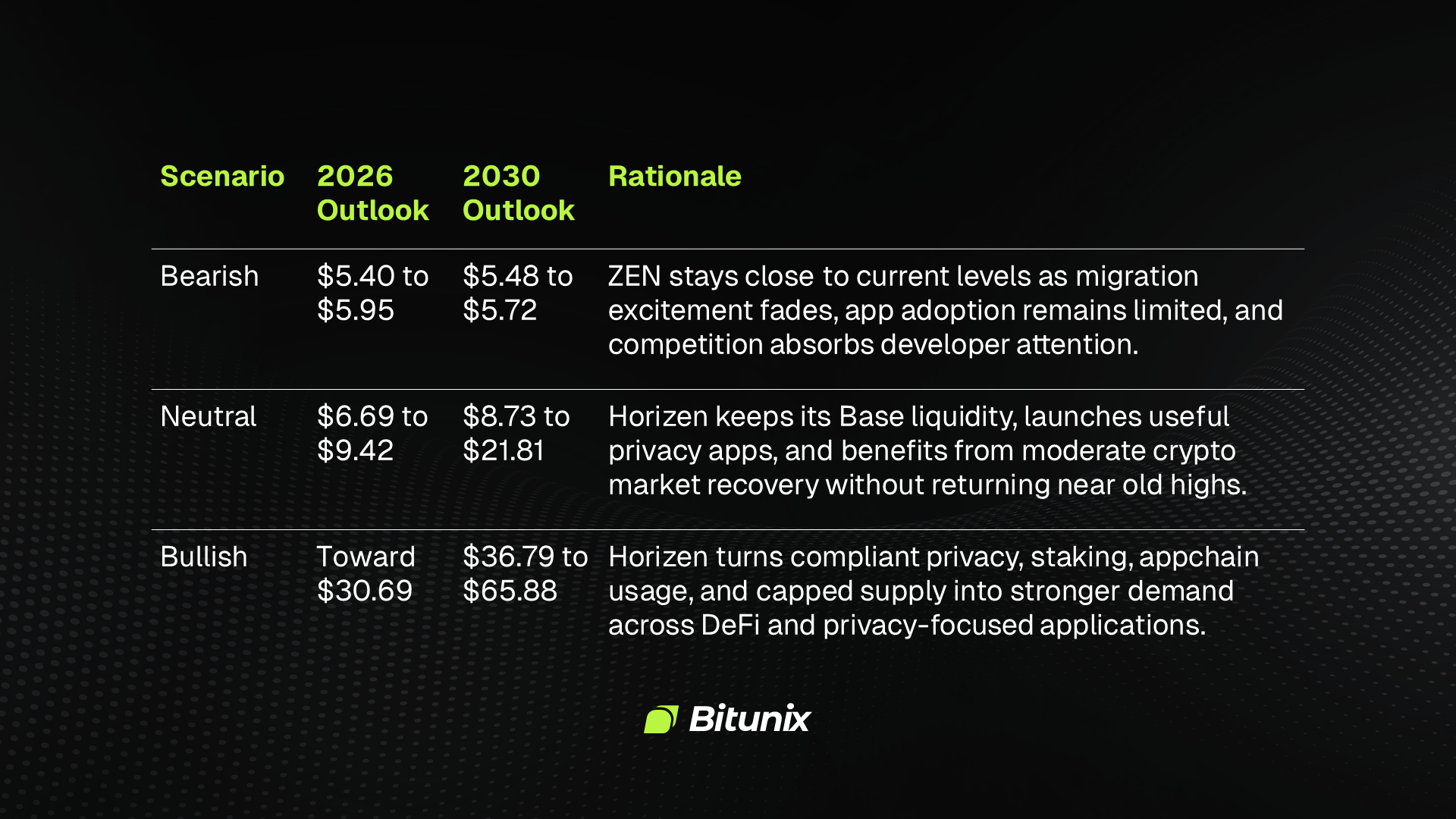
Horizen (ZEN) price prediction scenarios compare potential outcomes based on Base liquidity, app adoption, privacy-focused use cases, competition, and broader market recovery.
Conclusion: The Future of Horizen (ZEN)
Horizen (ZEN) has a clearer investment story following its move to Base, but its risk profile remains high. The project has a capped token supply, a completed Base migration, updated ecosystem goals, and a stronger focus on privacy for compliant Web3 applications.
Investing in ZEN requires a long-term perspective and an understanding of its unique value proposition. The upside case depends on appchain execution, liquidity, developer adoption, staking, and real demand for compliance-aware privacy. The downside case is also clear. Competition is intense, regulation remains important, and the market will not reward ZEN forever just because it has history.
For traders, ZEN is best treated as a high-risk ecosystem token tied to a major migration story. Watch Base liquidity, app launches, staking updates, governance activity, and broader market sentiment before making decisions. Ready to trade? Download the Bitunix app, register, and access ZEN/USDT markets with tools for active trading.
FAQ
What is Horizen (ZEN)?
Horizen is a blockchain ecosystem focused on privacy-enabled Web3 applications. ZEN is its native token, now migrated to Base as an ERC-20 asset. The project aims to support compliant privacy, appchain development, governance, and utility across decentralized applications.
How does Horizen (ZEN) work?
Horizen now uses Base infrastructure to support ZEN as an ERC-20 token while building toward privacy-focused appchain functionality. Its technology roadmap includes confidential compute, selective disclosure, developer-friendly tools, and applications that need private execution with auditability.
What is the utility of the Horizen (ZEN) token?
ZEN supports governance, ecosystem incentives, transaction activity, staking plans, and privacy-forward applications. Its future value depends on whether users and developers need ZEN inside the new Base-centered Horizen ecosystem.
Who are Horizen's (ZEN) main competitors?
Horizen competes with privacy infrastructure projects, Ethereum Layer 2 networks, zero-knowledge platforms, appchain ecosystems, and general smart contract networks. Its rivals include projects focused on confidential DeFi, privacy tooling, scalable execution, and developer-friendly blockchain infrastructure.
Is Horizen (ZEN) a good investment for the long term?
ZEN is a high-risk long-term investment. The Base migration gives Horizen a clearer direction, but the token still needs strong app adoption, liquidity, and utility. Investors should track the execution of the roadmap, ecosystem growth, staking, and market conditions before buying.
What factors could drive the price of Horizen (ZEN) up?
ZEN can rise if Horizen gains developer adoption, launches useful privacy apps, expands liquidity on Base, and strengthens staking or governance demand. Broader crypto market recovery and renewed interest in privacy-focused infrastructure can also support price growth.
What are the main risks associated with Horizen (ZEN)?
The main risks include weak app adoption, migration confusion, regulatory pressure, strong competition, low liquidity, and broader market downturns. ZEN also needs a clear utility after the migration. Without real usage, the token can remain under pressure.
How does Horizen (ZEN) differ from Bitcoin or Ethereum?
Bitcoin mainly serves as a decentralized store of value and payment network. Ethereum supports smart contracts and decentralized applications. Horizen focuses on privacy-enabled application infrastructure and has moved ZEN to Base to support DeFi access and appchain development.
What is the all-time high of Horizen (ZEN)?
Horizen reached an all-time high of $165.92. The token traded far below that level in early May 2026, which shows how much value the market removed after previous cycles and why recovery forecasts vary widely.
Where can I buy Horizen (ZEN)?
You can buy or trade ZEN on centralized exchanges that support the token and through supported Base-based liquidity venues. Bitunix offers ZEN/USDT for users who want market access. Always check fees, liquidity, and regional availability first.
Glossary
- Horizen: A blockchain ecosystem focused on privacy-enabled Web3 applications, Base integration, governance, and ZEN-powered utility.
- ZEN: Horizen's native token, now migrated to Base as an ERC-20 asset with a fixed 21 million supply.
- Base: An Ethereum Layer 2 network that gives ZEN access to lower fees, DeFi liquidity, and broader smart contract infrastructure.
- ERC-20: A common Ethereum token standard used for fungible assets that operate across compatible wallets, apps, and exchanges.
- Appchain: A blockchain or network layer designed for specific applications, use cases, or ecosystem needs.
- Confidential Compute: Technology that protects data during processing, helping applications keep sensitive information private while still executing on-chain logic.
- Compliance-Aware Privacy: Privacy infrastructure designed to protect user or business data while still supporting auditability, disclosure, and regulatory requirements.
- View Key: A tool that allows authorized parties to view selected private transaction or application data when required.
- DeFi: Decentralized finance applications that support trading, lending, borrowing, liquidity, and other financial activity without traditional intermediaries.
- Staking: The process of locking or delegating tokens to support network functions and potentially earn rewards.
- Tokenomics: The economic design of a token, including supply, utility, incentives, distribution, and value capture.
- Market Cap: A token's total market value, calculated by multiplying current price by circulating supply.
- Circulating Supply: The number of tokens currently available and tradable in the market.
- Crypto Price Prediction: An estimate of future token value based on market data, adoption, technical trends, and investor sentiment.
- Blockchain Technology: A distributed ledger system that supports tokens, smart contracts, decentralized applications, and verifiable on-chain activity.
Disclaimer
This article does not provide:
(i) investment advice or investment recommendations;
(ii) an offer or solicitation to buy, sell, or hold digital assets;
(iii) financial, accounting, legal, or tax advice.
Digital assets, including stablecoins and NFTs, involve high risk and may fluctuate significantly. Consider whether trading or holding digital assets is appropriate for you given your financial situation. Consult a qualified legal, tax, or investment professional when needed. You are responsible for understanding and complying with applicable local laws and regulations.
About Bitunix
Bitunix is a global cryptocurrency derivatives exchange trusted by over 3 million users across more than 100 countries. At Bitunix, we are committed to providing a transparent, compliant, and secure trading environment for every user. Our platform features a fast registration process and a user-friendly verification system supported by mandatory KYC to ensure safety and compliance. With global standards of protection through Proof of Reserves (POR) and the Bitunix Care Fund, we prioritize user trust and fund security. The K-Line Ultra chart system delivers a seamless trading experience for both beginners and advanced traders, while leverage of up to 200x and deep liquidity make Bitunix one of the most dynamic platforms in the market.
Bitunix Global Accounts
X | Telegram Announcements | Telegram Global | CoinMarketCap | Instagram | Facebook | LinkedIn | Reddit | Medium