

Article Summary
- This article provides a comprehensive comparison of Cardano and Solana, two of the most prominent Layer 1 blockchains competing for market share.
- It frames the core difference in their philosophies: Cardano's slow, methodical, research-driven approach versus Solana's focus on high speed, high throughput, and rapid iteration.
- The guide analyzes the strengths and weaknesses of each platform, acknowledging Cardano's security and decentralization against Solana's superior speed and developer adoption.
If you watch Layer 1 blockchains long enough, you start seeing the same story told in different costumes. While Cardano prioritizes correctness, careful design, and formal methods, Solana prioritizes speed, developer ergonomics, and shipping features fast.
And yes, you can trade both on a crypto exchange like Bitunix, but this guide is not about picking a side for you. It is about helping you understand how each network works, what each optimizes for, and what that means when you look at real ecosystem data and real constraints.
You will see people treat this as a simple SOL vs ADA argument. In practice, you are comparing two very different engineering philosophies, plus two different ecosystem shapes.
This deep dive will compare Cardano and Solana across key metrics, technology, performance, ecosystem, and tokenomics, to help you understand which of these top-tier blockchains might have the edge in the long run.
The Core Technology
Before you compare TPS claims, tokenomics, or app ecosystems, it helps to start with the why behind each chain’s design. Cardano and Solana start from different assumptions about security, time, and developer experience, so they naturally optimize for different bottlenecks.
To keep the tech comparison clean, focus on these four building blocks:
- Consensus design: How the chain decides what’s valid, and how it recovers from stress
- Time and ordering: How transactions get sequenced and confirmed
- Programming model: What developers write, and how execution behaves
- Governance and upgrades: How changes get proposed, approved, and shipped
Cardano (ADA): The Academic Approach
Cardano’s consensus story starts with Ouroboros, a proof-of-stake family designed to come with formal guarantees. The Cardano documentation describes Ouroboros as the consensus protocol for Cardano and highlights a research-first posture:
"Ouroboros is the consensus protocol for Cardano, the first provably secure proof-of-stake protocol, and the first blockchain protocol based on peer-reviewed research."
That explains why Cardano tends to move carefully, with long research lead times and a preference for designs that can be analyzed and verified. In 2025, that same mindset showed up in ecosystem priorities reported by Cardano’s own developer survey coverage, where higher throughput and better documentation were highlighted as priorities, alongside a strong focus on identity and authentication use cases.
On programming, Cardano is known for a security-forward culture that historically leaned on Haskell and Plutus for smart contracts, and a UTXO-style accounting model (extended UTXO) that makes state changes explicit. The trade is familiar: you often get more predictable execution patterns and clearer reasoning about state, but developer onboarding can feel heavier than ecosystems that default to mainstream web tooling.
Governance also matters in Cardano’s technical identity, because it directly affects how changes land. In January 2026, Cardano’s news covered that an updated Cardano Constitution received support from 79% of active voting stake and took effect at an epoch boundary on January 24, 2026. The update also tightened governance standards (like requiring immutable links for off-chain documents) and stopped recognizing budget info actions, so treasury withdrawals must be fully self-contained.
Solana (SOL): The High-Performance Engine
Solana’s design begins with a different premise, which makes time explicit and execution fast. Solana uses Proof of History (PoH) as a cryptographic clock, alongside Proof of Stake for validator selection and consensus. The Solana developer guide explains PoH’s role like this:
"Since Solana uses PoH as a trusted clock, a transaction’s recent blockhash can be thought of as a timestamp."
That same guide gets more specific about mechanics that traders and developers actually feel. It notes that slots are configured to last about 400ms, and that blockhashes expire quickly, which pushes Solana applications to handle confirmation and retries properly. Solana's speed shows up as a set of engineering constraints that reward good client design and punish sloppy transaction handling.
If you want current ecosystem signals, look at usage and value locked. DeFi Llama’s Solana chain page shows $6.355B in DeFi TVL, plus very high daily usage, about 2.18M active addresses, and 87.48M transactions in the last 24 hours, alongside meaningful fees (around $650,348 in chain fees over 24h). Those numbers move day to day, but the scale difference versus smaller ecosystems is usually persistent enough to inform how people think about liquidity, discovery, and developer mindshare.
Solana also has a very explicit story about continuous performance work in 2025 and 2026. A June 2025 Solana network health report highlighted growth in developer participation and discussed the validator client landscape, which is part of the network’s resilience strategy. Then, in 2026, Solana published updates focused on network upgrades and performance improvements, signaling that the chain treats throughput and stability as an ongoing engineering program rather than a solved problem.
One practical point that often gets skipped in debates is validator requirements. Solana validators tend to need stronger hardware than many proof-of-stake chains, and that affects decentralization and operator diversity.
And if you are a trader looking at execution, you feel the difference in how quickly markets react. When SOL/USDT breaks a level, you often see liquidity respond fast because the ecosystem has many venues and very active participants.
The Head-to-Head Comparison
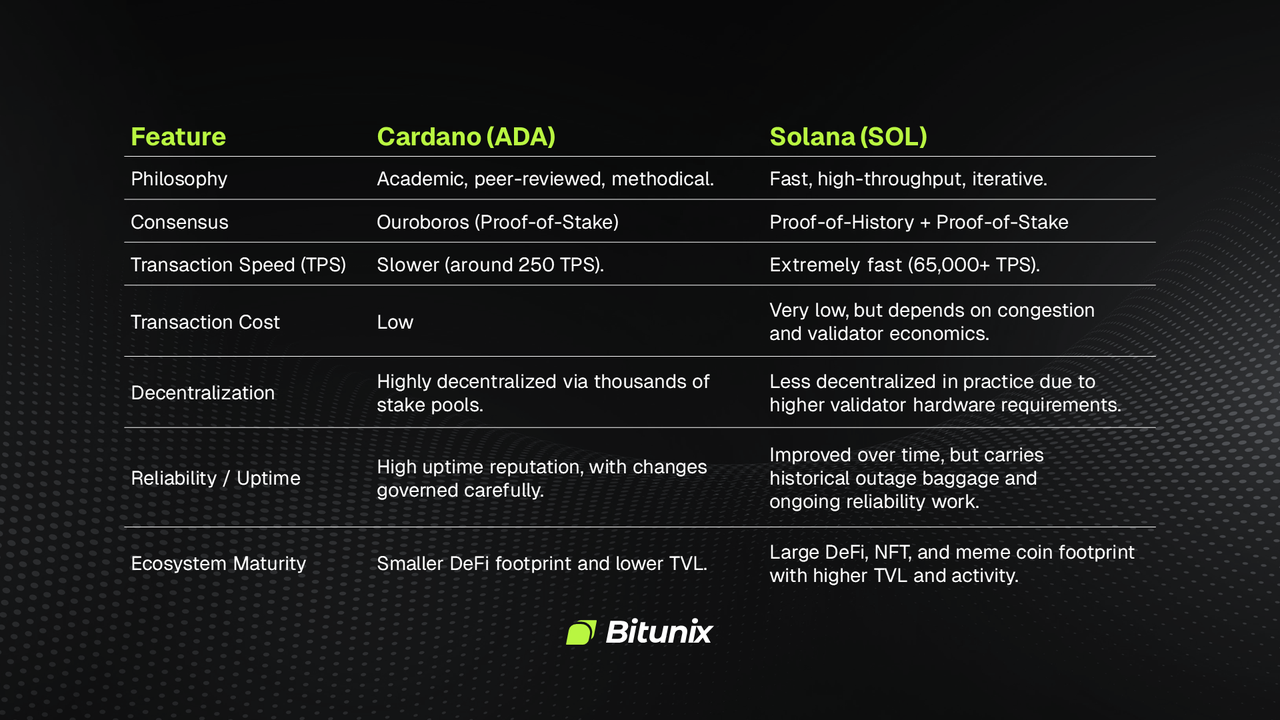
You can compare Cardano and Solana using the same technical criteria instead of opinions. The table below puts both chains into the same categories so you can evaluate tradeoffs clearly. It won’t decide whether Cardano or Solana is a better investment, but it helps you ask better, more specific questions.
The Investment Case for Each
People ask for a verdict, but investing is about matching an asset to your thesis and your time horizon. Here, the honest answer is that your best choice depends on what you believe will matter more over the next cycle: careful protocol evolution and governance, or raw network effects and high-frequency usability.
This is also where keyword debates like Cardano vs Solana can get unhelpful. The better framing is to separate adoption signals (usage, liquidity, developer activity) from structural signals (token supply rules, security assumptions, governance). Then you can decide what you personally weigh more.
The Case for Cardano (ADA)
If you want a slower-moving chain with an uptime-first culture, Cardano fits that profile. The Cardano Foundation reported that during a major November 2025 consensus disruption, block production continued, and the chain never went down, with the network converging back after about 14 hours. That track record appeals to risk-averse investors who care about reliability and operational predictability.
Cardano also benefits from a very committed community of stake pool operators and builders who coordinate upgrades under pressure. On decentralization, CardanoScan lists roughly 2,941 stake pools, which support a widely distributed validator set.
The Case for Solana (SOL)
If your SOL vs ADA thesis prioritizes adoption signals, Solana’s case is network effects plus high throughput. A 2025 Solana ecosystem report cited 7,625 new developers joining in 2024, $890B in DEX volume across the first five months of 2025, and median fees around $0.003178 during a major memecoin event, which points to real usage under load.
Performance and low costs make Solana viable for high-frequency apps like trading and gaming, which tend to pull in more users and builders. On institutional interest, CME Solana futures and major tokenized fund activity on Solana, and a February 2026 deal shows institutional capital moving in, with ParaFi investing $35M into Jupiter.
The Risks and Criticisms
Both chains have real risks, and you should treat them as important inputs. The easiest way to think about them is what could block adoption for each network.
Here are the main risks for each one of them:
Cardano Risks (Adoption + Pace):
- Slower Iteration: Research-first upgrades can take longer to land
- Mindshare Risk: A well-engineered chain can still lose if users and builders don’t show up
- Governance Complexity: More formal governance can slow coordination as stakeholders grow
Solana Risks (Reliability + Concentration):
- Uptime Expectations: Historical incidents make reliability a constant scrutiny point
- Validator Economics: Higher hardware expectations can narrow the operator set
- Trust Under Stress: Performance gains only matter if users believe the chain stays stable
Conclusion: Two Paths to the Same Goal
Cardano and Solana both aim to be the foundation for the next generation of the internet, but they take opposite paths. Cardano prioritizes correctness and decentralization, while Solana prioritizes performance and adoption.
In practice, those priorities shape what you can measure and feel as a user or investor. Cardano tends to emphasize conservative upgrades, formal methods, and a decentralization model built around many stake pools, which can appeal if you value predictability and long-term protocol stability. Solana tends to emphasize fast confirmations, high throughput, and very low transaction costs, which support high-frequency use cases like trading and gaming, and help create a strong ecosystem pull.
The verdict is that there is no clear winner. An investment in Cardano is a bet on academic rigor and long-term stability. An investment in Solana is a bet on network effects and raw performance.
Whether you believe in the methodical approach of Cardano or the sheer speed of Solana, Bitunix offers a secure and liquid market to trade both ADA and SOL. Download the app, register, explore the charts, do your research, and execute your strategy on our platform.
FAQ
Which is more decentralized, Cardano or Solana?
Cardano tends to look more decentralized on simple operator counts because it has thousands of stake pools. Solana can be more concentrated due to higher validator hardware requirements, which can reduce the set of viable operators.
Why has Solana had so many outages?
Solana has had many outages because its high-performance design exposed the network to validator-client bugs and transaction spam. Early on, limited spam controls let bots flood the chain (hundreds of thousands of TPS), causing memory/consensus failures. Later outages came from client issues and oversized blocks.
Why is Cardano’s development so slow?
Cardano prioritizes peer-reviewed research and formal guarantees, which adds time to design and rollout. Its governance structure and constitution-driven process can also add coordination steps before major changes happen.
Which blockchain has lower fees?
Solana generally has lower fees than Cardano. Solana’s fixed base fee is about 0.000005 SOL, often around $0.00025–$0.001 per transfer, with priority fees usually under $0.01. Cardano uses dynamic fees that commonly land around $0.15–$0.25 per transaction. So Solana fits micro-transactions and high-volume DeFi activity.
Can Cardano ever be as fast as Solana?
Cardano is unlikely to match Solana’s base-layer speed because it prioritizes formal verification and decentralization, with around 20-second blocks. Solana uses Proof-of-History, parallel processing, and close to 400ms blocks, reaching around 2,000–5,000 TPS.
Who is Charles Hoskinson, and who are Anatoly Yakovenko and Raj Gokal?
Charles Hoskinson is a founder figure in the Cardano ecosystem and is closely associated with its early vision and research-first approach. Anatoly Yakovenko and Raj Gokal are cofounders associated with Solana’s creation and early growth.
What is Total Value Locked (TVL) and how do they compare?
Total Value Locked (TVL) is the USD value of assets deposited in DeFi protocols on a blockchain, often used as a rough signal of liquidity and adoption. As of February 2026, Solana’s TVL sits around $9–15B, while Cardano’s is about $372M, so Solana’s DeFi footprint is much larger.
Which chain is better for NFTs?
Solana has been a major NFT venue because of low fees and fast confirmations, which support frequent marketplace actions. Cardano also has NFTs, but the ecosystem is smaller and usually sees less marketplace velocity.
What programming languages are used for Cardano and Solana?
Cardano is associated with Haskell and Plutus, plus newer developer tooling that broadens language access. Solana programs are commonly built with Rust, and the broader tooling and docs reflect that systems-programming heritage.
Is it possible for both blockchains to succeed?
Yes, because they optimize for different use cases and different developer preferences. One ecosystem can lead to conservative financial infrastructure, while another leads to high-frequency consumer and trading applications. The market often supports multiple winners when they serve different constraints well.
Glossary
- Proof of Stake (PoS): Consensus where validators secure the network using staked coins instead of mining power.
- Ouroboros: Cardano’s proof-of-stake protocol family built from peer-reviewed research and formal security analysis.
- Proof of History (PoH): Solana’s cryptographic clock that orders events by producing a verifiable sequence of hashes.
- Slot: A short time window when a Solana validator can produce a block, often around 400ms.
- Epoch: A larger time period grouping slots, used for reward calculations and governance boundaries.
- Validator: A node that verifies transactions and participates in consensus, earning rewards for honest operation.
- Stake Pool: Cardano’s operator model, where delegators pool stake to participate in block production.
- Smart Contract: Code deployed on-chain that executes deterministically, enabling DeFi apps and automated logic.
- Extended UTXO (eUTXO): A UTXO-based model that attaches richer data and scripts to transaction outputs.
- Finality: The point at which the network treats a transaction as irreversible under normal conditions.
- Tokenomics: The supply, issuance, incentives, and fee mechanics that shape a token’s economic behavior.
- Inflation Schedule: The planned token issuance rate over time, often declining toward a long-term target.
- Total Value Locked (TVL): Total value deposited in DeFi protocols, often used as an ecosystem activity proxy.
- Decentralization: How widely control and validation are distributed across independent operators and stakeholders.
- DeFi: Decentralized finance applications like lending, trading, and liquidity pools that run on smart contracts.
About Bitunix
Bitunix is a global cryptocurrency derivatives exchange trusted by over 3 million users across more than 100 countries. The platform is committed to providing a transparent, compliant, and secure trading environment for every user. Bitunix offers a fast registration process and a user-friendly verification system supported by mandatory KYC to ensure safety and compliance. With global standards of protection through Proof of Reserves (POR) and the Bitunix Care Fund, Bitunix prioritizes user trust and fund security. The K-Line Ultra chart system delivers a seamless trading experience for both beginners and advanced traders, while leverage of up to 200x and deep liquidity make Bitunix one of the most dynamic platforms in the market.
Bitunix Global Accounts
X | Telegram Announcements | Telegram Global | CoinMarketCap | Instagram | Facebook | LinkedIn | Reddit | Medium
Disclaimer: Trading digital assets involves risk and may result in the loss of capital. Always do your own research. Terms, conditions, and regional restrictions may apply.