
In leverage trading, there’s one price more important than your entry or exit price: your liquidation price. Ignore it, and you can do everything “right” in direction and still lose your margin. This guide explains what it is, why it exists, how it’s calculated, and how you keep your trades away from it.
Leverage is tempting because it magnifies returns. But it also magnifies mistakes, bad timing, and plain old noise. A normal dip in any crypto exchange becomes a margin emergency. That’s why you need to understand liquidation before you size up, not after you get the notification that your position got nuked.
This article will break down what the liquidation price means, how it is calculated, and provide actionable strategies that traders can use on platforms like Bitunix to manage their risk and avoid forced closure of their positions.
Liquidation Price Meaning In Plain English
Liquidation price is the price at which the exchange closes your leveraged position for you because your collateral is no longer enough to cover the minimum margin requirement. You don’t get to negotiate. The system does it automatically.
When people search for liquidation price meaning, they’re usually asking one thing: “At what price do I lose control of this trade?” That’s exactly the right question.
Liquidation exists for a boring but important reason: exchanges don’t want your losses to exceed your collateral. If your position keeps losing and your margin can’t support it, the exchange steps in and closes it to limit further damage to you and to the platform’s risk system. Divestopedia defines forced liquidation as a position being forcibly closed when it no longer meets margin requirements.
What Does Liquidation Price Mean?
Liquidation is the forced closing of a leveraged position because you no longer have enough margin to keep it open.
Think of your margin like the fuel in your tank. You can drive fast (high leverage), but you burn fuel quickly. If the price moves against you, that “fuel” gets consumed by unrealized losses. Once you’re below the maintenance requirement, the system starts liquidation procedures.
Exchanges do this automatically to protect the system. And yes, it can feel rude. But it’s also the reason you don’t end up owing the exchange money in most typical retail setups.
Understanding Margin: The Key to Liquidation
If the liquidation price is the cliff, the margin is the ground you’re standing on.
Initial Margin
Initial margin is what you put down to open the position. With leverage, your position size is larger than your deposit. Example: with 10x leverage, you control roughly 10 times the exposure of your margin (fees and rules aside).
Maintenance Margin
Maintenance margin is the minimum collateral you must keep to maintain the position. If your margin balance falls to this level, liquidation risk becomes real.
The maintenance margin is not always a single, fixed number. On many platforms, it changes with position size and risk tiers. Bybit, for example, ties maintenance margin rate to risk limit tiers in its liquidation price formulas.
And here’s an important “gotcha”: your liquidation trigger often depends on mark price, not the last traded price. That helps reduce manipulation and sudden wicks, but it also means you can get liquidated even if the last price never touched your liquidation level. Bybit explicitly describes liquidation as happening when the mark price reaches the liquidation price.
How is the Liquidation Price Calculated?
Let’s keep this intuitive first.
The Basic Relationship
A simplified way to think about it is:
Liquidation Price ≈ Entry Price − (Margin Buffer / Position Size) (for a long)
“Margin buffer” is basically your usable margin after accounting for maintenance margin and fees. A bigger buffer means liquidation is farther away. A bigger position size means liquidation is closer.
So what pushes liquidation closer?
- Higher leverage (because it increases position size relative to your margin)
- Higher maintenance margin requirements
- Fees (including funding and closing fees on some contracts)
- Volatility that hits the mark price hard
The Impact of Leverage
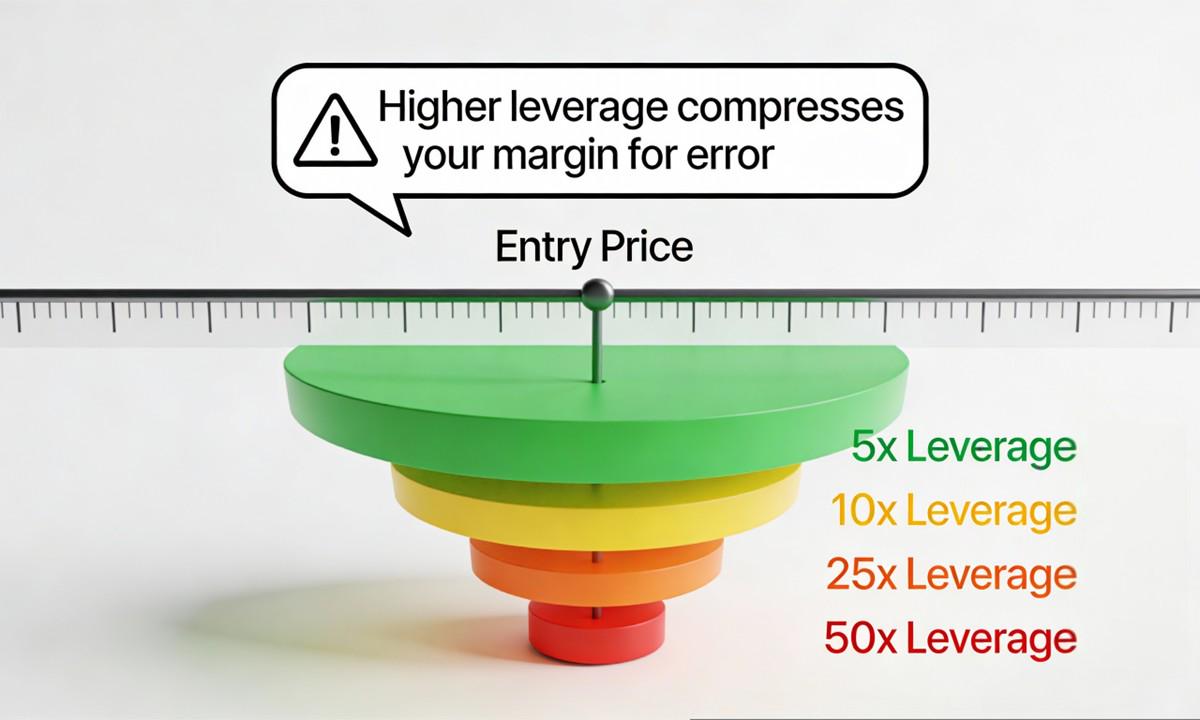
Here’s the intuition in numbers (illustrative, not a promise, because each exchange uses its own maintenance margin tiers and fee assumptions):
- If you go 10x long on Bitcoin at $100,000, your liquidation price might be around $90,500.
- But if you go 50x long at the same price, your liquidation price could be as close as $98,200. A small move against you can wipe out your position.
If you remember one thing about liquidation price meaning, remember this: higher leverage doesn’t just increase risk, it moves the “game over” line closer to your entry.
Real liquidation thresholds depend on maintenance margin rate, risk tiers, fees, and mark price behavior. Exchanges spell this out in their own formulas and documentation.
Use a Calculator Instead of Doing This by Hand
Most traders don’t need to memorize formulas. They need to check for liquidation before clicking “Open.”
Binance literally provides a Futures Calculator that includes a liquidation price tab so you can estimate risk before placing orders.
On Bitunix, the platform surfaces an “Estimated Liquidation Price,” described as the price at which a position is closed due to insufficient margin. Bitunix’s app release notes also mention adding “estimated liquidation price when placing orders,” which supports the idea that you can see it pre-trade.
Bottom line: Use the tool on the exchange you’re trading on. It’s faster, and it matches that platform’s exact rules.
Top 3 Strategies to Avoid Liquidation
Avoiding liquidation is mostly about giving your trade space and choosing where you accept loss.
1) Use Lower Leverage
This is the simplest fix and the one that traders resist the most.
Lower leverage gives your position breathing room. With 3x–5x, you can survive normal volatility without living in fear of a random wick. With 25x–50x, you’re basically saying, “I want to be right immediately.” Markets don’t care what you want.
If you’re new, start small. You can always scale up later. You can’t “scale back” a liquidation.
2) Use a Stop-Loss Order
A stop-loss closes your position before liquidation, at a price you choose. That’s the key difference.
Liquidation is usually the worst possible version of closing because:
- It’s forced,
- It can happen during fast moves,
- It often includes liquidation fees,
- And you lose flexibility.
Set your stop-loss at a level that invalidates your trade idea, not “just above liquidation.” If your stop is basically hugging liquidation, you’re still relying on the exchange’s engine to save you in a fast market. That’s not a plan.
3) Add Margin to Push Liquidation Farther Away
If you still like the trade but your liquidation is getting too close, you can add collateral (extra margin). This increases the buffer and moves liquidation farther from the current price.
Some examples show how adding extra margin changes the liquidation price calculation under isolated mode.
Two warnings:
- Adding margin can be smart risk management, or it can be “throwing good money after bad.” Only do it if your trade thesis still holds.
- If you keep adding margin just to avoid admitting you’re wrong, the market will eventually collect the tuition.
How Bitunix Helps You Manage Liquidation Risk
Bitunix documents its liquidation mechanics and how it handles risk tiers, including canceling open orders to release margin and, in some cases, partially reducing positions before full forced liquidation.
A few practical things this means for you:
- You can monitor an estimated liquidation price: Bitunix describes an “Estimated Liquidation Price” that shows the level where the position closes for insufficient margin.
- Liquidation behavior depends on risk tiers: larger positions and higher leverage can push you into different tiers with different maintenance margin rates, which changes your liquidation risk.
- Pre-trade visibility: Bitunix app updates mention adding estimated liquidation price when placing orders, which helps you sanity-check leverage before you enter.
If you trade, make it a habit to check the estimated liquidation price and margin ratio before opening a position, and again after you adjust leverage or size.
How to Start Trading on Bitunix
To start trading on Bitunix, first create an account. Go to the exchange’s website and sign up with your email or phone, then complete KYC so deposits and withdrawals stay unlocked.
Next, secure your account with 2FA, deposit USDT or another supported coin, and move funds into your spot or futures wallet. New users can practice with small orders, using limit or market trades on the main trading page.
If you prefer mobile, download the Bitunix app from the official links there, log in with the same account, and manage all your trades on the go.
Trade with confidence. Bitunix provides the professional-grade tools you need to manage risk effectively. Open an account today.
Conclusion: Trade Smart, Not Recklessly
Liquidation price is where the exchange closes your leveraged position because your margin can’t meet the maintenance requirement. It’s not “bad luck.” It’s math, fees, and risk rules doing their job.
To avoid liquidation:
- Use lower leverage so your trade can breathe.
- Use a stop-loss so you choose where to be wrong.
- Add margin only when it fits your plan, not your ego.
Professional traders obsess over downside. They treat survival as the goal and profit as the reward for surviving well. Do that, and you won’t have to “learn liquidation” the expensive way.
Don't learn about liquidation the hard way. Use the tools and knowledge in this guide to trade smarter on Bitunix.
FAQ
Is liquidation the same as a stop-loss?
No. A stop-loss is your order to exit at a chosen price. Liquidation is the exchange force-closing because your margin is too low.
Can my liquidation price change after I open a position?
Yes. It can change if you add/remove margin, if fees accrue, if your platform uses cross margin (shared balance), or if maintenance margin tiers change with position size.
What happens to the money when a position is liquidated?
Your position is closed to stop further losses. Depending on the platform and market conditions, you can lose most (or all) of the margin allocated to that position, plus fees.
What is a liquidation fee?
Many platforms charge a fee when liquidation occurs. Binance notes that forced liquidation typically incurs an additional liquidation fee, which varies by platform.
What is the difference between an isolated margin and a cross margin in relation to liquidation?
Isolated margin limits risk to the margin you assign to that position. Cross margin shares margin across positions, so one losing position can drag down your whole account and move liquidation levels around.
Can a spot trade be liquidated?
Plain spot trades don’t have liquidation because there’s no leverage and no margin requirement. But spot margin (borrowing) can be liquidated, and perpetual futures can be liquidated.
How can I see my liquidation price on Bitunix?
Bitunix refers to an “Estimated Liquidation Price” shown for positions, and its app updates mention showing the estimated liquidation price when placing orders.
What is a “liquidation cascade” or “squeeze”?
It’s when many leveraged positions get liquidated in a short time, and those forced closes push price further, triggering more liquidations. It’s a chain reaction.
Is it possible to have a liquidation price of $0?
For a long on a normal coin-margined or stablecoin-margined contract, not realistically. But cross margin, inverse contracts, and platform-specific rules can create extreme liquidation levels. Always rely on the exchange calculator and risk settings.
What is the safest leverage to use to avoid liquidation?
There’s no single safe number, but lower leverage (often 3x–5x for beginners) gives you more room. Your safest move is to size positions so a stop-loss hits a small, planned loss.
Glossary
- Liquidation Price: The price where the exchange force-closes your leveraged position due to insufficient margin.
- Liquidation: The forced closure of a position to prevent losses exceeding required collateral.
- Leverage: Borrowed exposure that increases position size relative to your margin.
- Margin: Collateral you post to open and maintain a leveraged position.
- Initial Margin: The collateral required to open a position.
- Maintenance Margin: The minimum collateral required to keep a position open.
- Mark Price: A reference price (often index-based) used by exchanges to trigger liquidation more fairly than last price.
- Position Size: The notional value of your trade exposure.
- Unrealized PnL: Profit or loss that exists on paper while the position is still open.
- Stop-Loss Order: An order that closes your position at a chosen price to cap losses.
- Isolated Margin: Margin mode where each position has its own dedicated collateral.
- Cross Margin: Margin mode where positions share collateral across the account.
- Risk Limit Tier: Exchange-defined tier that can change max leverage and maintenance margin based on position size.
- Liquidation Fee: A fee charged when liquidation occurs (platform-specific).
- Bankruptcy Price: A price level associated with liquidation engines where position margin is effectively exhausted (platform-specific).
About Bitunix
Bitunix is a global cryptocurrency derivatives exchange trusted by over 3 million users across more than 100 countries. At Bitunix, we are committed to providing a transparent, compliant, and secure trading environment for every user. Our platform features a fast registration process and a user-friendly verification system supported by mandatory KYC to ensure safety and compliance. With global standards of protection through Proof of Reserves (POR) and the Bitunix Care Fund, we prioritize user trust and fund security. The K-Line Ultra chart system delivers a seamless trading experience for both beginners and advanced traders. At the same time, leverage of up to 200x and deep liquidity make Bitunix one of the most dynamic platforms in the market.
Bitunix Global Accounts
X |Telegram Announcements |Telegram Global |CoinMarketCap |Instagram |Facebook |LinkedIn |Reddit |Medium