
Article Summary
- This article provides a technical but accessible overview of Zama, a cryptography company building open-source tools for Fully Homomorphic Encryption (FHE).
- It explains the groundbreaking concept of FHE: a form of encryption that allows computations to be performed on encrypted data without ever decrypting it. The result of the computation, when decrypted, is the same as if it had been performed on the raw data.
- The guide details Zama's core product, fhEVM, an extension to the Ethereum Virtual Machine (EVM) that allows developers to write smart contracts that can operate on encrypted data. This enables true on-chain confidentiality.
- It contrasts FHE with other blockchain privacy technologies like ZK-proofs, highlighting that ZK-proofs conceal the data itself, while FHE allows for computation on that concealed data.
- The article explores the potential use cases for Zama's technology, including private on-chain voting, confidential DeFi, and privacy-preserving AI applications.
- For decades, cryptographers have pursued the weird goal of computing on data without ever seeing it. Fully homomorphic encryption (FHE) finally makes that possible, and Zama is one of the teams pushing it from papers into tools developers can ship.
- Public blockchains work like a glasshouse. Every input, state update, and smart contract call can be inspected, indexed, and copied. That transparency helps verification, but it blocks a long list of real applications that require privacy. Think confidential voting, private balances, sealed bids, payroll, credit scoring, and anything involving identity-linked money.
- If you mostly interact with ZAMA/USDT through a crypto exchange instead of building on-chain, you still run into the same limitation, which is that the settlement layer stays public unless you add a privacy system on top. Bitunix comes up here because it's a familiar path for trading the assets connected to new infrastructure trends, including privacy tech.
- This guide breaks down FHE with a practical analogy, explains how Zama’s fhEVM technology works, and maps the types of private dApps it enables. You’ll also see where the limits are, because encrypted computation still has trade-offs.
What is Fully Homomorphic Encryption (FHE)?
FHE lets someone compute on ciphertext and return ciphertext, with the final plaintext matching the result you would get from raw data. That is the whole trick. You keep secrets encrypted end-to-end while still letting programs do useful work.
A helpful analogy is a locked transparent box. You put ingredients inside the box and lock it. Someone else puts on thick gloves and mixes, slices, and bakes through the box without opening it. When they hand it back, you unlock it and find the finished cake. They did real work, but they never saw or touched the ingredients directly.
In math terms, you can frame it like this: Compute(Encrypted_Data) produces an encrypted output that decrypts to Compute(Raw_Data). You never decrypt the input during processing, so the system running the computation never gets direct access to the raw values.
For a long time, FHE was possible in theory and painful in practice. The heavy part is keeping ciphertext usable after many operations, since encrypted values accumulate noise and need periodic refresh operations to stay correct.
Zama’s contribution is mostly engineering and packaging. In February 2025, Zama’s TFHE-rs library reached a stable v1.0.0 release, which matters because stable APIs let teams build production software instead of demos. That same year, Zama’s product updates highlighted continuous improvements across its FHE stack, including fhEVM releases and the introduction of a coprocessor approach for on-chain usage.
If you care about blockchain privacy, FHE is attractive because it hides the data during execution. That difference is the line between nobody can read my balance and nobody can even compute on my balance without revealing it.
Zama’s Solution - The fhEVM
Zama is not building a new base chain as a replacement for Ethereum or other networks. It’s building a confidentiality layer and a toolkit that can plug into existing EVM environments, so you can keep using Solidity while adding encrypted types and encrypted execution.
If you ask what is Zama from a developer perspective, the short answer is that it’s an open-source cryptography company building a protocol and libraries for confidential smart contracts on public blockchains. Its public materials describe a cross-chain protocol that runs confidential smart contracts on top of existing L1s and L2s.
Zama's June 2025 announcement also tied the work to real adoption constraints, like keeping public verifiability while adding confidentiality, and it positioned the protocol as a layer that can sit on top of multiple host chains.
An Extension, Not a New Chain
The fhEVM is best understood as an EVM extension and supporting infrastructure. You still write Solidity contracts, but you use encrypted data types and encrypted operations. Then, off-chain compute components handle the heavy cryptographic work, while on-chain contracts coordinate state changes and access control.
Zama's own updates describe fhEVM as deployable across EVM chains, and the January 2025 release post spells out the intent clearly:
"Developers can now build confidential smart contracts on any EVM chain."
That is important because it frames fhEVM as middleware and developer tooling rather than a standalone chain competing for consensus and blockspace.
How It Works
Before the step-by-step, it helps to internalize one thing: encrypted computation is expensive, so Zama's design pushes the heavy math away from the base chain. OpenZeppelin's 2025 security guide summarizes the pattern: off-chain coprocessors handle the heavy FHE work, and on-chain contracts orchestrate updates, access control, and decryption callbacks.
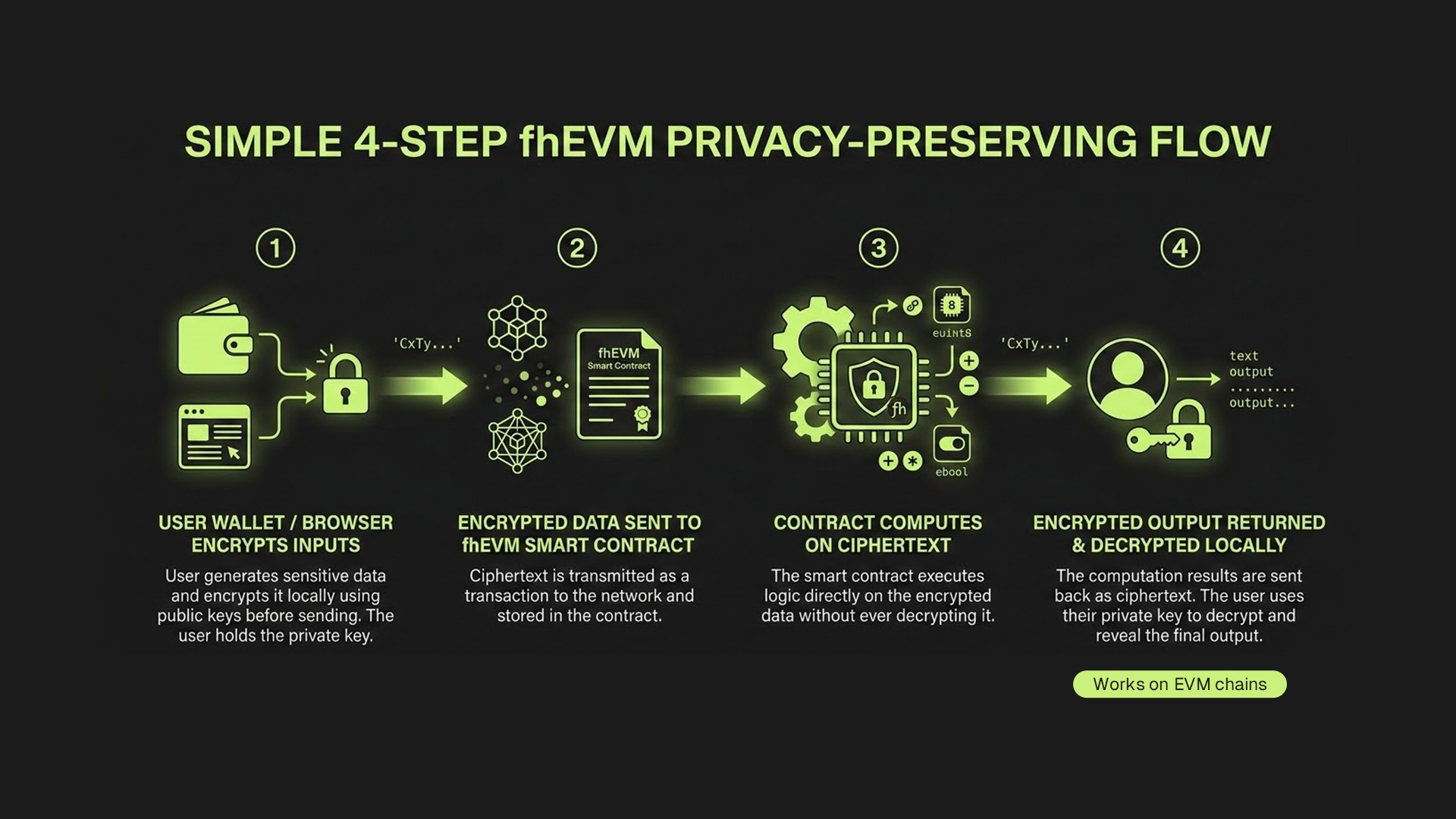
fhEVM keeps inputs and smart contract state encrypted end-to-end: you encrypt client-side, the contract computes on ciphertext, and you decrypt the output locally.
Now the steps:
- Your app encrypts inputs client-side, usually in the browser or wallet context, so plaintext never goes on-chain.
- The encrypted inputs get sent to a smart contract deployed in an fhEVM environment.
- The contract runs logic on encrypted values, like comparing an encrypted age to 18 or adding encrypted balances, while keeping the state encrypted.
- The result returns as encrypted data, and only an authorized party decrypts it based on rules enforced by the contract.
Developer Experience and Encrypted Types
This is where fhEVM crypto starts to feel tangible. Developers work with encrypted variants of common Solidity types. Zama's documentation lists ebool for booleans and euint8 through euint256 for unsigned integers, plus encrypted addresses.
Under the hood, those encrypted values often behave like handles rather than raw ciphertext sitting directly in contract storage. Zama docs describe these encrypted types as user-defined value types represented internally as bytes32 handles that reference encrypted values stored off-chain. That design keeps L1 execution lightweight while still letting contracts compose operations over encrypted state.
Decryption needs careful handling, so Zama provides explicit patterns for it. The documentation describes public decryption as something you use when contract logic or user presentation genuinely requires plaintext, while keeping confidentiality through the rest of the lifecycle.
How Fast Is It Today, With Real Numbers
FHE speed is the first question serious developers ask. Zama’s June 2025 post provided a concrete throughput snapshot of the protocol itself, stating that it increased from about 0.5 transactions per second to over 20 during development, and discussed scaling via stronger hardware over time.
The docs also expose operation cost tables in a unit called HCU, which helps you estimate relative costs across encrypted operations. For example, the HCU table shows an euint8 add at 84,000 HCU (scalar), and an euint64 add at 133,000 HCU, with multiplication and division costing much more.
FHE vs. ZK-Proofs - What’s the Difference?
People mix up ZK and FHE because both involve privacy, and both are cryptography-heavy enough to scare normal humans. The simplest split is task type.
Zero-knowledge proofs help you prove a claim about secret data without revealing the secret data itself. You use ZK when you want verification. A classic example is proving you are over 18 without revealing your exact birth date.
FHE helps you compute on secret data while keeping it secret during execution. You use FHE when you want computation. Instead of proving a property about a hidden value, you run program logic over encrypted values and keep state encrypted end-to-end.
Zama’s own protocol announcement explicitly positions FHE as the engine for encrypted computation and mentions using ZK in a narrower role, like ensuring user-provided encrypted inputs were formed correctly. That division of labor reflects how teams often combine primitives: FHE for private state and private logic, plus ZK where you want lightweight, checkable proofs about correctness at the boundary.
The KKRT Labs acquisition announcement in late 2025 also signals that Zama sees ZK as part of the broader scalability and security toolbox, even while FHE stays the core confidentiality primitive.
Potential Use Cases
Confidential smart contracts open a different design space. You stop treating privacy as an app-layer hack and treat it as a programmable property of the contract itself. Zama’s litepaper frames the target as issuing, managing, and trading assets confidentially on existing public blockchains, which maps directly to the use cases below.
Confidential DeFi: Private Balances and Amounts
In public DeFi, traders broadcast intent. That visibility enables copy trading, sandwiching, and other MEV tactics that punish users for being transparent by default. With encrypted balances and encrypted amounts, you reduce the information leak that front-runners depend on, especially for large trades or large positions.
Zama describes end-to-end encryption of transaction inputs and state, including protection against node operators seeing the data. Figment’s 2026 overview also points to confidential swaps, lending, and positions as direct targets, with privacy intended to reduce front-running and MEV in on-chain execution.
On-chain Gaming: Hidden Hands, Fair Outcomes
Poker is the go-to example because it’s easy to explain. You want the game to run on-chain, and you want everyone to verify fairness, but you do not want everyone to see your hand. With FHE-style confidentiality, players can keep private game state encrypted while still letting the game logic compute valid outcomes.
The key gain is that the chain can enforce rules without making secret game data public. That reduces the need for trusted servers and reduces the number of ways players can cheat by reading public state.
Private Voting: Reduce Coercion, Improve Governance Hygiene
DAO voting has a social problem as much as a technical one. When votes are public, powerful actors can pressure people, buy votes, or punish dissent. Private voting makes those tactics harder because individuals can vote without broadcasting their decision to everyone.
Zama’s protocol announcement lists governance as one of the domains held back by transparency, and it positions confidentiality as the missing requirement for broader adoption. In practice, encrypted ballots and encrypted tallies can keep individual votes private while still letting the system publish a verifiable final result.
Privacy-Preserving AI: Compute Without Collecting Raw Data
AI systems often want more data than users want to share. FHE offers a path where a model can run inference or even certain training steps on encrypted user data, so the AI operator never handles raw inputs. Zama has long positioned its FHE libraries for both blockchain and AI workloads, and its Series B announcement mentioned licensing technology across blockchain and AI before unveiling the protocol.
This use case is still hard, mostly due to performance and engineering complexity. Still, the direction is that if you can compute on encrypted data, you can build services that need insight without needing access.
Conclusion: The Dawn of On-Chain Privacy
Zama is providing open-source building blocks for a new generation of blockchain applications where confidentiality is programmable. Its fhEVM approach adds encrypted data types to Solidity-style development and relies on coprocessors and protocol coordination to keep encrypted computation practical.
The story also moved fast in 2025 and 2026. Zama announced a $57M Series B at a valuation over $1B in June 2025, launched protocol infrastructure on mainnet by the end of 2025, and ran real-value applications like a sealed-bid auction in early 2026. Those milestones show encrypted execution under real usage, not only in demos.
So, what is Zama in one sentence you can use? It’s a cryptography company building a confidentiality protocol and developer tooling that let smart contracts compute on encrypted state on top of public blockchains.
If you want to track privacy infrastructure as an investable trend, stay focused on developer traction, cost curves, and real usage. And if you plan to trade assets connected to privacy tech, download the Bitunix app and register an account so you can execute your plan with the same risk controls you use for any volatile market.
FAQ Section
Is Zama a blockchain or a company?
Zama is a company that builds open-source cryptography and a confidentiality protocol designed to run on top of existing public blockchains. Its litepaper describes the Zama Protocol as enabling confidential smart contracts on existing chains, rather than replacing them with a new base network.
Is Zama’s technology open source?
Yes. Zama maintains public repositories for key components such as TFHE-rs and the FHEVM framework, and publishes developer documentation for building confidential contracts. You can verify the open-source posture through the official GitHub projects and the docs site, which describe the libraries and how they integrate into EVM systems.
Will Zama have its own token?
Yes. Zama launched its ZAMA token in February 2026 and described it as a utility token used to pay for encryption and decryption operations and to reward operators and stakers. The token launch post also notes fee mechanics, including burning fees and emissions-based rewards.
How fast is FHE?
FHE is slower than normal computation, and you need to design around that. Zama reported protocol throughput rising from about 0.5 to over 20 transactions per second during development, and it describes scaling paths using stronger hardware.
What is the difference between homomorphic and fully homomorphic encryption?
Homomorphic encryption lets you perform some operations on encrypted data. Fully homomorphic encryption supports arbitrary computation, meaning you can compose many operations and still decrypt a correct final result. Zama’s protocol materials describe using FHE to keep inputs and smart contract state encrypted end-to-end, including during processing.
Which blockchains are using Zama’s fhEVM?
Zama positions fhEVM as deployable on EVM-compatible chains, and it has run public deployments and testing in Ethereum environments such as Sepolia, based on developer community discussions. Zama’s protocol design also targets integration on top of existing L1s and L2s rather than requiring users to move to a new base chain.
Who are the founders of Zama?
Zama was founded by Rand Hindi and Pascal Paillier, with Hindi serving as CEO and Paillier as CTO. Independent infrastructure research also notes additional academic leadership roles, reflecting Zama’s research-heavy team structure.
Is FHE quantum-resistant?
Zama’s documentation for TFHE-rs states that the Learning With Errors assumption forms the basis of security and is considered resistant to quantum attacks. The Zama Protocol litepaper also describes its FHE scheme as post-quantum and specifies security targets, which is the closest thing you get to an official claim in this area.
What are the main challenges for FHE adoption?
Performance and developer ergonomics lead the list. Encrypted operations cost more than plaintext operations, so teams must budget compute and design contracts carefully. Key management and decryption authorization also add complexity, which is why the protocol includes components for orchestration and decryption handling. Even with progress, apps must earn users despite higher costs.
Where can I learn more about FHE?
Start with Zama’s protocol litepaper for the system-level view, then move to the Solidity Guides to understand encrypted types and decryption patterns. If you want the cryptography layer, read TFHE-rs documentation on security assumptions and parameter choices. These sources give you both the why and the how, without skipping the trade-offs.
Glossary
- Fully homomorphic encryption (FHE): Encryption that supports arbitrary computation on ciphertext, producing ciphertext that decrypts to the correct result.
- Ciphertext: Encrypted data produced by an encryption scheme, designed to hide the underlying plaintext.
- Plaintext: The original unencrypted data you want to protect while still enabling computation or storage.
- fhEVM: Zama's EVM extension and framework that enables smart contracts to operate on encrypted data types.
- Confidential smart contracts: Contracts that keep inputs and state encrypted while still executing verifiable logic on-chain.
- Coprocessor: Off-chain compute node that performs heavy FHE operations and returns results for on-chain orchestration.
- Encrypted types (euint, ebool): Solidity-facing types that represent encrypted integers and booleans for confidential computation.
- Decryption oracle: Mechanism for controlled decryption when a contract or user needs plaintext output under explicit authorization.
- Key management service (KMS): Protocol component that coordinates key shares and decryption rights, often using threshold techniques.
- Threshold MPC: Multi-party computation used so no single operator controls the full decryption key.
- Zero-knowledge proof (ZK): Proof system that verifies a claim about secret data without revealing the data itself.
- Public verifiability: Property where observers can verify correct execution according to rules, even if data stays hidden.
- LWE: Learning With Errors, a hardness assumption commonly used in lattice-based cryptography and cited in TFHE security.
- Post-quantum: Designed to remain secure against known quantum attack models, usually grounded in lattice assumptions.
- HCU: Zama documentation unit used to estimate relative costs of encrypted operations across types and functions.
About Bitunix
Bitunix is a global cryptocurrency derivatives exchange trusted by over 3 million users across more than 100 countries. At Bitunix, we are committed to providing a transparent, compliant, and secure trading environment for every user. Our platform features a fast registration process and a user-friendly verification system supported by mandatory KYC to ensure safety and compliance. With global standards of protection through Proof of Reserves (POR) and the Bitunix Care Fund, we prioritize user trust and fund security. The K-Line Ultra chart system delivers a seamless trading experience for both beginners and advanced traders. At the same time, leverage of up to 200x and deep liquidity make Bitunix one of the most dynamic platforms in the market.
Bitunix Global Accounts
X | Telegram Announcements | Telegram Global | CoinMarketCap | Instagram | Facebook | LinkedIn | Reddit | Medium