
As digital asset trading continues to evolve, more users are looking beyond crypto-only markets. Many traders now follow major stocks just as closely as they follow Bitcoin, Ethereum, and altcoins. Names such as Tesla, Apple, Nvidia, Amazon, Circle, Intel, and MicroStrategy regularly shape broader market conversations, and demand for more flexible access to these market themes has grown accordingly.
At Bitunix, this shift is reflected in the expansion of TradFi-linked markets. Alongside crypto trading, users can now explore stock futures pairs tied to some of the most recognized public companies in the market. This creates a more connected trading environment for users who want access to multiple asset categories without relying on separate workflows across different platforms.
For beginners, stock futures may sound complicated at first. The good news is that the concept becomes much easier to understand once the basics are clear. In this guide, we explain what Bitunix stock futures are, how stock-linked markets work, why traders are interested in them, and what users should understand before trading pairs such as TSLAUSDT, AAPLUSDT, NVDAUSDT, AMZNUSDT, CRCLUSDT, MSTRUSDT, INTCUSDT, and HOODUSDT.
What Are Stock Futures on Bitunix?
Stock futures on Bitunix are trading products linked to the price movement of major stocks. Instead of buying and holding traditional shares through a conventional stockbroker, users can access stock-linked market exposure within the Bitunix trading environment.
This is an important distinction. Trading a stock-linked pair on Bitunix is not the same as directly owning company shares. Rather, it is a way to participate in price movements through a market structure designed for active trading. For many users, this offers a more familiar workflow, especially for those who are already used to crypto futures, margin-based trading, and fast-moving digital trading interfaces.
The stock futures lineup on Bitunix includes pairs tied to major market names, including:
- TSLAUSDT
- AAPLUSDT
- NVDAUSDT
- AMZNUSDT
- CRCLUSDT
- MSTRUSDT
- INTCUSDT
- HOODUSDT
These pairs give traders access to stock-related market themes through a USDT-based framework that feels more aligned with how many crypto-native users already trade.
Why Bitunix Added Stock Futures
At Bitunix, the goal is to build a platform that reflects how modern traders actually think and behave. Today, market attention moves quickly across categories. On one day, traders may focus on Bitcoin volatility. On another, they may watch gold during macro uncertainty. At the same time, major stocks like Tesla, Apple, and Nvidia continue to dominate headlines and attract strong market interest.
Adding stock futures helps bridge that gap. It allows users to access stock-linked opportunities in the same broader environment where they already trade crypto and other TradFi-linked markets. Instead of separating digital assets from traditional market themes, Bitunix brings them closer together in a more unified experience.
This matters because traders increasingly want convenience, flexibility, and broader market coverage. They do not always want to split attention between multiple platforms, multiple account structures, and completely different trading systems just to follow the markets that matter most.
Which Stock Futures Are Available on Bitunix?
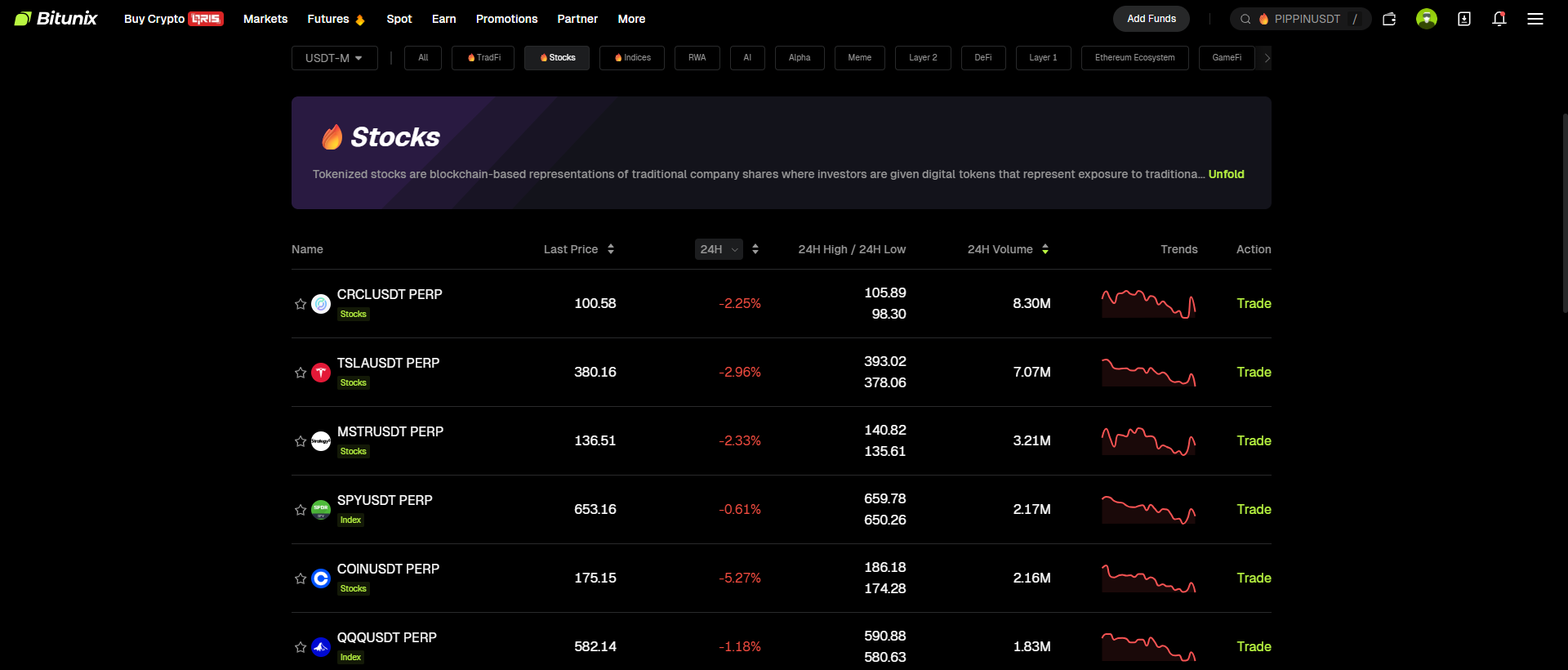
The Bitunix market interface shows a growing range of stock-linked futures pairs tied to recognized companies across technology, finance, and innovation-driven sectors. These include:
TSLAUSDT
Linked to Tesla, one of the most watched companies in the market. Tesla often attracts attention because of electric vehicles, innovation narratives, and broader risk sentiment.
AAPLUSDT
Linked to Apple, a globally recognized company that remains central to discussions around consumer technology, hardware, and market stability.
NVDAUSDT
Linked to Nvidia, a company that has become especially important in conversations around AI, semiconductors, and high-growth technology sectors.
AMZNUSDT
Linked to Amazon, a major player in ecommerce, cloud infrastructure, and large-cap tech performance.
CRCLUSDT
Linked to Circle-related market interest, which can attract attention from users already familiar with stablecoin and digital finance themes.
MSTRUSDT
Linked to MicroStrategy, a company widely followed in both equity markets and crypto-related discussions because of its Bitcoin exposure.
INTCUSDT
Linked to Intel, a major semiconductor company with strong relevance in the broader technology sector.
HOODUSDT
Linked to HOOD, a company associated with retail trading and digital-first investing culture.
This lineup gives users access to a broad mix of familiar stock themes, from tech leaders and innovation names to companies that are already well known among crypto-native audiences.
How Stock Futures on Bitunix Work
The core idea behind stock futures on Bitunix is straightforward. Users trade pairs that track the price movement of specific stock-linked markets. These pairs are quoted against USDT, which makes the structure more accessible to traders who already use stablecoins for capital management and trading activity.
This model is useful because it reduces friction. Instead of moving funds into a separate traditional brokerage account, users can stay within the Bitunix ecosystem and explore stock-linked markets through a workflow that feels more familiar.
In practice, traders monitor price, 24-hour change, 24-hour range, and volume just as they would in other active trading markets. They can compare different stock futures pairs, watch volatility, and decide which market aligns best with their strategy or risk tolerance.
For many users, the appeal is not just access to stock-linked markets. It is access through a familiar trading structure.
Why Traders Are Interested in Stock Futures
Stock futures matter because major equities continue to shape global market sentiment. Companies like Tesla, Apple, Nvidia, and Amazon are not niche assets. They are among the most closely watched names in finance. Their price moves can reflect broader themes such as technology growth, earnings expectations, AI adoption, consumer demand, and macro risk appetite.
On Bitunix, stock futures make these themes more accessible to users who already trade actively in digital markets. This creates several practical advantages.
First, stock futures expand market choice. Not every trading opportunity comes from crypto. There are periods when equity-linked volatility becomes a stronger focus for active traders.
Second, stock futures help users diversify what they monitor. A trader who only watches crypto may miss major stock-driven narratives that influence broader market sentiment.
Third, stock-linked trading pairs can be especially appealing to crypto-native users who already understand how market momentum, liquidity, and risk management work in fast-moving trading environments.
In short, stock futures on Bitunix help users engage with some of the most relevant names in the market without leaving the broader exchange ecosystem.
Stock Futures vs Owning Real Stocks
This is one of the most important points for beginners to understand. Trading stock futures is not the same as buying and holding actual shares through a stockbroker.
When a user buys real shares, they are purchasing direct ownership in a company through a conventional financial structure. When a user trades a stock futures pair on Bitunix, they are gaining exposure to price movement through a trading product linked to that stock.
That difference affects how the product is used. Stock futures are generally better suited to active trading and short-term market participation than to the traditional idea of long-term ownership. They are designed for users who want to respond to price changes, monitor markets closely, and manage positions actively.
This also means users should not confuse stock futures with conventional investing. They serve different purposes and fit different strategies.
Why USDT-Based Stock Trading Matters
One of the clearest benefits of Bitunix stock futures is that the pairs are tied to a USDT-based workflow. This matters because many Bitunix users already operate within a stablecoin-centered trading environment.
Using USDT as the base framework makes stock-linked markets more approachable for crypto-native traders. It allows them to think in familiar trading terms, compare opportunities across markets more easily, and manage exposure through a structure they already understand.
This is especially useful for users who want a more seamless way to move between crypto, commodities, and stock-linked products. Instead of treating these as completely separate financial worlds, Bitunix makes it easier to view them as part of one broader trading environment.
That convenience can improve market responsiveness. Traders can shift attention from crypto to stocks, or from stocks to commodities, without needing to rebuild their entire workflow from scratch.
How to Start Trading Stock Futures on Bitunix
For beginners, the process becomes easier when broken into a few clear steps.
1. Explore the stock futures market list
Start by reviewing the available stock-linked pairs on Bitunix. Look at names you already recognize and understand, such as Tesla, Apple, Nvidia, or Amazon.
2. Study market data
Before opening a trade, review price, 24-hour change, daily range, and volume. These indicators can help users understand whether the market is relatively calm or more active.
3. Choose the asset that fits your strategy
Different companies behave differently. Some may show stronger momentum. Others may react more directly to sector-specific news or broader market conditions.
4. Understand the role of leverage and margin
Before entering any position, users should understand how leverage affects exposure and how margin works in maintaining a position.
5. Set clear risk parameters
Risk control matters in any market, but it becomes even more important in leveraged environments. Position sizing and disciplined planning are essential.
6. Monitor the market actively
Stock-linked futures require attention. These markets can respond quickly to sentiment changes, company-specific developments, and macro events.
The key is to treat stock futures as active trading instruments rather than passive investments.
Which Stock Futures Pair Might Suit Different Traders?
Different users are drawn to different market characteristics.
Traders who prefer highly visible innovation themes may be more interested in TSLAUSDT or NVDAUSDT. These names often attract strong attention because they sit at the center of technology and growth narratives.
Users looking for more established large-cap exposure may pay closer attention to AAPLUSDT or AMZNUSDT. These names are widely followed and often viewed as core indicators of broader tech-sector sentiment.
Crypto-native users may find MSTRUSDT and CRCLUSDT especially familiar because of their connection to Bitcoin exposure and digital finance relevance.
Meanwhile, pairs like INTCUSDT and HOODUSDT may appeal to traders watching semiconductor demand, retail trading culture, or shifting financial technology narratives.
There is no single best market for everyone. The better question is which market a user understands best and can follow with discipline.
Key Risks to Understand Before Trading Stock Futures
While stock futures can offer useful market access, they also come with risks that every trader should take seriously.
Market volatility
Even well-known companies can move sharply. A recognized brand name does not automatically mean low risk.
News sensitivity
Stock-linked markets can respond quickly to earnings discussions, product announcements, macro headlines, sector rotation, or broader equity sentiment.
Leverage risk
Leverage can increase both gains and losses. New traders should be especially careful not to overextend positions.
Product misunderstanding
Users should clearly understand that stock futures are price-linked trading products, not the same as direct stock ownership.
Strategy mismatch
A product built for active trading may not suit users whose mindset is closer to long-term holding.
At Bitunix, we believe education is part of responsible market access. The more clearly users understand the structure and risks of stock futures, the better equipped they are to use these markets thoughtfully.
How Stock Futures Fit Into the Bigger Bitunix TradFi Offering
Stock futures are a major part of the broader TradFi category on Bitunix, but they are not the only part. Alongside stocks, Bitunix also offers commodity-linked markets such as gold, silver, copper, platinum, and palladium.
This broader TradFi lineup matters because it gives users more ways to respond to different market conditions. When equity momentum leads, stock futures may become the main focus. When macro uncertainty rises, commodity-linked markets may attract more attention. When digital assets regain momentum, users can still stay connected to crypto markets in the same broader environment.
That is the real strength of the Bitunix TradFi expansion. It reflects the reality that traders no longer think in rigid categories. They think in terms of opportunity, access, and the ability to respond to changing narratives across multiple asset classes.
Conclusion
Bitunix stock futures give users a practical way to engage with major stock-linked markets such as Tesla, Apple, Nvidia, Amazon, Circle, MicroStrategy, Intel, and HOOD through a trading environment designed for active market participation.
For beginners, the most important takeaway is that these products are linked to stock price movement, not direct share ownership. They are built for users who want exposure to market action, flexibility across categories, and a USDT-based trading workflow that feels familiar inside the Bitunix ecosystem.
As interest in multi-market trading continues to grow, stock futures are likely to become an increasingly important part of how users navigate both crypto and traditional financial themes. At Bitunix, this expansion helps create a more connected experience for traders who want access to the markets they already follow without unnecessary complexity.
For users who want broader market coverage, more flexibility, and a stronger bridge between crypto and traditional asset themes, Bitunix stock futures represent an important step forward.
FAQ
What are stock futures on Bitunix?
Stock futures on Bitunix are trading products linked to the price movement of major stocks such as Tesla, Apple, Nvidia, Amazon, Circle, MicroStrategy, Intel, and HOOD.
Can users trade stocks with USDT on Bitunix?
Yes. Bitunix stock futures are structured in a USDT-based trading environment, making them more accessible to users familiar with stablecoin-based workflows.
Is trading stock futures the same as buying real stocks?
No. Trading stock futures is not the same as purchasing actual company shares. It is a way to gain price exposure through a trading product rather than direct ownership.
Which stock futures pairs are available on Bitunix?
Based on the Bitunix market interface, available stock-linked pairs include TSLAUSDT, AAPLUSDT, NVDAUSDT, AMZNUSDT, CRCLUSDT, MSTRUSDT, INTCUSDT, and HOODUSDT.
Why are traders interested in stock futures?
Stock futures allow traders to engage with major equity market themes, diversify beyond crypto-only markets, and access familiar stock names through an active trading environment.
Are stock futures suitable for beginners?
They can be, but beginners should first understand how price-linked products work, how leverage affects exposure, and how risk management applies in active trading environments.
Why did Bitunix add stock futures?
Bitunix added stock futures to give users broader market access and a more connected way to explore both crypto and traditional financial themes from one platform.
Glossary
- Stock futures: Trading products linked to the price movement of specific stocks, designed for active market participation rather than direct ownership.
- Stock-linked markets: Markets whose price action is tied to publicly known companies such as Tesla, Apple, Nvidia, Amazon, and others.
- TradFi: Short for traditional finance, referring to conventional financial markets and assets such as stocks, commodities, banks, and brokers.
- USDT: A stablecoin pegged to the US dollar that is commonly used for trading, settlement, and margin on crypto platforms.
- Leverage: A feature that allows users to control a larger trading position with a smaller amount of capital, increasing both potential returns and potential losses.
- Margin: The amount of capital required to open and maintain a leveraged position.
- Volatility: The degree of price movement in a market over time.
- Liquidity: The ability to buy or sell a market efficiently without causing large price disruption.
- Market exposure: The extent to which a trader is affected by the price movement of a specific asset or market.
- Price-linked product: A trading product designed to follow the movement of an underlying market rather than provide direct asset ownership.
- Risk management: The process of controlling exposure through position sizing, planning, leverage discipline, and other protective trading practices.
- Large-cap stocks: Major public companies with significant market presence and strong investor attention.
About Bitunix
Bitunix is a global cryptocurrency derivatives exchange trusted by over 3 million users across more than 100 countries. The platform is committed to providing a transparent, compliant, and secure trading environment for every user. Bitunix offers a fast registration process and a user-friendly verification system supported by mandatory KYC to ensure safety and compliance. With global standards of protection through Proof of Reserves (POR) and the Bitunix Care Fund, Bitunix prioritizes user trust and fund security. The K-Line Ultra chart system delivers a seamless trading experience for both beginners and advanced traders, while leverage of up to 200x and deep liquidity make Bitunix one of the most dynamic platforms in the market.
Bitunix Global Accounts
X | Telegram Announcements | Telegram Global | CoinMarketCap | Instagram | Facebook | LinkedIn | Reddit | Medium
Disclaimer: Trading digital assets involves risk and may result in the loss of capital. Always do your own research. Terms, conditions, and regional restrictions may apply.