
Article Summary
- This article provides a detailed price prediction and fundamental analysis for the Celo (CELO) token.
- It explains Celo's unique value proposition as a mobile-first blockchain designed to make crypto payments as easy as sending a text message, mapping phone numbers to public keys.
- The bull case focuses on its strategic transition from an independent Layer 1 to an Ethereum Layer 2 (L2), its strong focus on stablecoins (cUSD, cEUR, cREAL) for real-world utility, and its leadership in the Regenerative Finance (ReFi) movement.
- The bear case highlights the intense competition in the Ethereum L2 space, the challenge of achieving mass adoption in emerging markets, and the regulatory scrutiny surrounding stablecoins.
- It presents detailed price prediction scenarios (bearish, neutral, bullish) for both 2026 and 2030, based on ecosystem growth and the success of its L2 migration.
Most blockchains chase traders first and users second. Celo took the opposite route. It started with the idea that billions of people already have smartphones, but many still lack reliable banking. So the network focused on payments, local currencies, and mobile access.
If you follow CELO on a crypto exchange like Bitunix, that bigger mission is worth watching because the long-term case depends far more on real usage than on short-term chart action.
Celo began as a mobile-first, carbon-negative blockchain built for low-cost transfers and easier onboarding. One of its signature ideas was linking phone numbers to wallet identities, so sending funds could feel closer to sending a message. That human layer still shapes the project, even after its bigger technical changes.
This analysis examines Celo's shift into Ethereum's Layer 2 ecosystem, its stablecoin strategy, and the real strengths and risks of the CELO token through 2026 and 2030.
The Technology and Ecosystem
Celo's core design has always aimed at phones first. The network is built around low fees, fast confirmation, and an easier identity UX, rather than assuming every user sits behind a desktop wallet and a bridge dashboard. Its phone number mapping uses Oblivious Decentralized Identifier Service (ODIS), which lets a user associate a number with a Celo address and then look up that identifier on-chain. That same mobile-first mindset also produced Plumo research, Celo's ultralight blockchain client work, although the current L2 no longer carries the old Plumo-specific field set from L1. For you as an investor, that means Celo's design still centers on access and simplicity, even if the plumbing changed under the hood.
"In 2024, Celo began migrating from its Layer 1 architecture to become an Ethereum Layer 2 network built on the OP-Stack."
That migration finished in March 2025, and the move was big. CELO became an ERC-20 native on Ethereum, and the network gained a native bridge to Ethereum, and block times fell from 5 seconds to 1 second. Celo also traded its old validator-led BFT consensus for a sequencer model, at least for now. So the upgrade improved interoperability and alignment with Ethereum, but it also changed the trust assumptions.
The upside is that Celo no longer has to win as an isolated chain. It can plug into Ethereum's developer base, bridge routes, and liquidity rails. cLabs framed that logic as early as the transition proposal, and by March 2025, Alchemy was already supporting the L2 launch with infrastructure tooling. That is the kind of move that makes developers more willing to build. If you are trading CELO on Bitunix, this is the sort of fundamental shift that matters more than a random green candle.
Then there is Mento, which is where the payments story gets real. In May 2025, Mento described itself as a multicurrency stablecoin platform with about $20 billion in annualized volume. The same post listed 15 stablecoins on Celo, including cUSD, cEUR, cREAL, cKES, and eXOF, and said those assets served more than 7 million users across payments, remittances, microloans, and FX trading.
The current Celo docs now market Mento as offering 25+ local digital currencies across the broader ecosystem. On DeFiLlama, Celo's stablecoin market cap sat around $183.79 million in April 2026, while Mento's cumulative DEX volume was about $29.9 billion—that kind of metric shows actual payment and currency-exchange activity.
The Bull Case: Real-World Utility and ReFi
Any Celo crypto price prediction that ignores network activity is guessing with one eye closed, and that becomes obvious as soon as you compare the outside forecasts. CoinCodex's price prediction expects CELO to trade between $0.05894 and $0.08268 in 2026, Kraken's model points to about $0.084 by the end of 2026 and $0.099 in 2030, MEXC's user-input model prints roughly $0.08126 today, and Changelly's forecast is far more optimistic, with a 2026 average near $0.217 and a 2030 average near $0.967, with a possible high of $1.14. Those are wildly different outcomes because Celo sits right between niche utility and mass-market payment upside.
1. The ReFi Leader
Celo still owns a clear lane in Regenerative Finance, or ReFi. Official Celo materials still describe the network as carbon-negative, and the current site copy says 20% of every transaction fee goes to a carbon offset fund. Even in 2026, tokenomics discussions kept the community's carbon-negative commitment front and center, and in a market full of chains that sound interchangeable, that gives Celo a distinct identity.
But climate branding alone does not carry a token. The better bullish argument is that Celo ties ReFi to everyday finance. Mento's stablecoins are used for remittances, mobile money, microloans, and FX trading, which gives the mission a practical spine. If crypto adoption in emerging markets keeps growing through payments rather than speculation, Celo is already standing in the right queue.
2. The Ethereum Alignment
The Ethereum L2 move is the strongest technical bull catalyst. It strips away the old problem of being a somewhat isolated L1 with good intentions but weaker liquidity gravity. Celo now has Ethereum settlement, an official native bridge, OP Stack alignment, and support from tooling providers like Alchemy. It also brought faster 1-second blocks and kept features such as fee abstraction, which lets wallets use tokens like stablecoins for gas in optimized experiences.
The adoption numbers from 2025 make that pivot more than theory. Celo's own year-end review reported 790,000 peak daily active users, 3.3 million peak weekly active USDT users, 5.2 million new users in 2025, and $65.916 billion in stablecoin volume that year. Those are not small-chain vanity metrics; they suggest the network already has user behavior that many L2s still hope to find.
3. Real-World Partnerships
By March 2026, Opera, one of the network's main partners, and Celo said MiniPay served 66+ countries, processed more than 420 million transactions, and registered 14 million accounts. Opera's March 31, 2026, release also said MiniPay had more than 14 million activated wallets across 60+ countries. That kind of distribution gives Celo an actual consumer pipe.
The product is also moving toward everyday commerce. Opera's WalletConnect Pay integration extended MiniPay into physical point-of-sale environments. At the same time, the March 2026 Celo-Opera proposal highlighted more than 50 million Opera browser users sitting in the rewards funnel for eventual MiniPay redemption. That is one of the best arguments that Celo can convert mobile reach into stablecoin activity.
And while recent public reporting is strongest on consumer payments rather than named Celo aid programs, 2025 humanitarian pilots elsewhere show why the thesis is credible. Mercy Corps Ventures reported a 29% reduction in total delivery costs, a 65% reduction in operational distribution costs, and strong user preference for electronic payments in an Afghanistan stablecoin pilot. That was not a Celo case study, but it supports the same idea Celo is chasing: stablecoin rails can solve real problems where legacy rails are slow, costly, or fragile.
The Bear Case: The L2 Bloodbath
Now for the rougher part, CELO has real usage, but usage and token performance are still different things. CoinGecko put CELO at around $0.081 on April 9, 2026, with a market cap of $48.6 million, daily volume of around $2.59 million, and a price still 99.2% below its all-time high of $9.82. Sometimes a low price means the market is still waiting for proof that activity will turn into durable value capture for the token. A careful Celo crypto price prediction has to deal with that gap directly.
1. Intense L2 Competition
Celo joined Ethereum's L2 arena, but that arena is crowded and ruthless. On L2BEAT, Celo's TVS was about $259.72 million in April 2026. Arbitrum One sat at $15.51 billion, Base was around $11.21 billion, showing a huge gap. Celo may have a clear story, but it is still fighting much larger ecosystems for developers, liquidity, and attention.
That competition also shapes perception. Many investors judge L2s through TVL, DEX volume, and composability before they care about social mission. On DeFi Llama, Celo's chain TVL was around $25.87 million, and 24-hour DEX volume was about $2.32 million in early April 2026. Those numbers show activity, but they do not yet put Celo in the same weight class as the biggest general-purpose rollups.
2. The Adoption Hurdle
Emerging-market adoption sounds great in a deck, but in practice, it is hard. You need education, local on- and off-ramps, regulator-friendly operations, and a simple UX that beats tools people already trust. In Kenya alone, Reuters reported in February 2026 that M-Pesa had 35 million users and was already expanding into stock trading, which shows the scale of the incumbents Celo is trying to challenge. That matters because people rarely change the financial apps they already trust just because a newer option uses blockchain under the hood.
So even if Celo has the better rails for cross-border money, it still has to win distribution, trust, and habit. That is a slower grind than crypto markets often price in.
3. Stablecoin Regulation
Regulatory pressure is another clear risk for Celo's stablecoin-focused model, and Reuters' recent reporting shows how detailed that scrutiny is becoming. In March 2026, Reuters noted that the Bank of England was open to revising its proposed sterling stablecoin rules, but those proposals still included holding caps and a requirement to keep 40% of backing assets at the central bank. Reuters also reported in October 2025 that EU officials viewed MiCA as a strong framework, while the ESRB pushed for urgent safeguards around some cross-border stablecoin structures.
These rules do not target Celo specifically, and Mento's current framing is overcollateralized rather than the loose algorithmic model people now fear after 2022. Even so, a network whose strongest product story is stablecoin payments will always feel policy pressure earlier than a chain that sells itself mainly on speculation or gaming.
Celo Crypto Price Prediction Scenarios For 2026 And 2030
A realistic forecast has to start with the outside range, and that range is wide enough to show how uncertain Celo's long-term path still is. CoinCodex stays conservative near current levels, Kraken also remains restrained, with 2030 still below $0.10, and Changelly is the outlier, with a much more aggressive path toward roughly $1 by 2030. When credible sites disagree this much, scenario analysis is more useful than pretending one neat target will solve the problem.
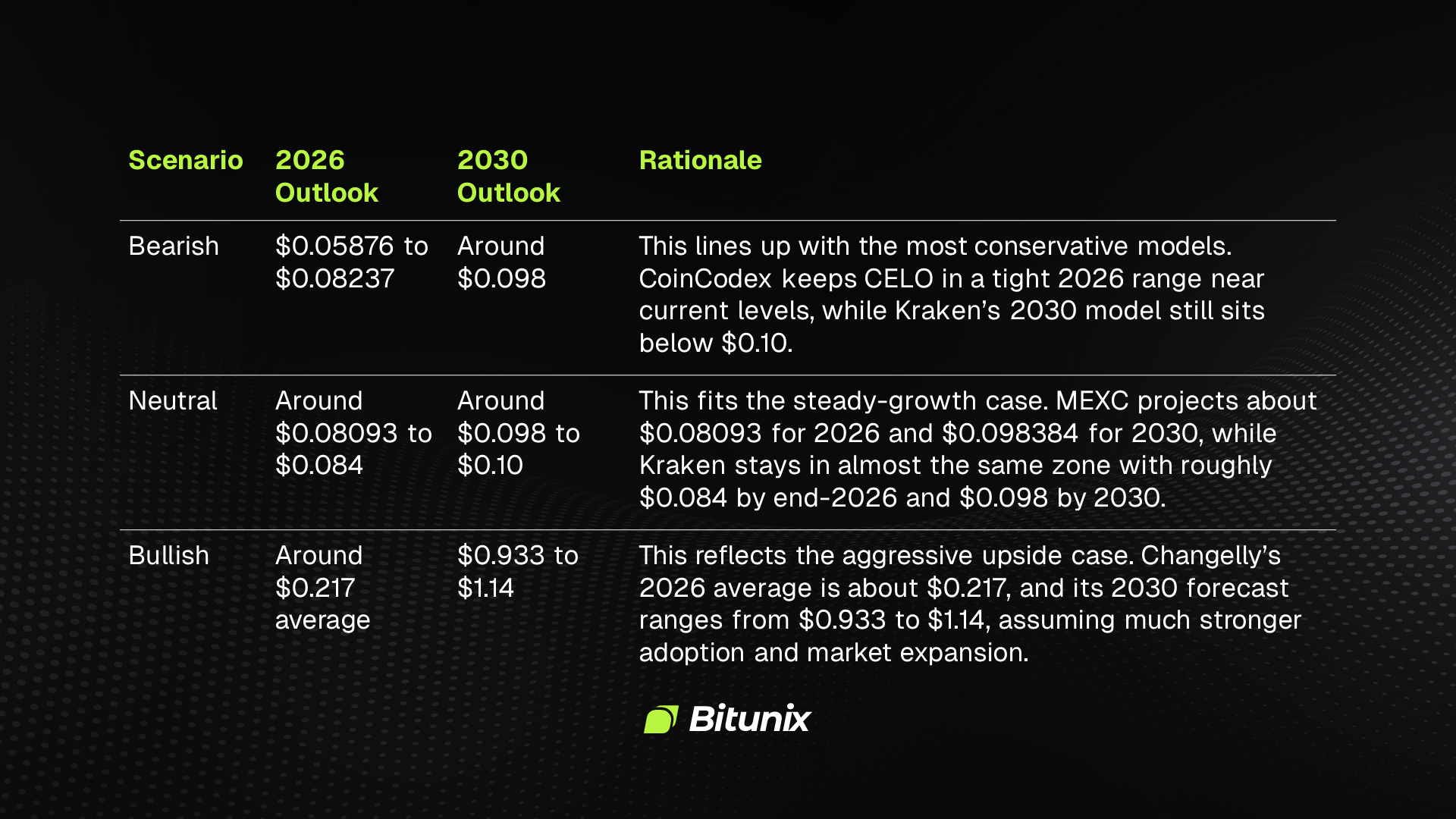
CELO price prediction scenarios for 2026 and 2030, comparing conservative, steady-growth, and bullish adoption outcomes.
The network already has stronger user and stablecoin data than many people realize. However, the token still needs a cleaner value-capture story and far more evidence that mobile usage can translate into sustained demand for CELO itself.
Conclusion: A Mission-Driven Blockchain
Celo remains one of the more interesting projects in crypto because it combines a clear social mission with a pragmatic technical pivot. The shift to Ethereum L2 gave it better infrastructure, better alignment, and a stronger shot at scale. It did not solve every problem, but it removed some old ones that were holding the ecosystem back.
Buying CELO means backing a thesis built around mobile payments, stablecoins, and real-world utility. It also means believing Celo can convert that activity into token value in a fiercely competitive L2 market. If you want market access while you follow that story, Bitunix offers CELO/USDT perpetual futures. You can download the Bitunix app, register an account, and watch the market closely before taking any position. Keep your trade's sizing sensible, since Celo has a real mission, but the market still wants stronger proof.
FAQ Section
What is Celo (CELO)?
Celo is an Ethereum Layer 2 focused on payments, stablecoins, and mobile-first access. CELO is the network's native token, and the broader ecosystem is built around low-cost transfers, local digital currencies, and user onboarding that works better on phones than many older crypto stacks.
Why is Celo transitioning to an Ethereum Layer 2?
Celo moved to Ethereum L2 to gain better scalability, stronger interoperability, and tighter alignment with Ethereum's developer and liquidity ecosystem. The migration also added a native bridge to Ethereum and reduced block times, which improves usability for payment-heavy applications.
What is a mobile-first blockchain?
A mobile-first blockchain is built to work well on smartphones, not just desktop wallets. In Celo's case, that means simpler identity tools, low fees, fast confirmation, and design choices aimed at users in markets where the phone is the main financial device.
How does Celo map phone numbers to public keys?
Celo uses ODIS. A phone number is converted into an on-chain identifier, and that identifier can then be used to look up the linked address. The goal is easier payments without exposing the raw phone number directly to every part of the system.
What are Celo stablecoins (cUSD, cEUR)?
Celo stablecoins are digital assets in the Celo ecosystem designed to track fiat currencies such as the US dollar and the Euro. Mento's platform supports a wider multicurrency set and targets payments, remittances, FX, and savings-style use cases.
What is Regenerative Finance (ReFi)?
ReFi is a branch of crypto finance that aims to support environmental and social regeneration instead of focusing only on extraction and short-term profit. On Celo, that idea shows up through climate-focused positioning, carbon offset funding, and mission-led ecosystem design.
Is Celo carbon-negative?
Current Celo materials still describe the network as carbon-negative, and the site says 20% of transaction fees are allocated to a carbon offset fund. That does not remove every criticism, but sustainability remains a central part of how the ecosystem defines itself.
What is the utility of the CELO token?
CELO functions as the native network token. It is used in the protocol, appears as a gas option in some wallet contexts, and gives holders a role in governance. On the L2 side, CELO also exists as an ERC-20 native on Ethereum.
What are the risks of investing in Celo?
The main risks are fierce L2 competition, uncertain token value capture, regulatory pressure around stablecoins, and the challenge of winning users in markets where strong mobile-money incumbents already dominate.
Where can I buy CELO?
You can buy CELO on major centralized exchanges and, depending on the venue, trade spot or derivatives. CoinGecko lists active CELO markets on exchanges such as OKX, Binance, and Gate, while Bitunix currently offers CELO/USDT perpetual futures.
Glossary
- Layer 2: A blockchain network built on top of Ethereum to improve speed, cost, or scalability while leaning on Ethereum for settlement or security.
- OP Stack: The modular rollup framework Celo adopted for its Ethereum L2 migration.
- CELO token: The native token of the Celo network, used in protocol operations and governance.
- Stablecoins: Crypto assets designed to track the value of fiat currencies or other reserve assets.
- Mento: Celo's multicurrency stablecoin platform for payments, remittances, FX, and related use cases.
- cUSD: A Celo ecosystem stablecoin designed to track the US dollar.
- cEUR: A Celo ecosystem stablecoin designed to track the Euro.
- cREAL: A Celo ecosystem stablecoin designed to track the Brazilian real.
- ODIS: Celo's identity layer for turning a phone number into a privacy-preserving on-chain identifier linked to a wallet address.
- Fee abstraction: A wallet experience where users can pay gas in approved tokens other than the native token.
- Native bridge: The official path for moving assets between Ethereum and Celo L2.
- TVS: Total Value Secured, an L2BEAT metric that estimates the value secured on a given rollup or optimium.
- ReFi: Regenerative Finance, a crypto-finance approach that aims to create social or environmental regeneration alongside financial activity.
- Sequencer: The privileged operator that orders transactions on many rollups, including Celo's current L2 setup.
- ERC-20: A standard token format on Ethereum. After the migration, CELO became native on Ethereum as an ERC-20 token.
Disclaimer
This article does not provide:
(i) investment advice or investment recommendations;
(ii) an offer or solicitation to buy, sell, or hold digital assets;
(iii) financial, accounting, legal, or tax advice.
Digital assets, including stablecoins and NFTs, involve high risk and may fluctuate significantly. Consider whether trading or holding digital assets is appropriate for you given your financial situation. Consult a qualified legal, tax, or investment professional when needed. You are responsible for understanding and complying with applicable local laws and regulations.
About Bitunix
Bitunix is a global cryptocurrency derivatives exchange trusted by over 3 million users across more than 100 countries. At Bitunix, we are committed to providing a transparent, compliant, and secure trading environment for every user. Our platform features a fast registration process and a user-friendly verification system supported by mandatory KYC to ensure safety and compliance. With global standards of protection through Proof of Reserves (POR) and the Bitunix Care Fund, we prioritize user trust and fund security. The K-Line Ultra chart system delivers a seamless trading experience for both beginners and advanced traders, while leverage of up to 200x and deep liquidity make Bitunix one of the most dynamic platforms in the market.
Bitunix Global Accounts
X | Telegram Announcements | Telegram Global | CoinMarketCap | Instagram | Facebook | LinkedIn | Reddit | Medium