
Article Summary
- This article provides a price prediction for Tezos (XTZ), a pioneering Layer 1 blockchain known for its self-amending ledger and on-chain governance.
- It frames Tezos as one of the original "Ethereum killers" that has since struggled to maintain market share against newer, faster blockchains.
- The bullish case is built on Tezos' robust and proven technology, its energy-efficient Liquid Proof-of-Stake (LPoS) consensus, its strong focus on real-world asset (RWA) tokenization through partnerships with major European banks, and its ability to seamlessly upgrade itself without hard forks.
- The bearish case centers on its significant loss of market share and developer mindshare to competitors like Solana and Avalanche, its relatively low transaction speeds compared to newer chains, and the perception that its ecosystem growth has stagnated.
In crypto, standing still is a good way to get run over. Tezos was built around that problem from day one. If you already watch the XTZ/USDT chart on a crypto exchange like Bitunix, you know the market has mostly treated Tezos as a useful, solid, and not very exciting token.
So, what is Tezos? It is a Layer 1 blockchain designed to upgrade itself through formal on-chain governance, without forcing the kind of splits that have fractured other networks. That built-in mechanism is the thing that lets the protocol evolve without requiring a hard fork, and the network is built around long-term upgradability and smart governance.
This analysis will explore the fundamental strengths and weaknesses of the Tezos network, weigh the bull and bear arguments for its future, and project potential price scenarios for XTZ as it seeks to reclaim its glory days.
The Bullish Case for Tezos
Bullish forecasters still see room for a serious rebound. Telegaon projects an average XTZ price of $6.05 in 2026, with a possible high of $7.13, while Bitget's January 2026 outlook put its high-end 2026 target at $2.46. Those are wide gaps, but they point to the same idea. Tezos still has upside if execution finally translates into usage and if the market starts valuing its governance model again.
Self-Amending Ledger
Tezos still owns one of the cleanest design ideas in Layer 1. Its protocol can be upgraded through an internal amendment process instead of forcing a chain split every time governance gets tense. The official docs spell it out clearly. Tezos uses a built-in on-chain mechanism for proposing, selecting, testing, and activating upgrades without the need to hard fork.
And Tezos has kept proving that the system works on the mainnet. Quebec, Seoul, and Tallinn updates are part of it. Quebec improved speed and staking economics with 8-second block times, 16-second finality, and further Adaptive Issuance refinements. Seoul added native multisig, aggregated attestations, and simpler unstaking, which made the network more practical for institutions and everyday users. Tallinn then pushed block times down to 6 seconds, strengthened security with an all-bakers attestation model, and improved storage efficiency for Michelson apps by up to 100x.
That steady upgrade record helps the bullish case. It shows Tezos can get faster, safer, and easier to use without hard forks or community splits. In a market where many chains talk about adaptability, Tezos has years of production-level proof that its governance model can keep delivering meaningful technical progress.
On-Chain Governance
Tezos does not treat governance as a side activity for forum regulars. It is built into the protocol itself. Token holders delegate to bakers, bakers vote on upgrades, proposals go through formal periods, and approved changes move from the test phase to activation on-chain. Messari noted in its Q3 2025 report that the governance process spans five periods over roughly two months and ten days, while official docs show the step-by-step amendment path from proposal to activation.
That process can look slow next to chains that move by social consensus and ship first. But slow is not always bad. In markets, slow can also mean legible, reviewable, and harder to capture. And because XTZ is used for staking, delegation, fees, and governance across both Layer 1 and Etherlink, the token still has direct network utility.
Real-World Asset Niche
Tezos has carved out a real niche in tokenization, especially in Europe, where compliance-heavy institutions tend to care more about upgradeability and governance. Official Tezos docs published in 2025 still highlight Société Générale's successful tests on Tezos, and a 2025 Chambers report noted that Société Générale Forge has issued digital securities on public blockchains such as Ethereum and Tezos.
The broader RWA market also got harder to ignore in 2025. CoinDesk reported in June 2025 that the real-world asset tokenization market had grown 380% in three years to reach $24 billion. Tezos does not own that market. But it does sit inside one of the few crypto themes that institutions actually use.
And there are concrete examples. In February 2025, Spiko said it would launch tokenized U.S. and EU T-bill money market funds on Etherlink. In the same month, Crowdfund Insider reported that Fraktion, a Tezos-powered tokenization platform, raised €1.1 million and was targeting real estate.
Energy-Efficient and Proven
Tezos still benefits from being a proof-of-stake network that did not need to retrofit itself into one. Proof-of-stake eliminates the need for high energy use, and Tezos positions that as a practical advantage for builders and institutions.
There were also signs of institutional maturation around the token itself. In January 2026, Coindesk reported that TenX acquired about 5.5 million XTZ for roughly $3.25 million as part of a strategic staking partnership. Then Bitnomial launched the first-ever U.S. Tezos futures on a CFTC-regulated exchange in February 2026. This event suggests the asset still matters enough to attract structured infrastructure around it.
The Bearish Case Against Tezos
Bearish models are just as easy to find, and some are much closer to current price reality. CoinCodex forecast XTZ at $0.2838 by the end of 2026, while Changelly's 2026 forecast put the range between $0.344 and $0.382.
Loss of Market and Mind Share
Tezos does not suffer from a technology identity crisis. It suffers from an attention crisis. As of March 13, 2026, Coinbase showed XTZ at around $0.3737 with a market cap of about $403.8 million, and down 47% year over year. CoinGecko put Tezos at $395 million in market cap and ranked it around 115 to 116. That is a long way from the top-tier mind share needed to lead a bull market.
The market has also moved on to faster and louder narratives. The Motley Fool noted in February 2025 that Tezos faces stiff competition from Ethereum, Solana, Cardano, and Avalanche, all of which have carved out greater market share. The central bearish argument is that Tezos may be technically sound, but soundness alone does not attract developers, liquidity, or scale-level speculation.
Lower Performance
Tezos has improved significantly in performance. Quebec improved block times, and Tallinn brought them down to 6 seconds and finality to 12 seconds. Etherlink also moved faster, with Tezos Spotlight reporting instant confirmations and sub-50ms receipts in January 2026.
Still, the market compares Tezos to chains that built their reputation on raw speed years ago. Chainspect's 2026 comparison page showed Tezos far behind Solana on real-time and max observed throughput. Even if you take those figures as directional, the perception problem is real. Tezos is improving, but it is still spending 2026 proving it can be fast enough, while rivals are already selling the next story.
Stagnant Ecosystem
Messari's Q4 2025 report said Etherlink transactions rose 50% quarter over quarter to 18.6 million, and daily active addresses nearly doubled to 9,860, which is encouraging. But the same report showed DeFi TVL falling to $37.2 million on Etherlink and $33.5 million on Tezos Layer 1. In other words, there is activity, but the economic depth is still modest.
Earlier in 2025, things looked better. Q3 ended with $45.1 million in Tezos Layer 1 TVL, and protocols like Youves and Sirius carried much of that load. But that also highlights the problem. The ecosystem still leans on a fairly small set of recognizable names. It has not produced the kind of breakout DeFi, gaming, or consumer application that drags the whole network into mainstream crypto conversation.
Even the usage mix tells a mixed story. The Tezos Foundation's H2 2025 report said gaming accounted for over 80% of active users across the ecosystem, while DeFi and tokenization continued to grow more slowly and unevenly. It suggests that Tezos still lacks broad-based traction across the sectors that usually drive token re-rating.
Conservative Image
Tezos' main strengths are governance, multisig, digital securities, tokenization, formal verification, and institutional-grade upgrades. They also make the network feel more conservative than chains that thrive on speed, memes, and risk appetite. That conservative image can help win regulated partnerships. It does less for attracting the kind of speculative crowd that pushes tokens vertically in bull phases. This is partly an inference, but it fits the gap between Tezos' technical progress and its market response in 2025 and early 2026.
Tezos Price Prediction 2026: Three Scenarios
The 2026 outlook for Tezos depends on two competing signals. On one side, the network is still active on the product front, with continued work on tokenization, Etherlink, and the broader Tezos X roadmap. On the other hand, the market is still valuing XTZ conservatively. Current pricing sits around $0.36 to $0.39, with a market cap near $392 million to $417 million depending on the tracker and timestamp. That gap between steady development and muted valuation is the core tension in any serious XTZ outlook.
Forecast models reflect that split very clearly. CoinCodex is cautious and projects XTZ near $0.2838 by the end of 2026, which implies limited upside from current levels. Kraken's model is steadier, putting 2026 around $0.41 under its sample growth assumptions, while Bitget lands in a similar range at about $0.4092. At the far bullish end, Telegaon projects a much wider 2026 band, with an average around $6.05 and a possible high above $7. That spread shows just how uncertain sentiment remains. Conservative models price Tezos as a durable but niche Layer 1, while the more aggressive ones assume a major rerating tied to stronger adoption and renewed investor attention.
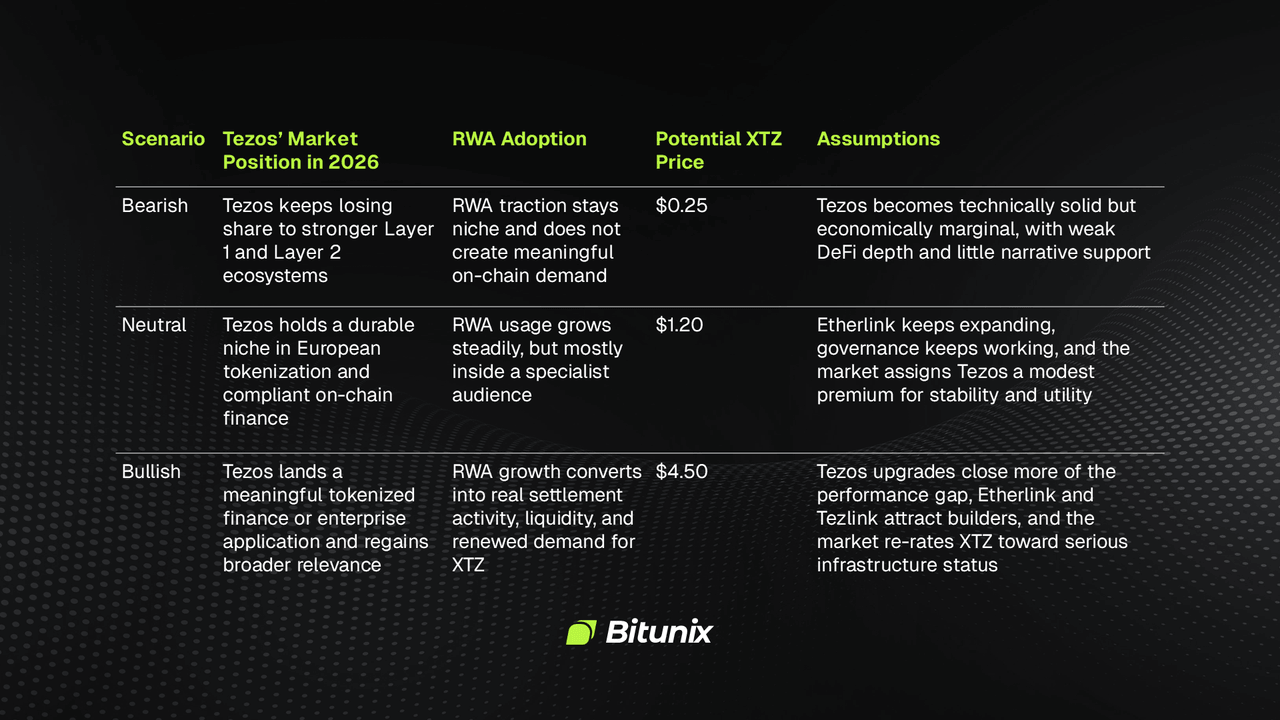
Tezos 2026 price scenarios range from a weak niche outcome at $0.25 to a stronger re-rating at $4.50, depending on RWA traction, ecosystem growth, and whether upgrades translate into real demand for XTZ.
The bearish target lines up with today's cautious models. The neutral target assumes Tezos wins its niche and gets paid for it. The bullish target still sits below the most aggressive outside forecasts. Still, it would require several things to go right at once: stronger Layer 2 adoption, clearer monetization of RWA activity, and a technology narrative that finally lands with developers.
Conclusion: A Bet on Substance Over Hype
Tezos remains a project for people who care about process, security, and governance. It has a credible tokenization story in Europe, and it continues to push technical upgrades that many older chains would struggle to coordinate. The upside case is real. So is the risk that the market keeps shrugging.
For long-term investors, XTZ is a patient bet. You are betting that crypto eventually rewards networks that can upgrade cleanly, support real financial assets, and survive. But this still is a bet against stronger competitors, deeper liquidity elsewhere, and a market that often confuses noise with progress.
Bitunix gives you a place to trade XTZ and other foundational Layer 1 assets. You can download the Bitunix app and register to keep Tezos on your watchlist, track the XTZ/USDT pair, and decide whether this slower, sturdier chain deserves a place in your portfolio.
FAQ
What is a self-amending ledger?
It is a blockchain design that lets the protocol update itself through on-chain governance instead of relying on disruptive hard forks. Tezos documentation treats this as one of the network's core features.
What is Liquid Proof-of-Stake?
Liquid Proof-of-Stake is Tezos' consensus model. It lets validators, called bakers, and delegators stake XTZ to secure the network while keeping governance tied to stake participation.
How does Tezos governance work?
Tezos governance works through a formal amendment process where proposals are submitted, voted on, tested, and then activated on-chain. The process is split across five periods and lasts about two months and ten days.
What is baking on Tezos?
Baking is Tezos' term for block production and validation. Bakers create blocks, validate other bakers' blocks, and publish attestations that help the network reach consensus.
How does Tezos compare to Ethereum?
Both are smart contract platforms, but Tezos puts more emphasis on self-upgrades and on-chain governance. Ethereum still dominates DeFi and market mind share, while Tezos has focused more on governance, tokenization, and a layered scaling path
through Etherlink and Tezlink.
What are some of the major projects built on Tezos?
In 2025 and 2026, some of the more visible names included Etherlink, Youves, Sirius, Spiko's tokenized money market funds, Fraktion for tokenized real estate infrastructure, and projects around digital art and NFTs.
Who are the founders of Tezos?
Arthur and Kathleen Breitman created Tezos. They created the project in 2014, with broader public support arriving during the 2017 crowdfunding period.
What was the Tezos ICO controversy?
The Tezos ICO controversy began after its 2017 token sale raised about $232 million, only to become stuck in a power struggle between the founders and the Tezos Foundation. The fight delayed the launch and triggered lawsuits alleging an unregistered securities offering, ending in a $25 million settlement in 2020.
Is Tezos a good investment for the long term?
It can be, but only if you believe governance, steady upgrades, and tokenized finance will matter more over time than short-term hype. The bullish case rests on continued RWA growth and successful execution on Etherlink and Tezos X, while the bearish case says Tezos stays niche and never regains broad market attention.
What is the total supply of XTZ?
Coinbase's March 2026 data shows a total supply of about 1.1 billion XTZ and lists max supply as not enough data. In practice, that means XTZ does not have a fixed hard cap like Bitcoin.
Glossary
- Adaptive Issuance: A Tezos monetary mechanism that adjusts staking rewards to help keep network security strong efficiently.
- Baker: A Tezos validator that creates blocks, validates blocks, and participates in governance voting.
- Baking: The Tezos process of producing blocks and confirming transactions through its proof-of-stake system.
- Data Availability Layer: A scaling component that helps rollups publish data efficiently while anchoring security to Tezos.
- Delegator: A user who stakes XTZ with a baker to earn rewards without running validator infrastructure.
- DeFi TVL: The total value locked in decentralized finance protocols, a common way to measure ecosystem depth.
- Etherlink: Tezos’ EVM-compatible Layer 2 that handles fast execution while settling and governing through Tezos.
- Finality: The point at which a blockchain transaction is considered irreversible under normal network conditions.
- Formal Verification: A method for checking smart contract correctness mathematically, which Tezos highlights for higher-value use cases.
- Hard Fork: A blockchain split that creates a separate chain, something Tezos tries to avoid through self-amendment.
- Liquid Proof-of-Stake: Tezos’ consensus model, where stake secures the network and also supports governance participation.
- On-Chain Governance: A governance model where protocol changes are proposed, voted on, tested, and activated on-chain.
- Real-World Assets: Off-chain assets such as real estate, funds, bonds, or securities represented on blockchain networks.
- Self-Amending Blockchain: A blockchain that can upgrade its core protocol through built-in governance without disruptive splits.
- Tezlink: A Tezos X runtime in testnet phase that aims to bring Michelson apps into a faster scaling environment.
Disclaimer
This article does not provide:
(i) investment advice or investment recommendations;
(ii) an offer or solicitation to buy, sell, or hold digital assets;
(iii) financial, accounting, legal, or tax advice.
Digital assets, including stablecoins and NFTs, involve high risk and may fluctuate significantly. Consider whether trading or holding digital assets is appropriate for you given your financial situation. Consult a qualified legal, tax, or investment professional when needed. You are responsible for understanding and complying with applicable local laws and regulations.
About Bitunix
Bitunix is a global cryptocurrency derivatives exchange trusted by over 3 million users across more than 100 countries. At Bitunix, we are committed to providing a transparent, compliant, and secure trading environment for every user. Our platform features a fast registration process and a user-friendly verification system supported by mandatory KYC to ensure safety and compliance. With global standards of protection through Proof of Reserves (POR) and the Bitunix Care Fund, we prioritize user trust and fund security. The K-Line Ultra chart system delivers a seamless trading experience for both beginners and advanced traders. At the same time, leverage of up to 200x and deep liquidity make Bitunix one of the most dynamic platforms in the market.
Bitunix Global Accounts
X | Telegram Announcements | Telegram Global | CoinMarketCap | Instagram | Facebook | LinkedIn | Reddit | Medium