Asset tokenization has become one of the most discussed developments in blockchain and financial technology, enabling ownership rights of physical and financial assets to be represented as digital tokens on a blockchain.
In traditional finance, ownership of assets such as real estate, bonds, commodities, or private equity often depends on centralized records, intermediaries, and lengthy settlement processes. Asset tokenization introduces a blockchain-based approach where ownership information and transaction records can be represented digitally.
Today, real-world asset (RWA) tokenization continues to gain widespread adoption as financial institutions, technology providers, and blockchain platforms actively connect traditional assets with decentralized infrastructure.
But how does asset tokenization actually work?
This article explains the complete technical process behind tokenizing real-world assets, including legal structuring, custody, smart contracts, blockchain infrastructure, and lifecycle management.
What is Asset Tokenization?

Asset tokenization is the process of converting ownership rights or economic interests in a real-world asset into digital tokens recorded on a blockchain.
Each token represents a defined portion of ownership, rights, or claims related to the underlying asset. Depending on the structure, token holders may receive benefits such as ownership rights, revenue distributions, voting participation, or transfer rights.
Tokenization can apply to a wide range of assets, including:
Real estate: Commercial buildings, residential properties, and land
Financial instruments: Bonds, equities, private equity, and funds
Commodities: Gold, energy products, and agricultural assets
Intellectual property: Patents, royalties, and licensing rights
Collectibles: Fine art, luxury goods, and rare items
How Traditional Assets Become Blockchain Tokens
A simplified tokenization model looks like this:
Real-World Asset → Legal Structure → Asset Verification → Custody → Smart Contract → Blockchain Token → Distribution Platform
For example, a real estate company seeking to tokenize a commercial building may:
Establish a legal entity representing ownership rights.
Verify the property's value through professional assessment.
Store ownership documents through appropriate custody arrangements.
Create blockchain tokens representing fractional interests.
Distribute tokens through a compliant marketplace.
The blockchain token itself does not replace legal ownership documents. Instead, it acts as a digital representation connected to an underlying legal framework.
The Asset Tokenization Process
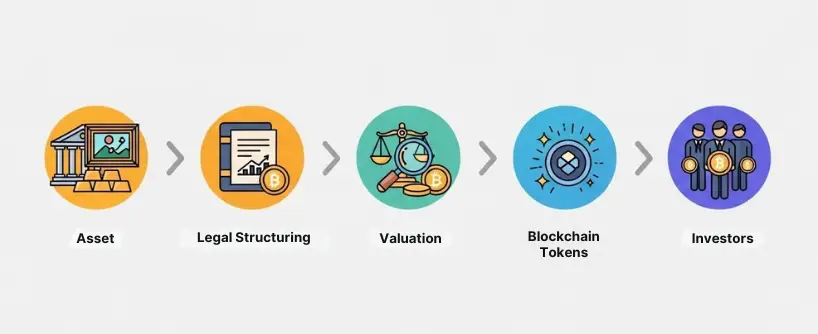
The process of tokenization can be divided into five technical steps:
Step 1: Asset Identification and Legal Structuring
The first stage involves identifying the asset to be tokenized and establishing the legal framework that connects the digital token with the underlying asset.
Ownership rights must be clearly defined, and compliance with applicable regulations is essential.
For example, in real estate tokenization:
Property ownership must be verified.
Legal agreements must define token holder rights.
The relationship between blockchain tokens and property ownership must be established.
This step ensures that the token represents a legitimate claim rather than simply a digital record without enforceable value.
Why Legal Structure Matters in Asset Tokenization
A common misunderstanding is that blockchain technology alone creates ownership.
In reality, tokenization depends on the connection between:
Blockchain records
Legal agreements
Asset custody
Regulatory requirements
Without proper legal structuring, a token may not provide clear ownership rights or protection for holders.
Step 2: Asset Valuation and Custody
Before creating tokens, the underlying asset must be evaluated and secured.
Asset valuation may involve:
Independent assessments
Market analysis
Financial audits
Professional appraisal
Custody arrangements are equally important because the physical asset must remain properly managed.
Examples:
Gold tokens may require secure storage of physical gold reserves.
Real estate tokens may require property documentation and ownership verification.
Financial asset tokens may require regulated institutions to hold underlying securities.
Custody creates the connection between the physical asset and its blockchain representation.
Step 3: Token Creation on Blockchain
Once legal and custody frameworks are established, the asset can be represented through blockchain tokens.
This process usually involves deploying smart contracts that define:
Token ownership rules
Transfer conditions
Compliance requirements
Distribution mechanisms
Governance features
Blockchain networks commonly used for tokenization include:
Token structures may vary depending on the asset type.
Fungible Tokens
Fungible tokens represent identical units that can be exchanged with each other.
Examples:
Non-Fungible Tokens (NFTs)
Non-fungible tokens represent unique assets or ownership records.
Examples:
Common Token Standards Used in Asset Tokenization
Different asset types may require different blockchain token standards.
Examples include:
ERC-20: Commonly used for divisible assets where each token represents an identical unit.
ERC-721: Designed for unique digital assets with individual characteristics.
Security Token Standards: Designed for regulated financial assets that require transfer restrictions and compliance features.
The choice of token standard depends on the asset structure, regulatory requirements, and intended use case.
Step 4: Distribution and Trading
After token creation, tokenized assets can be distributed through different platforms, including:
Depending on the structure, investors may acquire tokens using cryptocurrency or traditional payment methods.
One potential advantage of tokenization is fractional ownership.
For example:
A high-value property that previously required a single buyer may be divided into smaller digital units, allowing multiple participants to hold portions of the asset.
However, secondary market liquidity depends on factors such as:
Market demand
Regulatory accessibility
Trading infrastructure
Asset quality
Tokenization does not automatically guarantee active markets.
Step 5: Lifecycle Management
Tokenization continues after issuance.
Tokenized assets require ongoing management, including:
Ownership updates
Compliance monitoring
Revenue distribution
Reporting
Redemption processes
Smart contracts can automate certain activities, such as:
Blockchain records provide transparency by maintaining transaction histories that can be reviewed by authorized participants. Lifecycle management ensures that the digital representation remains connected to the underlying asset throughout its existence.
Technical Components of Tokenization

Asset tokenization relies on multiple technologies and operational systems working together. Blockchain provides the digital infrastructure, but successful tokenization also requires smart contracts, data verification, custody solutions, and compliance mechanisms.
Smart Contracts
Smart contracts are self-executing programs stored on a blockchain. They define the rules for how tokens are created, transferred, and managed.
In asset tokenization, smart contracts can automate functions such as:
For example, in tokenized real estate, a smart contract may automatically distribute rental income according to predefined ownership shares.
However, smart contracts do not independently verify whether an off-chain asset exists or whether legal ownership is valid. They operate based on the information and conditions provided to them.
Smart Contract Risks in Asset Tokenization
Although smart contracts improve automation and transparency, they introduce technical considerations.
Potential risks include:
For this reason, smart contract audits, security reviews, and careful development practices are important components of tokenization infrastructure.
Blockchain Infrastructure
Blockchain acts as the distributed ledger where token ownership records and transactions are stored.
Common blockchain requirements for asset tokenization include:
Public blockchains such as Ethereum are widely used for tokenized assets, while private or consortium blockchains may be preferred for certain institutional applications that require controlled access.
Blockchain infrastructure enables:
Transparent ownership records
Automated settlement
Programmable asset management
Reduced reliance on manual reconciliation
Why Interoperability Matters for Tokenized Assets
Tokenized assets may need to interact with multiple systems, including:
Without interoperability, tokenized assets may remain isolated within individual ecosystems. Future adoption depends partly on improving connections between blockchain networks and existing financial infrastructure.
Oracles
Oracles are systems that connect blockchain networks with external data sources.
Because blockchains cannot directly access real-world information, oracles provide data such as:
Asset prices
Interest rates
Market conditions
Legal updates
Performance metrics
For example, a tokenized commodity may require external price data to determine valuation, while a tokenized financial product may need updated interest rate information. Oracle accuracy is important because incorrect external data can affect how tokenized assets are valued or managed.
Custody and Security
Custody plays a critical role in connecting digital tokens with real-world assets.
A tokenized asset system typically requires secure management of:
Physical assets
Legal documents
Private keys
Blockchain records
Custody models may involve:
Security considerations include:
Asset Tokenization Security Checklist
Before evaluating a tokenized asset system, users and institutions may consider:
Area | Key Question |
|---|
Legal structure | Are ownership rights clearly defined? |
Asset verification | Is the underlying asset independently verified? |
Custody | Who manages and protects the asset? |
Smart contracts | Has the code undergone security review? |
Data sources | Are oracle mechanisms reliable? |
Compliance | Does the system follow applicable regulations? |
This framework helps distinguish between a technically functioning token and a properly structured tokenization solution.
Benefits of Asset Tokenization
Asset tokenization introduces several potential advantages by combining traditional assets with blockchain infrastructure.

Efficiency
Blockchain-based systems can reduce manual processes by automating ownership records, settlements, and certain compliance procedures.
Traditional asset transfers often involve multiple intermediaries, while tokenized systems may streamline some administrative processes.
Liquidity
Many traditional assets, such as real estate or private equity, can be difficult to divide or trade. Tokenization enables fractional ownership, allowing assets to be represented through smaller digital units.
However, liquidity depends on market participation, regulatory frameworks, and available trading infrastructure.
Transparency
Blockchain records provide a transparent transaction history.
Participants can verify:
Ownership changes
Token transfers
Transaction activity
This transparency can improve auditability when combined with appropriate legal and compliance systems.
Accessibility
Tokenization may lower barriers for accessing certain asset classes by enabling fractional participation. For example, instead of requiring ownership of an entire high-value asset, tokenized structures may allow participation through smaller units.
Asset Tokenization vs Traditional Asset Ownership
Traditional Asset Ownership | Tokenized Asset Ownership |
|---|
Records often managed through centralized systems | Ownership records can be represented on blockchain |
Transfers may require multiple intermediaries | Transfers can be automated through smart contracts |
Large assets are difficult to divide | Assets can potentially be fractionalized |
Settlement may take longer | Blockchain systems may enable faster settlement |
Tokenization does not replace traditional legal ownership systems. Instead, it creates an additional digital layer for representing and managing ownership rights.
Market Adoption in 2026
The tokenization market has transitioned from pilot experimentation into institutional scaling and commercial integration. Key market drivers include:
Institutional Fund Scaling: Major global asset managers actively manage tokenized money market funds, yield-bearing products, and public equities used directly for instant settlement and collateral.
Dominance of Government Debt & Yield: Tokenized U.S. Treasuries and sovereign bonds lead adoption, serving as the foundational risk-free yield layer across financial rails.
Institutional Infrastructure Integration: Platform efforts now prioritize cross-chain interoperability, unified compliance protocols, and bank-grade digital custody solutions.
Regulatory Standardisation: Comprehensive regulatory frameworks (such as full implementation of MiCA and expanded regional sandboxes) have reduced barriers for cross-border institutional capital.
Analyst projections remain bullish through 2030, though actual expansion is currently concentrated in highly liquid fixed-income and commodity-backed assets rather than traditionally illiquid private assets.
Why Institutions Are Exploring RWA Tokenization
Institutional interest in tokenization is driven by several potential benefits:
More efficient asset settlement
Programmable financial products
Improved transparency
Automated compliance workflows
Expanded access to certain markets
At the same time, institutions must address challenges involving regulation, custody, interoperability, and operational risk.
Challenges to Address
Despite its potential benefits, asset tokenization still faces several challenges.
Regulatory Compliance
Different jurisdictions have different rules regarding:
Digital securities
Ownership rights
Investor access
Reporting requirements
Clear regulatory frameworks remain important for wider adoption.
Liquidity Depth
Tokenization can make assets easier to divide, but it does not automatically create buyers and sellers.
Liquidity depends on:
Market demand
Trading platforms
Regulatory accessibility
Asset quality
Custody Risks
The connection between blockchain tokens and real-world assets must remain accurate.
Potential risks include:
Technology Integration
Large-scale adoption requires blockchain networks to work effectively with existing financial systems.
Key challenges include:
Scalability
Interoperability
Data reliability
Security standards
The Role of Bitunix Academy
As blockchain applications become increasingly technical, understanding concepts such as smart contracts, custody models, and token standards becomes essential.
Bitunix Academy provides educational resources covering blockchain technologies, digital assets, and emerging concepts such as real-world asset tokenization.
For readers exploring tokenization mechanics, understanding how blockchain infrastructure, smart contracts, and external data systems interact can provide a clearer view of how tokenized assets are created and managed.
Conclusion
Asset tokenization represents a significant development in the connection between traditional finance and blockchain technology.
By converting ownership rights into programmable digital tokens, tokenization creates new possibilities for asset management, fractional ownership, and automated financial processes.
However, successful tokenization requires more than blockchain technology alone. Legal structures, asset verification, custody solutions, smart contract security, and regulatory compliance all play essential roles.
As the RWA ecosystem continues to develop, understanding the technical foundation behind asset tokenization will become increasingly important for developers, institutions, and blockchain users.
Tokenization may reshape how certain assets are represented and managed, but its long-term adoption will depend on building secure, transparent, and compliant systems.