
Article Summary
- This article explains the concept of a "nonce" (Number Used Once) in the context of cryptography and blockchain technology.
- It breaks down the two primary types of nonces used in crypto: the Proof-of-Work (PoW) mining nonce (used in Bitcoin) and the Account Nonce (used in Ethereum).
- It details how miners use nonces to solve complex cryptographic puzzles and secure the network.
- It explains how account nonces prevent replay attacks and ensure transactions are processed in the correct order.
- The article includes a comparison table highlighting the differences between mining nonces and account nonces.
Behind every secure Bitcoin transfer and every fresh block on a blockchain sits a small technical detail that does a lot of heavy lifting. That detail is the nonce, short for number used once. It helps stop old data from being reused, keeps transaction order intact, and in some systems helps secure the entire network itself.
You do not need to write code to care about it. If you use Bitcoin, Ethereum, wallets, DeFi apps, or a crypto exchange, you are already relying on nonce logic in the background. Bitunix is one example, offering BTC and ETH markets, a public Proof of Reserves page, and mobile app access. At the same time, the blockchains underlying it still rely on nonce rules to determine what is accepted and in what order.
This guide explains where the nonce comes from, how it works in cryptography, and why Bitcoin and Ethereum use it in very different ways. By the end, you will understand the difference between a miner guessing millions of values per second and a wallet simply counting 0, 1, 2, 3.
The Cryptographic Foundation
Cryptography is the science of secure communication. It gives you hashing, digital signatures, encryption, and verification rules that let strangers coordinate over an open network without trusting each other first. Ethereum's glossary defines a nonce as a value that can only be used once, and its February 2026 developer docs still describe the account nonce as a replay-protection tool built into every account.
A cryptographic nonce adds freshness. Think of it like a concert ticket stub with a unique serial number. Once the staff scans that number, trying to use the same stub again does not work. In Ethereum's 2026 state-channel docs, the nonce works as a unique ID for transactions and records the order of state updates. In a separate February 2026 tutorial on sponsored transactions, ethereum.org shows that adding a nonce to signed data blocks replay attacks by rejecting reused messages after the mapping increments.
If you have ever asked how does a nonce work, the short answer is that it gives a transaction, message, or block attempt a unique marker. That marker changes the resulting hash or the validation state, so the network can tell old from new. This same family of cryptographic ideas also shows up in exchange transparency tools. Bitunix's Proof of Reserve page explains that it uses a Merkle tree and SHA256-based hashing so users can verify that balances are included in a published dataset without exposing everyone else's data.
The Mining Nonce (The Bitcoin Model)
Bitcoin uses proof of work. Miners compete to create a block header whose hash is below a target threshold. The Bitcoin developer reference describes the nonce field in the block header as a uint32_t, which means it is a 4-byte value, and says miners keep changing it to try to produce a header hash that is less than or equal to the target. The same reference notes that the target itself is encoded in the nBits field.
Satoshi Nakamoto described the idea neatly in the original Bitcoin whitepaper:
"For our timestamp network, we implement the proof-of-work by incrementing a nonce in the block until a value is found that gives the block's hash the required zero bits."
That is the heart of the Bitcoin mining nonce. Miners take block header data, hash it, check whether the result is below the target, and if it fails, they change the nonce and try again. If they burn through all 32-bit nonce values, miners can update the time or change the coinbase transaction, which changes the Merkle root and creates fresh search space.
So, what is a nonce in blockchain terms on the Bitcoin side? It is the adjustable field that lets miners keep generating new hash attempts without changing the whole block from scratch. Bitcoin's developer guide also points out that the block header has easy-to-modify fields, including the nonce, so miners can keep hashing efficiently. That is why the nonce is often called the golden ticket field. It is the small number that proves a huge amount of computational work happened behind the scenes.
And the scale in 2025 and 2026 has been huge. CoinShares reported in Q1 2026 that Bitcoin's network surpassed 1 zetahash per second for the first time in late August 2025 and peaked near 1,160 EH/s in early October 2025. Hashrate Index then reported on March 2, 2026, that the 7-day simple moving average had risen to 1,068 EH/s, with the 30-day average at 1,035 EH/s. That is relevant because more hashing power means greater network security and stronger resistance to attack.
This is also where the user view meets the protocol view. When you buy or move BTC through Bitunix, the exchange handles the interface, but the final settlement still relies on miners finding valid nonces and the network accepting the block.
The Account Nonce (The Ethereum Model)
Ethereum uses a different model. Asethereum.org explained in its March 31, 2026, comparison page, Bitcoin uses the UTXO model, while Ethereum uses an account-based model that behaves more like a bank account ledger. That design makes smart contracts easier to manage, but it also creates a new problem: the network needs a clean way to know which transaction from your account comes first, second, and third.
That is where the Ethereum account nonce comes in. Ethereum's February 23, 2026, account documentation states that each account has a nonce counter and that only one transaction with a given nonce can be executed for that account. The Yellow Paper defines the account nonce as the number of transactions sent from the address, and it also states that a transaction is only valid if the transaction nonce matches the sender account’s current nonce.
Ask what is a nonce in blockchain on Ethereum, and the answer changes from trial and error to sequencing. If you send a transaction with nonce 0, the network expects your next one to use nonce 1, then nonce 2, and so on. A replayed transaction fails because the nonce has already been consumed. Ethereum's 2026 gasless tutorial makes the point directly: add a nonce to the signed structure, accept it only if it matches the current mapping, then increment the mapping for next time.
This is also why stuck transactions can be annoying. If one transaction sits in the mempool with a gas setting that is too weak, later transactions from the same account can queue up behind it because the nonce order must remain sequential. Etherscan's gas tracker showed standard gas at 0.098 gwei and a pending queue of 92,880 transactions on April 3, 2026, while its daily transactions chart marked a record 2,896,853 Ethereum transactions on February 7, 2026.
If you withdraw ETH from Bitunix to your own wallet, you usually do not type the nonce manually because wallet software handles it for you. But when transactions get stuck, replaced, or canceled, the nonce becomes visible fast. Suddenly, that quiet counter in the background becomes the traffic cop for your whole account.
Comparison: What Is a Nonce in Blockchain for Bitcoin vs. Ethereum?
Bitcoin and Ethereum both use nonces, but they serve different purposes. In Bitcoin, the nonce helps miners search for a valid block hash. In Ethereum, the nonce keeps your account history in order and blocks replayed transactions.
Here is a comparison for both blockchains:
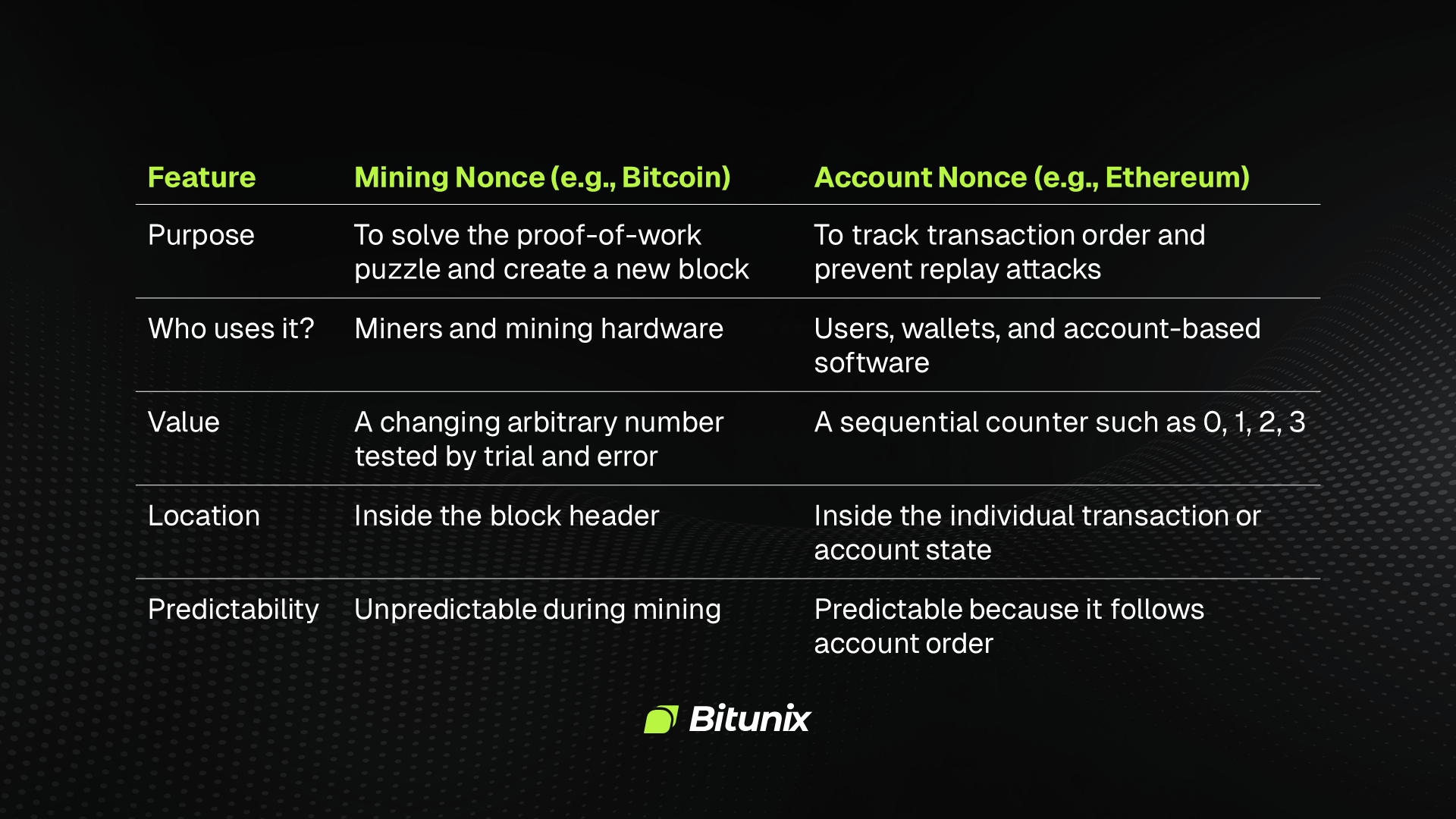
Key differences between mining nonces and account nonces, highlighting their roles in block creation and transaction ordering.
Conclusion: The Unsung Hero of Blockchain
The nonce looks small, but it sits at the center of blockchain security. In Bitcoin, it is the number miners keep changing until they produce proof of work. In Ethereum, it is the counter that protects your account from replay and keeps your transactions in the right order. Without it, both systems get messy fast.
Once you understand the nonce, a lot of crypto starts looking like engineering. That is useful whether you are building an app, checking a stuck wallet transaction, or learning why block explorers show pending queues and hash rate charts. And when you are ready to put that knowledge to work, you can download the Bitunix app and register to trade Bitcoin, Ethereum, and other digital assets with access to spot markets and on-platform reserve verification tools.
FAQ
What does nonce stand for?
Nonce stands for number used once. In cryptography, it refers to a value meant for single use so old data cannot be reused as if it were new. In blockchains, that idea becomes either a mining input or a transaction counter, depending on the network.
Why is a nonce only used once?
A nonce is used once, so the system can detect duplicates and reject replays. If the same signed message or transaction could be reused freely, an attacker could try to execute it again. Single-use values stop that by making each valid action unique.
What happens if two miners find the correct nonce at the same time?
Both blocks can briefly exist. Bitcoin nodes may see different valid blocks first, leading to a temporary chain split. The tie usually breaks when the next valid block is mined on one branch, and the network follows the longer chain with more accumulated proof of work.
How big is a Bitcoin nonce?
The nonce field in a Bitcoin block header is 4 bytes, or 32 bits. That gives miners 4,294,967,296 direct values to test before they need to refresh other fields, such as time or coinbase data, to keep searching.
Can I choose my own Ethereum nonce?
Yes, advanced users can set it manually, but most wallets assign it automatically. Manual nonce control is mainly useful when you need to replace, speed up, or cancel a stuck transaction. If you set it incorrectly, you can block later transactions from the same account.
What happens if I send an Ethereum transaction with the wrong nonce?
If the nonce is lower than the current account nonce, the network treats the transaction as already used and rejects it. If the nonce is too high, the transaction can sit pending until the missing earlier nonces are filled. Ethereum validates nonce order strictly.
How do I fix a stuck transaction caused by a nonce issue?
You usually fix it by replacing the stuck transaction with the same nonce and a higher fee, or by sending a cancel-style transaction that uses that same nonce. The goal is to clear the blocked slot so later transactions can move again.
Do Proof-of-Stake blockchains use nonces?
Yes, but usually not for mining. Ethereum no longer uses mining, yet account nonces still exist and still prevent replay attacks. In proof-of-stake systems, nonce logic often stays important for transaction uniqueness, ordering, signatures, and smart contract interactions.
Is a nonce the same as a private key?
No. A private key proves ownership and lets you sign transactions. A nonce is just a one-time value or counter used during verification, ordering, or mining.
How does a nonce prevent a replay attack?
It prevents replay by making each valid action unique in sequence or context. When a transaction or signed message includes the expected nonce, the system accepts it once and then moves forward. Reusing the same signed data later fails because the nonce no longer matches.
Glossary
- Nonce: A value used once to make a cryptographic operation or transaction uniquely identifiable.
- Cryptographic nonce: A one-time value added to signed or hashed data to prevent reuse and replay.
- Proof of work: Bitcoin's consensus method where miners compete to find a valid block hash below a target.
- SHA-256: The hash function named in the Bitcoin whitepaper for proof-of-work hashing.
- Block header: The 80-byte Bitcoin data structure miners hash during proof of work.
- Target threshold: The difficulty limit that a Bitcoin block hash must be below to be valid.
- Hash rate: The amount of computing power a proof-of-work network performs over time.
- Coinbase transaction: The special transaction miners modify when building a block, including extra nonce data.
- UTXO model: Bitcoin's model that tracks spendable outputs rather than account balances.
- Account-based model: Ethereum's ledger model that tracks balances and account state like a bank ledger.
- Ethereum account nonce: The transaction counter for an Ethereum account, used for ordering and replay protection.
- Replay attack: An attack where a valid signed message or transaction is captured and resent later.
- Mempool: The pool of pending blockchain transactions waiting to be included in a block.
- Gas fee: The fee paid to execute a transaction on Ethereum, denominated in gwei.
- Merkle tree: A cryptographic tree structure that compresses many records into a single root hash for efficient verification.
Disclaimer
This article does not provide:
(i) investment advice or investment recommendations;
(ii) an offer or solicitation to buy, sell, or hold digital assets;
(iii) financial, accounting, legal, or tax advice.
Digital assets, including stablecoins and NFTs, involve high risk and may fluctuate significantly. Consider whether trading or holding digital assets is appropriate for you given your financial situation. Consult a qualified legal, tax, or investment professional when needed. You are responsible for understanding and complying with applicable local laws and regulations.
About Bitunix
Bitunix is a global cryptocurrency derivatives exchange trusted by over 3 million users across more than 100 countries. At Bitunix, we are committed to providing a transparent, compliant, and secure trading environment for every user. Our platform features a fast registration process and a user-friendly verification system supported by mandatory KYC to ensure safety and compliance. With global standards of protection through Proof of Reserves (POR) and the Bitunix Care Fund, we prioritize user trust and fund security. The K-Line Ultra chart system delivers a seamless trading experience for both beginners and advanced traders, while leverage of up to 200x and deep liquidity make Bitunix one of the most dynamic platforms in the market.
Bitunix Global Accounts
X | Telegram Announcements | Telegram Global | CoinMarketCap | Instagram | Facebook | LinkedIn | Reddit | Medium