
As trading habits continue to evolve, more users are looking beyond crypto-only markets and paying closer attention to traditional asset categories. Commodities are one of the clearest examples of this shift. Gold, silver, copper, platinum, and palladium have long held an important place in global financial markets, and today they remain relevant for traders who want exposure to macro-driven price action, industrial demand narratives, and defensive market themes.
At Bitunix, this broader market interest is reflected in the expansion of TradFi-linked products. Alongside crypto and stock-linked markets, users can now explore commodity futures tied to some of the most recognized metals in traditional finance. This gives traders access to an additional category of markets without forcing them to move into a completely separate trading environment.
For many users, that matters. Commodity markets often behave differently from crypto, and they can respond to a different set of catalysts. That makes them useful not just as standalone trading opportunities, but also as part of a broader multi-market strategy. In some market conditions, commodity-linked products may attract more attention than altcoins. In others, they may serve as a useful complement to crypto and stock-linked exposure.
In this guide, we explain what Bitunix commodity futures are, how they work, which commodity-linked markets are available, and what traders should understand before exploring gold, silver, copper, platinum, and palladium on the platform.
What Are Commodity Futures on Bitunix?
Commodity futures on Bitunix are trading products linked to the price movement of traditional commodities. Rather than buying a physical commodity directly, users access price exposure through a tradeable market pair inside the Bitunix ecosystem.
This distinction is important. Trading a commodity-linked pair on Bitunix is not the same as holding physical gold bars, silver coins, or industrial metals. It is a way to participate in market movement through a structured trading product designed for active market participation.
For many users, this makes commodity markets more accessible. Instead of using a separate traditional brokerage workflow, traders can explore commodity-linked products through a trading interface that feels familiar, especially if they already use crypto exchanges and understand how active market environments operate.
The current commodity-related lineup includes:
- XAUUSDT
- XAGUSDT
- COPPERUSDT
- XPTUSDT
- XPDUSDT
- CLUSDT
These pairs give users access to major commodity themes through a USDT-based framework that sits alongside crypto and stock-linked markets on the same platform.
Why Commodities Matter in Trading
Commodities have remained relevant for decades because they sit at the intersection of finance, industry, and macroeconomics. They are not just abstract market symbols. They are tied to real-world supply, demand, production, industrial use, inflation expectations, and broader economic sentiment.
Gold and silver are often associated with wealth preservation, defensive positioning, and broader macro uncertainty. Copper is widely watched because of its industrial use and its relationship to economic activity. Platinum and palladium attract attention because of their specialized roles in industrial applications and their tighter supply-demand profiles.
For active traders, this makes commodities interesting in a different way from many crypto assets. While crypto may be driven more directly by token narratives, blockchain adoption, and digital asset sentiment, commodities often react to inflation expectations, central bank policy, industrial demand, global growth signals, and geopolitical developments.
At Bitunix, bringing commodities into the TradFi section helps reflect the way modern traders think. Many users no longer view crypto and traditional markets as separate worlds. They move across narratives and look for relevant opportunities wherever momentum and volatility appear.
Which Commodity Futures Are Available on Bitunix?
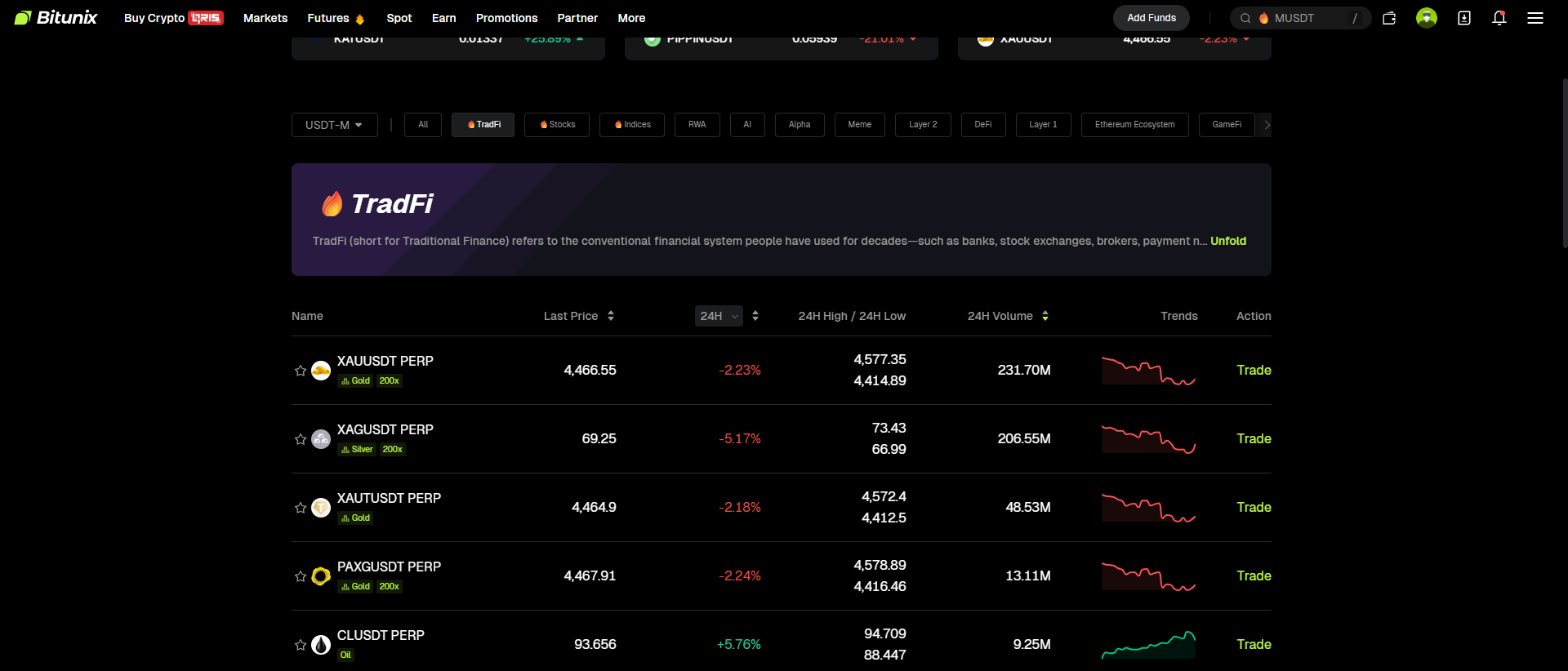
The Bitunix TradFi market shows a commodity lineup focused on metals that are already widely recognized in traditional markets.
XAUUSDT
This pair is linked to gold. Gold remains one of the most followed commodities in global finance and is often discussed during periods of economic uncertainty, inflation concern, and broad risk aversion.
XAGUSDT
This pair is linked to silver. Silver is often grouped with gold because of its precious metal status, but it also has a stronger industrial component and can behave differently in certain market conditions.
COPPERUSDT
This pair is linked to copper. Copper is closely watched because of its industrial role and its connection to manufacturing, construction, and broader economic activity.
XPTUSDT
This pair is linked to platinum. Platinum is a recognized precious and industrial metal that can attract interest for both its market scarcity and industrial demand profile.
XPDUSDT
This pair is linked to palladium. Palladium is another specialized metal that has historically drawn attention because of supply constraints and its role in industrial uses.
CLUSDT
This pair is linked to crude oil. Crude oil is a globally important energy commodity that can attract interest for both its economic significance and its sensitivity to supply, demand, and geopolitical developments.
Together, these markets create a more rounded commodity offering on Bitunix. Rather than focusing only on one flagship asset such as gold, the platform gives users access to multiple metals with different market characteristics and different demand drivers.
Why Bitunix Added Commodity Futures
At Bitunix, the move into commodity futures reflects a broader shift in user demand. Traders increasingly want access to more than one type of market. They do not only watch Bitcoin and Ethereum. They also pay attention to gold during risk-off conditions, silver during commodity rallies, or copper when industrial growth becomes a key narrative.
Adding commodity futures helps create a more complete platform environment. It gives users access to markets shaped by different drivers, which can be useful when crypto conditions become uncertain or when macro events shift attention toward traditional assets.
This expansion also makes the Bitunix TradFi category more meaningful. Stocks and commodities are two of the most important pillars of traditional market participation. By offering both, Bitunix gives users a broader way to engage with established financial themes without leaving the exchange ecosystem.
For users who are already comfortable using USDT-based trading workflows, the addition of commodity-linked markets can feel like a natural extension of how they already trade.
How Commodity Futures on Bitunix Work
The core concept is simple. Commodity futures on Bitunix allow users to trade products linked to the price movement of specific commodities. These markets are quoted against USDT, which makes them easier to understand for crypto-native users who already manage positions, capital, and risk in a stablecoin-based environment.
This structure reduces friction. Users do not need to learn an entirely different account model just to explore gold, silver, or copper-related price action. Instead, they can monitor commodity pairs in a setting that feels closer to the exchange interface they already know.
From a practical perspective, users can review the market list, compare price levels, check 24-hour performance, and monitor activity across different commodity pairs. This makes it easier to assess where momentum may be building and which market may fit a given trading approach.
That convenience is part of what makes the Bitunix TradFi expansion useful. It connects commodity themes with a platform experience designed for active market access.
Gold vs Silver: Two Precious Metals, Different Trading Behavior
Gold and silver are often mentioned together, but they are not identical markets. Understanding the difference matters for anyone exploring commodity futures on Bitunix.
Gold is usually viewed as the more established defensive metal. It tends to attract attention during inflation concerns, market stress, currency weakness, and broader macro uncertainty. Because of that, gold often carries a reputation as a more traditional store-of-value asset within commodity markets.
Silver shares some of those characteristics, but it also has stronger industrial exposure. That means silver may react not only to defensive market sentiment, but also to industrial demand expectations. In practice, this can lead to different trading behavior. Silver can sometimes be more volatile than gold,
especially when commodity speculation becomes more active.
For Bitunix users, this means XAUUSDT and XAGUSDT may suit different styles of market participation. Some traders may prefer the broader macro relevance of gold, while others may be drawn to the sharper movement that silver can sometimes show.
Copper, Platinum, and Palladium: Why Industrial Metals Matter
Beyond gold and silver, Bitunix also includes industrial and mixed-demand metals that can behave very differently from traditional safe-haven assets.
Copper is one of the most economically sensitive metals in the market. Because it is heavily used in infrastructure, manufacturing, and construction, many traders view copper as a useful indicator of industrial strength and economic demand. When growth-related themes dominate headlines, copper may become an important market to watch.
Platinum and palladium are more specialized, but they remain important in commodity trading because of their industrial roles and tighter market structure. These metals can be influenced by supply constraints, industrial demand patterns, and sector-specific shifts. For traders, that can create a different kind of opportunity compared with broader commodity markets.
What matters here is diversity. Bitunix commodity futures are not limited to one single narrative. The platform offers a mix of precious metals and industrial metals, which gives users more ways to interpret macro conditions and build broader market awareness.
Crude Oil: Why Energy Commodities Matter
Alongside metals, Bitunix also includes energy-linked markets that respond to a different set of macro and geopolitical forces.
Crude oil is one of the most closely watched commodities in global markets. Because it plays a central role in transportation, industry, and energy supply, many traders view oil as a key indicator of economic activity, inflation pressure, and broader market sentiment. When supply disruptions, production decisions, or geopolitical tensions dominate headlines, crude oil often becomes an especially important market to watch.
Compared with metals, crude oil tends to react more directly to shifts in production policy, inventory data, refinery demand, seasonal consumption trends, and international conflict risk. That gives it a distinct trading profile and makes it one of the most important benchmark commodities in the world.
What matters here is diversity. Bitunix commodity futures are not limited to metals alone. The platform also provides access to energy markets such as crude oil, giving users more ways to follow macro developments, understand cross-market relationships, and build broader market awareness.
Why Traders Use Commodity Futures
Commodity futures can appeal to traders for several reasons.
First, they expand market coverage. Not every strong opportunity appears in crypto. Commodities can become highly relevant when inflation, rate expectations, industrial activity, or global uncertainty dominate the market conversation.
Second, they introduce different types of volatility. Commodity markets are driven by different factors than many crypto assets, which can make them useful for traders who want exposure to non-crypto narratives.
Third, they support diversification. A trader who only watches digital assets may miss important moves in traditional markets. Commodity-linked products help widen the scope of what users can follow on Bitunix.
Fourth, they align well with macro trading thinking. Gold, silver, copper, platinum, and palladium are all tied to larger economic themes, which can make them especially attractive to users who like to trade around market context rather than only token-specific news.
At Bitunix, commodities help round out the TradFi experience by bringing these broader market themes into a familiar trading ecosystem.
Commodity Futures vs Holding Physical Commodities
This is an important distinction for beginners. Trading commodity futures on Bitunix is not the same as owning physical gold, silver, copper, platinum, or palladium.
When someone owns a physical commodity, they hold the asset itself in direct form. When someone trades a commodity futures pair on Bitunix, they gain price exposure through a market-linked product. The goal is participation in price movement rather than physical ownership.
That difference changes how the product is used. Commodity futures are more closely aligned with active trading than with physical asset storage or long-term collectible ownership. They are designed for users who want to monitor markets, manage positions actively, and respond to price changes in a more immediate way.
Understanding this helps prevent confusion. Commodity futures serve a trading function, not a physical holding function.
Why a USDT-Based Workflow Makes Commodity Trading Simpler
One of the practical advantages of Bitunix commodity futures is the USDT-based structure. For users already comfortable with crypto trading, this makes the transition into commodities much more straightforward.
USDT is already central to how many exchange users manage capital and move between markets. Extending that same logic into commodity-linked pairs means users can evaluate gold, silver, copper, platinum, and palladium within a familiar framework.
This can improve usability in several ways. It simplifies capital management, makes cross-market comparisons easier, and helps traders move between crypto, stock-linked, and commodity-linked markets without leaving the broader Bitunix environment.
That matters because modern trading is increasingly cross-asset. Users want flexibility, and the ability to navigate multiple categories through one workflow is a real advantage.
How to Start Trading Commodity Futures on Bitunix
For beginners, the best approach is to keep the process structured and simple.
1. Review the available commodity pairs
Start by exploring the Bitunix commodity market list and understanding which pairs are available.
2. Learn the market character of each asset
Gold, silver, copper, platinum, crude oil and palladium do not all behave the same way. Before trading, users should understand which macro or industrial themes tend to influence each one.
3. Monitor price and market activity
Use the market data available on the platform to compare daily movement, volatility, and volume across the available commodity pairs.
4. Choose one market to focus on first
Instead of jumping into every product at once, beginners may benefit from understanding one commodity clearly before expanding into others.
5. Understand leverage and margin
Before placing any trade, users should understand how leverage changes exposure and how margin requirements affect open positions.
6. Use disciplined risk management
Commodity markets can move quickly, especially around major macro headlines. Position sizing and careful planning remain essential.
Starting with a structured approach can help users explore commodity futures more responsibly and avoid treating all markets as if they behave the same way.
Key Risks to Understand Before Trading Commodity Futures
Commodity-linked products can be useful, but they are not risk-free. Every user should understand the core risks before trading.
Macro sensitivity
Commodity prices can react sharply to inflation data, interest rate expectations, geopolitical stress, and global growth sentiment.
Volatility differences
Not all commodity markets move in the same way. Some may be relatively steady under normal conditions, while others can show faster or more erratic moves.
Leverage risk
Leverage can magnify both gains and losses. New users should be especially careful not to overextend positions.
Product misunderstanding
Commodity futures are trading products linked to price movement. They are not the same as direct physical ownership.
Strategy mismatch
A user seeking passive exposure may not be well matched with an active trading product.
At Bitunix, market access works best when paired with clear education. The better users understand the structure and risks of commodity futures, the more responsibly they can use them.
How Commodity Futures Fit Into the Bigger Bitunix TradFi Offering
Commodity futures are a core part of the broader Bitunix TradFi category. Alongside stock-linked markets, they help create a more complete traditional finance trading environment inside the platform.
This matters because users increasingly move between market themes. During one period, tech-related stocks may attract attention. During another, gold may take center stage. In a different environment, copper or silver may become more active because of shifts in industrial or macro expectations.
By offering both stock-linked and commodity-linked markets, Bitunix gives users more flexibility to follow these changing narratives from one place. That reflects the reality of modern trading. Traders are no longer limited by narrow market categories. They want access, convenience, and the ability to respond when themes change.
Conclusion
Bitunix commodity futures give users access to some of the most recognized commodity markets in traditional finance, including gold, silver, copper, platinum, and palladium. For users who want to move beyond crypto-only trading, this opens the door to broader macro and industrial market themes within a familiar exchange environment.
The most important thing for beginners to understand is that these are price-linked trading products, not physical commodity ownership. They are designed for users who want active market exposure and a more flexible way to engage with traditional assets through a USDT-based workflow.
As multi-market trading becomes more common, commodity futures are likely to become a more important part of how users think about market access. At Bitunix, adding these markets helps create a broader TradFi offering that better matches how modern traders actually operate across crypto, stocks, and commodities.
For users seeking a more connected way to explore traditional market themes, Bitunix commodity futures represent a meaningful step toward a more complete trading experience.
FAQ
What are commodity futures on Bitunix?
Commodity futures on Bitunix are trading products linked to the price movement of commodities such as gold, silver, copper, platinum, crude oil and palladium.
Which commodity pairs are available on Bitunix?
Based on the Bitunix TradFi market interface, available commodity-linked pairs include XAUUSDT, XAGUSDT, COPPERUSDT, XPTUSDT, CLUSDT and XPDUSDT.
Is trading commodity futures the same as owning physical gold or silver?
No. Trading commodity futures is not the same as owning physical commodities. It is a way to gain price exposure through a trading product rather than direct ownership.
Why are gold and silver popular among traders?
Gold and silver are widely followed because they are established commodities that often attract attention during inflation concerns, macro uncertainty, and broader shifts in market sentiment.
Why does copper matter in commodity trading?
Copper is closely watched because of its industrial role and its connection to manufacturing, infrastructure, and overall economic activity.
Can users trade commodity futures with USDT on Bitunix?
Yes. Bitunix commodity-linked markets are structured in a USDT-based framework, which makes them more accessible to users familiar with stablecoin-based trading workflows.
Why did Bitunix add commodity futures?
Bitunix added commodity futures to give users broader market access and a more connected way to explore traditional financial themes alongside crypto and stock-linked markets.
Glossary
- Commodity futures: Trading products linked to the price movement of commodities such as gold, silver, copper, platinum, and palladium.
- Commodity-linked markets: Markets whose price action is tied to traditional commodities rather than crypto-native assets.
- TradFi: Short for traditional finance, referring to conventional financial markets and assets such as stocks, commodities, banks, and brokers.
- XAUUSDT: A commodity-linked market pair associated with gold.
- CLUSDT: A commodity-linked market pair associated with crude oil
- XAGUSDT: A commodity-linked market pair associated with silver.
- COPPERUSDT: A commodity-linked market pair associated with copper.
- XPTUSDT: A commodity-linked market pair associated with platinum.
- XPDUSDT: A commodity-linked market pair associated with palladium.
- USDT: A stablecoin pegged to the US dollar that is commonly used for trading, settlement, and margin on crypto platforms.
- Leverage: A trading feature that allows users to control a larger position with a smaller amount of capital, increasing both potential gains and potential losses.
- Margin: The amount of funds required to open and maintain a leveraged position.
- Volatility: The degree of price movement in a market over time.
- Macro factors: Broad economic forces such as inflation, interest rates, industrial demand, and geopolitical developments that can influence commodity prices.
- Price-linked product: A trading product designed to follow the movement of an underlying market rather than provide direct physical ownership.
- Risk management: The process of controlling exposure through position sizing, planning, leverage discipline, and other protective practices.
About Bitunix
Bitunix is a global cryptocurrency derivatives exchange trusted by over 3 million users across more than 100 countries. The platform is committed to providing a transparent, compliant, and secure trading environment for every user. Bitunix offers a fast registration process and a user-friendly verification system supported by mandatory KYC to ensure safety and compliance. With global standards of protection through Proof of Reserves (POR) and the Bitunix Care Fund, Bitunix prioritizes user trust and fund security. The K-Line Ultra chart system delivers a seamless trading experience for both beginners and advanced traders, while leverage of up to 200x and deep liquidity make Bitunix one of the most dynamic platforms in the market.
Bitunix Global Accounts
X | Telegram Announcements | Telegram Global | CoinMarketCap | Instagram | Facebook | LinkedIn | Reddit | Medium
Disclaimer: Trading digital assets involves risk and may result in the loss of capital. Always do your own research. Terms, conditions, and regional restrictions may apply.