

Article Summary
- This article provides a detailed price prediction and fundamental analysis for the IOTA token.
- It explains IOTA's unique architecture, the Tangle, a Directed Acyclic Graph (DAG) that enables feeless, highly scalable transactions.
- The bull case focuses on the massive growth of the Internet of Things (IoT), enterprise partnerships, and the transition to a fully decentralised network (IOTA 2.0).
- The bear case highlights the long history of delayed upgrades, intense competition from newer Layer-1 networks, and the challenge of regaining market relevance.
- It presents detailed price prediction scenarios (bearish, neutral, bullish) for both 2026 and 2030, based on enterprise adoption and technological milestones.
Traditional blockchains were never built with billions of machine-level payments in mind. Once you start talking about connected vehicles, industrial sensors, smart meters, and logistics devices paying each other tiny amounts, fees, and throughput become a real problem. IOTA was created to address that, originally through Tangle technology. And for anyone using a crypto exchange to get exposure to infrastructure-focused assets, Bitunix offers the IOTA/USDT pair, which keeps IOTA easy to access while its machine economy continues to develop.
That story is more complicated in 2026 than it was a few years ago. IOTA no longer fits neatly into the old description of a pure feeless DAG network. After the Rebased mainnet launch in May 2025, the protocol moved to an object-based DAG ledger with delegated proof of stake, MoveVM smart contracts, staking, and small transaction fees that are burned. So the investment case now rests on two things at once: the original vision of machine-to-machine infrastructure, and the project's ability to turn that vision into a usable modern network that enterprises and governments actually adopt.
This analysis will examine IOTA's technological evolution, its enterprise focus, and provide data-driven price predictions for 2026 and 2030.
The Technology and Ecosystem
IOTA's technology story still begins with the Tangle, even if the network has evolved far beyond that original design. The core historical idea was that instead of miners packaging transactions into blocks, each new transaction would help validate previous ones. That reduced dependence on miners and supported the project's early pitch as a scalable system for the Internet of Things. The old Tangle design was one of the reasons IOTA stood out in the first place, because it treated network activity as something that could help secure the system.
The bigger technical shift came with IOTA 2.0, which in practice arrived through the Rebased upgrade in 2025. The migration from Stardust to the new IOTA network began on May 5, 2025, and Rebased removed the Coordinator, introduced a fully decentralized delegated proof-of-stake network, and brought Move smart contracts into the base layer. That matters because Coordicide was the project's longest-running credibility test. IOTA finally crossed that milestone, but it did so by becoming a very different network from the one many older holders first bought into.
The official documentation now describes IOTA in terms that sound much closer to a modern Layer 1 than to the earlier feeless crypto thesis. The IOTA Ecosystem DLT Foundation whitepaper says the network is an object-based DAG ledger running delegated proof-of-stake, and the average transaction fees are around 0.005 IOTA and are burned. At the same time, developers can sponsor those fees on behalf of users, which means end users can still get a feeless experience even if the protocol itself is no longer literally fee-free.
IOTA Foundation materials also make clear that the current network is being positioned for real-world deployment. In the Q1 2025 progress report, the foundation wrote:
"The Product Adoption Department continues to drive the scalable adoption of the IOTA Mainnet through two key pillars: Product Management & Development and Partnerships & Engagements."
That product focus shows up in tools such as IOTA Identity, IOTA Gas Station, IOTA Notarization, and the Digital Product Passport demo tied to the Trust Framework. It also shows up in trade infrastructure such as TLIP and TWIN, where the pitch is more about auditable data exchange, credentials, and compliant digital workflows.
The IOTA token sits inside that new model as more than just a medium of exchange for machine-to-machine payments. The 2025 DLT Foundation whitepaper says it is used for staking, validator security, transaction fees, and storage deposits, with fees burned and delegators earning rewards. So if you are valuing the token in 2026, you are no longer looking only at the old M2M payment vision. You are also looking at how much economic activity, staking demand, and network usage the new protocol can actually generate.
The Bull Case: The IoT Economy
Any IOTA price prediction 2026 has to deal with a market that still cannot decide whether IOTA is a relic from an older cycle or an underpriced infrastructure play that finally got its main upgrade done. CoinGecko currently lists IOTA at around $0.0575, with a market cap of $252.9 million and 24-hour trading volume of about $6.46 million.
From there, forecast models split: CoinCodex's price prediction sees about $0.0533 by the end of 2026 and $0.0193 by 2030, Coinbase's 5% growth tool puts IOTA near $0.06 in 2026 and $0.07 in 2030, and MEXC's forecast is similarly conservative at about $0.0575 in 2026 and $0.0699 in 2030. Changelly's price prediction is far more optimistic, with a 2026 range of $0.135 to $0.164 and a 2030 range of $0.624 to $0.719, and CoinLore's forecast sits between cautious and aggressive, with a 2026 range of $0.0344 to $0.1465 and a 2030 target near $0.64.
1. The Machine Economy
Growth in connected devices is the main reason IOTA still has a believable long-term story. IoT Analytics said in its 2025 state-of-the-market update:
"the number of connected IoT devices is estimated to reach 39 billion in 2030, reflecting a CAGR of 13.2% from 2025."
Ericsson's 2026 outlook adds that cellular IoT connections alone are expected to reach 4.5 billion by the end of 2025 and approach 8 billion by 2031. If that machine economy keeps expanding, a network built around low-cost machine coordination still has a real addressable market.
What helps IOTA here is that its original design was aimed at low-value, high-frequency interactions between devices. A connected car paying for charging, tolls, or parking remains a better fit for a low-cost settlement rail than for a chain where every transaction competes with DeFi and NFT traffic. The project no longer offers a purely fee-free base layer in the old sense, but its low-fee model plus sponsored transactions still make it better suited to high-volume IoT-style activity than many chains built around retail trading first.
2. Enterprise Partnerships
Enterprise and government relationships are the second major bull argument. IOTA's 2025 review said the network expanded real-world trade adoption through TWIN, ADAPT, and Salus, while the Kenya Revenue Authority had successfully set up a TLIP node. The 2026 manifesto adds that a Swiss non-profit foundation governs TWIN and is being positioned as an open public digital infrastructure for global trade.
The IOTA Business Innovation Program offered up to €100,000 per applicant in 2025 for projects in tokenization, digital identity, and supply-chain tracking, and the East Africa summit in Nairobi brought together developers, policymakers, TradeMark Africa, and government officials around trade and logistics use cases. Those initiatives show that IOTA is still actively trying to win enterprise adoption rather than relying solely on legacy brand recognition.
3. Feeless Advantage
Although IOTA's feeless advantage needs to be more clearly described in 2026, it still remains part of the broader investment case. The current mainnet is no longer fully feeless at the protocol level, and the average transaction fees are around 0.005 IOTA. Even so, those fees are small, they are burned, and developers can sponsor them for end users through Gas Station.
What keeps the feeless crypto narrative relevant is that the user-facing experience can still remain effectively feeless even if the network itself is not. Instead of relying on a base layer with zero fees for everyone, IOTA now gives developers a way to absorb those costs so suppliers, logistics operators, or other participants do not need to hold tokens just to submit data or interact with applications.
The Bear Case: Delays and Competition
Current forecast models also explain why the bearish case still deserves some attention. CoinCodex projects a lower 2030 price than today, while Coinbase and MEXC only point to mild appreciation by the end of the decade. Even the optimistic estimates from Changelly and CoinLore do not matter much unless the network can translate technical progress into widespread adoption.
1. A History of Delays
The biggest bear argument is still credibility. IOTA spent years promising Coordicide, full decentralization, and a network architecture that would eventually outperform traditional blockchains for the Internet of Things. Rebased finally launched in 2025, but the long delay created a serious trust problem. While IOTA was rebuilding itself, the rest of the market moved on, and many investors stopped treating future technical delivery as enough on its own.
That history matters for valuation because a late delivery can still be punished even after it arrives. The technology may be stronger now, but the market remembers how long the project spent in transition. That makes it harder for IOTA to command a premium multiple relative to faster-moving competitors that captured developer attention while IOTA was still redesigning its base layer.
2. The Layer-1 Crowded Market
Competition is the next problem. By the time Rebased launched, Solana, Avalanche, Sui, and other high-speed networks had already built stronger on-chain ecosystems, larger communities, and more active developer pipelines. CoinGecko's Layer 1 category now sits above $2 trillion in market cap, indicating how crowded the field has become, meaning that IOTA is competing in one of the most saturated categories in crypto.
Developers now have many choices for cheap execution, enterprise-facing tooling, and smart contract deployment. Even if IOTA's design is still distinctive, distinct is not the same as dominant. If enterprises can get adequate performance and better ecosystem support elsewhere, IOTA's technical uniqueness may not be enough to reclaim market relevance.
3. Regulatory Uncertainty
As IOTA leans harder into enterprise adoption, trade, and government-facing products, it also inherits heavier compliance pressure. The Business Innovation Program itself said the goal was to help builders overcome privacy, regulatory compliance, and technological complexity, which is another way of saying those obstacles are already part of the business case. In supply chains, digital identity, and cross-border trade, data rules and audit standards are much stricter than in typical retail crypto use cases.
That can slow adoption even when the technology works, because government nodes, enterprise identity tools, and Digital Product Passport systems do not roll out like meme coins or perpetual futures markets. They move more slowly, require more approvals, and create more friction around data handling and security. For a token investor, that means IOTA may be targeting a real market, but one with a much longer sales cycle and tighter scrutiny.
IOTA Price Prediction 2026 and 2030 Scenarios
The range of forecasts around IOTA is wide enough that it makes more sense to think in scenarios. Conservative models from CoinCodex, Coinbase, MEXC, and TradersUnion stay close to current prices or even below them by 2030. The more optimistic set comes from Changelly and CoinLore, which assume that enterprise adoption and machine-economy relevance will eventually show up in the token.
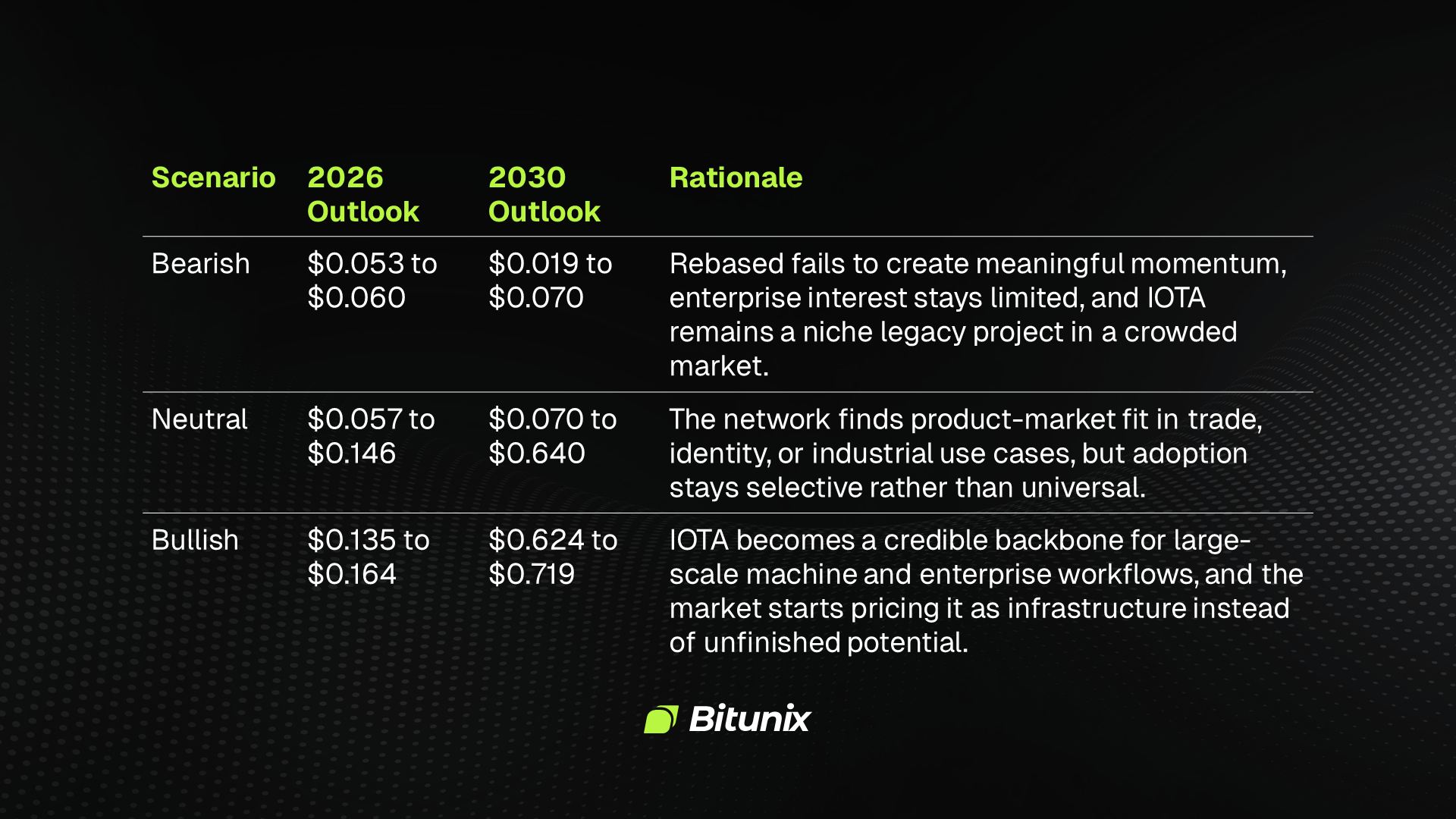
IOTA price prediction scenarios for 2026 and 2030, comparing bearish, neutral, and bullish outcomes based on enterprise adoption, product-market fit, and machine-economy infrastructure growth.
Conclusion: A Bet on the Machine Economy
IOTA remains one of the most technologically distinct projects in crypto, but it is not the same project it was a few years ago. The network finally crossed its biggest technical milestone with Rebased, removed the Coordinator, and repositioned itself as enterprise-grade infrastructure with staking, smart contracts, fee burning, and sponsored user interactions. That gives the project a stronger foundation than it had during its long transition phase.
Investing in IOTA is still a long-term bet on the machine economy, enterprise adoption, and the idea that connected devices and digital trade systems will need low-cost infrastructure built for constant interaction. That upside is real, but it comes with long sales cycles, a crowded Layer 1 market, and a history that still makes investors cautious. If you want exposure, Bitunix offers IOTA/USDT trading pairs, so you can download the Bitunix app, register, and decide whether the current price already discounts too much skepticism or not enough.
FAQ
What is IOTA?
IOTA is a distributed ledger network originally built on Tangle technology for machine-to-machine transactions. In 2025, it launched the Rebased upgrade, turning it into an object-based DAG ledger with delegated proof-of-stake and Move smart contracts.
How does the Tangle differ from a blockchain?
The Tangle was designed so that new transactions validate previous ones instead of relying on miners packaging transactions into blocks. That structure helped IOTA argue it could scale better for machine activity, although the current network architecture is now more complex than the original Tangle-only model.
Why are IOTA transactions feeless?
In the current Rebased network, they are not fully feeless at the protocol level. Official documentation says average transaction fees are about 0.005 IOTA, but developers can sponsor those fees, which allows feeless user experiences in apps and enterprise workflows.
What is the Coordinator in IOTA?
The Coordinator was the old central checkpointing component used to help validate network activity and prevent attacks while IOTA was still maturing. It became the main symbol of IOTA's incomplete decentralization until the Rebased upgrade finally removed it.
What is IOTA 2.0 or Coordicide?
IOTA 2.0, often called Coordicide, was the long-running effort to remove the Coordinator and achieve full decentralization. In practice, that vision arrived through the Rebased mainnet launch in 2025, which introduced a decentralized validator-based model.
What is the utility of the IOTA token?
The IOTA token now supports staking, transaction fees, storage deposits, fee burning, and validator security. It also remains part of the project's broader vision for machine payments and data-related economic activity inside enterprise and IoT-style applications.
How is IOTA used in the Internet of Things?
IOTA is positioned as infrastructure for connected-device economies, especially where low-cost payments, digital identity, notarization, and supply-chain coordination matter. Its current enterprise push also focuses on trade, product passports, and data integrity rather than only device micropayments.
Who are IOTA's main competitors?
Its main competitors are other low-cost Layer 1 and enterprise-oriented networks such as Solana, Avalanche, Sui, and similar chains that already captured developer attention while IOTA was still in transition.
What are the risks of investing in IOTA?
The biggest risks are its history of delays, slower enterprise adoption than bulls expect, tougher compliance demands in government and trade use cases, and competition from newer Layer 1 networks with stronger ecosystem momentum.
Where can I buy IOTA tokens?
You can buy IOTA on major centralized exchanges such as OKX, Binance, MEXC, Kraken, and Bitunix. CoinGecko currently lists OKX as the most active IOTA market, and Bitunix offers both spot and perpetual access.
Glossary
- IOTA token: The native asset of the IOTA network, used for staking, fees, storage deposits, and network security.
- Tangle technology: IOTA's original DAG-based ledger design where transactions help validate previous transactions.
- Internet of Things: A network of connected devices such as sensors, vehicles, and machines that exchange data and sometimes value.
- Feeless crypto: A crypto model where users do not directly pay transaction fees, or experience effectively fee-free usage through sponsorship.
- Enterprise adoption: Real business or government use of blockchain systems in production workflows.
- Directed Acyclic Graph: A ledger structure that is not organized into sequential blocks like a traditional blockchain.
- Coordinator: The old IOTA checkpointing mechanism that acted as a central point in network validation.
- IOTA 2.0: The long-term decentralization plan often referred to as Coordicide.
- Coordicide: The effort to remove the Coordinator and make the network fully decentralized.
- Rebased: The 2025 IOTA mainnet upgrade that introduced delegated proof of stake and Move smart contracts.
- Delegated Proof of Stake: A consensus system where token holders delegate stake to validators that secure the network.
- MoveVM: The Move virtual machine used for smart contracts on the Rebased IOTA network.
- Sponsored transactions: A model where developers or platforms pay network fees on behalf of users.
- Fee burning: The automatic destruction of transaction fees to reduce token supply growth.
- Machine-to-machine payments: Automated payments between devices without human intervention.
Disclaimer
This article does not provide:
(i) investment advice or investment recommendations;
(ii) an offer or solicitation to buy, sell, or hold digital assets;
(iii) financial, accounting, legal, or tax advice.
Digital assets, including stablecoins and NFTs, involve high risk and may fluctuate significantly. Consider whether trading or holding digital assets is appropriate for you given your financial situation. Consult a qualified legal, tax, or investment professional when needed. You are responsible for understanding and complying with applicable local laws and regulations.
About Bitunix
Bitunix is a global cryptocurrency derivatives exchange trusted by over 3 million users across more than 100 countries. At Bitunix, we are committed to providing a transparent, compliant, and secure trading environment for every user. Our platform features a fast registration process and a user-friendly verification system supported by mandatory KYC to ensure safety and compliance. With global standards of protection through Proof of Reserves (POR) and the Bitunix Care Fund, we prioritize user trust and fund security. The K-Line Ultra chart system delivers a seamless trading experience for both beginners and advanced traders, while leverage of up to 200x and deep liquidity make Bitunix one of the most dynamic platforms in the market.
Bitunix Global Accounts
X | Telegram Announcements | Telegram Global | CoinMarketCap | Instagram | Facebook | LinkedIn | Reddit | Medium