
Article Summary
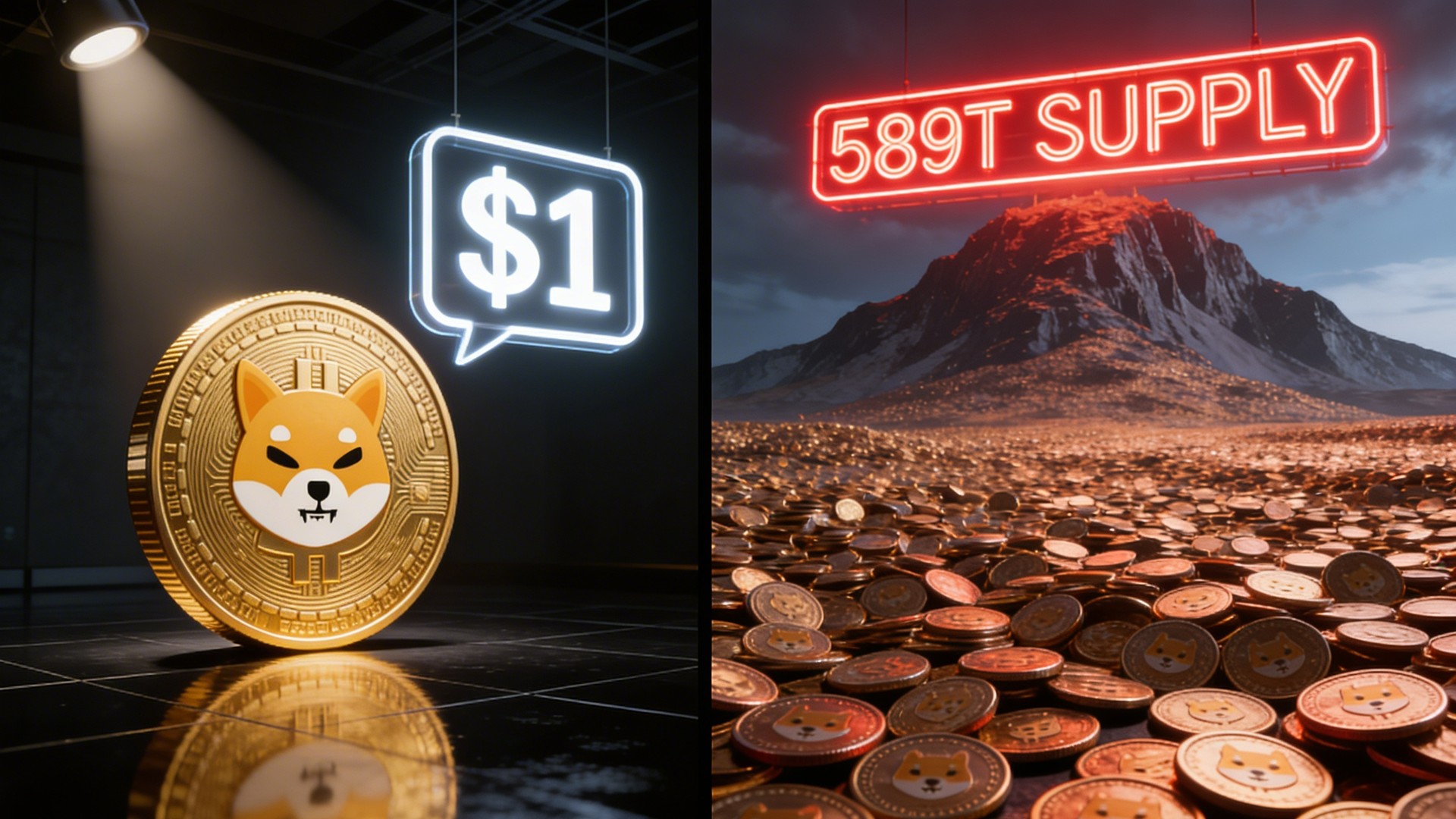
- This article directly addresses the popular question of whether Shiba Inu (SHIB) can reach a price of $1.
- It uses a simple, fundamental formula—Market Cap = Price x Circulating Supply—to demonstrate that a $1 SHIB price is mathematically impossible under current conditions.
- It calculates the required market cap for SHIB to hit $1 (over $589 trillion) and puts this number in perspective by comparing it to the market caps of Bitcoin, Apple, and the entire global GDP.
- The guide explains the role of token burning and the Shibarium Layer 2 network in reducing the total supply, but analyzes whether the current burn rate is significant enough to impact the price on such a massive scale.
- It concludes by shifting the focus from the unrealistic $1 dream to a more realistic valuation based on the growth and utility of the Shiba Inu ecosystem (Shibarium, ShibaSwap, etc.).
- Shiba Inu holders keep hearing the same dream that with a tiny price today, you will get a life-changing price tomorrow, and you will retire somewhere with good coffee. It's a fun thought, and it's also where a lot of people stop thinking.
- SHIB/USDT trades like a meme coin, but its price still follows the same math as any other asset with a fixed number of units. If you skip supply and market cap, you're basically guessing with extra steps. If you buy and sell through a crypto exchange, like Bitunix, you can trade SHIB fast, but you still need a thesis that survives basic tokenomics.
- This article will walk you through the straightforward calculation that reveals why SHIB cannot reach $1, and will then explore what realistic growth for the Shiba Inu ecosystem could look like.
The Sobering Math of Market Cap
Market cap is the simplest reality check in crypto. It answers the question of what the total value of all circulating tokens is, based on current prices. The formula is short:
Market Cap = Price x Circulating Supply
And every price target turns into a market cap target the moment you multiply.
To run the calculation, you need a reliable circulating supply number. CoinMarketCap shows SHIB's supply directly on its live asset page, along with market cap, volume, and holder count. CoinMarketCap lists the supply like this:
"It has a circulating supply of 589,243,725,105,815 SHIB coins and a max. supply of 589,552,695,333,683 SHIB coins."
That circulating supply is the reason the $1 dream collapses. If you set the price to $1.00 and multiply by roughly 589.24 trillion tokens, the required Shiba Inu market cap becomes about $589 trillion.
Shiba Inu Price Prediction $1: The Market Cap Reality Check
Let's put $589 trillion in perspective using current, dated reference points from 2025 and 2026. The IMF DataMapper (WEO October 2025 dataset) puts world GDP in 2026 at about $123.58 trillion in current prices. Global investable assets are large, too, but they still do not get you anywhere near $589T. A Visual Capitalist snapshot of global investment assets for 2025 estimates global equities at about $127.9 trillion.
Now compare the SHIB-at-$1 market cap to big, familiar benchmarks that people actually track. Reuters reported Apple briefly topping about $4.005 trillion in market value in October 2025. Crypto benchmarks are still smaller. CoinGecko's 2025 annual report says the total crypto market cap ended 2025 at about $3.0 trillion, after falling 10.4% over the year.
So when you see a Shiba Inu price prediction of $1 content going viral, it implies a value larger than global GDP by a wide margin and larger than the entire 2025 crypto market by roughly two orders of magnitude.
It also helps to contrast SHIB's current scale with the fantasy scale, because it shows how big the gap is. CoinMarketCap currently lists SHIB with a market cap in the low single-digit billions and about 2.90M holders, which is a huge distribution but a very different world from trillion-dollar valuation targets.
You can run the same math to see if SHIB can reach 1 cent, because many people shift to that goal once $1 looks unrealistic. At $0.01, the market cap target becomes about $5.89 trillion with today's supply, which still exceeds the entire crypto market size at the end of 2025.
That's why the $1 target is impossible under current conditions, and why $0.01 remains highly improbable without a very long period of exceptional growth. Supply makes the bar high, and market structure makes it even higher because capital tends to spread across many coins during bull markets.
Reliable crypto forecast sites are far from aligned on Shiba Inu. CoinCodex’s model is relatively conservative and projects SHIB around $0.00000546 by the end of 2026 and about $0.000002674 by 2030, while Coinpedia is much more bullish, estimating a 2026 range of $0.0000200 to $0.0000990 and a 2030 range of $0.000180 to $0.000330. Taken together, those sources suggest the market sees SHIB as a high-variance asset: modest outcomes are still plausible, but the more aggressive 2030 targets assume much stronger long-term adoption, ecosystem growth, and sustained speculative demand than current conservative models do.
What About Token Burning?
Once the market cap math sinks in, most people pivot to burns. That's the right direction, because supply reduction is the only path that changes the multiplication problem. But you still need scale, and you need to measure it honestly.
A token burn permanently removes tokens by sending them to addresses that cannot spend them. In practice, it reduces supply over time, which can support price if demand holds or rises. That is the entire idea behind the Shiba Inu token burn narrative.
The burn discussion also benefits from using a single, consistent reference source. Shibburn is a widely used tracker that lists burn transactions and explains how it calculates burns using dead wallets and the black hole address, starting from the initial one quadrillion supply baseline.
Shibarium's Role in Burning SHIB
Shibarium is the ecosystem's Layer 2 network, and it links usage to burns through a fee mechanism. The Shib Daily described the operational setup in January 2025: each transaction contributes a base fee to a burn contract, BONE accumulates, and users can initiate the burn through the ShibTorch V2 dashboard.
The same Shib Daily coverage also framed the burn process as part of a multi-chain expansion, where fees collected across supported chains get consolidated and used to burn SHIB on Ethereum. That detail shows that the burn engine depends on transaction activity.
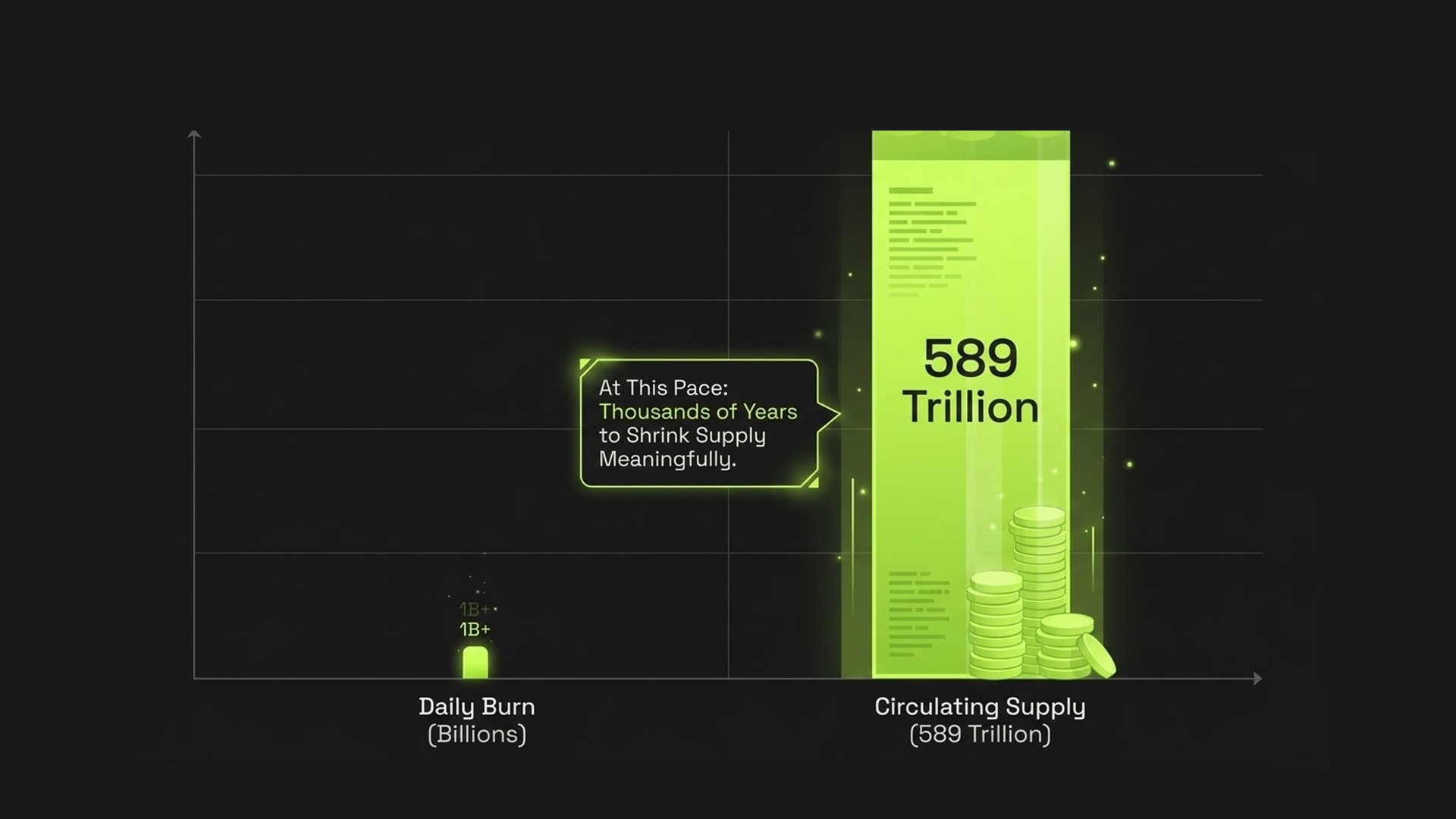
Even burning billions of SHIB per day barely dents a 589T circulating supply, so supply reduction takes thousands of years at typical rates.
The Burn Rate Reality
Burn headlines often sound dramatic because the percentage change looks huge. A single large burn can spike the burn rate by thousands of percent, even if the absolute number burned remains tiny relative to the supply.
For example, MEXC's January 2026 coverage reported a 10,731% surge in burn rate, tied to about 173 million SHIB burned in one day, with one transaction accounting for about 171.68 million of that total. 173 million sounds big until you compare it to 589.24 trillion. If you burned 173 million every day for a full year, you would burn about 63 billion annually, which is still a rounding error next to the current circulating supply.
Here's the timeline reality check that most posts avoid. At about 63 billion burned per year, burning down a 589 trillion circulating supply takes roughly 9,300 years, assuming supply and burn rates stay constant and ignoring demand changes.
This is why burns do not solve the $1 target. Burns can support a long-term supply story, but they need extreme, sustained throughput to shift price targets by orders of magnitude. You can still like burns as a discipline while admitting the current pace does not rewrite the market cap math.
The Realistic Bull Case for Shiba Inu
Once you stop treating $1 as the goal, you can evaluate SHIB like a real ecosystem bet. A realistic SHIB price prediction depends on demand growth, product usage, and whether Shibarium and ShibaSwap create activity that lasts longer than a meme cycle.
This section focuses on measurable drivers you can track monthly, such as network transactions, active app development, DeFi activity, and the general market cycle.
1) The Shibarium Ecosystem
Shibarium's traction is the center of the practical bull case because it ties directly to usage and indirectly to burns. In April 2025, FXStreet reported Shibarium reached 1 billion transactions about 18 months after launch, highlighting scale and reliability milestones like block production volume.
For a more direct snapshot, Shibariumscan publishes live network stats such as total blocks, average block time, total transactions, and wallet address counts. Those numbers give you an objective view of whether the network stays active week after week.
The important takeaway is that if Shibarium usage grows and stays elevated, the ecosystem has a real base for utility narratives, and the burn mechanism has more raw material to work with over time.
2) ShibaSwap and DeFi
ShibaSwap is important because it anchors liquidity and gives the ecosystem a place to capture DeFi activity. In September 2025, The Shib Magazine described a ShibaSwap redesign that introduced a Positions page, consolidating liquidity management across legacy pools and concentrated liquidity pools in a single dashboard.
That redesign also emphasizes usability improvements that matter for retention. The Shib Magazine notes that users can claim accrued trading fees as rewards without withdrawing their initial capital in certain position types, which keeps liquidity working while users take profits.
If you want to track whether ShibaSwap becomes a meaningful demand driver, watch liquidity depth, user retention, and whether new pools attract capital for more than a few hype weeks.
3) Gaming and Metaverse
Gaming and metaverse projects can drive engagement, but only if people actually use them. SHIB: The Metaverse reached early access in January 2025, marking a concrete step from concept to something users can download and try.
On the gaming side, Shib's news site continues to publish gameplay and strategy content for Shiba Eternity, including feature updates and gameplay mechanics that keep the community engaged beyond price talk.
Treat these initiatives like product bets. When users spend time and money inside ecosystem products, utility narratives get stronger, and the ecosystem becomes less dependent on pure speculation.
4) Market Cycles
Even strong ecosystems get pulled around by the broader market. In 2025, CoinGecko reported that the total crypto market cap ended the year at around $3.0T, which shows how macro sentiment can expand or compress the entire playing field SHIB competes in.
Market cycles also change how capital spreads. In a strong bull phase, meme coins can run hard because traders chase momentum, while in risk-off phases, liquidity drains and even good projects struggle. If you plan long-term, build a strategy that assumes both regimes will happen.
Conclusion: From Meme Dream to Utility Reality
The math does not leave room for a $1 target with today's supply. With roughly 589.24 trillion SHIB in circulation, reaching $1 would imply a market cap of around $589 trillion, exceeding the scale of the global economy in any realistic scenario.
The Shiba Inu token burn program still matters, but only as a long-term lever tied to real usage. ShibTorch V2 and Shibarium's fee-to-burn setup show the ecosystem is building mechanics that connect activity to supply reduction, yet even large burn days remain tiny relative to total supply.
Any Shiba Inu price prediction $1 that ignores supply is selling a story, not doing analysis. If you want a realistic SHIB price prediction, focus on Shibarium adoption, ShibaSwap usage, and whether ecosystem products create sustained demand. If you trade SHIB, download the Bitunix app, register, and stick to risk limits that match the volatility of meme coin trading.
FAQ Section
Will Shiba Inu ever reach 1 cent ($0.01)?
At $0.01, SHIB would need a market cap near $5.89 trillion with today's circulating supply around 589.24T. That level exceeds the entire crypto market cap at the end of 2025, which was set at roughly $3.0T.
What is Shibarium?
Shibarium is Shiba Inu's Layer 2 network designed to support ecosystem apps and lower transaction costs. It also supports a burn pipeline where transaction-based fees accumulate in a burn contract, and users can initiate burns through ShibTorch V2 once thresholds are reached.
How much SHIB is burned every day?
Daily burns vary widely, and single large burns can distort percentages. In early 2026, one widely reported spike burned about 173 million SHIB in a day, driven mostly by one transaction around 171.68 million.
What is the difference between SHIB, BONE, and LEASH?
SHIB is the primary ecosystem token with a very large supply and broad exchange listings. BONE functions as Shibarium's gas token and accumulates in burn contracts that can later trigger SHIB burns through ShibTorch V2. LEASH has a much smaller supply and niche ecosystem utility.
Is Shiba Inu a good long-term investment?
SHIB remains a high-volatility asset, so long-term success depends on ecosystem adoption rather than supply predictions. Track Shibarium usage metrics, ShibaSwap product upgrades, and whether burns scale with sustained transaction demand. Treat it as a risk asset and size positions accordingly.
Who created Shiba Inu?
Shiba Inu (SHIB) launched in August 2020, created by an anonymous person or group using the pseudonym Ryoshi. DailyCoin reports Ryoshi never confirmed a real identity, later deleted public posts, and disappeared from social media, leaving ongoing development to the current Shiba Inu team.
What was the all-time high for SHIB?
SHIB's all-time high price was $0.00008845, associated with an October 28, 2021 date.
How many people hold Shiba Inu?
CoinMarketCap currently lists about 2.90 million SHIB holders on its statistics panel. Holder counts help you understand distribution and community size, but they do not directly predict price because many wallets hold tiny amounts, and liquidity concentration still matters.
Can the developers burn a large portion of the supply?
Developers can only burn tokens they control or tokens collected via defined fee mechanisms. Most SHIB sits in public wallets, so the team cannot remove other people's holdings. Large supply reduction requires sustained fee-based burns or voluntary burns by holders, both tied to real activity.
Where can I track the SHIB burn rate?
Use Shibburn for a burn dashboard that lists burn transactions and explains the methodology using dead wallets and the black hole address. It gives you a direct view of burned amounts, recent transactions, and rate changes without relying on social media screenshots.
Glossary
- Market cap: Total valuation estimate calculated as price multiplied by circulating supply.
- Circulating supply: Tokens available to the market, excluding tokens that are locked or provably removed.
- Max supply: Maximum token amount expected to exist under the protocol's supply rules.
- Fully diluted valuation: Market cap if the max supply traded at the current price.
- Tokenomics: Supply, distribution, and incentive design that shapes how a token behaves economically.
- Token burn: Permanent removal of tokens by sending them to an unrecoverable address.
- Burn address: Address with no accessible keys, used to destroy tokens permanently.
- Burn rate: Short-term measure of how many tokens were burned over a defined time window.
- Layer 2: Scaling network that settles activity off the main chain while inheriting security assumptions.
- Shibarium: Shiba Inu's Layer 2 network tied to ecosystem apps and burn mechanics.
- Gas fee: Fee paid to process transactions on a blockchain network.
- Base fee: Core portion of a transaction fee that can be routed to protocol-defined destinations.
- BONE: Shibarium gas token used to pay fees and accumulate toward burn triggers.
- ShibTorch V2: Tool that lets users initiate burns after fee thresholds accumulate in burn contracts.
- DEX: Decentralized exchange that enables trading through smart contracts and liquidity pools.
About Bitunix
Bitunix is a global cryptocurrency derivatives exchange trusted by over 3 million users across more than 100 countries. At Bitunix, we are committed to providing a transparent, compliant, and secure trading environment for every user. Our platform features a fast registration process and a user-friendly verification system supported by mandatory KYC to ensure safety and compliance. With global standards of protection through Proof of Reserves (POR) and the Bitunix Care Fund, we prioritize user trust and fund security. The K-Line Ultra chart system delivers a seamless trading experience for both beginners and advanced traders. At the same time, leverage of up to 200x and deep liquidity make Bitunix one of the most dynamic platforms in the market.
Bitunix Global Accounts
X | Telegram Announcements | Telegram Global | CoinMarketCap | Instagram | Facebook | LinkedIn | Reddit | Medium