Article Summary
- TVL is a key metric in Decentralized Finance (DeFi) that measures the total value of all assets currently deposited in a specific protocol or across an entire blockchain.
- These assets are typically locked in smart contracts for activities such as staking, lending, and liquidity provision.
- TVL is the most common way to gauge the health, adoption, and overall market share of a DeFi protocol or a Layer-1/Layer-2 ecosystem.
- A rising TVL generally indicates growing user trust and capital inflow, which is a bullish sign.
- A falling TVL can signal declining confidence, user capital withdrawals, or falling asset prices.
- Understanding TVL is essential for anyone looking to invest in or use DeFi protocols.
TVL is one of the most essential DeFi metrics, as it shows where money is actually flowing in the market. When analysts compare different blockchains or DeFi protocols, they look beyond price and strongly consider a project’s TVL to determine its market share and potential for massive adoption.
This article will explain what TVL means in crypto, how it works, what it tells you about a project’s health, and where you can track it yourself. In the end, you should have the necessary information to make better-informed decisions when trading on a crypto exchange.
What is TVL?
Total Value Locked (TVL) is a fundamental metric in decentralized finance (DeFi) that represents the total value of digital assets deposited or locked in a specific DeFi protocol at any given time. TVL can also be calculated for entire blockchain ecosystems by summing the locked value across all DeFi protocols of a particular blockchain network.
Generally, assets are locked in a DeFi protocol’s smart contracts through staking, lending, liquidity pools, or yield farming. The industry consensus is to express TVL in USD, enabling easy, convenient comparisons across protocols, platforms, and blockchains.
Traditional finance users may wonder: What is TVL in crypto?
In crypto, TVL is the equivalent of Assets Under Management (AUM) in traditional finance, a fundamental measure of a DeFi project’s scale.
You can think of a DeFi protocol as a digital bank. The TVL is the total amount of money all its customers have deposited into their savings, lending, and investment accounts. A bank with a higher TVL is generally seen as larger and more trusted.
According to Investopedia, "At a peak in December 2021, decentralized applications had a TVL of more than $179 billion.”
How to Interpret TVL - What Does It Tell You?
The TVL in a DeFi protocol can reveal necessary information about the project’s potential and the market’s overall health at a given time. Here are three ways to interpret TVL that can help you tweak your trading strategy:
A Measure of Trust and Adoption
A consistently high and increasing TVL is a powerful signal of user confidence. It also indicates that the protocol's services are valuable and that participants trust its security, functionality, and potential for returns.
A Measure of Market Share
You can use TVL to compare protocols and blockchains to determine which has the largest market share. A comprehensive analysis could reveal which project is worth backing within specific market conditions.
A Measure of an Entire Blockchain’s Health
You can examine a blockchain’s TVL to assess the growth of its overall DeFi ecosystem relative to competing chains. According to DefiLlama, Ethereum consistently ranks first among blockchains, with a TVL of $73.97 billion.
The Nuances of a TVL Analysis - What to Watch Out For
You should always consider a DeFi protocol's TVL before committing funds to it. However, TVL is not 100% indicative of that project’s potential, security, or transparency. Malicious developers can fake or manipulate a protocol’s TVL by double-counting its underlying assets.
Alternatively, they can use whale manipulation tactics, moving large amounts of funds into a protocol to artificially inflate TVL and create a false sense of popularity or adoption.
Here are other caveats of TVL you should consider:
TVL Can Be Volatile
As explained above, the TVL of a protocol or a blockchain is generally measured in USD. If the price of the underlying assets (like ETH) goes down, the TVL will also decline, even if no one withdraws their funds. It may look like users are abandoning the project, but the decline is only due to falling prices.
The TVL-to-Market Cap Ratio
The TVL-to-market cap ratio is calculated by dividing a project's market capitalization by its total value locked. The ratio helps determine if a DeFi protocol's native token is overvalued or undervalued relative to the total crypto assets secured within its smart contracts.
For example, a low ratio can suggest that the protocol’s market cap is undervalued relative to the amount of capital it manages.
Beware of Mercenary Capital
If a protocol’s TVL surges instantly, it is not a sign that the protocol has gained increased market share or user trust. Some of a protocol’s TVL might be from yield farmers, who will quickly move their capital to another protocol if it offers a slightly higher APY. A stable, long-term TVL is more valuable than a spiky, volatile one.
Where to Track TVL
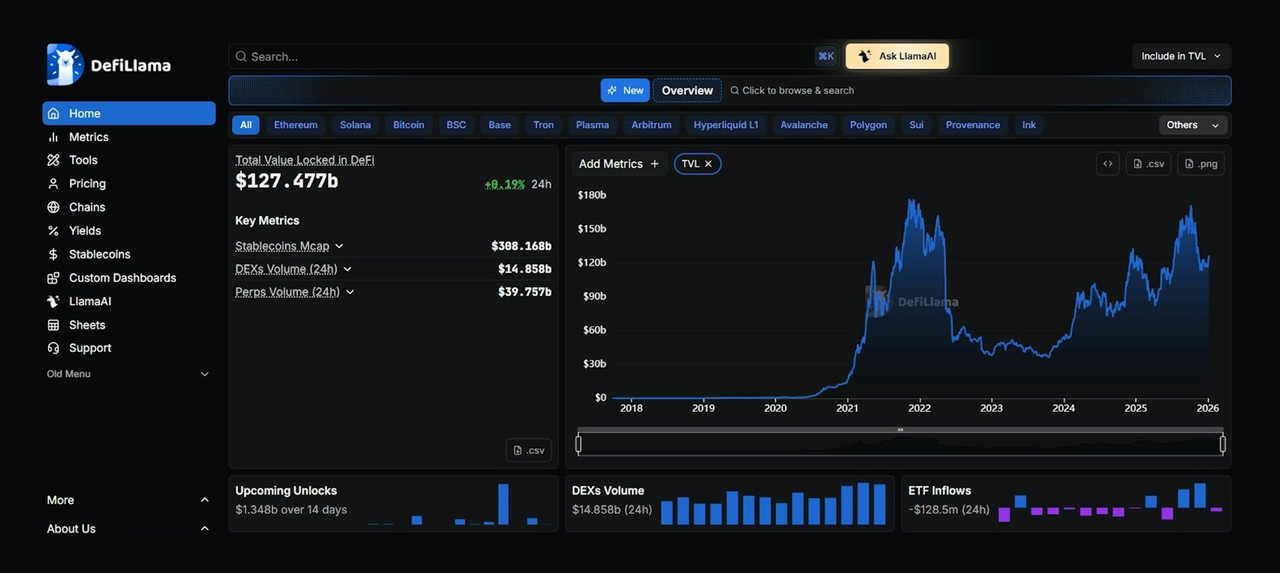
DefiLlama is the industry-standard tool for tracking TVL across all blockchains and protocols. It is the largest TVL aggregator for DeFi metrics with fully open-source data maintained by a team of passionate individuals and contributors from hundreds of protocols.
As of January 2026, DefiLlama is the go-to source for anyone wondering: What is TVL in crypto? The website provides comprehensive TVL analysis for:
- 6733 protocols
- 503 chains
- 19241 pools
- Revenue for 1732 protocols
- Volume for 976 DEXs
You can monitor TVL across protocols and blockchains on other reputable platforms, such as DappRadar. Additionally, some protocols publish their TVLs and relevant TVL analysis on their official websites.
Conclusion: Look Beyond the Price
TVL is a measure of user trust, adoption, and market share in the DeFi space. You should always check a project’s TVL and monitor it continuously as part of your research. This way, you can gain a better understanding of a project’s health than by looking at its price chart alone.
Bitunix empowers you with the tools and knowledge to look beyond the hype. While you research the next big DeFi project using TVL, know that you can trade its token securely on the platform.
Bitunix offers a wide, versatile selection of DeFi protocols for you to research. Trade tokens on the dedicated Spot market or open a perpetual futures position to trade with leverage and capitalize on market swings.
New users can deposit crypto or link a fiat method (KYC required only for fiat operations) and start trading with as little as $10. Alternatively, you can join the Earn program, which provides several staking opportunities.
The low Bitunix fees have convinced over 3 million traders to join the platform. Moreover, Bitunix reassures users that their assets are safe with a dedicated Protection Fund, high security, and compliance with global regulations.
Bitunix is available for both desktop and mobile users. You can download the Bitunix mobile application for iOS or Android on the app download page.
Sign up today!
FAQ Section
Is a higher TVL always better?
No, a higher TVL is not proof of a high-potential DeFi project. TVL indicates the project’s liquidity and user trust. However, it does not represent a guarantee of strong fundamentals.
What is a good TVL for a DeFi project?
A DeFi project’s TVL depends entirely on the project's age, function, the blockchain it operates on, and its stage of growth. However, its value is not necessarily indicative of a prosperous crypto initiative.
How is TVL different from market cap?
TVL measures the value of assets held within a DeFi protocol's smart contracts. Meanwhile, the Market Cap shows the total value of a project's token.
Can TVL be faked or manipulated?
Yes, a DeFi project’s TVL can be and has been faked or manipulated through several methods, including double-counting, whale manipulation, and pooling native tokens.
What does it mean when a protocol’s TVL is declining?
A decrease in a protocol's TVL indicates that the total amount of digital assets deposited or collateralized in that project is declining. The reasons behind this decline include massive user withdrawals, asset depreciation, and diminishing confidence in the project.
Which blockchain has the highest TVL?
Ethereum consistently holds the top spot for the highest TVL among blockchains.
Does spot trading on an exchange like Bitunix contribute to TVL?
No, spot trading on an exchange like Bitunix does not directly contribute to a project’s TVL. It is a metric specific to DeFi protocols and measures assets locked in smart contracts, whereas Bitunix is a centralized exchange.
How quickly can TVL change?
TVL in DeFi can change instantaneously and significantly due to the market’s extreme volatility.
Where is the best place to track TVL for free?
The best place to track TVL for free is DefiLlama. It is widely regarded as the most comprehensive and reliable free platform for DeFi data and analytics.
Glossary
TVL: The entire value locked in a protocol, a rough usage proxy.
DeFi: Decentralized finance applications on public blockchains.
Layer 1: Base blockchain that verifies and records transactions.
Layer 2: A scaling solution that processes transactions off the main chain and posts proofs to L1.
Gas: Network fee for processing a transaction.
Altcoin: Any crypto asset that is not Bitcoin.
Volatility: Degree of price fluctuation for an asset over time.
Proof of Stake (PoS): Consensus where validators lock native tokens to secure the network and earn rewards.
Validator: Operator that proposes or attests blocks in PoS and shares rewards with delegators.
Incentive Program: Extra token rewards used to direct liquidity or votes.
Governance: Process for changing parameters or logic, often token-based with timelocks.
Trading Pair: A combination of two different digital or fiat currencies that can be exchanged for one another on a cryptocurrency exchange.
Stable Pair: A pool of assets that track similar values, such as two stablecoins.
About Bitunix
Bitunix is a global cryptocurrency derivatives exchange trusted by over 3 million users across more than 100 countries. At Bitunix, we are committed to providing a transparent, compliant, and secure trading environment for every user. Our platform features a fast registration process and a user-friendly verification system supported by mandatory KYC to ensure safety and compliance. With global standards of protection through Proof of Reserves (POR) and the Bitunix Care Fund, we prioritize user trust and fund security. The K-Line Ultra chart system delivers a seamless trading experience for both beginners and advanced traders. At the same time, leverage of up to 200x and deep liquidity make Bitunix one of the most dynamic platforms in the market.
Bitunix Global Accounts
X |Telegram Announcements |Telegram Global |CoinMarketCap |Instagram |Facebook |LinkedIn |Reddit |Medium