
Article Summary
- This guide provides an introduction to the Aptos (APT) blockchain and a practical guide to trading the APT/USDT spot pair on Bitunix.
- It explains the key technological innovations of Aptos, including the Move programming language and the Block-STM execution engine.
- The article breaks down the three main price drivers for APT: Technological Advancements, Ecosystem Growth, and Developer Adoption.
- It outlines three distinct strategies for trading APT: Fundamental Long-Term Holding, Technical Swing Trading, and Narrative-Based Trading.
- The guide positions Bitunix as an excellent platform for trading APT, thanks to its high performance, low fees, and secure environment.
Born from the ashes of Meta’s abandoned Diem project, Aptos arrived with a promise of unparalleled speed and reliability. Generally, a new Layer-1 network with this level of backing is a field of opportunity for crypto traders. So, how lucrative is an APT-USDT trading strategy on a professional crypto exchange?
Aptos is a technologically advanced Layer-1 with a strong pedigree derived from its Meta heritage and VC funding. Its unique Move language, fast transaction speeds, and growing DeFi, NFT, and gaming ecosystem make it a compelling asset for traders and investors.
This article explores the core technology of the Aptos blockchain. It also analyzes the key price drivers and provides actionable strategies for trading the APT/USDT pair on Bitunix.
What is Aptos (APT)? A Look Under the Hood
Aptos is one of the youngest Layer-1 blockchain prospects with a unique technological path and a promising roadmap. Aptos Labs was founded in 2021 by ex-Diem engineers Mo Shaikh and Avery Ching. However, its history began long before, with a Meta-backed initiative to create a global, regulated stablecoin payment system and blockchain. It was originally announced in 2019 as Libra, only to be abandoned less than two years later.
Shaikh and Ching seized the opportunity to continue developing the project and launched the Aptos mainnet in October 2022. Since the beginning, Aptos has been branded as a new Layer-1 blockchain focused on scalability, speed, and user-friendliness using the Move language and parallel execution. Its Meta heritage helped it attract significant VC funding and the interest of some of the industry’s top brands.
Aptos has three key features:
The Move Programming Language
Move is a new, safer programming language designed specifically for creating secure assets and smart contracts, reducing the risk of hacks. Its goal is to enable common libraries, tooling, and developer communities across diverse blockchains with vastly different data and execution models.
Block-STM Execution Engine
This technology enables Aptos to process transactions in parallel, resulting in incredibly high throughput. Notably, it can manage over 160,000 transactions per second (in tests). It was inspired by Software Transactional Memory (STM). Additional developments enable it to group transactions into blocks and execute them speculatively in parallel while ensuring deterministic outcomes. This process significantly boosts blockchain throughput.
The APT Crypto Token
The APT token is the native cryptocurrency of the Aptos blockchain. It is used to pay transaction fees, participate in governance, and secure the network through staking. Additionally, the network uses it as an incentive for developers building on the platform.
The Aptos Price Drivers - What Moves the APT-USDT Pair?
As with most crypto pairs in the spot market, the APT-USDT pair is influenced by market sentiment, macroeconomic factors, and technological developments. Here is how the pair reacts to some of these conditions:
Technological Milestones & Upgrades
The price of APT is sensitive to news about major network upgrades, performance improvements, and successful stress tests. Demonstrating the technology's capability through successful milestones is key to enhancing investor confidence.
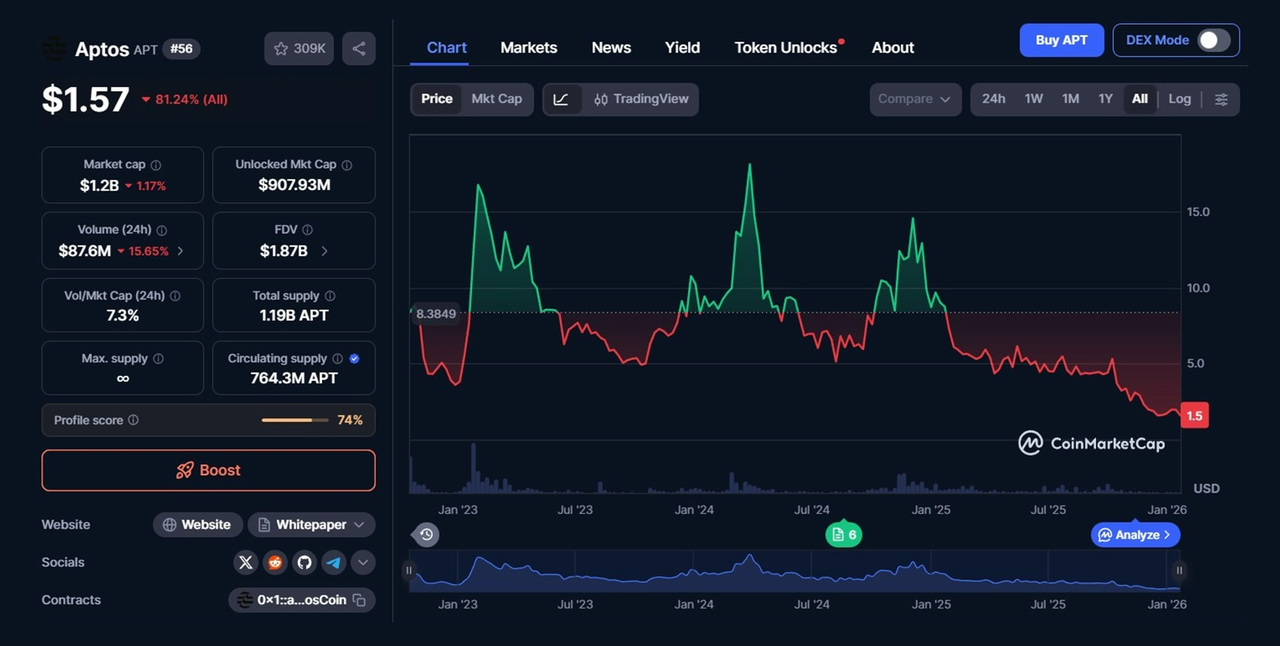
For example, in February 2024, Aptos introduced the first secure and instant on-chain randomness API for PoS blockchains, enhancing functionality for NFTs and gaming. This technological breakthrough pushed the $APT token’s value from around $8.6 to nearly $18.10 in less than a month.
Ecosystem Growth & dApp Launches
Like most layer-1 blockchains, Aptos relies on high-quality, secure projects launching and performing well on its blockchain. The more high-performance projects, such as crypto wallets, DeFi protocols, and NFT marketplaces, that launch on Aptos, the greater the demand for the APT crypto token, driving up its value.
Developer Adoption
Last but not least, Aptos’ success depends on convincing developers to build on it. For example, news of major developer conferences, hackathons, and grants can be a strong bullish signal.
Aptos offers comprehensive developer-friendly documentation, including advanced tools, SDKs, guides, and tutorials for both beginner and advanced developers. In 2025, Aptos distributed over 200 grants to projects across DeFi, NFTs, infrastructure, and tooling.
The project has a dedicated Aptos Foundation that has already committed $200M in grants to expand DeFi. For example, the Aptos Grant DAO is a community-driven, recurring grant program that funds Move-based projects. Additionally, Aptos rewards developers for building on the blockchain through the Payment Grant program.
Three Strategies for Trading APT/USDT
Trading APT/USDT on Bitunix requires adapting your strategy to real-time market conditions, including technical patterns, momentum shifts, and bullish or bearish sentiment. Regardless of the strategy you choose, you should always have a solid risk management approach.
Strategy 1: Fundamental Long-Term Holding (HODLing)
This strategy involves buying and holding APT, expecting its value to grow as the network matures. This approach is suitable for traders and crypto enthusiasts who believe in Aptos's long-term technological superiority. It involves buying and holding APT with the expectation that its value will grow as the network matures.
Your best option for implementing this strategy is to use Dollar-Cost Averaging (DCA) to accumulate APT over time. Simultaneously, you should focus on the project’s fundamental progress rather than short-term price fluctuations.
Strategy 2: Technical Swing Trading
This strategy relies on accurate technical analysis to capture price swings over days or weeks. Its goal is to find ideal prices to buy or sell APT, holding positions overnight to capture momentum. Beginners may find this approach daunting, which is why technical swing trading best suits experienced traders.
Your best choice is to use chart patterns, moving averages, and indicators like the MACD to identify entry and exit points based on market trends.
Strategy 3: Narrative-Based Trading
This Aptos trading strategy implies trading based on the prevailing market narrative. For example, if there is a lot of hype around "Solana killers" or new Layer-1s, Aptos is likely to perform well. New technological breakthroughs, upgrades, or important partnerships can also help the Aptos price spike.
When you use narrative-based trading in the spot market, you must monitor crypto news and social media to be up-to-date with the most recent developments. Beginners could try this strategy if they can gauge the current narrative and trade accordingly. However, more seasoned traders will anticipate the ideal trading moments with better accuracy.
Why Trade APT/USDT on Bitunix?
Bitunix is a high-performance crypto exchange with deep liquidity and a user-centric approach. Here are the main reasons for trading APT for USDT on Bitunix:
High-Performance Trading Engine
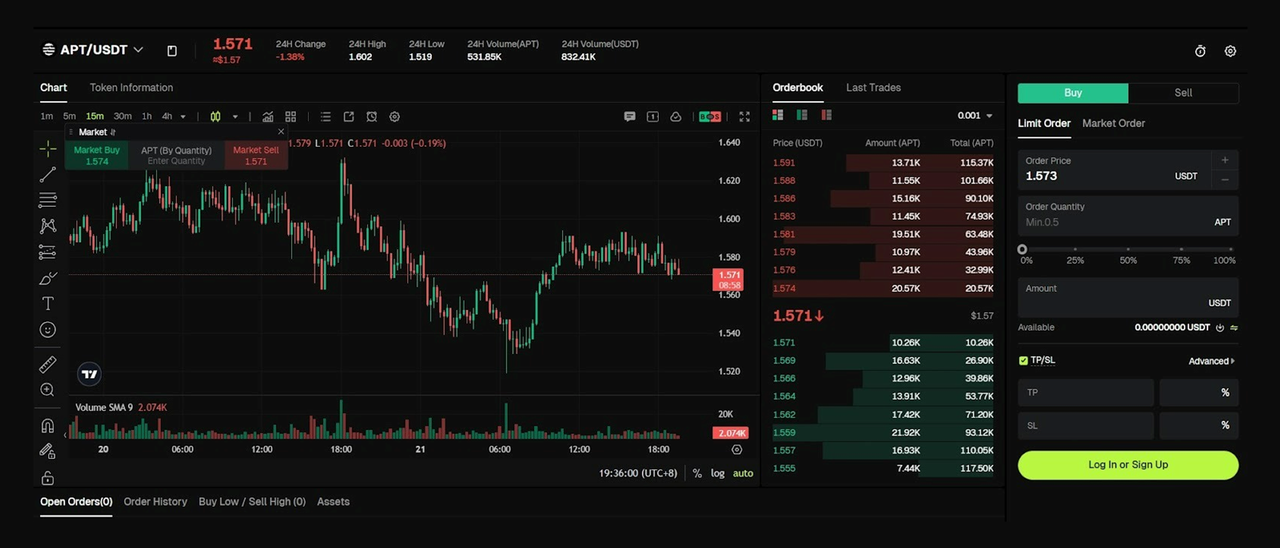
A fast blockchain deserves a fast exchange. Bitunix’s engine ensures your trades are executed instantly, without delay. The platform offers fast trade execution, with most operations confirmed in milliseconds.
Low Fees to Maximize Gains
The Bitunix fees are some of the lowest and most convenient in the industry. Trading APT/USDT on the spot market has a 0.08% maker fee and a 0.1% taker fee. These fees correspond to the lowest tier of Bitunix’s multi-tier VIP system, where fees decrease at each level. For example, members of the last tier (VIP Level 7) pay a fee of 0.010% for takers and 0.0325% for makers.
The futures trading fee for APT/USDT follows the same tiered maker/taker model. The base fee for new or non-VIP (VIP 0) users is 0.02% for Makers and 0.06% for Takers. Lower trading fees allow you to keep more of your profits, which is essential for both long-term investors and active traders.
Secure and Trusted Platform
Bitunix prioritizes user security and has an impeccable track record as one of the few professional crypto exchanges to have never succumbed to a hacker’s attack. Bitunix reassures users that their assets are safe with a dedicated Protection Fund, high security, and compliance with global regulations.
Conclusion: Tapping into a New Era of Blockchain Performance
Aptos represents a significant step forward in Layer-1 technology. Trading the APT/USDT pair on Bitunix gives you direct exposure to this innovation. Whether you’re a long-term believer or an active trader, Aptos offers compelling opportunities.
Be part of the next generation of blockchain. Sign up for Bitunix and start trading APT/USDT today.
Bitunix is available for both desktop and mobile users. You can download the Bitunix mobile application for iOS or Android from the app download page.
FAQ Section
What is the main difference between Aptos and Sui?
The main difference between Aptos and Sui lies in their implementations of the Move language and their data models. Aptos uses an account-centric model with AptosBFT for broad enterprise/DeFi use. Meanwhile, Sui uses an object-centric model with Narwhal/Tusk DAG consensus, aiming for gaming/high-volume apps.
What is the Move programming language, and why is it important?
Move is a secure, resource-oriented programming language for smart contracts, with a focus on asset safety. It is important for building reliable decentralized applications across different blockchains.
Is Aptos more centralized than other blockchains?
Yes, the Aptos blockchain is considered more centralized than established competitors like Ethereum, but it is often compared to Solana in terms of trade-offs between speed and decentralization.
What are the biggest projects currently being built on Aptos?
The list of major projects building on Aptos includes Thala Labs, Aave (V3), Echelon, Hyperion, Amnis Finance, and Echo Protocol.
What was the Diem project, and how is it related to Aptos?
The Diem project was a Meta-backed initiative designed to create a global, regulated stablecoin payment system and blockchain, originally announced in 2019 as Libra.
Is APT an inflationary or deflationary token?
Aptos (APT) is primarily an inflationary token with built-in deflationary mechanisms.
How does Aptos’s transaction speed compare to Ethereum and Solana?
Aptos offers significantly faster transaction finality (sub-second) and potentially higher throughput than Ethereum. While Aptos boasts higher theoretical potential (up to 160k TPS), Solana generally offers higher current real-world throughput (thousands of TPS).
What are the risks of investing in a new Layer-1 like Aptos?
Investing in a new Layer-1 (L1) blockchain such as Aptos carries inherent high risk primarily due to fierce competition in the L1 space and potential technical hurdles.
Glossary
Layer 1: Base blockchain that verifies and records transactions.
Layer 2: A scaling solution that processes transactions off the main chain and posts proofs to L1.
IEO: A method for crypto startups to raise funds by selling new tokens directly on a crypto exchange's platform, with the exchange acting as an intermediary.
IDO: The process of launching a cryptocurrency on a decentralized exchange (DEX).
TVL: The entire value locked in a protocol, a rough usage proxy.
DeFi: Decentralized finance applications on public blockchains.
Gas: Network fee for processing a transaction.
Altcoin: Any crypto asset that is not Bitcoin.
Volatility: Degree of price fluctuation for an asset over time.
Proof of Stake (PoS): Consensus where validators lock native tokens to secure the network and earn rewards.
Validator: Operator that proposes or attests blocks in PoS and shares rewards with delegators.
Incentive Program: Extra token rewards used to direct liquidity or votes.
Governance: Process for changing parameters or logic, often token-based with timelocks.
Trading Pair: A combination of two different digital or fiat currencies that can be exchanged for one another on a cryptocurrency exchange.
Stable Pair: A pool of assets that track similar values, such as two stablecoins.
About Bitunix
Bitunix is a global cryptocurrency derivatives exchange trusted by over 3 million users across more than 100 countries. The platform is committed to providing a transparent, compliant, and secure trading environment for every user. Bitunix offers a fast registration process and a user-friendly verification system supported by mandatory KYC to ensure safety and compliance. With global standards of protection through Proof of Reserves (POR) and the Bitunix Care Fund, Bitunix prioritizes user trust and fund security. The K-Line Ultra chart system delivers a seamless trading experience for both beginners and advanced traders, while leverage of up to 200x and deep liquidity make Bitunix one of the most dynamic platforms in the market.
Bitunix Global Accounts
X | Telegram Announcements | Telegram Global | CoinMarketCap | Instagram | Facebook | LinkedIn | Reddit | Medium