

Article Summary
- Leverage in crypto means borrowing capital from an exchange to increase the size of your trading position.
- It allows you to control a large amount of cryptocurrency with a small amount of your own money (called margin).
- For example, with 10x leverage, a $100 deposit can control a $1,000 position.
- The primary benefit of leverage is that it amplifies potential profits from small price movements.
- The primary risk is that it also amplifies potential losses, and a small price move against you can result in the total loss of your deposit (liquidation).
- This guide explains what leverage means in simple terms and provides essential rules for using it safely.
- Bitunix offers a secure platform with clear risk management tools to help you use leverage responsibly.
Leverage is one of the most powerful and most dangerous tools a crypto trader can touch. It turns small price moves into bigger wins. It also turns small mistakes into fast losses. If you have ever watched a position swing from green to red in seconds and thought, what just happened, leverage was probably involved.
On a crypto exchange, leverage often shows up in futures trading. You pick a pair like Bitcoin against Tether, open a long or short, and choose a number like 5x or 10x. That number quietly changes everything. Your liquidation level moves. Your fees matter more. Your stop loss stops being optional.
A lot of beginners learn leverage backwards. They start with the number and hope the market behaves. A better approach is to start with the meaning, then the math, then the safety rules.
This guide explains the leverage crypto meaning in simple terms, using clear examples. You will learn how it works, why liquidation happens, and three rules that keep you in the game. We will also cover how Bitunix displays key info like risk limits and how take profit and stop loss can be set directly in the futures order flow.
What Does Leverage Mean in Simple Terms?
The Power of Borrowing
Using leverage is like getting a mortgage to buy a house. You put down a deposit. The lender covers the rest. In trading, your deposit is the margin, and the lender is the exchange. Your margin is the money you post to open the position.
This matters because you now control a bigger position than you paid for. That is the point. It is also the problem and its why it’s so important to understand leverage crypto meaning before getting started.
Understanding the X Factor
When you hear 10x leverage, it means your margin controls a position that is 10 times larger.
A quick example:
- Without leverage: You use $100 to buy $100 worth of Bitcoin. If Bitcoin goes up 5%, you make $5.
- With 10x leverage: You use $100 as margin to control $1,000 worth of Bitcoin. If Bitcoin goes up 5%, the position gains $50. That is a 50% return on your $100 margin.
One more detail that beginners miss is that exchanges often cap leverage based on position size tiers. On Bitunix, the maximum leverage can reach 200x on BTC/USDT and ETH/USDT for eligible users, and that max changes by tier as your position grows.
The Inevitable Risk: Understanding Liquidation
The Flip Side of Amplification
Let’s reuse the same numbers. With 10x leverage, your $1,000 position loses $50 if the market drops 5%. Since you only put in $100, you just lost half your margin from a normal-sized move.
Now picture 50x or 100x. The space for error shrinks fast.
What Is Liquidation?
Liquidation is the exchange closing your position because your margin can no longer support it. On Bitunix, forced liquidation triggers when the mark price reaches your liquidation price, and your margin fails the maintenance requirement.
There is a practical takeaway here: liquidation is not a moral judgment. It is a margin check that happens automatically.
Also, treat any displayed liquidation price as an estimate, not a promise. Bitunix’s futures agreement states that the liquidation price shown on the platform is for reference only and is not binding.
The Higher the Leverage, the Closer the Liquidation Price
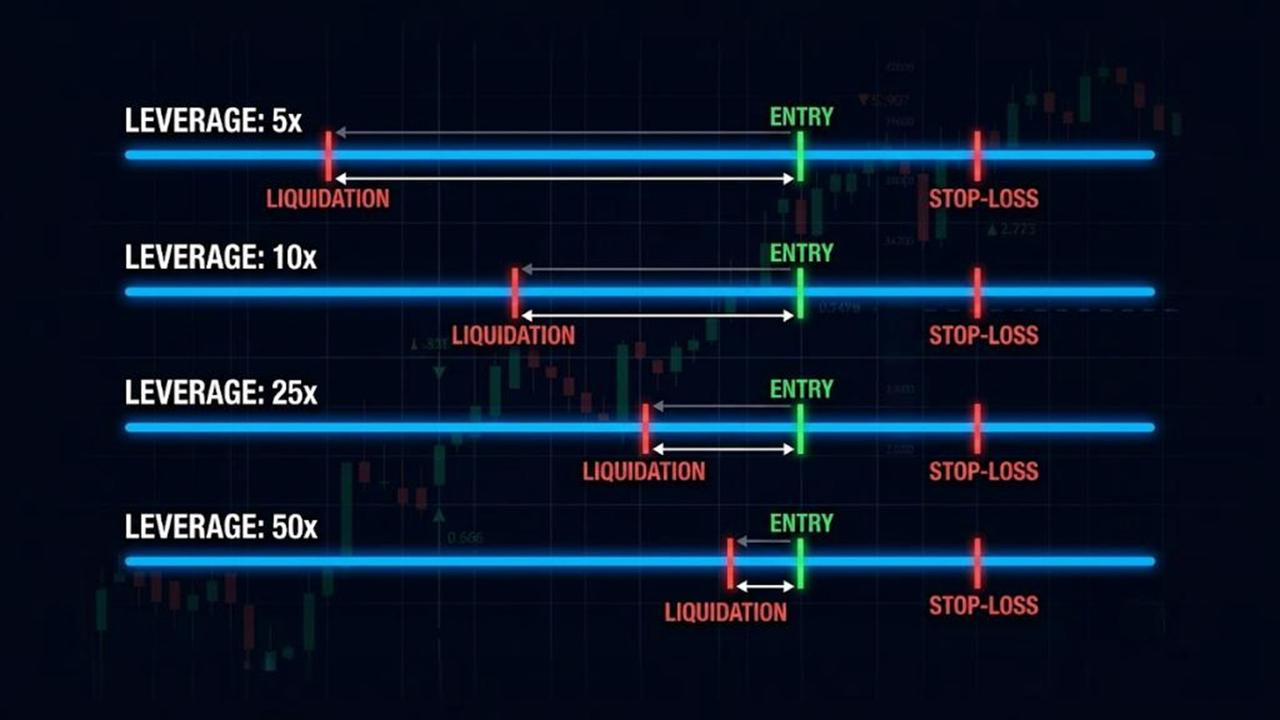
This is the core concept. High leverage means a tiny move against you can wipe out your margin.
At 100x leverage, a 1% move against your position can be enough to liquidate, depending on fees and the maintenance margin rate. That is why the liquidation line creeps toward your entry as leverage rises.
If you want the simplest mental model, use this: leverage buys you speed, and it charges you stability.
The 3 Golden Rules for Using Leverage Safely
Rule 1: Start With Low Leverage or None
Beginners do best at 2x to 5x. And yes, plenty of serious traders stay in that range. The goal is staying alive through volatility, not trying to win the lottery with one trade.
If you feel bored at low leverage, that is usually a sign you are trading for adrenaline, not for a plan.
Rule 2: Always Use a Stop Loss
A stop loss is your safety net. It closes your trade at a predefined loss, so a small mistake does not become a full liquidation.
Think of it like a seatbelt. It does not stop crashes. It changes what a crash costs.
On Bitunix, take profit and stop loss can be set in the futures order panel and triggered by different price references, such as latest, mark, or index, depending on the order settings.
Rule 3: Only Risk What You Can Afford to Lose
Leverage magnifies the emotional damage, too. If you put rent money into margin, every tick becomes personal.
A clean rule is to treat your margin as already spent. If that sentence makes your stomach drop, reduce size. And one more reality check from the FCA:
Significant price volatility, combined with the inherent difficulties of valuing cryptoassets reliably, places retail consumers at a high risk of suffering losses from trading crypto derivatives.
How to Use Leverage Responsibly on Bitunix
Bitunix built a lot of the guardrails into the futures system. You still need to use them.
Read The Liquidation Mechanics Before You Trust The Leverage Number
Bitunix runs tiered risk limits in futures. As position size increases, maximum leverage and maintenance margin requirements change by tier, and the system can cancel orders or reduce positions as part of the liquidation process.
So if you increase size, re-check your tier and your margin buffer. Do not assume yesterday’s leverage settings behave the same at a larger position.
Set Exits At The Same Time You Enter
The easiest way to trade responsibly is to place your take profit and stop loss when you open the position, not after the market starts moving.
Bitunix supports setting take profit and stop loss from the futures trading page and from the position management page.
Practice Without Turning It Into a High-Stakes Lesson
If you have access to a practice mode, use it. If you do not, another option on Bitunix is the futures bonus, which is designed to let users experience futures trading features in a real environment while taking less risk. Just remember, it comes with rules and expiration details.
Leverage is a tool for professionals, and Bitunix gives you professional-grade tools to use it responsibly. Learn to trade smart. Sign up today.
Conclusion
Leverage makes your position larger than your deposit. That is the whole trick. It amplifies gains and losses, and it moves liquidation closer as you increase the multiplier. If you remember only one thing, it is that leverage is not free money. It is borrowed exposure with strict rules.
Use low leverage, set stop losses, and keep position size boring. That is how traders stay around long enough to learn.
If you want to explore futures features on Bitunix, do it the safe way: start small, check your liquidation estimate, and set exits before you click confirm.
Now that you understand the meaning and the risks, you’re ready to practice. Use the Bitunix demo account to experience leverage trading without risking a single dollar.
FAQ
Is leverage trading the same as margin trading?
They are related. Both involve borrowing. In crypto, margin trading often refers to borrowing funds in spot markets, while leverage is commonly used in futures contracts. The risk logic is similar; your margin supports a larger position.
What is the maximum leverage I can use on Bitunix?
On some pairs, Bitunix offers up to 200x leverage for eligible users, with tiered limits that depend on position size.
Can I lose more than my initial deposit with leverage?
Exchanges liquidate positions to prevent losses from exceeding your margin, but fast markets and slippage can make outcomes worse than expected. Always treat margin as at risk and use stop losses.
What is a margin call?
It is a warning that your margin is getting too low and you need to add funds or reduce the position. Some platforms send alerts, then liquidate if the margin keeps dropping.
Why do exchanges offer such high leverage if it is so risky?
High leverage attracts active traders and increases volume. Risk controls like maintenance margin and tiered limits help the exchange manage exposure, but they do not protect you from bad sizing.
How do I calculate my liquidation price?
Many platforms provide a calculator and show an estimated liquidation price in the trading interface. Bitunix also notes that liquidation triggers around the mark price reach the liquidation price when the margin cannot meet maintenance requirements.
Is it possible to trade crypto with leverage without getting liquidated?
Yes, with low leverage, conservative size, and strict stop losses. Liquidation risk never fully disappears, but you can push it far away from your entry.
What is the difference between isolated margin and cross margin?
Isolated margin limits risk to one position’s margin. Cross margin shares margin across positions in the same account, which can keep one position alive but can also drag others into liquidation.
Does leverage affect my trading fees?
Fees are usually charged on position size, not just your margin. Higher leverage often means you take larger positions, so fees become more meaningful relative to your deposit.
What are the safest cryptocurrencies to trade with leverage?
None is truly safe with leverage. More liquid, large-cap pairs often have tighter spreads and deeper order books, which can reduce slippage risk, but leverage still magnifies losses.
Glossary
Margin: The deposit you post to open and maintain a leveraged position.
Leverage: A multiplier that lets your margin control a larger position size.
Position size: The total exposure of your trade, often larger than your margin when leveraged.
Long: A trade that profits if the price rises.
Short: A trade that profits if the price falls.
Liquidation: Automatic closure of a position when margin cannot meet maintenance requirements.
Liquidation price: The mark price at which liquidation occurs, typically shown as an estimate.
Maintenance margin: The minimum margin required to keep a position open.
Mark price: A reference price used to reduce manipulation and trigger liquidation checks.
Index price: A reference price derived from broader market prices, used in triggers on some platforms.
Stop loss: An order that closes a position when the price hits a predefined loss level.
Take profit: An order that closes a position when the price hits a predefined profit target.
Tiered risk limit: A leverage and margin framework that changes limits based on position size.
Slippage: The difference between the expected fill price and the actual fill price during execution.
Profit and loss: Your net gain or loss on a position after price movement and fees.
About Bitunix
Bitunix is a global cryptocurrency derivatives exchange trusted by over 3 million users across more than 100 countries. At Bitunix, we are committed to providing a transparent, compliant, and secure trading environment for every user. Our platform features a fast registration process and a user-friendly verification system supported by mandatory KYC to ensure safety and compliance. With global standards of protection through Proof of Reserves (POR) and the Bitunix Care Fund, we prioritize user trust and fund security. The K-Line Ultra chart system delivers a seamless trading experience for both beginners and advanced traders. At the same time, leverage of up to 200x and deep liquidity make Bitunix one of the most dynamic platforms in the market.
Bitunix Global Accounts
X |Telegram Announcements |Telegram Global |CoinMarketCap |Instagram |Facebook |LinkedIn |Reddit |Medium