

Article Summary
- This article provides a price prediction and fundamental analysis for the VIRTUAL token.
- It explains Virtual Protocol's mission: to build a decentralized factory for creating, training, and monetizing AI agents (virtual beings) that can interact across various games and metaverse platforms.
- The bull case focuses on the explosive growth of the AI sector, the unique value proposition of user-owned AI companions, and the potential for these agents to generate revenue for their creators.
- The bear case highlights the intense competition in both the AI and metaverse sectors, the technical challenges of cross-platform interoperability, and the reliance on the broader adoption of virtual worlds.
- It presents detailed price prediction scenarios (bearish, neutral, bullish) for both 2026 and 2030, based on the success of AI integration in gaming and the growth of the Virtual Protocol ecosystem.
The metaverse without inhabitants is just expensive empty land. Virtuals Protocol tries to solve that by giving digital worlds characters, workers, entertainers, and service providers that do more than stand around. The project is built as infrastructure for AI agents that can develop a personality, make decisions, interact with users, and operate as economic actors on-chain, and if you want to track or trade VIRTUAL/USDT from a crypto exchange, you can visit Bitunix.
The big question is simple. Can Virtuals become real infrastructure for AI-powered digital life, or is it still an early-stage narrative trading with a very good pitch deck and a lot left to prove? The answer sits somewhere in between.
This analysis will examine Virtual Protocol's technology, its position within the AI and gaming sectors, and the broader market dynamics to provide data-driven price predictions for 2026 and 2030.
The Bull Case: The AI and Metaverse Convergence
The optimistic case starts with the fact that VIRTUAL is no longer a tiny, unknown token. On April 3, 2026, CoinGecko showed VIRTUAL at around $0.6518, with about $45.5 million in 24-hour volume, roughly $427.8 million in market cap, and a price still 87.1% below its all-time high of $5.07.
Published forecasts are spread out, but the upside band is clear. CoinCodex's price prediction places year-end 2026 near $0.90 and 2030 near $1.82. Changelly's forecast is more aggressive, with a December 2026 average around $1.18 and a 2030 average near $1.46, with a $2.69 upper target. Gate's forecast's 2030 average is about $1.11. So the bullish path requires real adoption to catch up with the story.
1. The AI Narrative Dominance
AI remains one of the strongest forces in both tech and crypto. Meta alone guided for $115 billion to $135 billion in 2026 capital expenditures, largely to support AI infrastructure and its superintelligence efforts.
In crypto, Grayscale said AI and tokenization were among the sectors that stood out in Q1 2026, and Crypto.com's January 2025 AI agent research put the AI agents segment at about $15.3 billion in market capitalization at the time, with agent platforms like Virtuals Protocol at the center of the trend.
When capital, developer attention, and retail imagination all lean toward the same theme, speculative assets at that intersection usually get traction. Virtuals sits right there, between AI crypto, creator tools, and metaverse-style digital identity.
2. User-Owned AI
The core appeal of Virtuals is ownership. The protocol is built around tokenized agents rather than rented assistants trapped in one company's app. Its whitepaper frames AI agents as economic actors capable of producing output, earning revenue, coordinating tasks, and managing resources autonomously. At the same time, the tokenization layer lets founders launch AI agents on-chain using VIRTUAL liquidity.
Messari's September 2025 report described these agents as ownable, investable, and monetizable entities, with a combined agent market cap of more than $500 million and over $8 billion in DEX volume across launched agents at that time. That is the sharpest part of the bull thesis. If users want decentralized AI agents they can co-own and monetize, Virtuals has a clearer answer than most centralized AI tools do.
3. Cross-Platform Interoperability
Interoperability is the dream that keeps this project interesting. Virtuals is not trying to build one chatbot or one game character. It is trying to build an economic layer for agents that can work across ecosystems. Messari noted that Virtuals agents are already operational across Ethereum Layer 2s and Solana, with ACP handling coordination across chains.
The official changelog shows Butler gaining cross-chain support across Base, Ethereum, BNB Smart Chain, Polygon, and Arbitrum in December 2025. Then in March 2026, Virtuals moved ACP into Arbitrum's DeFi-heavy environment to let agents transact natively there. If that keeps expanding, one agent identity can become more useful across games, social platforms, services, and on-chain commerce.
4. The Creator Economy for AI
The strongest practical progress is on the builder side. Virtuals now gives developers tools to launch, price, manage, and monetize agents in ways that look more like SaaS than meme speculation. In March 2026, the protocol added subscription tiers and pricing configuration so developers could move from one-off jobs to recurring revenue models. Earlier updates added import and export tools for job offerings, visibility controls, ratings and reviews, and better search and ranking.
Genesis, introduced in April 2025, was built as a fairer token launch mechanism for AI agent tokens. Put simply, Virtuals is trying to build Shopify for AI agents while also serving as the payment rail, launchpad, and governance layer. That is the sort of stack that can create lasting creator demand if usage continues to compound.
The Bear Case: Execution and Competition
On the downside, Kraken's simple forward model puts VIRTUAL around $0.63 in 2026 and $0.77 in 2030. Gate's model is slightly higher, with a 2026 average around $0.65 and a 2030 average near $1.11. Coinbase's projection tool is similarly conservative because it is driven by a fixed growth-rate assumption rather than protocol-specific fundamentals.
That reminds you that a flat or slow-growth outcome is still on the table, especially for an asset already trading far below its peak. In other words, the market has already voted once against easy optimism.
1. Intense Competition
Virtuals is not alone anymore. Crypto.com's AI agent research grouped the space into multiple platform categories and highlighted Virtuals alongside other agent ecosystems in a sector that exploded fast. That is good for validation, but bad for margins and attention.
New AI token projects show up every week, and the barrier to launching a tokenized story is much lower than the barrier to building reliable agent infrastructure. Virtuals has real product depth, but it is competing in a market where investors often rotate to the freshest narrative before the old one finishes shipping.
2. Metaverse Adoption Lag
Virtuals still needs the broader digital-world economy to get bigger. DappRadar found that blockchain gaming reached 5.8 million daily unique active wallets in Q1 2025, but that was still a 6% quarterly drop. By Q3 2025, gaming remained the biggest Web3 category with 25% of all active wallets, yet DappRadar still described the industry as stagnant and struggling to attract a mainstream audience.
McKinsey's 2025 AI survey tells a similar story on the enterprise side. Almost all respondents were using AI in some form, but nearly two-thirds had not yet scaled it across the enterprise. So yes, the metaverse and AI-agent story is alive. It just has not fully arrived yet.
3. Technical Complexity
Virtuals is aiming at a hard engineering problem. Its own ACP documentation explains why agent commerce needs standards for trust, delivery verification, escrow, and dispute reduction. One agent hiring another sounds good until you remember that real money, real tasks, and real errors are involved.
The project is still actively shipping privacy controls, OpenClaw integrations, cross-chain support, and monetization tools in 2026. That is encouraging, but it also shows how much machinery still needs to work smoothly at the same time.
4. Token Utility and Value Accrual
The VIRTUAL token does have real utility. Official documentation shows it acts as the base asset for agent tokens, the routing currency for agent-token purchases, the currency agents spend in ACP, the source asset for staking into veVIRTUAL, and the governance asset behind on-chain proposals. So the design is not empty. But value accrual still needs scale.
CoinGecko's current data showed about $3,350 in 24-hour protocol fees and $0 in project revenue on the snapshot page it tracks. That is only a single-day reading, but it still highlights the central risk. If usage stays interesting but small, the VIRTUAL token can remain useful without becoming scarce enough to justify much higher valuations.
VIRTUAL Price Prediction Scenarios (2026 & 2030)
A sensible Virtual Protocol price prediction should be anchored in published forecasts. Across Kraken, Gate, CoinCodex, and Changelly, the rough 2026 band runs from about $0.63 to $1.30, while the 2030 band runs from about $0.77 to $2.69.
The table below turns those outside forecasts into practical bear, neutral, and bull buckets:
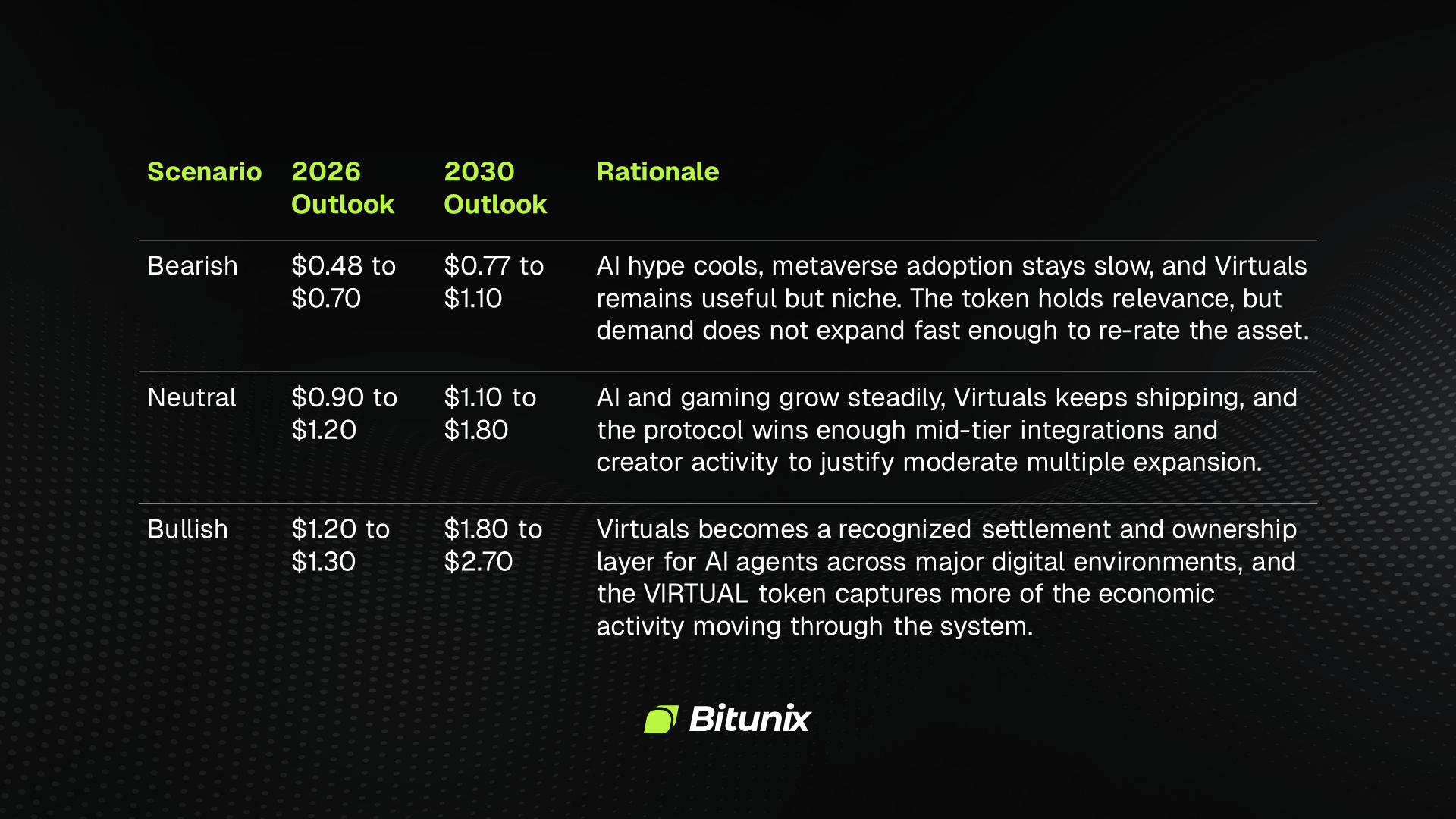
Virtual Protocol outlook table comparing bearish, neutral, and bullish scenarios for 2026 and 2030 based on AI adoption, metaverse growth, and token value capture.
Conclusion: A Bet on the Digital Future
Virtuals Protocol is trying to build infrastructure for a world where AI agents are not just tools, but participants. That is an ambitious thesis, and ambition cuts both ways. On the positive side, the project has a real architecture, clear token utility, active product updates, and a credible link to two large narratives: AI and digital worlds. On the risk side, adoption is still early, competition is fierce, and the token still needs broader economic throughput to justify a major long-term rerating.
So, is VIRTUAL a good investment? It is a high-risk bet on AI infrastructure inside Web3. If you think decentralized AI agents will become a meaningful part of gaming, social media, creator tools, and on-chain services, VIRTUAL has a serious case. If you think the metaverse stays niche and AI agent demand consolidates under centralized platforms, the upside looks much smaller.
For investors who want exposure to the edge of AI crypto and Web3 gaming, Bitunix provides spot and derivatives market access, plus Proof of Reserves tools, and you can download the Bitunix app and register there to track VIRTUAL and other leading AI tokens.
FAQ
What is Virtual Protocol (VIRTUAL)?
Virtuals Protocol is an on-chain infrastructure layer for AI agents. It gives builders tools to create, tokenize, deploy, and monetize agents that can act as digital services or businesses. The VIRTUAL asset sits at the center of payments, liquidity, staking, and governance.
What are decentralized AI agents?
Decentralized AI agents are software agents that can make decisions, interact with users or other agents, and execute tasks while relying on blockchain rails for wallets, settlement, token ownership, and coordination. The idea is to let agents act economically without depending on one centralized platform.
How does Virtual Protocol use AI?
Virtuals uses AI through its GAME framework, which helps agents plan and make decisions based on goals, personality, context, and available actions. It also uses ACP so agents can discover one another, hire services, pay on-chain, and verify outcomes through standardized rules.
What is the utility of the VIRTUAL token?
The VIRTUAL token works as the base asset for agent-token liquidity, the routing currency used when users buy agent tokens, the currency agents spend inside ACP, the asset users lock to receive veVIRTUAL, and the governance token used to steer protocol decisions.
Can I create my own AI agent on Virtual Protocol?
Yes. Virtuals is built for builders and traders alike. Its launch system and tooling let founders or developers create agents, tokenize them, configure offerings, manage pricing, and now even set subscription tiers, which makes the platform more practical for creators building ongoing agent businesses.
How does Virtual Protocol differ from other AI crypto projects?
Its main difference is structure. Many AI crypto projects focus on compute, data, or model access. Virtuals focuses on agent ownership, agent commerce, and agent monetization. It tries to make AI agents behave like on-chain businesses rather than simple chatbot products or narrative tokens.
What is the relationship between Virtual Protocol and the metaverse?
Virtuals fits the metaverse thesis because it can supply digital worlds with persistent agents that act, interact, and earn. Those agents can serve as characters, creators, assistants, or service providers. The bigger the market for immersive digital environments becomes, the larger Virtuals' potential addressable market becomes.
Where can I buy the VIRTUAL token?
You can buy VIRTUAL on centralized exchanges and through on-chain routes. CoinGecko lists active centralized markets for VIRTUAL, and Bitunix also provides a project page and trading access around the asset inside its broader exchange environment. On-chain, users can swap through supported decentralized venues.
Is VIRTUAL a good long-term investment?
It is a speculative long-term asset. The upside depends on whether Virtuals becomes real infrastructure for AI agents across games, social apps, and on-chain services. The downside is that adoption stays narrow and token utility never scales enough to support materially higher valuations.
What are the main risks of investing in AI crypto tokens?
The main risks are crowding, narrative whiplash, slow real-world adoption, technical failure, tokenomics that do not translate into durable value capture, and the wider volatility of crypto markets. AI crypto can look brilliant during hot cycles and very ordinary once the market asks for revenue.
Glossary
- AI agent: A software system that can reason, plan, and act on goals, often by calling tools or APIs instead of only replying to prompts.
- Decentralized AI agents: AI agents that use blockchain rails for wallets, transactions, ownership, and coordination rather than relying on one central operator.
- ACP: Agent Commerce Protocol, the Virtuals standard for discovery, hiring, payment, escrow, and verification between agents onchain.
- GAME: Virtuals' modular agent framework that lets agents make decisions using goals, personality, context, and available actions.
- Agent tokenization: The process of launching AI agents as on-chain economic entities with tradable ownership and liquidity tied to VIRTUAL.
- veVIRTUAL: The vote-escrowed version of VIRTUAL that users receive by locking tokens to gain rewards and governance power.
- Governance: The on-chain process through which veVIRTUAL holders propose, debate, and vote on protocol direction and treasury use.
- Liquidity pair: A trading pair in a liquidity pool. In Virtuals, new agent tokens are paired with VIRTUAL.
- Routing currency: The asset that sits in the middle of transactions. Virtuals uses VIRTUAL as the routing asset for agent-token demand.
- Bonding curve: A token launch mechanism where pricing changes automatically as demand and supply move through a defined formula.
- Buyback and burn: A tokenomic mechanism that uses funds to repurchase tokens and remove them from circulation, reducing supply.
- Cross-chain interoperability: The ability for assets, wallets, or agent activity to work across multiple blockchains or Layer 2 networks.
- Escrow: A smart contract mechanism that holds payment until job conditions or delivery checks are satisfied.
- dUAW: Daily unique active wallets, a common Web3 activity metric used by DappRadar to track user engagement.
- FDV: Fully diluted valuation, the market value implied if the token's maximum supply were already in circulation.
Disclaimer
This article does not provide:
(i) investment advice or investment recommendations;
(ii) an offer or solicitation to buy, sell, or hold digital assets;
(iii) financial, accounting, legal, or tax advice.
Digital assets, including stablecoins and NFTs, involve high risk and may fluctuate significantly. Consider whether trading or holding digital assets is appropriate for you given your financial situation. Consult a qualified legal, tax, or investment professional when needed. You are responsible for understanding and complying with applicable local laws and regulations.
About Bitunix
Bitunix is a global cryptocurrency derivatives exchange trusted by over 3 million users across more than 100 countries. At Bitunix, we are committed to providing a transparent, compliant, and secure trading environment for every user. Our platform features a fast registration process and a user-friendly verification system supported by mandatory KYC to ensure safety and compliance. With global standards of protection through Proof of Reserves (POR) and the Bitunix Care Fund, we prioritize user trust and fund security. The K-Line Ultra chart system delivers a seamless trading experience for both beginners and advanced traders, while leverage of up to 200x and deep liquidity make Bitunix one of the most dynamic platforms in the market.
Bitunix Global Accounts
X | Telegram Announcements | Telegram Global | CoinMarketCap | Instagram | Facebook | LinkedIn | Reddit | Medium