

Article Summary
- This article explains the concept of block confirmations on the Ethereum network in a simple, beginner-friendly way.
- It defines a block confirmation as the process by which a transaction is verified, added to a block, and then further secured as new blocks are added after it.
- The guide clarifies the significant changes brought by the transition to Proof-of-Stake (the "Merge"), introducing the concepts of Epochs, Slots, Justified Blocks, and Finalized Blocks.
- It provides a practical answer to "how many confirmations are needed," explaining that for most exchanges and services, a transaction is considered secure once the block containing it is finalized (typically after about 13-15 minutes).
- The difference between a transaction being included in a block and being finalized is a key focus.
You’ve just sent some ETH to your Bitunix or any other crypto exchange account. You check the block explorer, and it says 'Success,' but the funds aren't in your wallet yet. What's going on? The answer lies in a crucial security process called block confirmations.
That delay can feel confusing. You broadcast a transaction, you get a hash, and you want closure. The gap between sent and final, enough to credit, is where most new users start worrying, especially when the amounts are meaningful or you’re on a deadline.
This guide will demystify Ethereum block confirmations. We'll explain how the process works in the modern Proof-of-Stake era and clarify what it means for your transaction to be truly secure.
What Is a Block Confirmation?
Ethereum groups transactions into blocks. Ethereum.org describes it in just one line: "Blocks are batches of transactions with a hash of the previous block in the chain."
Now imagine a paper ledger. Each block is a page that gets stapled on top of the last page. Your transaction lives on one page. A confirmation is what you get every time Ethereum staples a new page on top of the page that contains your transaction.
When your transaction first appears in a block, it has one confirmation. As the chain adds more blocks after it, you rack up more confirmations. Each new block makes it harder to rewrite recent history without the network noticing and rejecting the change.
In practice, confirmations matter because temporary disagreements can happen at the chain tip. Two blocks can compete for the same position for a short moment. The network resolves it, and one branch becomes the canonical chain. Waiting for confirmations reduces the chance that your transaction ends up on the losing branch.
The Big Change: Confirmations After the Merge
Ethereum still adds blocks quickly, but the meaning of safe changed after the Merge. In Proof-of-Work, people relied heavily on a simple count of blocks after their transaction. In Proof-of-Stake, Ethereum adds something stronger than a lot of blocks, a consensus milestone called finality.
Here’s why this matters for real life. A wallet or block explorer can show Success quickly because your transaction was executed and made it into a block. That does not guarantee that your exchange credits the deposit immediately. Exchanges want to see your deposit in a block that Ethereum has finalized, so it can’t be replaced by a short chain reorg.
Ethereum’s post-Merge timing system also explains why you often see a predictable rhythm. You’ll notice a fast initial inclusion, then a longer wait where nothing seems to happen, and then your deposit gets credited. That second phase is usually the platform waiting for finality plus internal wallet synchronization.
Slots And Epochs
Before the definitions, it helps to know that Ethereum measures time in repeating units. Those units coordinate who proposes blocks and who votes on them, which is how Ethereum builds confidence in the chain’s history. When you understand slots and epochs, you can predict the rough waiting time.
A slot is a 12-second window when Ethereum can propose one block. An epoch groups 32 slots, which works out to about 6.4 minutes, according to Ethereum’s own documentation.
Justified And Finalized
Justification and finalization come from how validators vote over time. Think of justification as the network agrees this checkpoint is correct, and finalization as the network locks it in. The Ethereum consensus protocol notes that time proceeds in 12-second slots and 32-slot epochs, and that validator votes get counted at epoch boundaries.
A practical way to remember it is that a block becomes much safer after the epoch that contains it gets justified, and it becomes effectively irreversible when that checkpoint gets finalized.
Ethereum has had moments where finality slowed or stopped temporarily, and that made headlines because it showed why being included in a block and finalized are different concepts.
In May 2023, Ethereum lost finality for over an hour, meaning it produced blocks but could not lock them as irreversible. It was the second disruption within 24 hours. The prior day had a 25-minute period where blocks were proposed but not validated. The cause was unclear.
How Many Block Confirmations In Ethereum
People still ask this as a number because that’s how it worked for years. The short answer is that confirmations are now less useful than finality, but you still see confirmation counts in explorers and in exchange deposit policies.
In the Proof-of-Work era, many exchanges waited for something like 12 confirmations for ETH deposits.Binance, for example, has published deposit guidance that referenced 12 confirmations for ETH. That old rule-of-thumb existed because deeper confirmations reduced reorg risk.
Post-Merge, Ethereum produces blocks in 12-second slots and groups them into 6.4-minute epochs. A block’s strongest safety guarantee arrives when the checkpoint that contains it becomes finalized, which usually happens after about two epochs, framing finality as roughly 15 minutes.
So what do you do with that in practice? You match the status to your risk. Here is the main information you need to know:
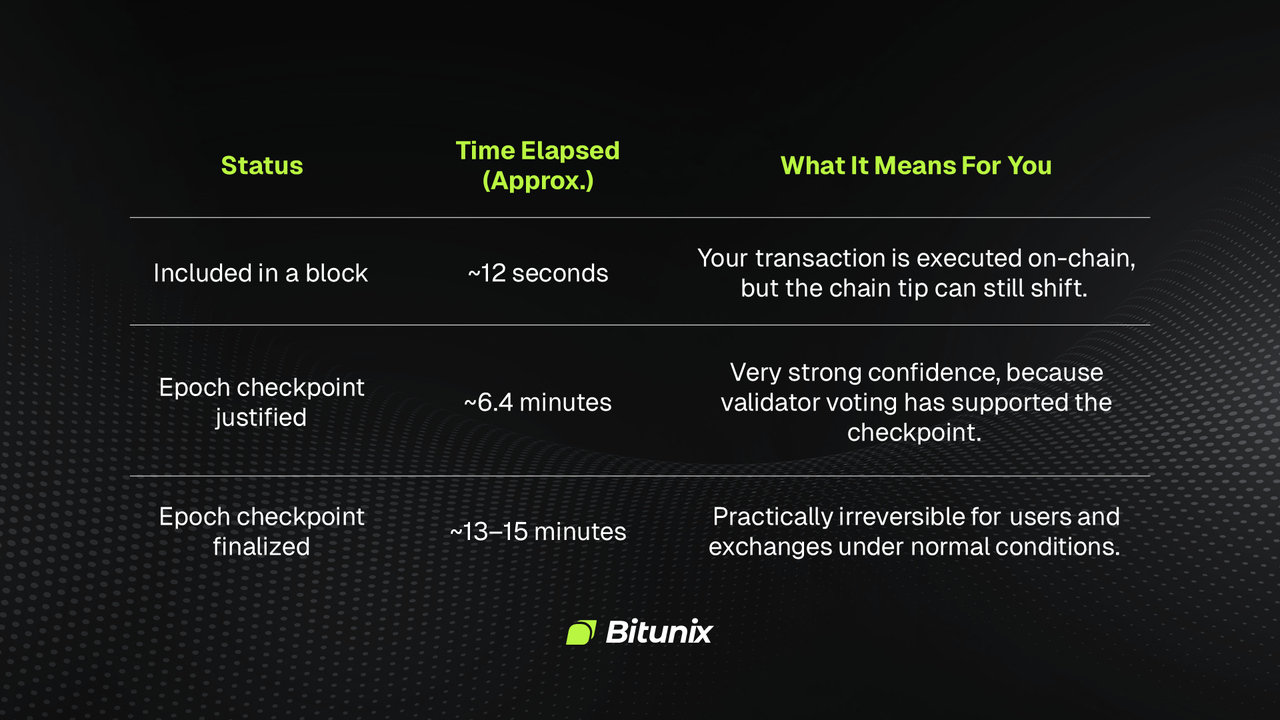
If you want a real-world example of how exchanges translate this into policy, some platforms still express it as a high confirmation count. Bitflyer, for instance, lists Ethereum deposits as requiring 80 confirmations, which they equate to about 16 minutes, lining up with the finality window in practice.
Now you can see why the same transaction can look done on Etherscan and still wait on the exchange. Etherscan explains that a successful transaction is permanent on the network, yet exchanges may still not show the funds immediately because they apply their own processing and deposit logic.
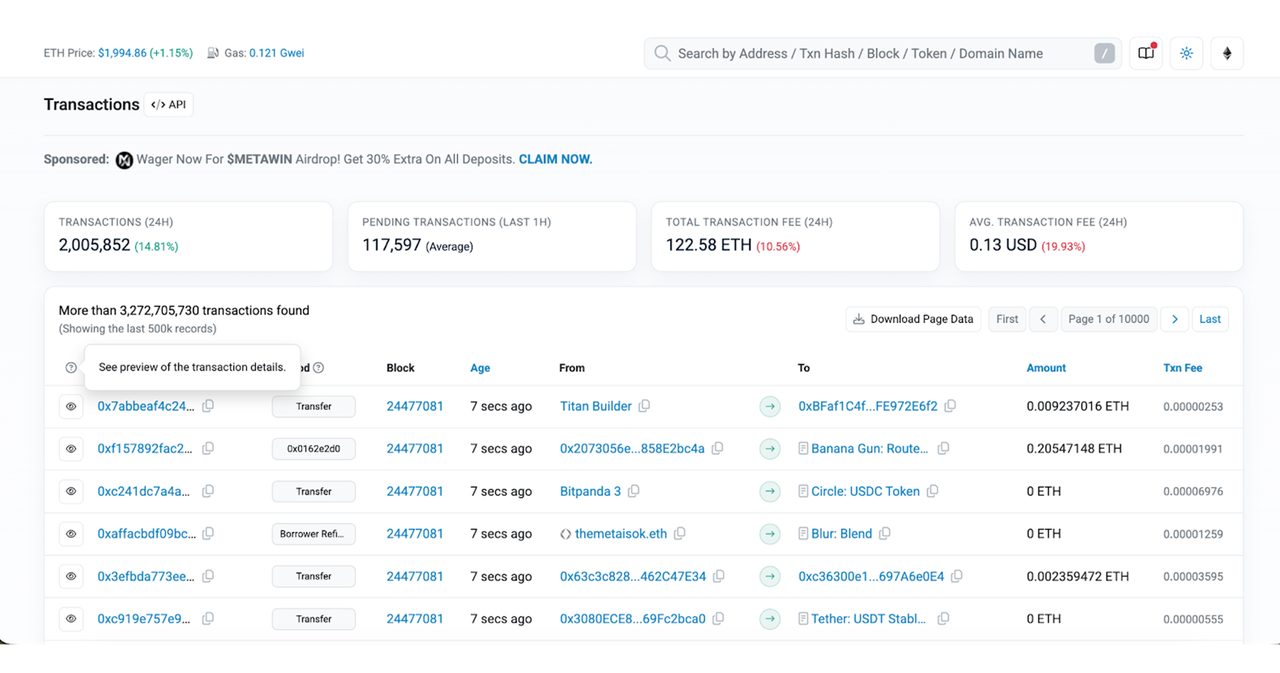
This also helps with Ethereum transaction time expectations. You often get inclusion fast, and then you wait for finality plus exchange processing. If the network is busy, inclusion itself can slow down because of fees.
Why Exchanges Like Bitunix Wait For Finality
Exchanges have one main job with deposits. They need to credit your account only after they feel confident the chain won’t remove that deposit from history.
That’s about double-spend protection. If a platform credits you too early, a rare reorg or consensus issue could remove the deposit transaction. The exchange would then face a gap between its internal ledger and the blockchain’s ledger.
Bitunix’s support material explains that a deposit can exist on the blockchain and still not be credited because the block is waiting for confirmation, and that even after confirmation, there can be a synchronization delay before the platform wallet reflects it.
This is also the moment to keep your expectations grounded. Bitunix does not control Ethereum’s consensus timing. Ethereum decides when blocks get proposed and when checkpoints finalize. The exchange decides how many ETH confirmations or what finality threshold it wants before crediting.
If you’re new and want to reduce mistakes, the best operational habit is to use the official deposit process and double-check network selection when depositing crypto on Bitunix, or any other exchange.
What Makes A Transaction Pending On Ethereum?
Sometimes the delay happens before confirmations even start. That’s when you see an Ethereum transaction pending in your wallet or on the explorer.
Fees drive most pending issues. Validators choose which transactions to include, and users can signal urgency by paying higher priority fees. Ethereum’s gas documentation explains that the priority fee incentivizes validators and lets users outbid others for inclusion.
If your transaction sits pending for a long time, it often means your fee settings were too low for the current demand. Wallets commonly let you speed up by replacing the transaction with the same nonce and a higher fee.
A second cause is nonce ordering. If you have an older pending transaction with nonce 12, then a new transaction with nonce 13 cannot confirm until nonce 12 lands or gets replaced. This trips up beginners because the second transaction can look fine, yet it cannot move.
Conclusion: Patience Is Security
While it might feel like a delay, the time it takes for an Ethereum transaction to be finalized is a feature, not a bug. The process of justification and finalization in the Proof-of-Stake system provides a powerful guarantee that your transaction is permanent and secure.
The next time you're waiting for an ETH deposit, you'll know that the network is working to make your funds safe. Finality is worth the short wait, and the remaining delay often comes from exchange synchronization and internal processing rather than the chain itself.
Experience the security and efficiency of the Ethereum network. Download the app, sign up, and deposit or trade ETH on Bitunix today, where we prioritize the safety of your assets by adhering to the highest standards of transaction finality. If you want to trade right after your deposit clears, the ETH/USDT market is the pair most users check first.
FAQ
Why does my transaction say Success, but my funds haven’t arrived?
Success means Ethereum processed your transaction without reverting, but your balance can still lag. If you sent a token, it may show under Token Transfers, not your ETH balance. Exchanges also wait for more confirmations before crediting.
Can a finalized Ethereum transaction be reversed?
Under normal conditions, finalized history is treated as irreversible for users and exchanges. Ethereum finality relies on validator voting over epochs, and reversing finalized blocks would require an extreme, slashable event.
Is confirmation time the same for all ERC-20 tokens?
The chain timing is the same because ERC-20 transfers settle in Ethereum blocks. What changes is the exchange policy. Some platforms require more confirmations for certain tokens, even though the underlying finality window stays similar.
Why are Bitcoin confirmations slower than Ethereum’s?
Bitcoin confirmations take longer because Bitcoin targets one block every 10 minutes, while Ethereum produces blocks about every 12 seconds after Proof-of-Stake. Bitcoin also relies on multiple confirmations (often 1–6) for strong security, so transfers commonly take 10–60 minutes to settle.
What is a gas fee, and how does it affect Ethereum transaction time?
A gas fee is the cost you pay in ETH for the network to process your transaction. It depends on gas used and gas price (base fee plus a tip). When the network is busy, higher tips get included faster, and low fees can leave your transaction pending.
What happens if the block with my transaction is not finalized?
If your transaction lands in a block that doesn’t finalize, it still shows as included, but it stays reversible in rare edge cases. Exchanges and bridges often pause or delay credits until finality returns, so you wait longer. In most cases, validators recover, and finality resumes within 1–2 hours.
How can I check the status of my Ethereum transaction?
Use a block explorer. Paste your transaction hash and check whether it is pending or included, then track confirmations and time. If you’re depositing to an exchange, also check the exchange deposit history.
What does transaction dropped mean?
Dropped usually means the network stopped relaying your transaction, often because the fee was too low and it fell out of node mempools. Many wallets let you replace it with a higher-fee transaction using the same nonce. If you used an exchange withdrawal, you need the sender platform to resend it.
Does Bitunix set the confirmation time, or does Ethereum?
Ethereum sets block and finality timing through slots and epochs. Bitunix sets when it credits deposits based on confirmation and synchronization logic. That’s why two users can see the same on-chain status and still get credited at slightly different times.
What is a block explorer?
A block explorer is a website that displays on-chain data in a readable way. Etherscan is a common example, where explorers help you confirm whether a transaction is pending, included, or buried under more blocks.
Glossary
- Block: A batch of transactions linked to the previous block by hash.
- Block Confirmation: A new block is added after the block that includes your transaction.
- Finality: The point where the network treats history as effectively irreversible.
- Justified: A checkpoint that validator voting has strongly supported.
- Slot: A 12-second window when a block can be proposed.
- Epoch: A group of 32 slots, about 6.4 minutes.
- Validator: A participant that proposes blocks and votes on consensus in Proof-of-Stake.
- Attestation: A validator vote that supports blocks and checkpoints.
- Chain Reorganization (Reorg): When the chain tip changes and recent blocks get replaced.
- Mempool: Where pending transactions wait before inclusion (node-dependent).
- Gas: The unit that measures computation cost for transactions.
- Base Fee: The protocol fee component introduced by EIP-1559.
- Priority Fee: The tip that helps your transaction get included sooner.
- Nonce: The sequence number that orders transactions from an account.
- Block Explorer: A tool that lets you view on-chain blocks and transactions.
About Bitunix
Bitunix is a global cryptocurrency derivatives exchange trusted by over 3 million users across more than 100 countries. The platform is committed to providing a transparent, compliant, and secure trading environment for every user. Bitunix offers a fast registration process and a user-friendly verification system supported by mandatory KYC to ensure safety and compliance. With global standards of protection through Proof of Reserves (POR) and the Bitunix Care Fund, Bitunix prioritizes user trust and fund security. The K-Line Ultra chart system delivers a seamless trading experience for both beginners and advanced traders, while leverage of up to 200x and deep liquidity make Bitunix one of the most dynamic platforms in the market.
Bitunix Global Accounts
X | Telegram Announcements | Telegram Global | CoinMarketCap | Instagram | Facebook | LinkedIn | Reddit | Medium
Disclaimer: Trading digital assets involves risk and may result in the loss of capital. Always do your own research. Terms, conditions, and regional restrictions may apply.