Article Summary
- Market capitalization (market cap) is the total value of a cryptocurrency. It is calculated by multiplying the Circulating Supply by the Price of a single coin.
- Market cap, not the price of a single coin, is the most accurate measure of a crypto project's size and value.
- A coin with a low price is not necessarily "cheap" if it has a massive supply, resulting in a large market cap.
- Cryptocurrencies are generally categorized by their market cap: Large-Cap (e.g., Bitcoin), Mid-Cap, and Small-Cap (often called "low-cap gems").
- Understanding market cap is essential for assessing a project's growth potential and risk level.
It is very easy to get caught up in the price of cryptocurrencies, especially when trading altcoins and meme coins. You see a project trading at just $0.20 and think, “Wow, what a bargain, I am going all in.” In reality, the price of a token tells you very little about its underlying economic value.
It is far more important to consider market capitalization. Arguably, understanding market capitalization is one of the most important aspects of investing, not only in crypto but also in traditional markets, because it provides a much clearer picture of valuation than spot price alone.
Market capitalization refers to the total value of cryptocurrency based on its circulating supply and price. For example, even though Solana-USDT trades around $142, this does not mean it is undervalued compared to Zcash at $500. Despite the higher token price, Solana’s market cap is several times larger than Zcash’s, reflecting a much higher overall valuation.
This guide explains what market cap really means, how to use it correctly, and why thinking in market capitalization rather than price can lead to better trading and investment decisions on your crypto exchange of choice.
Part 1: What Is Market Cap and How Is It Calculated?
The good thing about market caps is that they really are not difficult to calculate, and most platforms display them alongside the token price. Nonetheless, when dealing with non–blue-chip cryptocurrencies, it is an important concept to understand. In addition, many crypto assets do not have their full supply in circulation, which directly affects how market capitalization should be interpreted.
Market capitalization is calculated by multiplying a token’s price by its circulating supply. Circulating supply refers to the number of coins that are actively available and tradable in the market.
It is important to distinguish between circulating, total, and maximum supply. For example, Bitcoin has a maximum supply capped at 21 million coins, with roughly 19.9 million already in circulation. Because most BTC is already released, its market cap closely reflects its full valuation.
Circulating supply matters most because it represents the value the market is currently assigning to the tradable portion of a network.
To illustrate why price alone is misleading, consider two examples. Coin A trades at $100 with a supply of 1 million coins, giving it a $100 million market cap. Coin B trades at $0.10 with a supply of 10 billion coins, resulting in a $1 billion market cap. Even though Coin A’s price is far higher, Coin B is the larger project.
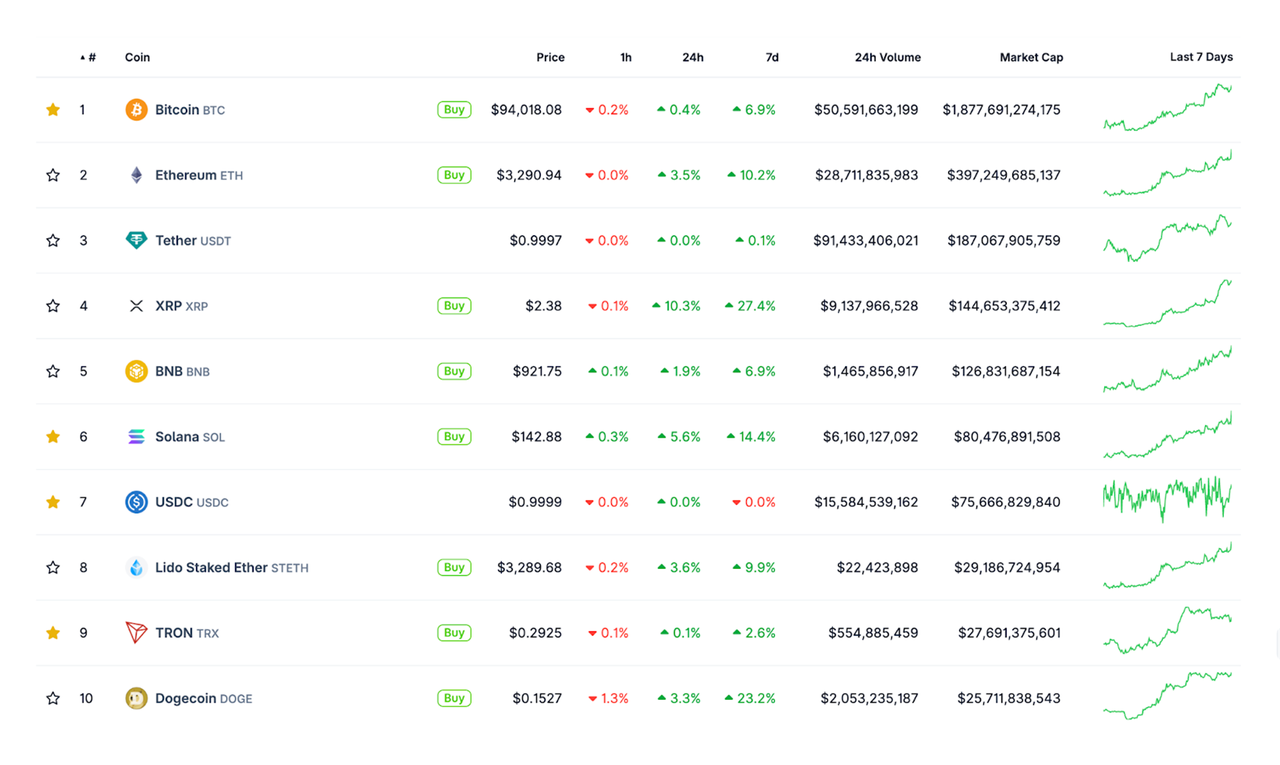
This same logic applies in real markets. Dogecoin may trade around $0.15, yet its market cap can exceed $24 billion. Meanwhile, Litecoin might trade near $82 but carry a market cap closer to $6 billion, making it the smaller asset despite the higher price.
Part 2: The 3 Tiers of Crypto - Understanding Market Cap Categories
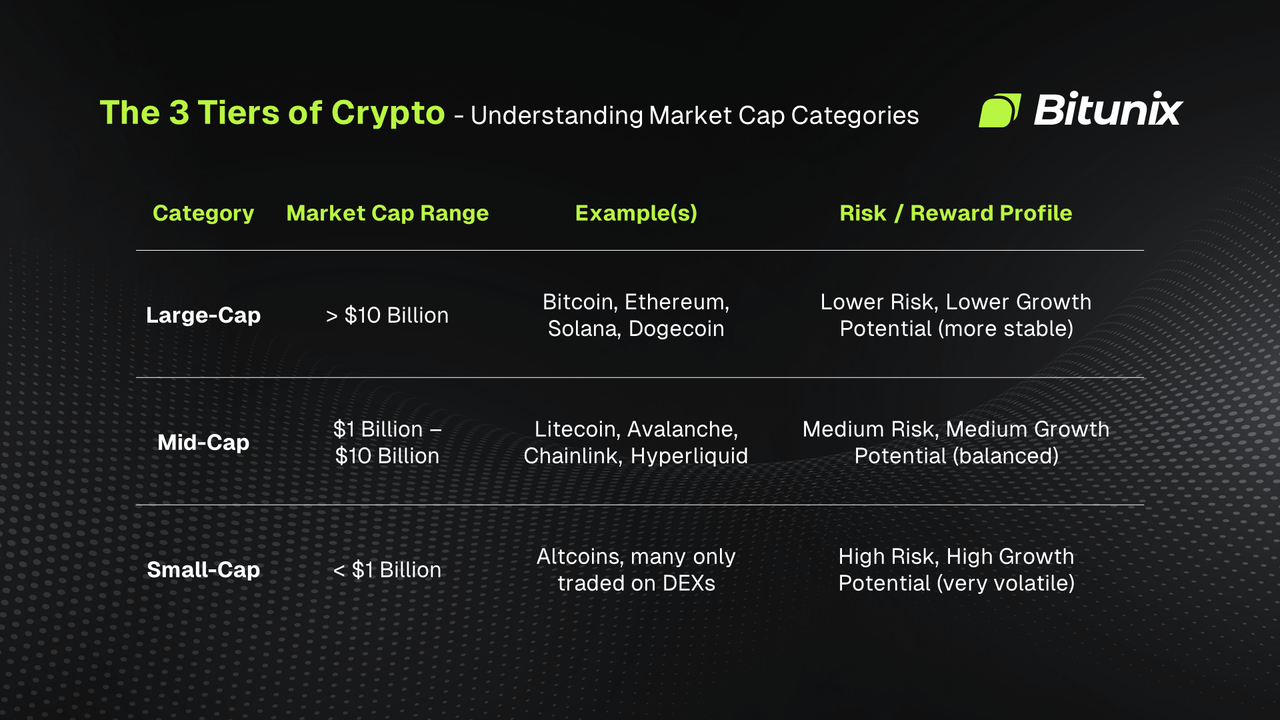
Large-cap cryptocurrencies tend to offer stability rather than extreme upside. Assets such as Bitcoin sit at the top of the market cap rankings and are deeply embedded in the crypto ecosystem. While it is very unlikely that Bitcoin will deliver a 100x return from current levels, it is also extremely unlikely to collapse to zero. Large-cap projects generally have strong liquidity, widespread adoption, and established infrastructure, which reduces downside risk but also limits explosive growth potential.
Mid-cap assets sit in the middle of the risk spectrum. A project like Avalanche has already proven its technology and ecosystem, but still has room to grow if adoption accelerates. Compared to Bitcoin, Avalanche has a higher potential upside, but it also carries more risk due to competition, market cycles, and execution challenges. This is where many traders look for a balance between growth and survivability.
Small-cap altcoins and micro-cap cryptocurrencies carry the highest risk and the highest potential reward. For example, a coin like FLOKI, with a market cap around $500 million, could theoretically see large percentage gains, but it also faces a much higher chance of sharp drawdowns.
At the extreme end, micro-cap tokens often trade only on decentralized exchanges and can have market caps measured in the millions or even thousands of dollars. Newly launched meme coins on platforms such as pump.fun or four.meme can start with only a few thousand dollars in market cap.
Part 3: How to Use Market Cap in Your Research
Understanding market cap in crypto makes researching potential investments far more accurate and reduces the risk of adding tokens to your portfolio that are extremely overvalued or carry excessive downside. Market cap helps traders focus on valuation rather than being distracted by low token prices or short-term hype.
One of the most practical uses of market cap is assessing growth potential. For example, if someone is looking at an Ethereum-based meme coin, comparing projects like PEPE and Shiba Inu is useful. With PEPE around a $2.7 billion market cap and SHIB closer to $5.4 billion, PEPE would theoretically have more room for upside, assuming similar demand.
Market cap is also essential for avoiding scams. A coin with a quadrillion supply and a price of $0.00000001 may look cheap, but a quick calculation often reveals an unrealistic valuation that cannot be sustained.
Reliable market cap data can be found on platforms such as CoinMarketCap, CoinGecko, and directly on trading platforms like Bitunix, which display market cap alongside price and volume.
Final Thoughts
Thinking about market capitalization rather than simply looking at prices is critical to carrying out effective research in the cryptocurrency market. Many newcomers make the mistake of assuming certain coins are “cheap” just because they trade at a low price, when in reality their fully diluted market capitalization means they are significantly overvalued. By focusing on market cap, traders gain a clearer understanding of valuation, risk, and realistic upside potential. Put your knowledge of market capitalization into practice on the Bitunix crypto exchange by signing up or downloading the app today.
FAQs
What is the difference between market cap and fully diluted valuation (FDV)?
Market cap uses only circulating supply, while FDV assumes every token that can ever exist is already in circulation. FDV often highlights future dilution risk that market cap alone does not show.
Can a coin’s market cap be higher than Bitcoin’s?
Technically yes, but realistically very unlikely given Bitcoin’s liquidity, adoption, and role as the primary store-of-value asset in crypto.
Is a low market cap always a good sign?
No. A low market cap can indicate early growth potential, but it can just as easily reflect poor fundamentals, weak demand, limited liquidity, or a project that is unlikely to survive long term.
How does circulating supply change over time?
Circulating supply changes as new tokens are mined, vested, unlocked, or released from team, investor, or ecosystem allocations. If supply grows faster than demand, price pressure often follows.
What is a good market cap for a new project?
There is no perfect number. Very small market caps offer higher upside but extreme risk, while slightly larger early-stage projects may signal better funding, development progress, and long-term viability.
Why isn’t price per coin a good metric?
Because price ignores supply. A token priced at fractions of a cent can still be massively overvalued if its circulating supply is enormous.
Does market cap affect a coin’s volatility?
Yes. Lower market cap assets usually experience sharper price swings due to thinner liquidity, while large-cap coins tend to move more slowly and absorb larger trades with less impact.
How do I find new, low-cap crypto projects?
Low-cap projects are often found on decentralized exchanges, launchpads, analytics tools, and early-stage tracking sites. However, these projects require deep research because failure rates are high.
What is the total market cap of all cryptocurrencies?
The total crypto market cap represents the combined value of all cryptocurrencies and changes constantly based on price movements, token launches, supply changes, and market sentiment.
Where can I see the market cap of a coin on Bitunix?
On Bitunix, market cap is shown directly on each asset’s trading page alongside price, volume, and other key metrics.
Glossary
Market Capitalization: Total value of circulating crypto supply.
Circulating Supply: Tokens currently available on the market.
Fully Diluted Valuation: Value assuming all tokens exist.
Large-Cap Crypto: Established assets with high valuation.
Small-Cap Crypto: Lower valuation, higher risk assets.
Token Supply: Total number of coins issued.
About Bitunix
Bitunix is a global cryptocurrency derivatives exchange trusted by over 3 million users across more than 100 countries. At Bitunix, we are committed to providing a transparent, compliant, and secure trading environment for every user. Our platform features a fast registration process and a user-friendly verification system supported by mandatory KYC to ensure safety and compliance. With global standards of protection through Proof of Reserves (POR) and the Bitunix Care Fund, we prioritize user trust and fund security. The K-Line Ultra chart system delivers a seamless trading experience for both beginners and advanced traders. At the same time, leverage of up to 200x and deep liquidity make Bitunix one of the most dynamic platforms in the market.
Bitunix Global Accounts
X |Telegram Announcements |Telegram Global |CoinMarketCap |Instagram |Facebook |LinkedIn |Reddit |Medium