
Article Summary
- This article provides a head-to-head comparison of Bitcoin (BTC) and XRP, two of the most prominent cryptocurrencies, from an investment perspective for 2026.
- It frames Bitcoin as a decentralized store of value (digital gold) and XRP as a centralized medium of exchange designed for cross-border payments.
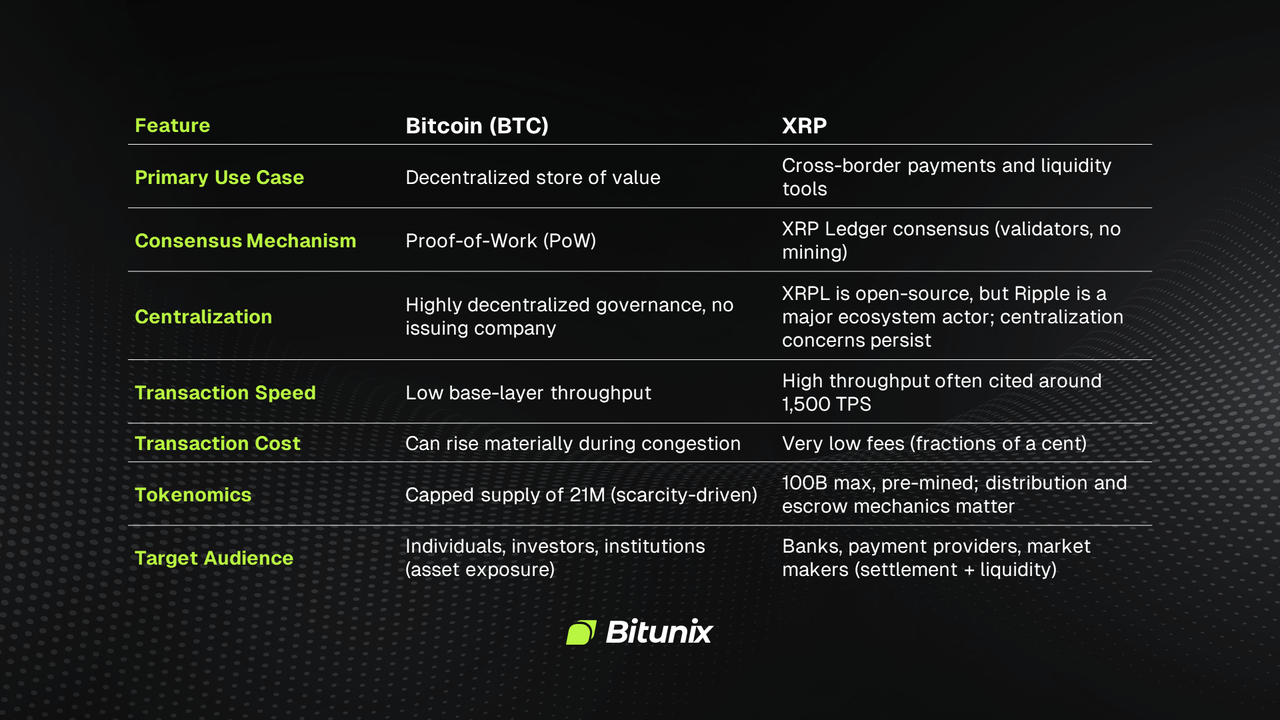
- A detailed comparison table is the centerpiece, breaking down key differences in their consensus mechanisms (Proof-of-Work vs. XRP Ledger Consensus Protocol), transaction speed, cost, and tokenomics.
- The guide discusses the ongoing regulatory story surrounding XRP and its potential impact on its future price and adoption.
In the world of cryptocurrency, Bitcoin is the undisputed king. But for years, another giant, XRP, has pursued a completely different vision, not to be a new form of money, but to make the old form of money move faster. As we look toward 2026, which asset holds more promise?
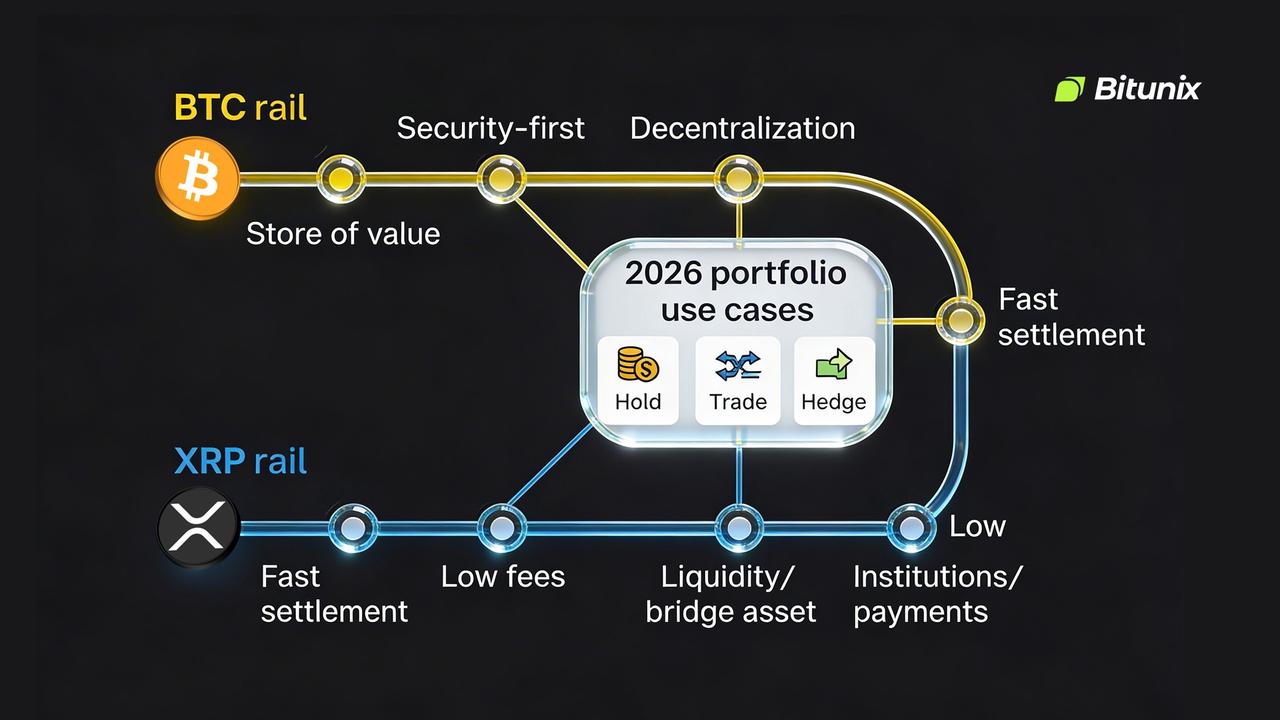
Bitcoin focuses on decentralization, censorship resistance, and a fixed supply. XRP focuses on speed, low fees, and settlement efficiency. That difference shows up the moment you try to use them. Bitcoin works like long-term digital collateral. XRP behaves more like payment plumbing.
You’ll find both assets on almost any crypto exchange, including Bitunix, where BTC and XRP are available through liquid spot markets like BTC/USDT and XRP/USDT. That makes it easy to compare performance, rotate exposure, or hedge without leaving the platform.
This comparison will break down the fundamental differences between Bitcoin vs XRP, from their technology and use cases to their investment potential, to help you understand their unique roles in the evolving digital economy.
The 30,000-Foot View: Digital Gold vs. Digital Oil
When thinking about the duel Bitcoin vs XRP, both can go up, both can crash, and both attract serious traders. But they behave like tools built for different jobs. One looks like a savings technology. The other looks like settlement plumbing.
Bitcoin (BTC): The Store of Value (Digital Gold)
Bitcoin’s modern narrative centers on scarcity plus security. The 21 million cap is part of why investors treat it like digital gold. The security model comes from Proof-of-Work, where miners spend real-world energy to compete for block production.
That design has a cost: limited base-layer throughput. Most estimates put Bitcoin’s on-chain capacity in the low single-digit range, roughly 3 to 7 transactions per second, depending on assumptions.
So Bitcoin scales by layering. If you care about payments, you’ll hear about the Lightning Network, which moves smaller transfers off-chain and settles back to Bitcoin periodically.
Bitcoin itself defines itself like this: "A purely peer-to-peer version of electronic cash would allow online payments to be sent directly from one party to another without going through a financial institution."
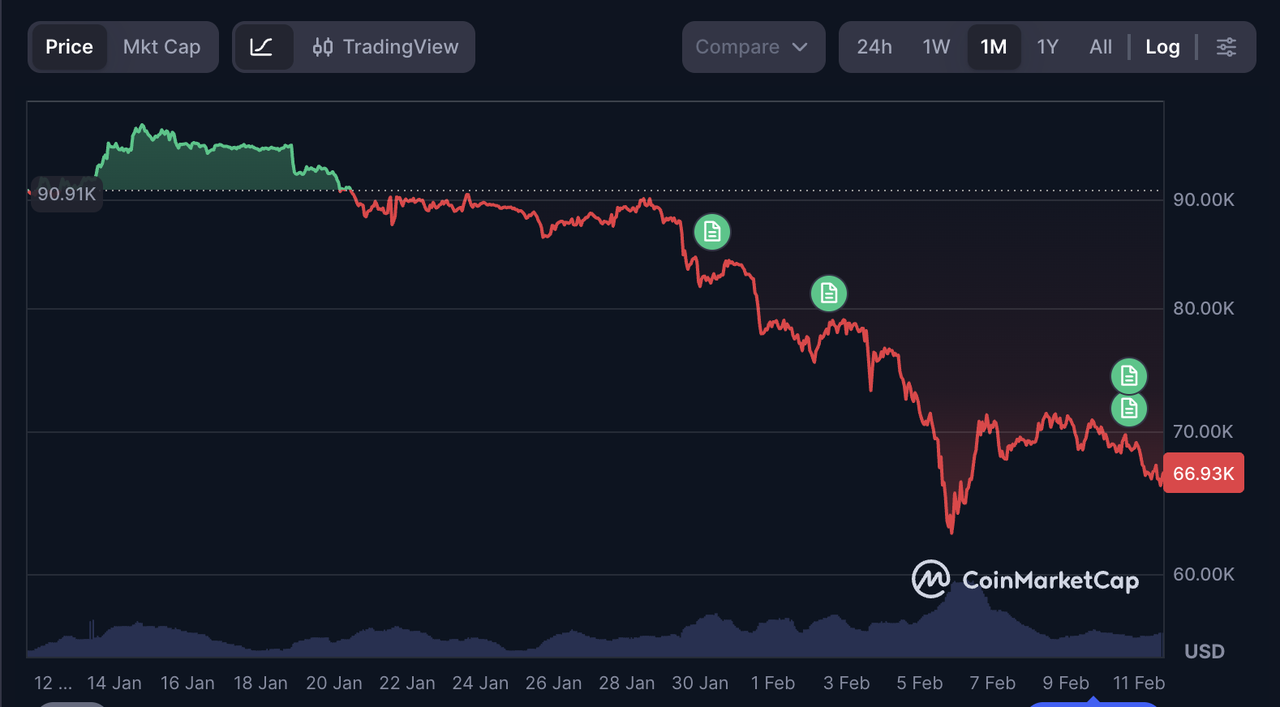
In early 2026, Bitcoin’s biggest development has been the market structure. Price action has been volatile after a steep drop from the October 2025 peak, and Bitcoin ETFs have amplified the push-and-pull between inflows and risk-off selling.
Some days brought heavy ETF drawdowns and sharp single-day declines in major funds, while other days saw inflows return as traders tried to pick a bottom. On-chain data also shows many longer-term holders kept sitting tight, with a growing share of BTC not moving for a year or more, even as the price fell.
XRP: The Medium of Exchange (Digital Oil for Finance)
XRP targets fast settlement and low transaction costs. The network behind it, the XRP Ledger, aims to confirm transfers in a few seconds, which makes it better suited to moving value than sitting still as long-term collateral.
It reaches an agreement through a validator voting process. Each server follows a Unique Node List (UNL) of validators it trusts, shares proposed transactions, and updates its proposal based on validator votes. Once a supermajority (commonly 80%) of trusted validators agrees, the network closes the next ledger and finalizes those transactions, usually within a few seconds.
Fees work differently, too. On the XRP Ledger, every transaction includes a small fee set in the transaction itself, and that fee is destroyed. The goal is spam resistance, not miner revenue, which helps keep costs low even when activity rises.
XRPL puts it bluntly on its XRP overview page: "XRPL uses a consensus protocol. Designated servers called validators, which anyone can operate, come to an agreement on the order and outcome of XRP transactions every three to five seconds."
In 2026, XRP’s story is less about survival and more about implementation. The SEC case is finished, with Reuters reporting the SEC ended the lawsuit. At the same time, U.S. XRP ETFs have pulled in sizable net inflows since their late-2025 launch, with Yahoo Finance reporting cumulative inflows around $1.37 billion by mid-January 2026.
On the tech side, the XRP Ledger has been preparing major node upgrades: XRippled 3.0.0 shipped new amendments and fixes in late 2025, and early-2026 release candidates show the network is still iterating on core infrastructure.
The Head-to-Head Comparison
The table below highlights the practical differences that change how each asset trades: security model, decentralization, throughput, fees, and supply mechanics. They come from design choices that shape user experience, institutional adoption, and risk.
One detail that deserves extra attention: supply dynamics. Ripple created an escrow structure that releases up to 1 billion XRP per month as an upper limit, with unused amounts typically re-escrowed.
That doesn’t automatically mean constant selling, but it does mean XRP traders pay attention to distribution and market liquidity.
The Investment Case for 2026
If you’re comparing BTC vs XRP as a trader, you’re not only choosing technology. You’re choosing what catalysts matter and what risks you can tolerate. So, for a balanced portfolio for passive income, check each coin and what kind of risk it brings to your investments.
The Case for Bitcoin (BTC)
Bitcoin’s institutional asset phase is now tied to ETF flows and broader risk appetite. Forecasts move around, but Bitcoin price predictions for 2026 continue to treat this year's targets, like $150k, as plausible in bullish conditions.
Lightning keeps improving and pushes Bitcoin toward faster payments, but adoption depends on UX and liquidity. For many portfolios, the simpler Bitcoin thesis remains: scarcity, security, and survivability across market cycles.
Currently, the forecasts for BTC's price by the end of the year vary a lot. CoinCodex forecasts Bitcoin ending 2026 around $78,524 based on its model’s end-of-year estimate. Changelly’s 2026 outlook is higher, projecting a December 2026 range of about $130,516 to $153,147, with an average near $134,174. CoinPriceForecast also posts a higher path for 2026, listing an end-of-year target around $132,293.
The Case for XRP
TheRipple vs. SEC case is now effectively over. Reuters reported that on August 8, 2025, the SEC ended its lawsuit against Ripple and both sides agreed to dismiss their appeals. The outcome keeps a $125 million fine in place and keeps an injunction that restricts Ripple’s sales of XRP to institutional investors.
The key point for traders is that exchange-traded XRP sales were not treated the same way as institutional sales in the earlier court rulings, but Ripple still faces limits on how it can sell into institutions.
XRPL’s pitch is operational efficiency, including fast settlement, low fees, and high throughput. That makes XRP’s demand story more usage-linked than Bitcoin’s. XRP’s lower unit price can feel more approachable to retail traders hunting percentage moves.
The Risks to Consider
Both assets can hurt you if you size them wrong or ignore how they fail. So, pay attention to these risks:
Bitcoin Risks
Bitcoin’s risks come from the same choices that make it durable: a conservative base layer and a security model tied to mining. If you trade BTC, you’ll feel these risks most during high-demand periods and regulatory headline cycles.
- Scalability constraints: The base layer is limited; congestion can push fees up and slow settlement.
- Energy narrative risk: Proof-of-Work draws criticism and can invite policy pressure.
- Competition: Other chains compete on throughput and programmability, which can pull mindshare and liquidity during risk-on phases.
XRP Risks
XRP’s biggest risk used to be legal uncertainty. That cloud has lifted, but regulation still matters because the final outcome keeps specific restrictions on Ripple’s institutional XRP sales, and headlines can still move price fast.
- Distribution and selling pressure concerns: Escrow mechanics are transparent, but market participants still watch releases closely.
- Centralization perception: XRPL is open-source, but Ripple’s role in the ecosystem remains a turn-off for decentralization maximalists.
- Regulatory headline risk: Even with major milestones, regulation remains a moving target, and news cycles can move prices fast.
How to Trade BTC and XRP on Bitunix
If your goal is execution, you want three things: clear markets, reasonable fees, and risk controls you’ll actually use.
Bitunix supports spot trading for both BTC and XRP through pairs like BTC/USDT and XRP/USDT, so you can buy or sell directly at the current price (market order) or set your own price (limit order). And if you also trade derivatives, Bitunix lists perpetual futures for major pairs like BTC/USDT, where you can use leverage and manage positions with futures-specific controls.
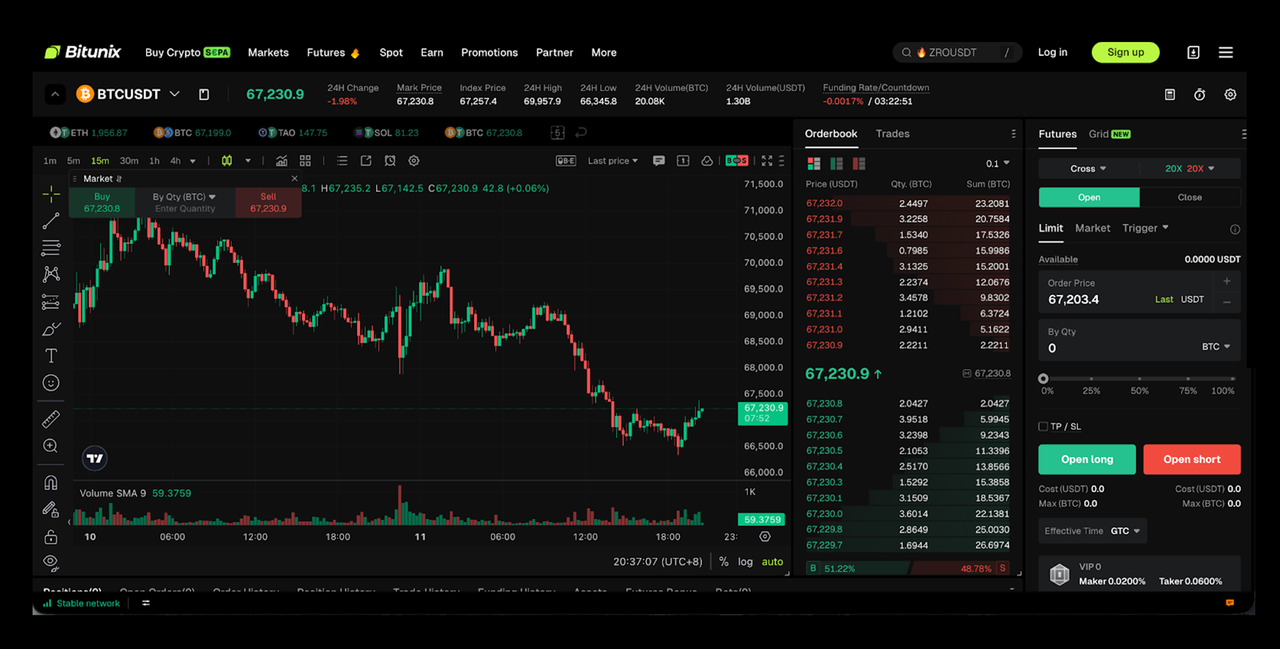
For newer traders, the most important step is learning the mechanics: order types, slippage, and position sizing. A practical starting point is a spot trading walkthrough that explains how spot orders work and what to watch for.
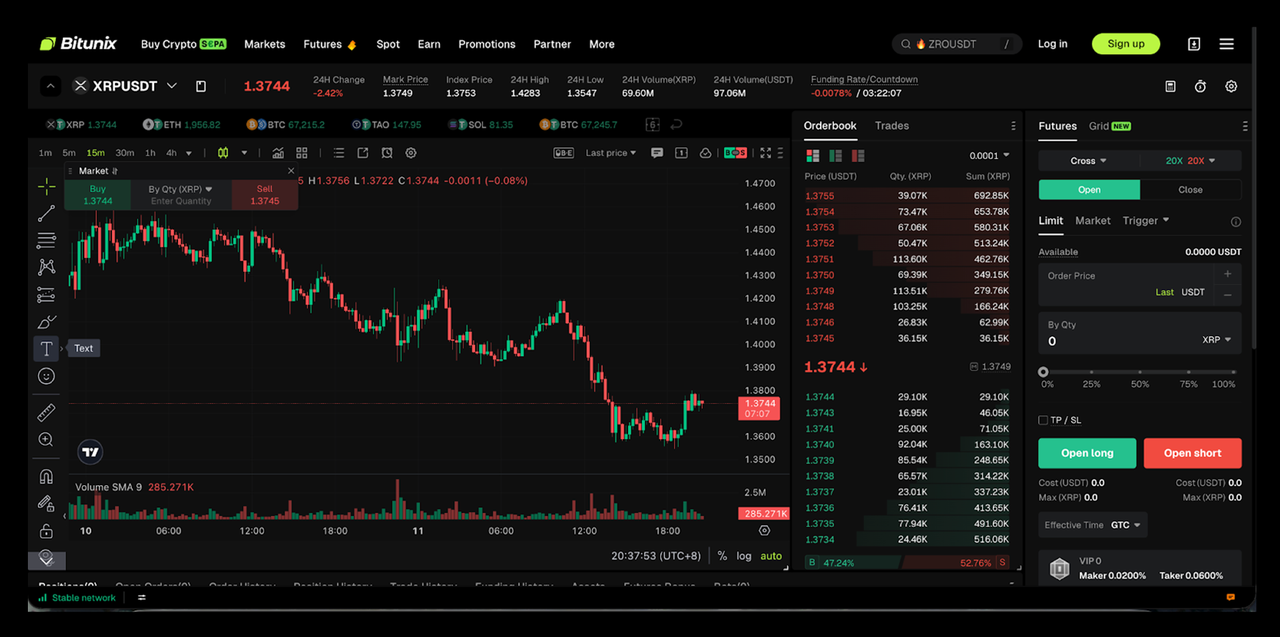
Security and transparency matter. Bitunix publishes Proof of Reserves reports and uses Merkle Tree verification so you can check that your balance is included in the overall liabilities and compare that total against Bitunix’s published reserve holdings, supporting 1:1 backing and independent user checks.
That doesn’t remove market risk, but it does address a common exchange concern: whether assets are verifiable.
Step-by-step: How to trade BTC and XRP on Bitunix
Here is how to start trading on Bitunix:
- Create an account and sign in.
- Fund your account. Go to Assets → Deposit and send crypto to your Bitunix deposit address (double-check the selected network).
- Open Spot Trading in the app or web.
- Search for the pair you want, and open the market page.
- Choose an order type (Market for instant execution, Limit for a specific price), enter the amount, then tap Buy/Sell to place the trade.
- At the end, your assets will be available in your wallet for holding, trading or staking.
With deep liquidity and a user-friendly interface, you can easily add BTC or XRP to your portfolio. Download the app, and sign up for Bitunix, and start trading today.
Conclusion: Which Horse to Back in 2026?
You’re not picking a winner in a boxing match. You’re choosing exposure to two different mechanisms: Bitcoin’s scarcity-and-security model versus XRP’s settlement-and-liquidity model. That’s why the debate around should I buy Bitcoin or XRP keeps coming back. The right answer depends on your goal.
A lot of traders land on a blended approach. They hold Bitcoin as the long-duration anchor, then size XRP smaller as a catalyst-driven position. That structure matches how these assets typically trade. BTC moves with macro liquidity and institutional flows, while XRP moves hard on legal, adoption, and narrative shifts.
Whatever you choose, treat predictions as scenarios. Use strict risk rules, assume volatility, and plan exits before you enter. When you’re ready to execute, Bitunix gives you access to both markets, plus basic learning material and reserve transparency resources in one place.
Do your own research, understand your risk tolerance, and when you're ready to make your move, Bitunix is here to help you execute your strategy.
FAQ
Is XRP a security?
U.S. courts treated XRP differently depending on how it was sold. The SEC ended the Ripple lawsuit in August 2025, leaving a $125 million fine and an injunction related to Ripple’s institutional XRP sales in place.
Will XRP ever reach the price of Bitcoin?
Unit price comparisons are misleading because supply differs massively. Bitcoin has a 21M cap, and XRP has a 100B max. For XRP to match BTC’s price, XRP’s market cap would need to be astronomically larger.
Who owns more XRP, the public or Ripple Labs?
Ripple has historically held large XRP allocations and used an escrow system to schedule potential releases, with up to 1B XRP per month as an upper limit. That structure increases supply predictability, but traders still watch distribution closely.
Is Bitcoin mining profitable in 2026?
Profit depends on your electricity cost, hardware efficiency, Bitcoin price, and network difficulty. When difficulty rises or price drops, margins compress fast. Many miners survive through scale, cheap power contracts, or newer ASICs. Retail mining is usually tougher.
Can XRP run without Ripple Labs?
XRPL is open-source and uses validators rather than mining. The network does not require Ripple to sign transactions. Still, Ripple remains a major ecosystem influence through development, partnerships, and holdings, which shapes perception and market behavior.
What is the environmental impact of Bitcoin vs. XRP?
Bitcoin’s Proof-of-Work consumes significant energy because mining secures the chain. XRPL does not use mining and is typically described as low-energy by design. That difference affects ESG narratives and regulatory scrutiny around infrastructure choices.
Why is XRP so much faster and cheaper than Bitcoin?
Bitcoin optimizes for security and decentralization, which limits base-layer throughput. XRPL uses a different consensus model and targets high throughput, often cited at around 1,500 TPS, with very low fee levels.
What are the main competitors to XRP?
In payments and settlement, XRP competes with stablecoins, bank-led rails, and other fast chains. Some institutions prefer stablecoins for price stability, while others explore private or permissioned networks.
Has the supply of Bitcoin already been fully mined?
No. Bitcoin releases new supply through block rewards, which decline via halving events. The remaining supply will be mined over many years. The important point for traders is that issuance is predictable and trends downward over time by protocol rules.
Where can I securely store my BTC and XRP after buying them on Bitunix?
After buying BTC or XRP on Bitunix, you can keep funds on the exchange for active trading, using protections like 2FA and Proof of Reserves with Merkle Tree verification. For long-term holding, withdraw to self-custody.
Glossary
- Consensus mechanism: The method a network uses to agree on transaction order and validity.
- Proof-of-Work (PoW): Security model where miners use compute power to secure a chain.
- Validator: A node that participates in consensus by proposing and validating ledger updates.
- Throughput (TPS): Transactions per second that a network can process.
- Settlement: When a transaction becomes final and irreversible on a ledger.
- Liquidity: How easily an asset can be bought/sold without a large price impact.
- Bridge asset: Asset used as an intermediary to move value between currencies/markets.
- Tokenomics: Supply, issuance, distribution, and incentives that shape a token’s economy.
- Escrow: Locked funds are released according to predefined rules and schedules.
- Spot trading: Buying/selling an asset for immediate delivery at current market prices.
- Perpetual futures: Derivatives contracts without an expiry date, often using funding rates.
- Funding rate: Periodic payment between long/short traders to keep perp prices aligned.
- Censorship resistance: The ability to transact without a central party blocking you.
- Layer 2: Secondary network built on top of a base chain to improve speed/cost.
- Self-custody: Holding crypto in a wallet where you control the private keys.
About Bitunix
Bitunix is a global cryptocurrency derivatives exchange trusted by over 3 million users across more than 100 countries. The platform is committed to providing a transparent, compliant, and secure trading environment for every user. Bitunix offers a fast registration process and a user-friendly verification system supported by mandatory KYC to ensure safety and compliance. With global standards of protection through Proof of Reserves (POR) and the Bitunix Care Fund, Bitunix prioritizes user trust and fund security. The K-Line Ultra chart system delivers a seamless trading experience for both beginners and advanced traders, while leverage of up to 200x and deep liquidity make Bitunix one of the most dynamic platforms in the market.
Bitunix Global Accounts
X | Telegram Announcements | Telegram Global | CoinMarketCap | Instagram | Facebook | LinkedIn | Reddit | Medium
Disclaimer: Trading digital assets involves risk and may result in the loss of capital. Always do your own research. Terms, conditions, and regional restrictions may apply.