

Article Summary
- This article provides a price prediction and fundamental analysis for the JUP token.
- It explains Jupiter's role as the premier liquidity aggregator on Solana, routing trades across multiple DEXs to ensure users get the best possible prices.
- The bull case focuses on Jupiter's absolute dominance in Solana trading volume, its expanding product suite (perpetuals, DCA, limit orders, launchpad), and the overall growth of the Solana ecosystem.
- The bear case highlights the token's high fully diluted valuation (FDV) compared to its circulating supply, intense competition from other aggregators and centralized exchanges, and the inherent risks of the DeFi sector.
- It presents detailed price prediction scenarios (bearish, neutral, bullish) for both 2026 and 2030, based on Solana's market share and Jupiter's ability to capture value.
If you have traded on Solana, there is a good chance you have already used Jupiter without thinking much about it. It sits in the background like a routing brain, scanning liquidity venues and trying to find the best swap path for your order. That is why many traders casually call it Jupiter exchange, even though the more accurate label is a Solana DEX aggregator built to route orders across the ecosystem rather than operate as a single liquidity pool.
That distinction matters for price analysis. Usage can be huge while token value capture stays modest. Revenue can grow while unlocks still weigh on price, and a product can become core plumbing without the token automatically becoming a moonshot. For traders who want exposure through a crypto exchange, Bitunix offers JUP/USDT perpetuals, spot, and futures market access across its broader market stack. You can trade the asset there, but the long-term case still depends on what happens on-chain.
This analysis will examine Jupiter's market dominance, its expanding utility beyond simple swaps, and the tokenomics of JUP to provide data-driven price predictions for 2026 and 2030.
The Bull Case: Dominating the Fastest Chain
As of April 2026, JUP traded around $0.16 to $0.17, with a market cap of $585 million to $590 million and a fully diluted valuation of around $1.14 billion.
Forecasts from major platforms vary a lot. CoinCodex puts 2026 in a $0.111 to $0.199 range. Kraken's simple 5% growth tool lands at about $0.17 for 2026 and $0.20 for 2030. Changelly's forecast is more upbeat, with a December 2026 average of $0.320 and a 2030 average of $0.352, while Benzinga's price prediction projects a far wider 2026 range of $0.535 to $1.279 and a 2030 range of $1.441 to $2.030. That spread suggests a bullish case exists, but it needs strong execution. A sensible Jupiter crypto price prediction starts with actual protocol traction.
1. Unrivaled Market Share
Jupiter still acts like Solana's default trading router. Its own developer docs say Jupiter is the liquidity infrastructure behind the majority of DeFi on Solana, and the platform now offers production-grade APIs for builders as well as traders. DefiLlama shows why that claim has weight: Jupiter's combined stack was sitting at about $1.745 billion in TVL, $11.961 billion in 30-day DEX aggregator volume, and $148.36 million in 24-hour aggregator volume in early April 2026.
Dune put the point even more plainly in May 2025:
"Jupiter is currently one of the largest sources of DEX trading on Solana, accounting for around 20% of total volume in May."
Traders do not always want to think about Orca, Raydium, Meteora, SolFi, or the best order route. They want the best fill. Jupiter became the app that handles that headache for them. And in crypto, the app that removes friction often wins over the one with the prettiest whitepaper.
2. Beyond Aggregation
Jupiter is no longer just a swap router. Its current developer docs list swaps, tokens, price APIs, lending, trigger orders, recurring DCA orders, prediction markets, and perps. DefiLlama's combined Jupiter page shows how broad that stack has become: annualized fees were about $201.94 million, annualized revenue about $61.58 million, cumulative revenue about $341.9 million, and cumulative perp volume about $471.1 billion. In Q1 2026 alone, DefiLlama tracked $68.39 million in gross protocol revenue across the Jupiter suite.
That is the strongest part of the bull thesis. Jupiter is trying to become an execution layer for on-chain finance. Perps alone remain meaningful, with DefiLlama showing about $697.8 million in TVL and $72.5 million in open interest on Jupiter Perpetual Exchange. If traders keep using one interface for swaps, recurring buys, limit entries, leverage, and lending, the protocol has more ways to earn and more ways to defend mindshare.
3. The Jupuary Airdrop and Community
Airdrops can create tourists, but they can also create a real base. Jupiter's February 2025 community audit said the first large user airdrop reached almost 2 million users in crypto, and the 2025 Jupuary round set aside 700 million JUP for distribution. The proposed 2025 allocation rewarded swap users, DCA users, limit-order users, perp users, community members, and especially stakers, allocating 210 million JUP to them alone. Later, DAO documentation explained that future airdrop eligibility was revised to include staking and voting, which tied rewards more closely to active participation.
That shaped JUP’s token culture by tying it more closely to participation instead of short-term farming. Crypto traders love free tokens, but most leave after the airdrop. Jupiter tried to keep them engaged by rewarding continued involvement rather than one-time claiming.
4. Solana's Resurgence
The bull case for JUP is basically a leveraged case on Solana DeFi.DeFi Llama showed Solana at about $5.539 billion in DeFi TVL, $924.43 million in 24-hour DEX volume, and $521.76 million in 24-hour perps volume in early April 2026.
Solana’s own February 2026 ecosystem report highlighted that Jupiter Lend had exited beta with zero bad debt and 83,000 active users, then added native staked SOL as collateral. If Solana keeps absorbing traders, builders, and stablecoin activity, Jupiter sits near the middle of that traffic.
The Bear Case: Tokenomics and Competition
The cautious case is just as real. Lower-end models like Kraken and CoinCodex keep JUP near $0.17-$0.20 in 2026, with only modest upside by 2030. Even Changelly's 2030 average at $0.352 is far below the kind of numbers bulls sometimes throw around on social media.
So the market isn't pricing Jupiter as an inevitable top-tier winner. It is pricing it like a protocol with strong usage, visible revenue, and a token that still has something to prove. Any Jupiter crypto price prediction that ignores supply and value capture is only telling half the story.
1. The FDV Overhang
This is the first thing serious traders look at. DefiLlama's combined Jupiter page showed a market cap of around $589.4 million and an FDV of around $1.139 billion in April 2026. Its unlock tracker listed a circulating supply of roughly 3.551 billion JUP and an upcoming April 27, 2026, unlock of about 53.47 million JUP, worth $8.88 million. The tracker also notes that burns are not fully modeled, which is a useful reminder that token dashboards can be messy even when the project is trying to stay transparent.
Jupiter did cut its supply aggressively. The official February 2025 audit confirmed a 3 billion token burn at Catstanbul and a reduced team allocation. But vesting pressure just became more structured. A good protocol can outperform operationally and still feel heavy if too much inventory keeps entering the market.
2. The Aggregator Dilemma
Aggregators win users by being cheap and efficient. That also makes monetization tricky. Jupiter support says Terminal and Mobile use Ultra by default, with regular swap fees generally in a 0% to 0.5% range depending on pair volatility. DefiLlama's Jupiter Aggregator page shows annualized aggregator revenue of about $22.8 million on cumulative routed volume above $1.2 trillion. That is real revenue, but it also shows how thin the take rate is relative to the amount of value passing through.
Put differently, Jupiter excels at helping users avoid poor execution. The harder question is whether the protocol can keep taking a cut without pushing traders toward direct Automated Market Maker venues (AMM) or rival interfaces.
3. Intense Competition
Jupiter dominates mindshare, but Solana DeFi is not a one-shop town. Dune's May 2025 note placed Jupiter at around 20% of Solana DEX volume in that month, second to Raydium. Dune's November 2025 digest also showed that proprietary AMMs were taking a larger share of routing volume within the Jupiter ecosystem, with HumidiFi nearing 50% of Jupiter-routed volume by November, and DefiLlama still shows meaningful liquidity on Orca and Raydium around the JUP token.
That is the double-edged sword of being a router. You benefit from the whole ecosystem, but you also depend on it. Liquidity venues, prop AMMs, and centralized exchanges keep competing on price, speed, and convenience.
4. Smart Contract and Ecosystem Risks
Jupiter is still DeFi. That means smart contract, oracle, execution, and chain-level risks never go away. Jupiter's own support docs warn that products like Jupiter Lend depend on on-chain oracles such as Pyth, Chainlink, and Redstone, and that delayed or inaccurate feeds can affect positions. Solana's status page showed no incidents for February through April 2026, which is a positive sign for chain stability, but the protocol remains directly exposed to whatever happens on Solana.
And recent market behavior shows how quickly sentiment can turn when Solana DeFi gets rattled. Even if Jupiter itself is operating normally, major ecosystem shocks can spill into JUP pricing through perps, liquidity pools, and general risk aversion.
Jupiter Crypto Price Prediction Scenarios For 2026 And 2030
The cleanest way to frame the outlook is to anchor it to published forecasts, then sort them into realistic scenarios. Kraken and CoinCodex sit at the cautious end. Changelly lands in the middle. Benzinga provides the most optimistic mainstream range in the source set.
Here are the main price predictions for JUP between 2026 and 2030:
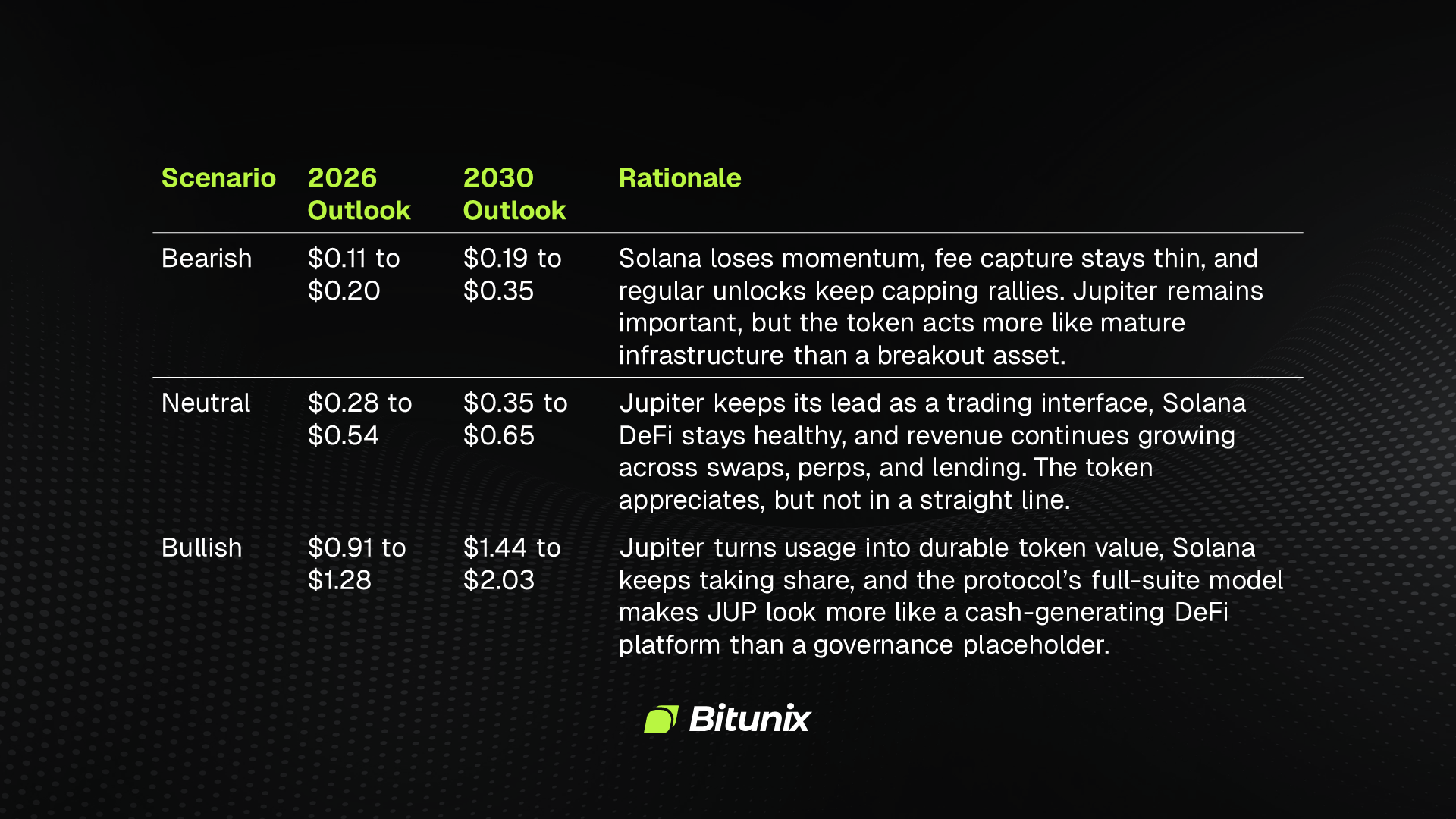
Scenario-based price projections outlining potential outcomes from bearish to bullish, with key drivers behind each outlook.
Conclusion: The Engine Room of Web3
Jupiter is more than a swap page. It is the routing layer, the tooling layer, and increasingly the product layer for a large part of Solana DeFi. That is why it keeps showing up in real volume data, developer tooling, lending, recurring orders, and perps.
But the token story still needs discipline. Unlocks matter, and fee capture also matters. Governance utility helps, but it does not solve everything by itself. So, is JUP a good investment? If you believe Solana keeps growing, and Jupiter keeps converting product usage into holder revenue and stronger token alignment, the answer is yes for a high-risk, utility-driven allocation. If you think Solana cools off or Jupiter stays useful without capturing enough value, the upside gets much thinner.
For traders who want exposure through a centralized venue, Bitunix offers JUP markets, a public Proof of Reserves framework, and mobile access. You can download the Bitunix app and register there if you want to track JUP and other DeFi tokens from one place.
FAQ Section
What is Jupiter (JUP)?
Jupiter is a Solana trading and DeFi platform best known for routing swaps across multiple liquidity venues. The JUP token is the project's governance asset, used in staking, voting, and community incentive systems around the broader Jupiter ecosystem.
How does a DEX aggregator work?
A DEX aggregator scans multiple on-chain liquidity sources, compares routes, and sends your trade through the path that offers the best execution after fees and slippage. Jupiter does that on Solana, so you do not need to manually compare each venue before swapping.
What blockchain is Jupiter built on?
Jupiter is built on Solana. It is a DeFi infrastructure on Solana for swaps, lending, limit orders, DCA, and more, and its protocol metrics on DefiLlama are tracked entirely on the Solana chain.
What is the utility of the JUP token?
Today, the JUP token mainly supports governance, staking, voting, and incentive alignment. DefiLlama also tracks holder revenue tied to JUP buybacks from 50% of platform revenue, which gives the token a stronger economic link than pure governance coins usually have.
What is the LFG Launchpad?
LFG is Jupiter's token launch platform for new Solana projects. It helps projects launch into the Jupiter ecosystem and keeps user attention inside the same interface traders already use for swaps, perps, and other DeFi actions.
Does Jupiter charge fees for swapping?
Yes. Jupiter Ultra generally charges 0% to 0.5% for regular swaps, depending on the pair and volatility. Gasless trades can add a capped surcharge. The platform shows fees in the quote before you confirm, which makes the cost easier to inspect before execution.
How does Jupiter compare to Uniswap?
Jupiter specializes in routing across Solana liquidity sources, while Uniswap is a core AMM protocol built around liquidity pools and smart contracts, mainly associated with Ethereum and EVM ecosystems. One is an execution router first. The other is a pool-based exchange protocol first.
What are the risks of the JUP token unlocks?
Unlocks increase circulating supply, and traders often price that in before the tokens actually hit the market. DefiLlama's unlock tracker showed another 53.47 million JUP scheduled for late April 2026, which is why supply calendars stay central to any JUP valuation model.
Where can I buy the JUP token?
You can access JUP via on-chain Solana wallets and centralized trading venues. Bitunix offers JUP/USDT perpetuals and broader market access, while Jupiter itself remains the main on-chain interface for routing Solana token trades.
Is JUP a good long-term investment?
JUP works best as a high-conviction bet on Solana DeFi infrastructure, not as a low-risk defensive holding. The long-term case depends on sustained volume, stronger token value capture, controlled emissions, and Jupiter staying central to Solana trading as the ecosystem matures.
Glossary
- DEX aggregator: A protocol that routes trades across multiple decentralized exchanges to improve execution.
- TVL: Total value locked, or the dollar value of assets deposited in a protocol's smart contracts.
- FDV: Fully diluted valuation, the project value implied if all tokens were circulating.
- Perpetuals: Leveraged futures-like contracts with no expiry date, common in crypto trading.
- Open interest: The notional value of active derivatives positions that remain open.
- DCA: Dollar-cost averaging, a recurring buy strategy that spreads entries over time.
- Limit order: An order that executes only at a specified price or better.
- Slippage: The difference between the expected trade price and the final execution price.
- Governance token: A token that lets holders vote on protocol proposals and ecosystem decisions.
- Staking: Locking tokens to participate in governance and earn incentive-based rewards.
- Buyback: Protocol revenue used to repurchase tokens from the market, often to support holders.
- Airdrop: A distribution of tokens to users, often based on activity, loyalty, or governance participation.
- Liquidity routing: The process of selecting the best path across venues for a trade.
- Oracle risk: The risk that delayed or inaccurate price feeds distort lending or trading outcomes.
- Token unlock: A scheduled release of previously locked tokens into circulation.
Disclaimer
This article does not provide:
(i) investment advice or investment recommendations;
(ii) an offer or solicitation to buy, sell, or hold digital assets;
(iii) financial, accounting, legal, or tax advice.
Digital assets, including stablecoins and NFTs, involve high risk and may fluctuate significantly. Consider whether trading or holding digital assets is appropriate for you given your financial situation. Consult a qualified legal, tax, or investment professional when needed. You are responsible for understanding and complying with applicable local laws and regulations.
About Bitunix
Bitunix is a global cryptocurrency derivatives exchange trusted by over 3 million users across more than 100 countries. At Bitunix, we are committed to providing a transparent, compliant, and secure trading environment for every user. Our platform features a fast registration process and a user-friendly verification system supported by mandatory KYC to ensure safety and compliance. With global standards of protection through Proof of Reserves (POR) and the Bitunix Care Fund, we prioritize user trust and fund security. The K-Line Ultra chart system delivers a seamless trading experience for both beginners and advanced traders, while leverage of up to 200x and deep liquidity make Bitunix one of the most dynamic platforms in the market.
Bitunix Global Accounts
X | Telegram Announcements | Telegram Global | CoinMarketCap | Instagram | Facebook | LinkedIn | Reddit | Medium