
Article Summary
- This guide focuses on professional risk management practices specifically for perpetual futures trading on Bitunix.
- It explains the unique risks of futures trading, notably leverage and liquidation, in clear, practical terms.
- The article introduces five core risk management strategies that traders can implement immediately: Position Sizing, Stop-Loss Orders, Take-Profit Targets, Leverage Limits, and Portfolio Diversification.
- It includes practical examples showing how to calculate safe position sizes and set appropriate stop-loss levels.
- The article positions Bitunix's risk management tools (like liquidation price indicators) as essential safeguards for futures traders.
Trading Bitunix futures offers incredible profit potential, but it also carries significant risks. The difference between a successful trader and one who loses everything often comes down to one thing: risk management.
Futures trading attracts traders seeking higher returns with minimal financial commitments. However, it is a trading practice that requires solid discipline and advanced strategy. More importantly, without risk management, crypto futures trading is nothing more than hazardous gambling.
This guide will teach you the five essential risk management strategies for futures trading on Bitunix, help you understand your liquidation price, and show you how to trade with confidence and control on a professional crypto exchange.
The Unique Risks of Futures Trading
Futures trading is better suited for experienced crypto traders. However, beginner and intermediate traders can also access this market after in-depth research and analysis. The first step of trading crypto futures is understanding the unique risks of this practice:
Leverage Amplifies Both Gains and Losses
Leverage enables traders to take large positions with small initial margins, thereby achieving high returns. However, this increased exposure also significantly increases the risk of substantial losses. For example, you can use a 10x leverage, e.g., which allows you to control a $1,000 position. As a result, a 10% market move results in a 100% gain or loss on your initial funds. Meanwhile, a 20% move in the wrong direction liquidates you.
Bitunix offers perpetual futures trading with up to 200x leverage on select pairs, such as BTC/USDT. This tool is especially suited to advanced traders with high-risk strategies.
Liquidation Risk
Liquidation is a safety mechanism against significant losses from the crypto market’s volatility. When your position loses so much value that it can no longer cover the margin requirement, which is your collateral, the exchange automatically closes your position. The result of liquidation is that you lose your entire initial investment.
24/7 Market Volatility
Unlike the stock market, the crypto market is open 24/7, allowing trades to run nonstop. The main benefit is unlimited access to the futures market. On the other hand, prices can move dramatically while you sleep, potentially triggering your stop-loss or liquidation.
Funding Rates
Holding a perpetual futures position incurs funding costs. The Funding Rate is a periodic, small payment exchanged directly between long and short traders to keep perpetual futures prices aligned with the spot price. It is an ongoing cost that eats into profits and must be managed wisely.
Strategy 1 - Position Sizing (The Foundation)
Position sizing is a fundamental risk management practice that determines how much capital to allocate to a single trade. Generally, it abides by the golden rule of trading, which says that you should never risk more than 1-2% of your total trading capital on a single trade.
Here’s an example of how to implement it:
- Determine your total capital (e.g., $10,000).
- Decide your risk per trade (e.g., 2%, which is $200).
- Calculate how much you can lose before liquidation based on your leverage and stop-loss level.
- Size your position accordingly.
Suppose you have $10,000 and use 5x leverage, you can control a $50,000 position. If you set your stop-loss at 4% below entry, you risk $2,000 (20% of capital). This is too much. Instead, reduce your position size so you only risk $200 (2% of capital).
This technique is crucial for sustained success in trading. It helps manage drawdowns and control overall risk by aligning your trade size with your specific capital, risk tolerance, and the current market volatility.
Strategy 2 - Stop-Loss Orders (Your Safety Net)
A Stop-Loss (SL) order automatically closes a position when the price reaches a specific, predetermined value to limit potential losses. Generally, traders set stop losses at 2-5% below their entry price, depending on volatility and leverage. This tool is ideal for beginner and intermediate traders looking to trade perpetual futures with a decent safety net. Without it, you might hold a losing position, hoping for a recovery, only to get liquidated.
Follow these simple steps to implement SL orders in your perpetual futures strategy:
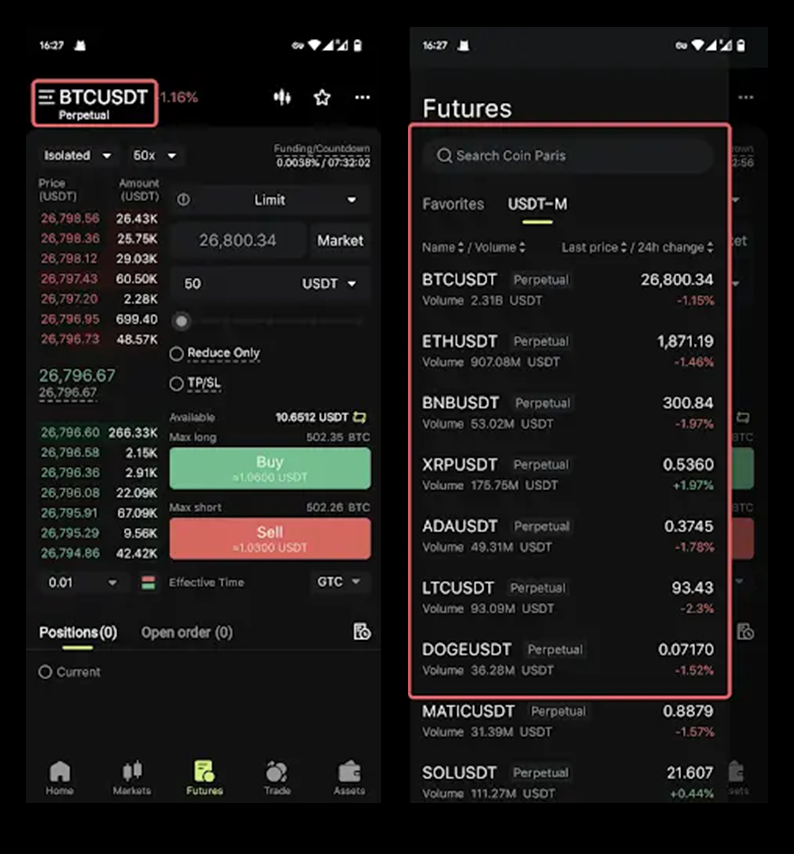
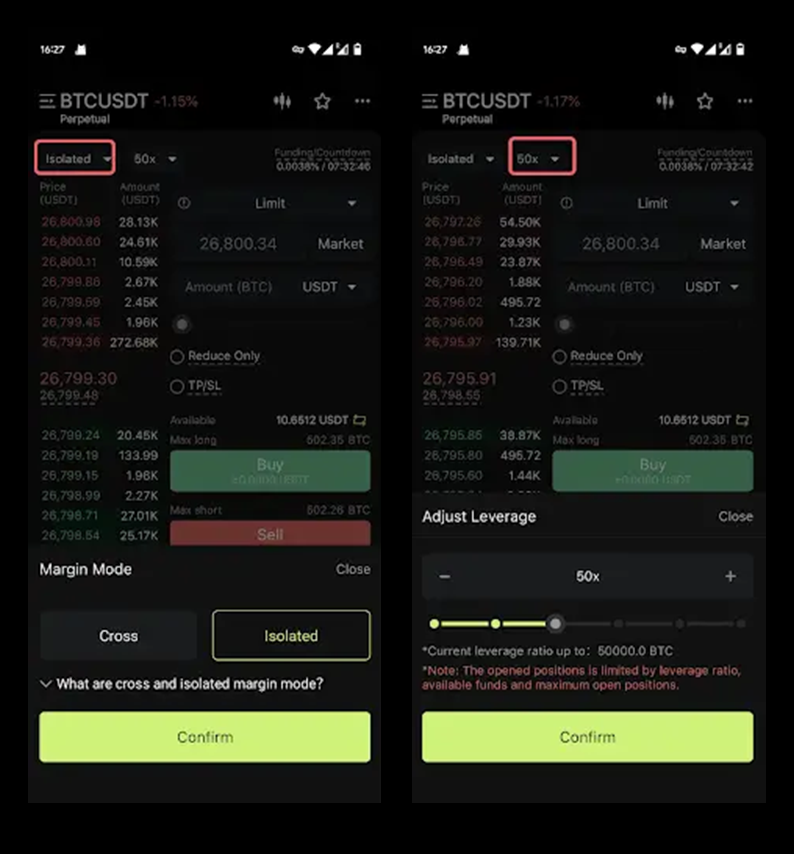
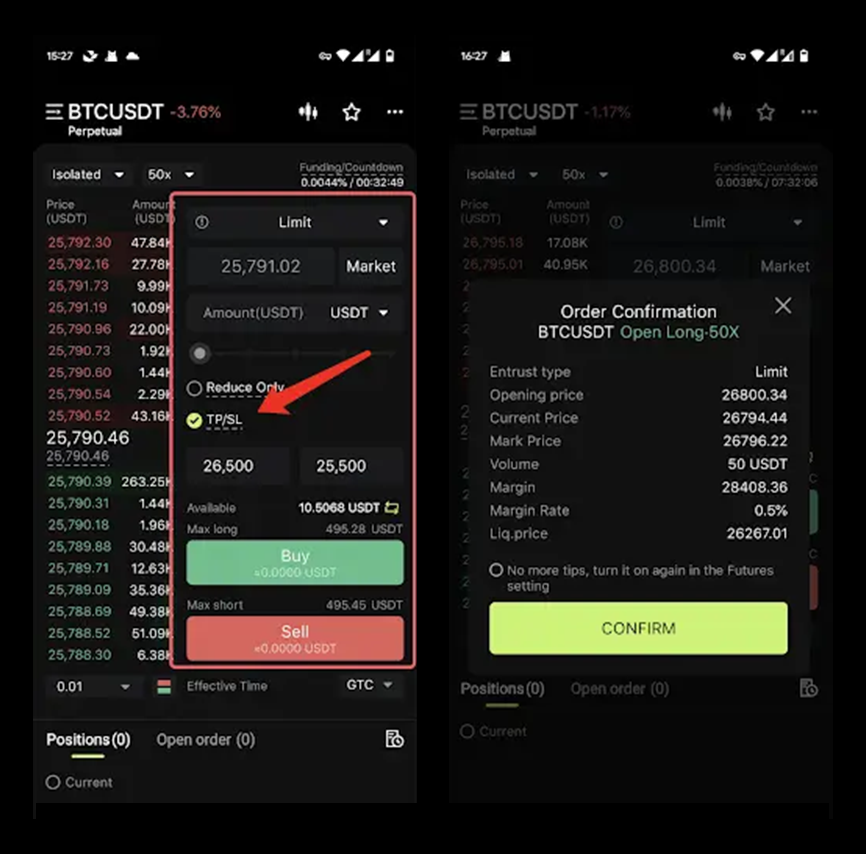
Lastly, click Buy if you want to open a long position, or click Sell if you want to open a short position.
Strategy 3 - Take-Profit Targets (Lock in Wins)
A Take-Profit (TP) order automatically closes a profitable position at a predetermined price, protecting your earnings against the market’s extreme volatility. This strategy gives you emotional control, helping you overcome the illusion that you can earn more while taking on substantially increased risk.
Your take-profit should be at least 2-3x your risk. For example, if you risk $200, aim to make $400-600. Build your gains steadily with a TP order and lock in your wins with minimal risk.
Strategy 4 - Leverage Limits (Know Your Limits)
Another effective crypto futures risk management strategy is to use the leverage that better suits your trading style, experience, and emotional control. Here are a few examples from the leverage spectrum that you can use to trade futures on Bitunix:
1x Leverage (No Leverage)
In this case, you are not using any leverage. This practice is essentially spot trading.
2-5x Leverage (Conservative)
This strategy is great for learning the trade and building confidence. For instance, $100 with 5x leverage controls a $500 position, so a 10% market move yields $50 profit or loss ($500 x 10%), a 50% return on your $100.
5-10x Leverage (Moderate)
This strategy is suitable for experienced traders with solid risk management. It allows you to amplify potential profits. However, it also magnifies losses, as a small price drop can quickly liquidate an entire $100 investment to a $1,000 position if you had 10x leverage.
10x+ Leverage: (Aggressive)
This tactic is best used only by professional traders with solid experience, extensive knowledge, and deep liquidity. It is a common strategy in crypto and margin trading for increased exposure. However, it carries high liquidation risk, where a small market move against you can wipe out your investment.
As a beginner, you should prioritize safety and start with a maximum leverage of 2-3x. As you gain experience and confidence, gradually increase to 5x. Avoid anything above 10x until you become a seasoned professional.
Strategy 5 - Portfolio Diversification
The old saying best explains this simple perpetual futures strategy: "Don't put all your eggs in one basket." Even if you have limited capital, your best choice is to spread it across multiple positions, trading pairs, and strategies to reduce overall risk.
Instead of risking your entire capital on one BTC/USDT long position, split it across three smaller positions: Bitcoin, Ethereum, and Solana. If one goes against you, the others might offset the loss.
Alternatively, you can diversify your portfolio by adding asset classes such as stablecoins and memecoins. These two types of cryptocurrency react differently to the same market conditions, and either could provide a safety buffer during extreme volatility.
Understanding Your Liquidation Price on Bitunix Futures
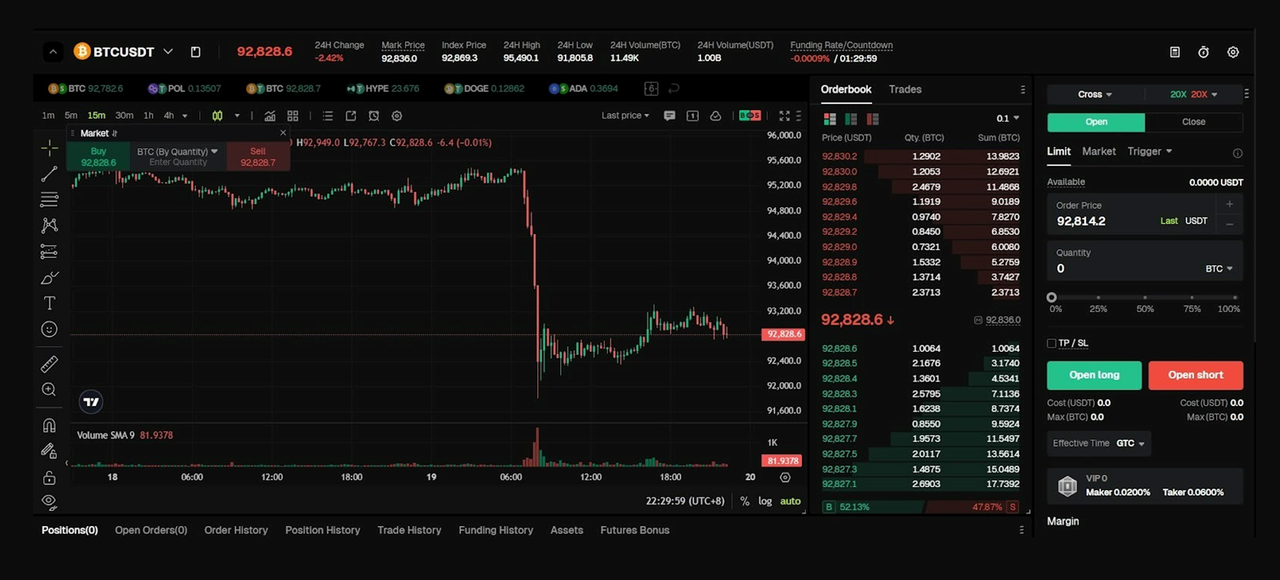
On Bitunix, your liquidation price is the price at which your position is automatically closed due to insufficient margin.
How do I calculate my liquidation price on Bitunix?
Below is the formula for calculating your liquidation price on Bitunix. However, you should first consider the elements involved in the formula:
Entry Price
This value is the price at which you opened your position.
Leverage
Leverage is your amplified exposure (e.g., 10x means $100 in margin controls a $1,000 position).
Margin
This value is the collateral you put up (Initial Margin) and the minimum required to stay open (Maintenance Margin).
Mark Price
Bitunix uses a Mark Price (based on spot index prices) to avoid manipulation, which is what triggers liquidation, not just the last traded price.
Use this simple calculation to determine your liquidation price for a long position:
- Calculate Initial Margin Ratio (IMR): 1 ÷ Leverage (e.g., 1/10x = 0.10 or 10%).
- Apply the Formula: Liquidation Price = Entry Price × (1 - IMR + Maintenance Margin %).
Example:
- Long BTC at $40,000, 10x Leverage, 0.5% Maintenance Margin
- Entry Price: $40,000
- Leverage: 10x
- IMR: 1/10 = 0.10 (10%)
- Maintenance Margin: 0.5% (0.005)
- Calculation: $40,000 × (1 - 0.10 + 0.005) = $40,000 × 0.905 = $36,200
- Result: Your BTC position would liquidate if the price drops to $36,200.
Always know your liquidation price before entering a trade. If it's too close to the current price, reduce your leverage or position size.
Conclusion: Risk Management is Your Competitive Advantage
Each of the five strategies discussed above embodies the maximum level of risk management you can integrate into your futures trading strategy. Together, they form the foundation of professional crypto trading.
Traders who master risk management don't necessarily make the biggest profits, but they're the ones who survive and thrive over the long term.
Implement these strategies in your next Bitunix futures trade. Start small, follow your rules, and let risk management guide you toward consistent profits.
Bitunix is available for both desktop and mobile users. You can download the Bitunix mobile application for iOS or Android on the app download page.
Sign up for Bitunix and start trading crypto futures today!
FAQ Section
What is the safest leverage level for a beginner futures trader?
Beginner futures traders should opt for a conservative leverage range, specifically between 1x and 5x, to ensure the highest level of safety.
What's the difference between a stop-loss and a take-profit order?
A stop-loss (SL) order automatically closes a losing trade at a preset price to limit losses. Meanwhile, a take-profit (TP) order automatically closes a winning trade at a target price to lock in profits.
Can I change my stop-loss after I've placed it?
Yes, you can change your stop-loss (SL) after placing it. On Bitunix, you can do it either by dragging it directly on the chart or by going to your Open Orders or Position sections and modifying the trigger price and quantity for existing SL/TP orders.
What happens if the price gaps past my stop-loss (e.g., during low liquidity)?
In this case, your order will be triggered, but it will execute at the next available price after the gap, not at your specific stop-loss level.
How do funding rates affect my risk management strategy?
Funding rates directly affect risk by influencing holding costs, signaling market sentiment, and shaping liquidation risk.
What is the 1-2% risk rule, and why is it important?
The 1-2% risk rule in trading means risking only 1% or 2% of your total trading capital on any single trade, a crucial principle for capital preservation, long-term survival, and consistent profitability.
Can I use multiple stop-losses on a single position?
Yes, you can use multiple stop-losses on a single position, often by setting them at different price levels or using a trailing stop, to manage risk and capture profits in stages.
How do I know if my position size is appropriate?
Your crypto futures position size is appropriate when it aligns with your risk tolerance and is calculated using your account balance, risk percentage, stop-loss distance, and chosen leverage, ensuring potential losses stay within acceptable limits.
Glossary
IEO: A method for crypto startups to raise funds by selling new tokens directly on a crypto exchange's platform, with the exchange acting as an intermediary.
IDO: The process of launching a cryptocurrency on a decentralized exchange (DEX).
TVL: The entire value locked in a protocol, a rough usage proxy.
DeFi: Decentralized finance applications on public blockchains.
Layer 1: Base blockchain that verifies and records transactions.
Layer 2: A scaling solution that processes transactions off the main chain and posts proofs to L1.
Gas: Network fee for processing a transaction.
Altcoin: Any crypto asset that is not Bitcoin.
Volatility: Degree of price fluctuation for an asset over time.
Proof of Stake (PoS): Consensus where validators lock native tokens to secure the network and earn rewards.
Validator: Operator that proposes or attests blocks in PoS and shares rewards with delegators.
Incentive Program: Extra token rewards used to direct liquidity or votes.
Governance: Process for changing parameters or logic, often token-based with timelocks.
Trading Pair: A combination of two different digital or fiat currencies that can be exchanged for one another on a cryptocurrency exchange.
Stable Pair: A pool of assets that track similar values, such as two stablecoins.
About Bitunix
Bitunix is a global cryptocurrency derivatives exchange trusted by over 3 million users across more than 100 countries. The platform is committed to providing a transparent, compliant, and secure trading environment for every user. Bitunix offers a fast registration process and a user-friendly verification system supported by mandatory KYC to ensure safety and compliance. With global standards of protection through Proof of Reserves (POR) and the Bitunix Care Fund, Bitunix prioritizes user trust and fund security. The K-Line Ultra chart system delivers a seamless trading experience for both beginners and advanced traders, while leverage of up to 200x and deep liquidity make Bitunix one of the most dynamic platforms in the market.
Bitunix Global Accounts
X | Telegram Announcements | Telegram Global | CoinMarketCap | Instagram | Facebook | LinkedIn | Reddit | Medium