
As the digital asset industry matures, traders are no longer looking at crypto in isolation. Many now follow a much wider range of markets, including stocks, gold, silver, and other macro-sensitive assets alongside Bitcoin, Ethereum, and altcoins. This shift is one of the main reasons TradFi has become a more important concept in crypto trading conversations.
At Bitunix, we see this change clearly. Users increasingly want a smoother way to move between crypto-native opportunities and traditional market themes without needing to switch between entirely different ecosystems. That is where TradFi comes in.
TradFi, short for traditional finance, refers to the conventional financial system and the asset classes associated with it. This includes stocks, commodities, banking systems, brokerage infrastructure, and long-established financial markets. While crypto and DeFi introduced new models for value transfer and trading, TradFi still represents a massive part of global market activity and remains central to how many investors understand risk, growth, and capital flows.
On Bitunix, TradFi is not just a buzzword. It represents a growing category of markets that connect users with price exposure tied to traditional assets such as major stocks and commodity-linked trading pairs. For beginners, this opens the door to a more flexible trading experience. For active traders, it creates more ways to respond to changing market conditions from a single platform.
In this guide, we explain what TradFi means, how it differs from crypto, why it matters on Bitunix, and what traders should understand before exploring TradFi markets such as stocks, gold, silver, copper, platinum, and palladium.
What Does TradFi Mean?
TradFi is short for traditional finance. It generally refers to the established financial system that existed long before blockchain technology became mainstream. When people talk about TradFi, they are usually referring to familiar market structures such as equities, commodities, banks, centralized exchanges, brokers, payment rails, and financial institutions.
In simple terms, TradFi includes the financial products and infrastructure that most people already recognize. Stocks, for example, fall under TradFi. So do precious metals such as gold and silver. Commodity markets, trade finance systems, and institutional financial networks are also part of the broader traditional finance landscape.
This makes TradFi very different from DeFi, which is built around blockchain-based protocols and smart contracts. DeFi aims to remove intermediaries and create open, programmable financial systems. TradFi, by contrast, relies on more established institutional frameworks.
That difference matters, but it does not mean the two worlds are disconnected. In fact, the gap between them is narrowing. As crypto platforms evolve, users increasingly expect access to both digital asset markets and traditional asset-linked opportunities in one place.
Why TradFi Matters in Crypto Trading Today
A few years ago, many crypto platforms focused almost entirely on digital assets. Today, market behavior looks different. Traders may start the day watching Bitcoin, then shift attention to gold after a macroeconomic headline, and later monitor stock-linked instruments tied to major companies. This broader market awareness is becoming more common.
That is one reason TradFi is becoming more relevant within the crypto industry. Users are not only interested in coins and tokens. They also want exposure to narratives shaped by inflation, interest rates, earnings expectations, commodity cycles, and broader economic sentiment.
On Bitunix, the addition of TradFi markets reflects this change in user demand. Rather than separating crypto from traditional asset exposure, we provide a more connected environment where traders can explore multiple market categories within one platform interface.
This matters for several reasons:
First, it improves convenience. Many traders prefer not to manage completely separate workflows across different platforms when they want to monitor both crypto and traditional market themes.
Second, it expands opportunity. Market conditions do not always favor the same asset class. There are periods when crypto leads, periods when gold attracts attention, and periods when stocks become the main focus. A broader market offering gives traders more flexibility.
Third, it creates a more familiar bridge for users entering crypto from a traditional market background. Some users are already comfortable with equities or commodities and want a platform where they can also explore digital assets. Others come from crypto and want to learn how stock-linked and commodity-linked trading works.
What TradFi Markets Are Available on Bitunix?
On Bitunix, the TradFi offering includes markets tied to both stocks and commodities. Based on the available market lineup, users can access products linked to widely recognized names and sectors.
In the stocks category, Bitunix includes trading pairs connected to companies such as Tesla, Apple, Nvidia, Amazon, Circle, MicroStrategy, Intel, and HOOD. This gives traders access to stock-linked market themes that are already widely followed across global finance and media.
In the commodities category, Bitunix includes gold, silver, copper, platinum, and palladium-linked markets. These assets have long played a major role in traditional finance, both as trading instruments and as broader indicators of economic conditions, industrial demand, and risk sentiment.
This combination is important. It shows that TradFi on Bitunix is not limited to a narrow test category. Instead, it covers a meaningful set of markets that traders already recognize and actively follow.
For beginners, the key point is simple. TradFi on Bitunix means users can explore price exposure tied to traditional financial assets while remaining inside a familiar exchange environment.
TradFi vs Crypto: What Is the Difference?
Understanding the difference between TradFi and crypto helps users navigate both categories more confidently.
Crypto refers to blockchain-native assets and systems. Bitcoin, Ethereum, stablecoins, altcoins, and DeFi protocols all belong to the crypto side of the market. These assets are built around distributed ledger technology and often rely on token-based ecosystems.
TradFi refers to traditional financial assets and systems. Stocks, commodities, brokerage structures, banks, and legacy financial infrastructure are all part of TradFi.
The difference is not only technological. It is also about asset identity and market behavior. A stock-linked product and a crypto token may both be tradeable on the same platform, but they respond to different drivers. Crypto markets often react to blockchain adoption, token utility, regulation, network growth, and broader digital asset sentiment. Traditional assets may respond more directly to earnings, macroeconomic data, industrial demand, monetary policy, or sector-specific developments.
That said, the modern trading environment increasingly brings these categories together. Traders now compare Bitcoin with gold, follow tech stocks alongside AI-related tokens, and watch stablecoin flows alongside macro headlines. On Bitunix, TradFi and crypto can be viewed as complementary market categories rather than completely separate worlds.
Why Bitunix Added TradFi Markets
At Bitunix, we understand that traders want broader market access and a more efficient way to act on opportunities. The addition of TradFi markets is part of that broader direction.
Users no longer think only in terms of crypto versus non-crypto. Instead, they think in terms of where momentum, volatility, and opportunity are forming. Sometimes that is in digital assets. Sometimes it is in commodities. Sometimes it is in stock-linked markets tied to major global brands.
By adding TradFi markets, Bitunix gives users a more complete trading environment. This helps reduce friction for traders who want to monitor several market categories at once and manage positions through a more unified experience.
It also makes the platform more relevant to a wider range of users. Crypto-native traders can explore stocks and commodities without leaving the exchange ecosystem, while traditional market participants may find a more accessible entry point into digital asset trading.
In practical terms, this creates a stronger bridge between familiar financial themes and the speed, accessibility, and flexibility that many users already associate with crypto trading platforms.
What Assets Fall Under TradFi on Bitunix?
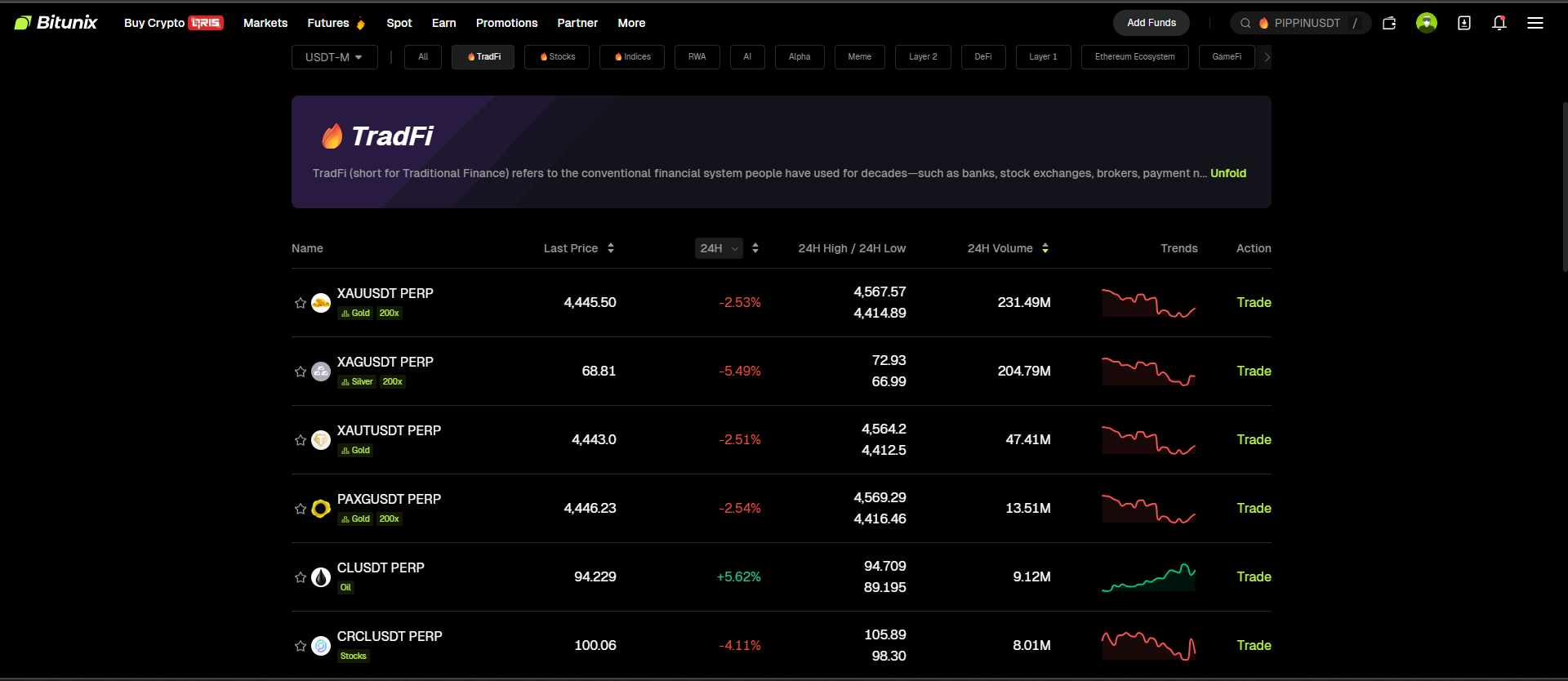
TradFi on Bitunix can be understood through two main groups: stock-linked markets and commodity-linked markets.
Stock-linked markets
These markets are tied to well-known companies and public market themes. Examples on the platform include Tesla, Apple, Nvidia, Amazon, Circle, MicroStrategy, Intel, and HOOD. These are the kinds of names traders often follow because they sit at the center of technology, digital finance, retail investing, and broader equity market narratives.
Commodity-linked markets
These include precious metals and industrial metals such as gold, silver, copper, platinum, crude oil and palladium. These assets are widely recognized in traditional finance and often attract attention during periods of inflation concern, industrial expansion, macro uncertainty, or defensive portfolio positioning.
Together, these categories make TradFi on Bitunix more than a basic add-on. They give users access to some of the most recognizable traditional market themes through a structure that feels familiar to active exchange traders.
Why Traders Are Interested in Stocks and Commodities on Bitunix
The appeal of TradFi markets on Bitunix comes from both market relevance and trading convenience.
Stocks remain one of the most followed asset classes in global finance. Traders track names like Tesla, Apple, Nvidia, and Amazon because these companies sit at the center of innovation, consumer demand, technology growth, and market sentiment. Their price movements often attract attention far beyond traditional equity investors.
Commodities, meanwhile, offer a different kind of market exposure. Gold and silver are often discussed during risk-off conditions, inflation concerns, and macro uncertainty. Copper is frequently linked to industrial demand and economic activity. Platinum and palladium can also attract interest due to their specialized industrial roles and unique supply-demand dynamics.
For Bitunix users, being able to access both stocks and commodities in one environment has obvious value. It allows traders to diversify what they watch, compare different market themes more easily, and respond to changes in macro conditions without relying on multiple disconnected platforms.
How TradFi Trading on Bitunix Fits Into a USDT-Based Workflow
One of the main reasons traders are interested in Bitunix TradFi markets is the ability to engage with stock-linked and commodity-linked instruments through a crypto-native platform experience.
For many users, USDT already plays a central role in trading activity. It is commonly used for capital management, portfolio rotation, and margin-based workflows in digital asset markets. Extending that familiarity into TradFi-linked trading makes the experience more natural for crypto-native users.
Instead of approaching stocks and commodities through a completely separate traditional broker workflow, users can explore these markets in an environment that aligns more closely with the trading logic they already know. This reduces friction and makes it easier to compare opportunities across asset classes.
This structure may be especially useful for traders who are already comfortable navigating market lists, price charts, leverage settings, order types, and perpetual-style interfaces.
What Beginners Should Understand Before Trading TradFi Markets
TradFi-linked markets can be useful, but beginners should approach them with a clear understanding of how these assets behave.
First, traditional assets are not driven by the same forces as crypto alone. A stock-linked market may react to company-specific developments, industry sentiment, and macroeconomic expectations. A commodity-linked market may move based on inflation signals, industrial demand, supply constraints, or broader geopolitical developments.
Second, volatility can vary significantly between markets. Some assets may move more slowly under normal conditions, while others can react sharply to news or broader shifts in risk sentiment. Understanding the character of each market matters.
Third, leverage increases both opportunity and risk. While leveraged trading can amplify returns, it can also magnify losses. That makes position sizing, margin awareness, and risk control essential, especially for traders exploring a new category for the first time.
Fourth, stock-linked and commodity-linked instruments are not the same as directly owning underlying shares or physical assets. Users should understand the structure of the products they are trading and avoid assuming they function exactly like traditional ownership.
At Bitunix, we believe education matters. The more users understand the market they are entering, the better positioned they are to trade responsibly.
Why TradFi and Crypto Work Well Together
Rather than treating TradFi and crypto as opposing systems, it is more useful to see them as overlapping parts of the modern market landscape.
Crypto remains one of the most innovative areas of finance, but traditional assets still shape global capital flows and investor behavior. Gold remains relevant. Stocks remain central to market narratives. Commodities remain important indicators of economic activity. At the same time, crypto continues to evolve as both an asset class and a technological framework.
On Bitunix, bringing these categories together reflects how traders actually think. They want access to multiple market themes, fast execution, and a platform environment that supports broader market participation.
This is why TradFi matters. It is not simply a legacy label. It is a practical category that helps users understand how traditional assets fit into a more connected digital trading experience.
Conclusion
TradFi on Bitunix represents a meaningful expansion beyond crypto-only trading. It gives users access to markets tied to stocks and commodities such as Tesla, Apple, Nvidia, gold, silver, copper, platinum, and palladium, all within a more unified exchange environment.
For beginners, the concept is straightforward. TradFi means traditional finance. On Bitunix, that means access to asset categories that extend beyond blockchain-native tokens and connect traders with broader market themes.
As market behavior becomes more cross-asset and more users look beyond a single category, TradFi is likely to play a bigger role in how traders think, plan, and execute. At Bitunix, we see this as part of a broader shift toward flexible, multi-market access for users who want to navigate crypto and traditional financial themes more efficiently.
Whether a user starts with crypto, commodities, or stock-linked markets, the core benefit remains the same: more choice, more market relevance, and a platform experience designed for the way modern traders actually move across opportunities.
FAQ
What is TradFi?
TradFi stands for traditional finance. It refers to conventional financial systems and assets such as stocks, commodities, banks, brokers, and long-established market infrastructure.
What does TradFi mean on Bitunix?
On Bitunix, TradFi refers to markets linked to traditional financial assets, including stock-related and commodity-related trading products available through the platform.
What TradFi assets are available on Bitunix?
Bitunix TradFi markets include stock-linked products tied to companies such as Tesla, Apple, Nvidia, Amazon, Circle, MicroStrategy, Intel, and HOOD, as well as commodity-linked markets such as gold, silver, copper, platinum, and palladium.
How is TradFi different from crypto?
Crypto refers to blockchain-native assets such as Bitcoin, Ethereum, and altcoins. TradFi refers to traditional financial assets and systems such as stocks, commodities, and conventional market infrastructure.
Why did Bitunix add TradFi markets?
Bitunix added TradFi markets to give users broader exposure across multiple market categories and to create a more connected trading experience that includes both crypto and traditional asset-linked opportunities.
Can beginners explore TradFi on Bitunix?
Yes, but beginners should first understand the asset category they are trading, how leverage works, and the risks associated with market volatility and margin-based trading.
Glossary
- TradFi: Short for traditional finance, referring to the conventional financial system that includes stocks, commodities, banks, brokers, and established market infrastructure.
- Crypto: Blockchain-based digital assets such as Bitcoin, Ethereum, stablecoins, and other tokens traded in the digital asset ecosystem.
- DeFi: Short for decentralized finance, describing blockchain-based financial services that use smart contracts instead of traditional intermediaries.
- Stocks: Financial assets that represent ownership shares in publicly listed companies and are commonly traded in traditional financial markets.
- Commodities: Raw materials or primary goods such as gold, silver, copper, platinum, and palladium that are traded in global markets.
- Stock-linked markets: Trading products whose price movement is tied to publicly traded companies such as Tesla, Apple, Nvidia, Amazon, and other major firms.
- Commodity-linked markets: Trading products whose price movement is tied to traditional commodities such as gold, silver, copper, platinum, and palladium.
- USDT: A widely used stablecoin pegged to the US dollar that is commonly used for trading, settlement, and margin on crypto platforms.
- Leverage: A trading feature that allows users to control a larger position with a smaller amount of capital, increasing both potential gains and potential losses.
- Margin: The amount of funds required to open and maintain a leveraged trading position.
- Volatility: The degree to which an asset’s price moves over time, often used to describe how stable or unstable a market is.
- Perpetual futures: A type of derivatives contract that allows traders to speculate on asset price movements without a fixed expiration date.
- Liquidity: The ease with which an asset can be bought or sold in the market without causing a large change in price.
- Risk management: The process of controlling trading exposure through tools such as position sizing, leverage control, stop-loss planning, and disciplined strategy.
- Market exposure: The level of access or sensitivity a trader has to the price movement of a specific asset or market category.
- Traditional assets: Financial instruments associated with traditional markets, including stocks, commodities, and other non-crypto asset classes.
About Bitunix
Bitunix is a global cryptocurrency derivatives exchange trusted by over 3 million users across more than 100 countries. The platform is committed to providing a transparent, compliant, and secure trading environment for every user. Bitunix offers a fast registration process and a user-friendly verification system supported by mandatory KYC to ensure safety and compliance. With global standards of protection through Proof of Reserves (POR) and the Bitunix Care Fund, Bitunix prioritizes user trust and fund security. The K-Line Ultra chart system delivers a seamless trading experience for both beginners and advanced traders, while leverage of up to 200x and deep liquidity make Bitunix one of the most dynamic platforms in the market.
Bitunix Global Accounts
X | Telegram Announcements | Telegram Global | CoinMarketCap | Instagram | Facebook | LinkedIn | Reddit | Medium
Disclaimer: Trading digital assets involves risk and may result in the loss of capital. Always do your own research. Terms, conditions, and regional restrictions may apply.