
What Is Aerodrome?
AERO is the native governance and incentive token of Aerodrome Finance, a core decentralized exchange (DEX) on the Base network. As the leading DEX on Base in terms of both liquidity and trading volume, Aerodrome serves not only as a key liquidity engine for the ecosystem but also as a prominent example of how the DeFi industry has advanced the ve(3,3) model.
The launch of Aerodrome represents an important milestone in DeFi's development. In 2023, following the strong growth of Velodrome, a leading DEX within the Optimism ecosystem, its core team identified the significant potential of Base, the Layer 2 network launched by Coinbase. To replicate and further improve this successful model on Base, the team officially launched Aerodrome in August 2023.
From the early development stage, the team recognized a fundamental challenge faced by traditional AMM DEXs: the conflict of interests between liquidity providers (LPs) and token holders. When protocols issue additional token incentives to attract liquidity, increased selling pressure often weighs on token prices, eventually leading to declining liquidity.
To address this issue, Aerodrome adopted an optimized ve(3,3) economic model, redesigning the relationship between on-chain incentives and token value capture. The launch of AERO aims to solve the sustainability challenges of liquidity in traditional DeFi models. As the core engine powering Base's DeFi ecosystem, AERO represents the integration of efficiency and governance within decentralized finance.
Data Source: Coin68
The ve(3,3) Model: How Aerodrome Aligns Liquidity and Governance
What Is ve(3,3)?
To understand ve(3,3), we can break it down into two components: ve (vote escrow) and (3,3) (game theory). Together, they form an economic model that combines token locking with incentive alignment mechanisms.
- ve (Vote-Escrow): Originating from the Curve protocol, vote escrow allows users to lock the platform's native tokens for a specific period in exchange for non-transferable veTokens. The longer the lock period, the greater the voting power and reward rights users receive.
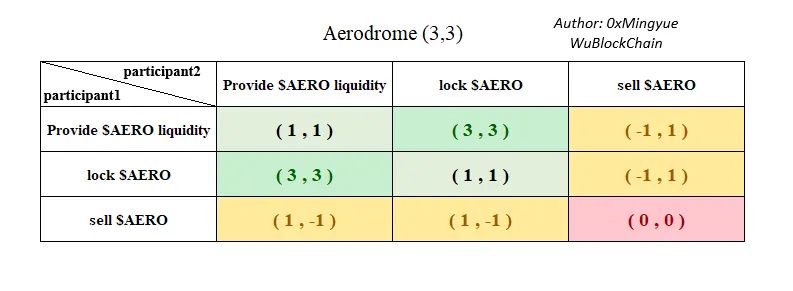
- (3,3) (Game Theory Model): Originating from OlympusDAO, this matrix represents the idea that when all participants choose to "lock tokens for the long term," they can collectively generate higher returns and achieve a mutually beneficial outcome. Conversely, if some participants choose to "Farm, Claim, Dump," the overall returns for the community may be negatively affected.
Data Source: Medium
Why Is the ve(3,3) Model More Effective?
In traditional decentralized exchanges, liquidity providers often sell their earned platform tokens immediately after receiving incentives, causing tokens to fall into an inflationary "Farm, Claim, Dump" cycle. The core advantage of the ve(3,3) model is that it fundamentally addresses this issue.
Under this mechanism, newly issued platform tokens are no longer simply a source of selling pressure. Instead, they become valuable assets used to compete for voting power. By locking their tokens for the long term, token holders transform them into non-transferable voting tokens, shifting their role from pure speculators to protocol stakeholders and decision-makers.
The core value of this model lies in its precise liquidity allocation mechanism and innovative bribery system, which transforms the competition among different participants into a three-party flywheel. Locked voters determine which liquidity pools receive token emissions, while external projects seeking deeper liquidity for their own tokens provide financial incentives to voters in exchange for voting support. In return, voters receive 100% of the trading fees generated by the selected pool as well as the full amount of bribery rewards.
However, despite appearing to create a highly efficient flywheel, the model also comes with several potential drawbacks and risks in practice. First, users face significant opportunity costs. To maximize benefits, funds typically need to be locked for up to four years, which reduces flexibility in responding to market downturns or adjusting positions in a highly volatile crypto market.
Second, the mechanism carries the risk of a reverse death spiral. During bear markets, declining trading volumes can reduce fee revenue, while projects may have less incentive or budget to provide bribes. As a result, locking yields may decline significantly.
Finally, large whales or yield aggregator protocols with substantial capital can potentially accumulate excessive voting power through large-scale locking. This may lead to incentive structures being controlled by a small number of participants, creating the risk of governance centralization, malicious voting, and potential harm to smaller investors.
Aerodrome's Continuous Evolution: From Slipstream to Slipstream V2
Aerodrome has continued to evolve beyond traditional stable and volatile liquidity pools. By keeping pace with the latest DeFi innovations, the protocol has undergone major product and efficiency upgrades, helping shape the technological direction of the Base ecosystem.
- Volatile and Stable Pools (Core Infrastructure)
During its early stages, Aerodrome introduced two fundamental pool types designed for different asset categories. Volatile pools (vAMM) were designed for standard crypto assets such as AERO and ETH, based on the x · y = k formula. Stable pools (sAMM) were designed for stablecoins or similarly valued assets such as USDC and USDbC, using the x³y + y³x = k formula. These pools provided a strong liquidity foundation for the early development of the Base ecosystem.
- Slipstream (The Concentrated Liquidity Revolution)
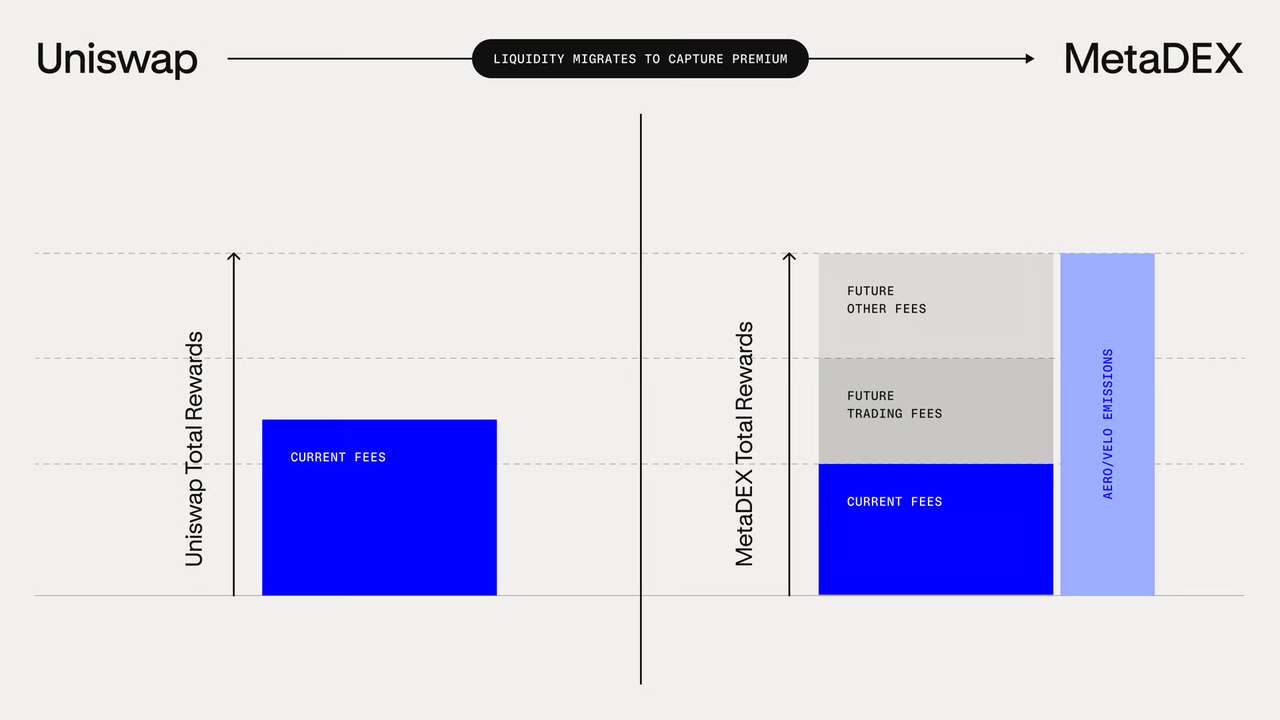
In spring 2024, Aerodrome officially introduced Slipstream, a feature optimized from the concentrated liquidity concept pioneered by Uniswap V3. LPs can customize price ranges when providing liquidity, while the ve(3,3) mechanism is seamlessly integrated into the model. This allows Slipstream pools to achieve significantly higher capital efficiency than traditional pools, further strengthening Aerodrome's leading position in large-scale spot trading liquidity on Base.
- Modular Integration with Automated Liquidity Strategies
As the ecosystem expanded, Aerodrome gradually opened modular integrations with automated liquidity management protocols such as Beefy and Gamma. Developers and strategy platforms can leverage Aerodrome's efficient liquidity layer to build automated compounding and rebalancing strategies, allowing Aerodrome to evolve from a standalone exchange into a core liquidity marketplace for the broader Base ecosystem.
Data Source: blog.dromos.xyz
AERO Tokenomics
AERO was officially launched in August 2023, at a critical stage when the Base mainnet had just gone live and the ecosystem urgently needed strong liquidity support. To quickly build community participation and attract quality liquidity, Aerodrome conducted a strategically significant "airdrop" by distributing a large portion of the initial supply directly to veVELO holders who actively participated in Velodrome governance within the Optimism ecosystem. This approach enabled a seamless ecosystem transition and helped overcome the challenges of an early-stage network launch.
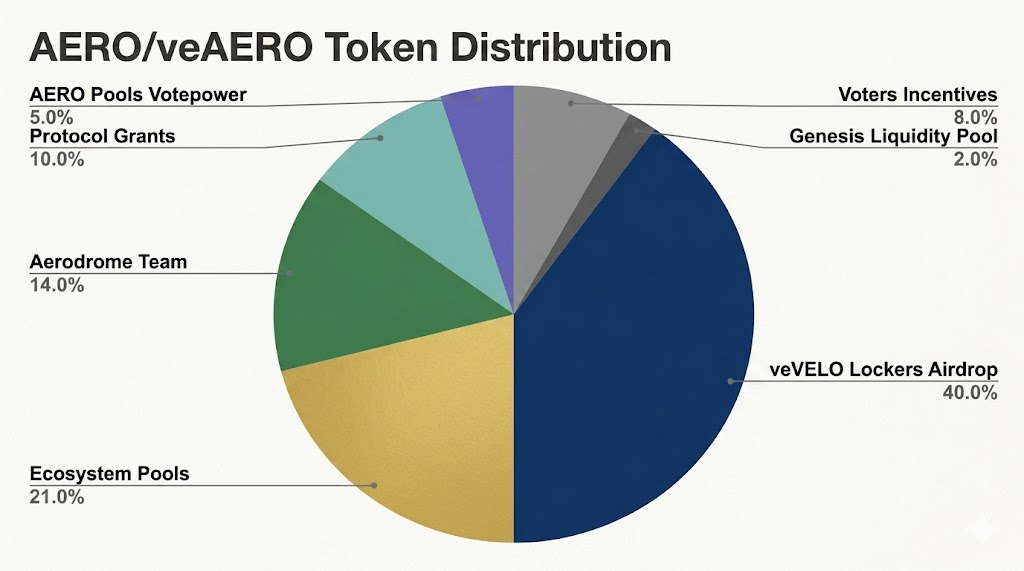
AERO's initial total supply was 500 million tokens. Its allocation design placed a strong emphasis on community governance and decentralization rather than capital interests. More than 90% of the tokens were allocated to community and liquidity-related purposes, avoiding the potential selling pressure typically associated with VC or private investment allocations in traditional projects.
The initial allocation structure was as follows:
- 40% of the tokens were distributed directly through an airdrop to veVELO lockers in the Optimism ecosystem, enabling a targeted migration of users;
- 21% was allocated to a public goods fund to support long-term ecosystem development;
- 19% was allocated to the development team with strict long-term vesting conditions;
- The remaining approximately 10% was dedicated to liquidity and voting incentives.
This "institution-minimized" allocation model helped Aerodrome establish a strong community foundation and deep governance participation from the first day of launch.
How to Buy AERO
Early users and Velodrome community members primarily acquired their initial AERO allocation through the airdrop. Users can also earn AERO emissions by providing liquidity (LP) to Aerodrome's Slipstream or traditional liquidity pools, but this approach comes with the risk of impermanent loss caused by significant market volatility. For ordinary investors, managing concentrated liquidity positions requires a higher level of DeFi expertise and is generally more suitable for experienced liquidity providers.
Through centralized crypto exchanges like Bitunix, users can purchase AERO directly with fiat currencies or stablecoins. Some platforms also support instant purchases via credit cards, significantly lowering the entry barrier for new users. Before using an exchange, users typically need to register an account and complete Know Your Customer (KYC) verification to comply with global Anti-Money Laundering (AML) and Counter-Terrorist Financing (CTF) regulations.
Bitunix provides a comprehensive compliance and risk management framework. Through mechanisms such as cold and hot wallet separation, multi-signature protection, and real-time monitoring, the platform helps enhance asset security for users.
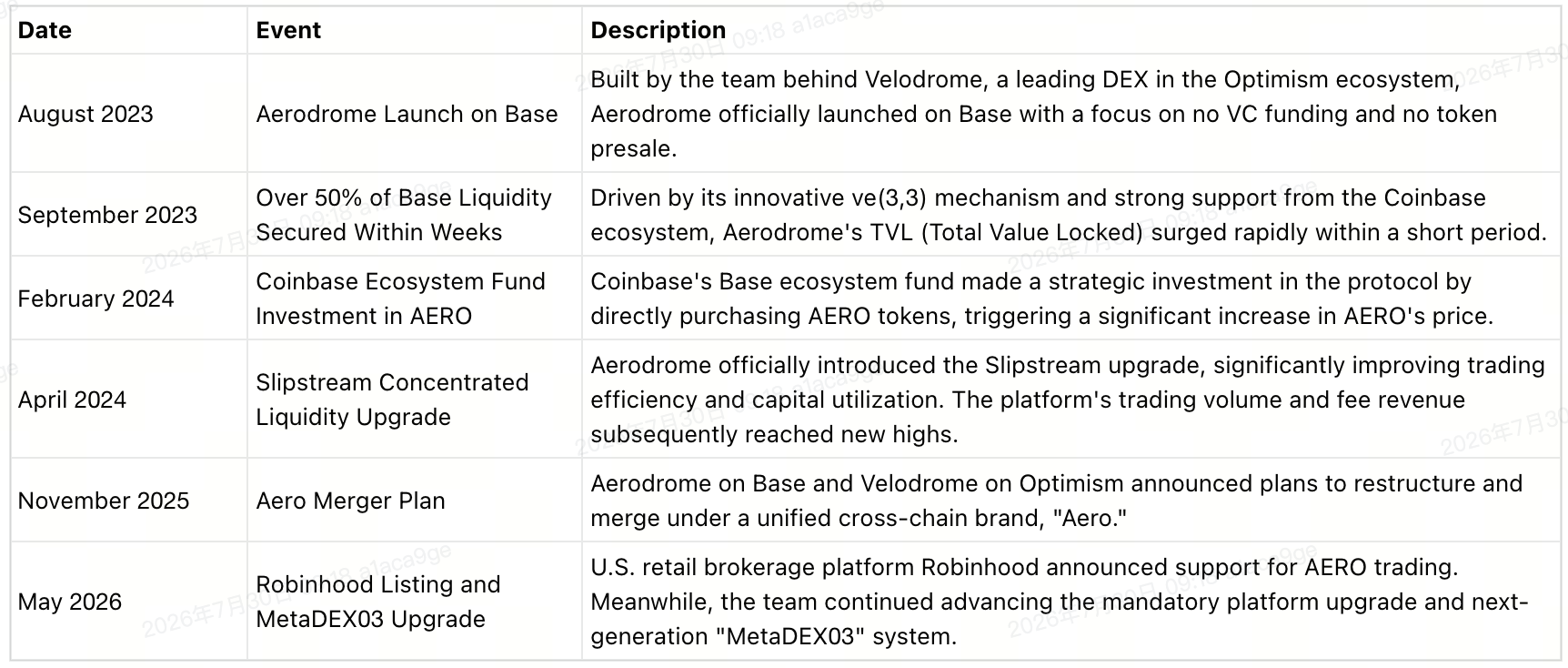
Aerodrome Timeline: Key Milestones
Disclaimer
This article is not intended to provide:
(i) investment advice or investment recommendations;
(ii) an offer or solicitation to buy, sell, or hold digital assets; or
(iii) financial, accounting, legal, or tax advice.
Digital assets you hold, including stablecoins and NFTs, involve significant risks and may experience substantial price volatility. You should carefully consider whether trading or holding digital assets is suitable for you based on your financial circumstances.
For advice specific to your situation, please consult your legal, tax, or investment professionals. You are solely responsible for understanding and complying with all applicable local laws and regulations.
About Bitunix
Bitunix is a global cryptocurrency derivatives exchange trusted by over 5 million users across more than 150 countries/districts. The platform is committed to providing a transparent, compliant, and secure trading environment for every user. Bitunix offers a fast registration process and a user-friendly verification system supported by mandatory KYC to ensure safety and compliance.
With global standards of protection through Proof of Reserves (POR) and the Bitunix Care Fund, Bitunix prioritizes user trust and fund security. The K-Line Ultra chart system delivers a seamless trading experience for both beginners and advanced traders, while leverage of up to 200x and deep liquidity make Bitunix one of the most dynamic platforms in the market.
Bitunix Global Accounts
X | Telegram Announcements | Telegram Global | CoinMarketCap | Instagram | Facebook | LinkedIn | Reddit | Medium