
Article Summary
- This article provides a detailed price prediction and fundamental analysis for the Harmony (ONE) token.
- It explains Harmony's core technology: a fast, secure, and highly scalable Layer 1 blockchain utilizing state sharding and Effective Proof-of-Stake (EPoS).
- The bull case focuses on its underlying technological strength, EVM compatibility, and the team's ongoing efforts to rebuild trust and ecosystem utility.
- The bear case heavily emphasizes the devastating $100 million Horizon bridge hack in 2022, the subsequent loss of developer trust, and the intense competition from newer, unblemished Layer 1s and Layer 2s.
- It presents detailed price prediction scenarios (bearish, neutral, bullish) for both 2026 and 2030, based on the project's ability to execute a successful turnaround.
Harmony is an open, fast, and secure blockchain built for decentralized applications. Its original appeal was low fees, fast finality, Ethereum compatibility, and a sharding design that aimed to scale without making developers relearn everything from scratch. If you want to keep an eye on the market side of that story, Bitunix, a crypto exchange, offers trading for ONE/USDT, which tracks Harmony’s native token, ONE.
The harder part for Harmony's growth is the reputation issue. It once looked like a serious high-throughput Layer 1 contender. Then the Horizon bridge exploit broke trust, damaged liquidity, and pushed the project into a long rebuild.
This analysis will examine Harmony's impressive technological foundation, the lasting impact of its security breach, and provide data-driven price predictions for 2026 and 2030 based on its potential for a comeback.
The Technology: Sharding and EPoS
Harmony's core technical identity is its sharding design. The official docs say the network is sharded across state, network, and transactions, and that each shard maintains its own chain of blocks and state database. That means validators do not need to store the full global state, and transactions can be processed in parallel rather than one long queue. The mainnet is running with 4 shards and 2-second block production with finality, making Harmony a true sharding blockchain, not just a faster single-chain system with better marketing.
The consensus layer is Effective Proof-of-Stake, or EPoS. It reduces stake centralization by using effective stake rather than raw stake and by bounding it around the network median. In simple terms, it aims to prevent a few validators from dominating the network simply because they have more capital. There is also support for delegation, reward compounding, slashing for double-signing, and penalties for unavailability. So the design is also about trying to keep validator power from clustering too heavily.
Harmony is also fully EVM-compatible. Ethereum developers can port dApps over with familiar tooling, and the January 2026 development update says the team continued aligning the Harmony VM with recent Ethereum EIPs. That matters for investors because compatibility lowers the barrier to entry. And if you trade the ONE token on Bitunix, the main idea underneath is still that Harmony can remain useful as a cheaper EVM environment if the chain regains enough trust and developer attention.
The Bear Case: The Horizon Hack and Lost Trust
A realistic Harmony (ONE) price prediction has to start with the damage. Current market data already shows how small the ecosystem has become. DeFi Llama puts Harmony TVL around $8.1 million in stablecoins, about $317 in 24-hour DEX volume, and about $33.1 million in market cap for ONE.
At the same time, CoinGecko says the token still trades about 99.4% below its all-time high of $0.379. Published forecasts are also weak.
- CoinCodex's forecast places 2026 between $0.001617 and $0.002285.
- Bitget's model puts 2026 near $0.002273 and 2030 near $0.002763.
- Changelly's price prediction is more optimistic for late 2026 with a $0.00632 average and $0.00690 max, but much more pessimistic for 2030 with a $0.000377 average.
1. The $100 Million Breach
The Horizon Bridge hack remains the center of the bear case. Reuters described the event this way:
"U.S. crypto firm Harmony said on Friday that thieves stole around $100 million worth of digital coins from one of its key products."
CoinDesk later reported that the attack was linked to a North Korean hacking group. The exploit targeted Horizon, the bridge connecting Harmony to other chains, and the size of the loss permanently changed how the market viewed Harmony's risk profile. Even years later, that incident still dominates every serious discussion about Harmony crypto.
2. The Aftermath
The damage was not limited to one bad week; two months after the exploit, The Block reported that DeFi Kingdoms would leave Harmony for Klaytn. That was relevant because DeFi Kingdoms had been one of the chain's biggest users and liquidity anchors. Today's on-chain numbers show how thin the ecosystem looks by comparison, with DefiLlama reporting tiny DEX volume and a very small stablecoin base.
The recovery process also stayed messy. Official community recovery threads show May and June 2025 disbursements were still being processed, but they were hurt by ONE hitting a four-year low during that period. Separate September 2025 community comments were still openly demanding fuller recovery and criticizing the pace of reimbursement. That is a bad sign for any turnaround asset. When victims are still waiting years later, trust remains fragile, no matter how clean the code updates look.
3. The Brutal L1 Landscape
While Harmony was rebuilding, rivals kept evolving, and one proof of that is that DeFi Llama currently shows Solana with about $5.67 billion in DeFi TVL and Avalanche with about $742.5 million. In contrast, L2BEAT shows Arbitrum One securing about $15.46 billion and OP Mainnet about $1.49 billion.
That is how real the competition is. Harmony is not trying to recover into an empty field; it is trying to recover in a market where faster chains, bigger DeFi bases, and Ethereum Layer 2 networks already took the space it once hoped to win.
The Bull Case: The Turnaround Story
At today's scale, Harmony does not need to become a top-tier chain again to outperform from current levels, so a bull case is possible. It only needs to prove that the network can still support useful applications, retain a functioning validator base, and build even modest new demand. That is why a second Harmony (ONE) price prediction angle matters: the token is now priced more like a distressed legacy asset than an active growth chain. If the network stabilizes, the multiple can move even without a full return to 2021 conditions.
1. The Tech Still Works
The strongest bullish argument is that the exploit hits a bridge, not the base chain's sharding or EPoS design. Reuters described the loss as coming from one of Harmony's products, while the underlying network was a 4-shard proof-of-stake chain with 2-second blocks and state sharding.
That does not erase the damage to trust, but it does suggest that the exploited bridge and the core consensus stack were different failure points. For investors, that distinction matters. The chain's architecture was not disproven by the hack, even if the ecosystem around it was badly hurt.
2. Rebuilding Efforts
Harmony is making enough movement to come out of the other side stronger. The network's late-2024 and 2025 roadmap posts focused on 1-second finality, DeFi tooling, and an open AI ecosystem, and the July 2025 update says v2025.1.1 went live on mainnet with improvements to consensus, bootnode stability, P2P networking, and observability.
Then the January 2026 update said the Harmony VM was further aligned with recent Ethereum EIPs and that cross-shard receipt issues had been resolved. That is the pace of a smaller team trying to keep the base layer relevant while experimenting with new use cases.
3. The Deep Value Play
This is the other side of the same coin. CoinGecko says ONE is still roughly 99.4% below its all-time high, and if you believe the project can rebuild even a modest application base, that discount starts to look like optionality.
The current Harmony 2030 forecast spread shows how unstable the thesis still is. CoinCodex sees a weak 2026 range topping out near $0.002285, while Changelly's late-2026 view runs much higher before turning sharply lower by 2030. So, the market is willing to price in a temporary rebound, but it does not yet trust a durable comeback. That is why Harmony is a classic high-risk turnaround setup rather than a clean growth story.
Harmony (ONE) Price Prediction Scenarios (2026 & 2030)
The best way to frame the outlook is to use the forecast spread rather than pretend one number is enough. CoinCodex is cautious, Bitget is slightly higher but still modest, while Changelly gives the widest swing, bullish for late 2026 and bearish for 2030.
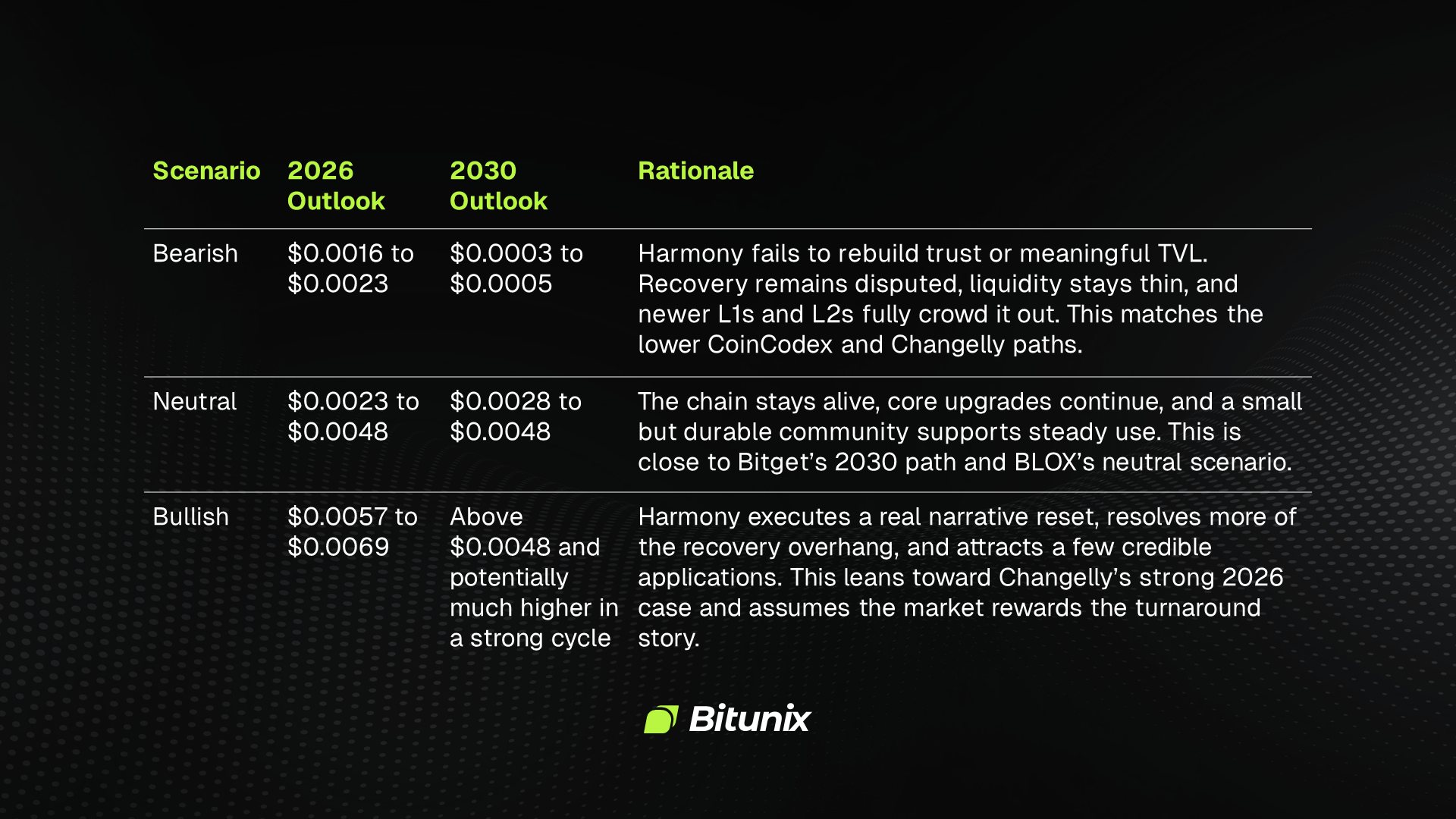
Harmony outlook table comparing bearish, neutral, and bullish scenarios for 2026 and 2030 based on trust recovery, ecosystem activity, and the chances of a turnaround.
Conclusion: A High-Stakes Gamble
Harmony still has the bones of a serious blockchain, including the sharding architecture, EPoS, which offers a thoughtful answer to stake concentration, and EVM compatibility, which lowers the technical barrier for developers. None of that changed. What changed was trust, and that's harder to fix.
ONE is a genuine turnaround bet built around a simple question: can the market eventually separate Harmony's base-layer technology from the damage caused by the bridge failure, and can the team rebuild enough utility to make the ecosystem relevant again? That outcome is possible, but it is still a long shot.
If you want to keep that setup on your screen and act when conditions change, start by downloading the Bitunix app, then register to access ONE markets alongside the wider Layer 1 field.
FAQ Section
What is Harmony (ONE)?
Harmony is a proof-of-stake Layer 1 blockchain built for decentralized applications. Its main identity comes from state sharding, low fees, fast finality, and full EVM compatibility, which makes it easier for Ethereum-style apps to run on the network.
What was the Horizon bridge hack?
The Horizon bridge hack was the June 2022 exploit that drained about $100 million from Harmony's cross-chain bridge product. Later reporting linked the incident to a North Korean hacking group, and it became the defining event in Harmony's reputation and recovery story.
Is the Harmony blockchain secure?
The chain itself still runs its sharded proof-of-stake design, and the official docs continue to describe a functioning 4-shard network with EPoS and slashing. But investors should separate chain design from ecosystem trust. The bridge exploit damaged confidence, even if the core consensus layer survived.
How does Harmony's sharding work?
Harmony divides the network across shards for state, network, and transaction processing. Each shard keeps its own chain and state database, which lets the network process transactions in parallel instead of forcing all validators to handle the same workload every time.
What is Effective Proof-of-Stake (EPoS)?
EPoS is Harmony's staking system. It uses effective stake rather than raw stake to reduce concentration around a few large validators. The docs also describe delegation, slashing, compounding, and uptime penalties as part of the security and validator design.
Is Harmony compatible with Ethereum?
Yes. Harmony is 100% EVM-compatible, and recent 2025 and 2026 updates show continued work to keep the Harmony VM aligned with Ethereum improvements. That allows Ethereum developers to port applications with familiar tools and workflows.
Can Harmony recover from the hack?
It can recover partially, but the bar is high. The chain still ships upgrades, but ecosystem usage remains small, and recovery efforts are still disputed in community threads. A comeback requires new utility, stronger trust, and a reason for developers and users to return.
What is the all-time high of ONE?
CoinGecko lists Harmony's all-time high at $0.379. It shows how far the asset has fallen and how much recovery the market would need to price in before anyone can talk seriously about reclaiming old highs.
Can I stake ONE tokens?
Yes. Harmony uses proof-of-stake, and validators and delegators can participate via EPoS. Staking supports network security and can earn rewards, though validator uptime, effective stake, and slashing rules all affect the outcome.
Where can I buy Harmony (ONE)?
You can buy ONE on centralized crypto exchanges and then move it on-chain if needed. Bitunix offers ONE market access, and its official blog also explains how to buy, sell, and track the asset through the platform.
Glossary
- Harmony crypto: The broader asset and ecosystem identity built around Harmony's Layer 1 blockchain and the ONE token.
- ONE token: Harmony's native token, used for staking, validation, fees, and broader network participation.
- State sharding: A model where each shard maintains its own chain and state database instead of all validators storing the full global state.
- Network sharding: The division of validators into separate shard committees so they do not all communicate and validate as one large global set.
- Transaction sharding: A structure where transactions are processed by specific shards, allowing parallel execution and higher throughput.
- EPoS: Effective Proof-of-Stake, Harmony's staking model designed to reduce stake concentration and support decentralization.
- Effective stake: The stake metric used in EPoS is bounded around the network median rather than tracking raw stake alone.
- Slashing: Penalties applied to validators and delegators for double-signing or severe unavailability.
- Cross-shard transaction: A transaction that moves from one Harmony shard to another and relies on cross-shard messaging and state coordination.
- Crosslink: Data sent from shard chains to the beacon chain to verify and endorse canonical shard blocks.
- EVM compatibility: Harmony's ability to run Ethereum-style smart contracts and support familiar Ethereum tooling.
- Finality: The point at which a block or transaction is considered confirmed and not reasonably reversible. Harmony's docs describe 2-second block production with finality.
- TVL: Total value locked, or the capital deposited in DeFi protocols on a chain.
- Horizon bridge hack: The 2022 exploit that stole about $100 million from Harmony's bridge product and permanently damaged ecosystem trust.
- Harmony 2030 forecast: A long-range view of where ONE could trade by 2030, based on whether the chain remains niche, revives, or fades further.
Disclaimer
This article does not provide:
(i) investment advice or investment recommendations;
(ii) an offer or solicitation to buy, sell, or hold digital assets;
(iii) financial, accounting, legal, or tax advice.
Digital assets, including stablecoins and NFTs, involve high risk and may fluctuate significantly. Consider whether trading or holding digital assets is appropriate for you given your financial situation. Consult a qualified legal, tax, or investment professional when needed. You are responsible for understanding and complying with applicable local laws and regulations.
About Bitunix
Bitunix is a global cryptocurrency derivatives exchange trusted by over 3 million users across more than 100 countries. At Bitunix, we are committed to providing a transparent, compliant, and secure trading environment for every user. Our platform features a fast registration process and a user-friendly verification system supported by mandatory KYC to ensure safety and compliance. With global standards of protection through Proof of Reserves (POR) and the Bitunix Care Fund, we prioritize user trust and fund security. The K-Line Ultra chart system delivers a seamless trading experience for both beginners and advanced traders, while leverage of up to 200x and deep liquidity make Bitunix one of the most dynamic platforms in the market.
Bitunix Global Accounts
X | Telegram Announcements | Telegram Global | CoinMarketCap | Instagram | Facebook | LinkedIn | Reddit | Medium