Article Summary
- This article provides a detailed price prediction and fundamental analysis for the NKN (New Kind of Network) token.
- It explains NKN as a decentralized data relay network that incentivizes users to share their unused internet bandwidth, creating a more efficient and secure internet infrastructure.
- The bull case focuses on the growing demand for decentralized Web3 infrastructure, the massive scale of NKN's node network, and its potential to disrupt traditional telecom monopolies.
- The bear case highlights the immense challenge of competing with established, centralized internet service providers (ISPs), the technical complexity of routing data globally, and limited mainstream awareness.
- It presents detailed price prediction scenarios (bearish, neutral, bullish) for both 2026 and 2030, based on network adoption and bandwidth demand.
Large parts of the modern internet still run through centralized choke points, from telecom backbones to cloud delivery layers. NKN, short for New Kind of Network, was built to challenge that model by rewarding people for contributing unused connectivity and bandwidth to a peer-to-peer network. And for anyone already familiar with a crypto exchange like Bitunix, NKN fits into the part of the market focused less on payments or meme narratives and more on the infrastructure that Web3 still needs in order to function at scale.
The pitch is that NKN uses economic incentives to motivate internet users to share network connections and build a decentralized internet routing layer. This article looks at how that design works, where the project has shown real traction, and how current market forecasts frame NKN's 2026 and 2030 outlook.
The Technology and Ecosystem
NKN's technology is built around the idea that instead of rewarding miners for burning computation like Proof-of-Work, NKN rewards nodes for helping move data across the network. The official documentation says participants receive rewards by contributing more network resources than they consume, and it presents the network as a self-incentivized system that minimizes wasted connectivity and bandwidth.
The project's own docs summarize that design well:
"The novel PoW does not result in a waste of resources. Instead, it is a peer-to-peer sharing mechanism at the blockchain level."
Proof of Relay is the mechanism the network uses to guarantee connectivity and data transmission capacity, while nodes earn rewards for relaying useful traffic, and that is why the project has always framed itself as infrastructure.
The routing model underneath that is based on Cellular Automata on Networks. It is a natural way to model networks with dynamic local rules and changing topology, which is important because the system is supposed to keep adapting as nodes join, leave, and reroute traffic. In simple terms, NKN is trying to make decentralized routing more scalable without falling back on a central coordinator.
Current NKN documentation for nConnect over Tuna says users can share unused network bandwidth through a decentralized overlay connection, with standard mode relaying traffic for free through mining rewards and Tuna mode charging small NKN-denominated fees for better performance. The same docs say Tuna can deliver around 100ms end-to-end latency and 10+ Mbps throughput between international devices in standard client mode, which gives the project a more practical product layer than many infrastructure tokens have.
The NKN token serves as the economic incentive for node runners, and NKN's older system-architecture explainer describes it as the medium for paying for data transmission resources in a decentralized peer-to-peer network. Even if the wording comes from an older architecture post, the current documentation still supports the same basic logic: nodes share bandwidth, users consume network services, and the token ties those incentives together.
The Bull Case: The Web3 Infrastructure Demand
The bullish case for NKN depends on whether its infrastructure footprint starts turning into stronger usage, revenue potential, and token demand. CoinGecko currently lists NKN at $0.0080, with 24-hour trading volume of roughly $212,000 and a market cap of around $6.4 million.
Public price models already show how differently analysts see NKN's upside. CoinCodex's forecast places 2026 between about $0.004844 and $0.01049, while MEXC's price prediction stays close to current levels with roughly $0.00827 by the end of 2026 and $0.00973 by 2030. CoinLore's forecast is much more optimistic, pointing to about $0.0617 in 2026 and around $0.2204 by 2030, and Bitget's April 2026 scenario analysis pushes the 2030 bull case closer to $0.4458 if NKN gains broader attention. Taken together, those forecasts suggest the upside case depends on real network adoption and stronger visibility.
1. The Largest Node Network
Scale is one of the strongest points in NKN's favor. In its November 2025 network update, the team said the mainnet was relaying around 11 billion messages per day, with daily active mainnet nodes ranging from about 10,500 to 24,500 and nearly 7,820 daily SDK users. That is not small by crypto infrastructure standards, and it helps explain why the project still presents itself as one of the largest decentralized node networks in the world.
That node count matters because resilience in decentralized internet design comes from distribution. Bitget's April 2026 analysis put current full consensus nodes above 25,000 and argued that this still exceeds Bitcoin's node count. Even if different counting methods can make node comparisons messy, the basic point is that NKN still maintains a large, live network at a token valuation that suggests the market has barely noticed.
2. Disrupting Telecoms
Disrupting incumbent internet infrastructure is a huge claim, but the market context makes it easier to understand why bulls keep making it. A January 2026 CDN market report from MarketsandMarkets said the sector is projected to grow from $27.25 billion in 2025 to $42.89 billion by 2030, underscoring the value already in content delivery and traffic optimization.
The same report put the demand side in plain terms:
"The global CDN market is gaining momentum as organizations adopt digital-first engagement models that depend on reliable and consistent content delivery across regions."
If a peer-to-peer relay network can lower infrastructure costs or improve resilience for streaming, messaging, or edge delivery, it starts to compete for part of a very real budget that centralized CDN vendors already serve.
3. Web3 Foundation
As Web3 grows beyond simple token transfers, it needs networking infrastructure that is not forced to rely entirely on centralized cloud providers. NKN's March 2025 AI-agent communication launch framed the protocol as a universal communication layer for billions of autonomous AI agents, while current docs around nConnect, Tuna, and DataRide all point to the same broader ambition: become the network layer underneath messaging, streaming, file transfer, and machine communication.
If decentralized applications want end-to-end encrypted transport, censorship resistance, or direct peer-to-peer communication without centralized bottlenecks, they need more than storage and settlement. They need transport rails too, and NKN is one of the few older projects still trying to build exactly that layer, which is why bulls see it as more than just a speculative altcoin.
The Bear Case: The Goliath Problem
Forecast models also make the bearish case easy to take seriously. CoinCodex's 2026 range starts below the current price, and its end-2030 estimate sits around $0.00248. MEXC's model-based scenario stays almost flat into 2030, and Coinbase's 5% growth tool keeps NKN near S$0.01 through the end of the decade. Those are stagnation forecasts, describing a token that remains alive, but never grows into a major infrastructure asset in the eyes of the market.
1. Entrenched Monopolies
The first problem is that NKN is trying to compete, at least indirectly, with telecom and CDN giants that already own physical infrastructure, enterprise relationships, and huge delivery networks. A decentralized relay layer can work around some of that by using spare capacity and peer-to-peer paths, but it still lives in a world where the underlying fiber, mobile networks, and cloud backbones are dominated by major incumbents.
That makes adoption hard, even if the technology works. Large enterprises do not switch critical traffic to a new routing layer just because the idea is innovative. They care about service guarantees, uptime, compliance, procurement cycles, and integration with existing systems. For NKN, that means the addressable market may be large, but the path to taking meaningful share from incumbent infrastructure providers is much slower than crypto investors usually like.
2. Technical Complexity
Routing data efficiently across a big decentralized network of consumer-grade connections is also hard in a very practical sense. NKN's own Tuna documentation highlights better performance through multiple simultaneous overlay paths and says Tuna service providers need to be paid for higher-performance service. That suggests the project can deliver strong performance. However, it also shows that decentralized routing still requires more engineering than just turning on a node and expecting enterprise-grade results everywhere.
Latency, path selection, packet reliability, and endpoint quality all become harder when the network is distributed across home connections and community-run infrastructure. NKN's documentation treats that complexity as a feature of a dynamic self-organizing system, but for the market, it is still a source of risk. If the user experience falls behind dedicated enterprise networks, adoption will stay niche no matter how interesting the architecture looks on paper.
3. Niche Awareness
Consumer-facing dApps, meme coins, and fast-moving DeFi products usually get the retail excitement, while bandwidth sharing and decentralized routing do not. Bitget's April 2026 analysis made that point directly by arguing that NKN built real infrastructure early, but newer DePIN projects captured the narrative and the capital.
That gap between utility and attention can matter a lot for price. NKN's November 2025 update showed real usage, 11 billion daily messages, and active applications such as nMobile and Novon.tv, yet the token still trades near micro-cap levels. That means the market may continue to undervalue it for a long time if infrastructure demand fails to turn into a stronger narrative.
NKN Price Prediction Scenarios (2026 & 2030)
The forecast ranges below reflect a market that sees both survival and upside, but not a clean consensus. CoinCodex and MEXC anchor the cautious end, Coinbase's scenario tool stays similarly flat in local-currency terms, CoinLore provides the stronger upside path, and Bitget's April 2026 scenario analysis pushes the stretch case higher if NKN ever gets a real DePIN rerating.
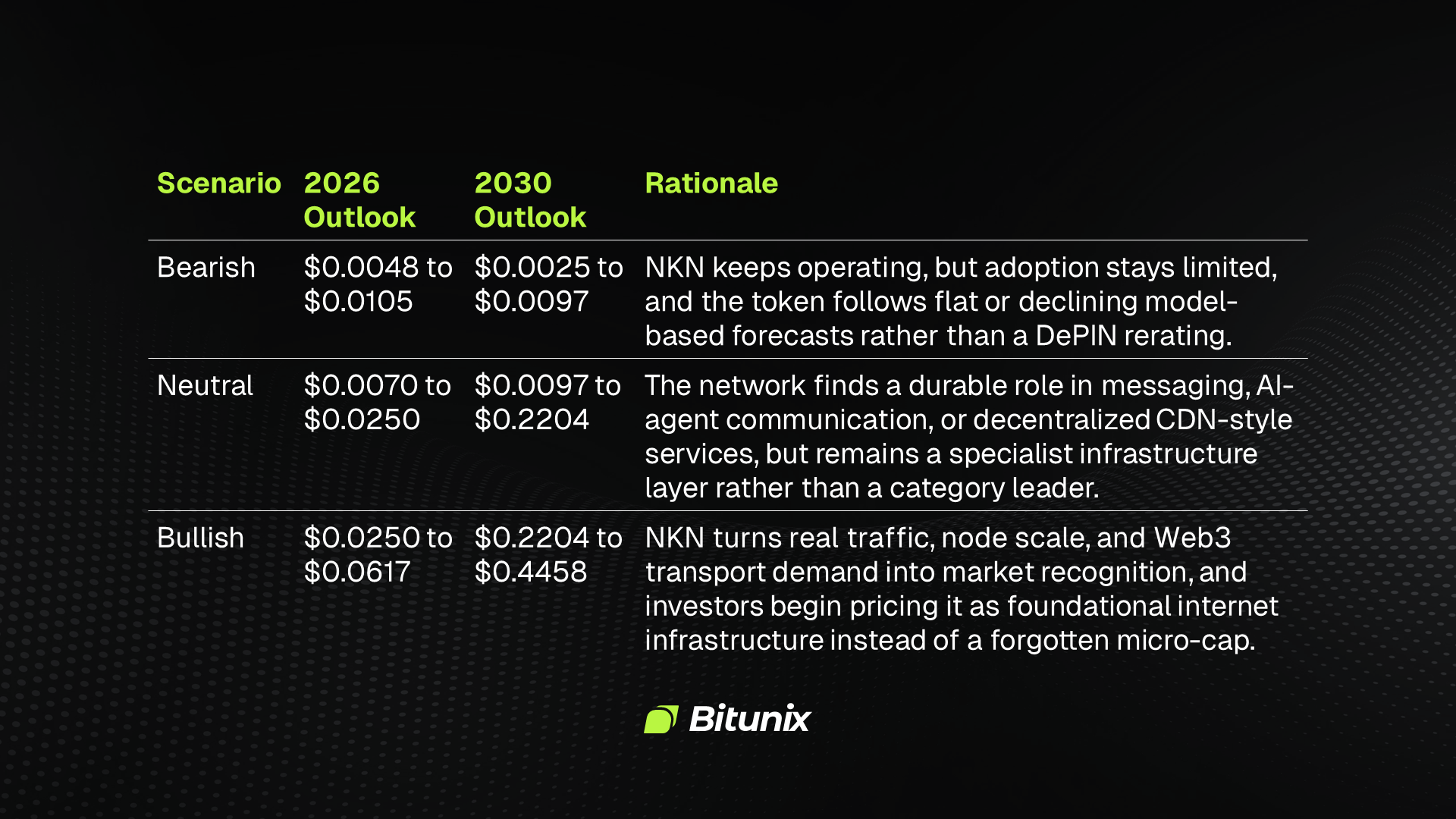
NKN price prediction scenarios for 2026 and 2030, comparing bearish, neutral, and bullish outcomes based on adoption, Web3 infrastructure demand, and decentralized networking growth.
Conclusion: A Bet on Decentralized Bandwidth
NKN remains one of the more ambitious infrastructure projects in crypto because it is trying to decentralize network transport itself. The project still has a live network, real products, documentation that matches the architecture, and recent signs of meaningful throughput.
Investing in NKN is still a long-term bet on decentralized data transmission, bandwidth sharing, and the idea that Web3 eventually needs transport rails that do not depend entirely on centralized providers. That bet has upside, but it also comes with brutal competition, technical complexity, and a market that may keep overlooking infrastructure stories. Whether the current valuation looks like neglect or a warning depends on how much real adoption you think NKN can convert from network scale and product usage.
If you want exposure to the spot and future markets, you can download the Bitunix app, register, and decide whether the current valuation looks like neglect or a warning.
FAQ
What is NKN?
NKN, or New Kind of Network, is a public, blockchain-based peer-to-peer networking project that rewards users for sharing connectivity and unused bandwidth. Its goal is to create a decentralized internet transport layer rather than relying only on centralized servers and network operators.
How does NKN decentralize the internet?
NKN decentralizes internet transport by letting independent nodes relay data across the network and earn rewards for doing so. Instead of routing everything through centralized providers, it creates multiple possible paths between peers and uses token incentives to encourage bandwidth sharing.
What is Proof of Relay?
Proof of Relay is NKN's consensus mechanism that rewards nodes for relaying real network data instead of spending energy on hash puzzles. As nodes forward packets, they add digital signatures that create a verifiable chain, proving useful work while keeping the packet contents private.
How can I earn NKN tokens?
You can earn NKN by running a full node that helps relay network traffic. NKN's mining model rewards participants who contribute more network resources than they consume, and Tuna service providers can also receive NKN payments for higher-performance routing services.
What is the utility of the NKN token?
The NKN token is the network's economic incentive. It rewards node runners for bandwidth and relay activity, and it is also used as payment for certain network services, especially higher-performance decentralized connectivity such as Tuna mode.
How does NKN compare to traditional ISPs?
Traditional ISPs and CDNs own centralized infrastructure and enterprise relationships, while NKN tries to use peer-to-peer nodes and shared spare bandwidth. That can improve censorship resistance and flexibility, but it also means NKN faces a much harder path to large-scale enterprise adoption.
What is a Content Delivery Network in the context of NKN?
In NKN's context, a CDN means the decentralized delivery of media, files, or other content across distributed nodes rather than relying solely on centralized edge servers. NKN has positioned products such as nCDN and related bandwidth services as alternatives for certain delivery and streaming use cases.
How many nodes does the NKN network have?
NKN's November 2025 update said daily active mainnet nodes ranged from about 10,500 to 24,500. A Bitget analysis published in April 2026 described the network as maintaining more than 25,000 full consensus nodes, though exact counts vary by methodology.
What are the risks of investing in NKN?
The main risks are intense competition from incumbents and newer DePIN projects, the difficulty of delivering low-latency performance across decentralized consumer-grade connections, and limited mainstream awareness compared with more retail-friendly crypto sectors.
Where can I buy NKN tokens?
You can buy NKN on major centralized exchanges such as MEXC, Gate, and KuCoin. Availability can vary by platform and product type, so it is worth checking the latest listing status directly on the exchange before trading.
Glossary
- NKN token: The native asset used to reward node operators and pay for network services.
- New Kind of Network: The full name of NKN, a blockchain-based decentralized networking project.
- Decentralized internet: A networking model that reduces dependence on centralized service providers and routes traffic through distributed peers.
- Bandwidth sharing: The practice of contributing unused internet capacity so others can transmit data across the network.
- Web3 infrastructure: Foundational tools and networks that support decentralized applications, communication, storage, and transport.
- Proof of Relay: NKN's consensus mechanism that rewards nodes for relaying useful data.
- Cellular Automata on Networks: The mathematical model NKN uses to describe routing and evolving network topology.
- Peer-to-peer data transmission: Direct or distributed movement of data between nodes without relying entirely on centralized intermediaries.
- Tuna: NKN's higher-performance networking mode for decentralized overlay connections.
- nConnect: NKN's decentralized secure remote access product.
- nCDN: NKN's decentralized content delivery network concept and service layer.
- SDK users: Developers or applications using NKN software development tools to build on the network.
- Node operator: A participant who runs NKN software and helps relay data across the network.
- Micro-cap: A token with a relatively small market capitalization, often making price swings sharper.
- CDN market: The broader industry for content delivery networks, where NKN hopes decentralized routing can become competitive.