
Article Summary
- This article provides a detailed price prediction and fundamental analysis for the Superverse (SUPER) token.
- It explains Superverse (formerly SuperFarm) as a comprehensive Web3 gaming ecosystem that includes a suite of games (like Impostors), an NFT marketplace, and tools for creators to launch their own tokens and NFTs.
- The bull case focuses on the massive reach of its founder (EllioTrades) and associated influencers, the high quality of its flagship game Impostors, and its ability to onboard traditional gamers.
- The bear case highlights the heavy reliance on influencer marketing, the historical volatility of gaming tokens, and intense competition from established gaming studios and platforms.
- It presents detailed price prediction scenarios (bearish, neutral, bullish) for both 2026 and 2030, based on player adoption and ecosystem growth.
In Web3 gaming, building a decent product is only half the job. You also need attention, distribution, and a reason for people to stay once the first wave of hype fades. Superverse aims to solve that by linking games, communities, and token utility into a broader network that relies heavily on creator reach and gaming integrations. If you already trade using a crypto exchange, Bitunix offers the SUPER/USDT trading pair, but that listing alone does not shape the token’s future. Its long-term direction still depends on whether the ecosystem can turn broad reach into sustained player activity and stronger demand.
At its current stage, Superverse is better understood as a gaming-focused Web3 hub with built-in reach, shared liquidity, and token integration across partner titles. That makes the investment case both interesting and messy, which is a familiar pattern in crypto gaming. This analysis will examine Superverse's ecosystem, its flagship game Impostors, and provide data-driven price predictions for 2026 and 2030.
The Technology and Ecosystem
Superverse is trying to be the connective tissue between games, creators, and tokenized economies. The official website emphasizes distribution, liquidity, and unified token utility across partner games, and the docs make clear that SUPER remains the core ERC-20 asset of the ecosystem. For traders who do not want to interact with every on-chain layer directly, Bitunix gives liquid market access. However, the actual value case still comes from what happens inside the Superverse ecosystem itself.
Superverse's own site describes the core advantage in a very direct way:
"SuperVerse is an authentic and irreplicable web3 network of highly passionate partners and players. We have built-in reach for any title to be successful."
That summary captures the basic thesis: Superverse wants to give games access to users and liquidity on day one, while SUPER gains more places where it can be used.
1. The Superverse Ecosystem
The current platform is being integrated across elite Web3 gaming titles, while the network already has 200-plus integrations and is built around attention, liquidity, and gameplay. The homepage also highlights Blackhole as its first liquidity protocol and says part of those fees are used to buy back SUPER.
By 2026, outside coverage also describes Superverse as a multi-part gaming hub. Bitget's March 2026 guide describes it as a blockchain gaming ecosystem that links titles, NFT marketplaces, and decentralized applications, while CoinMarketCap's 2026 explainer frames the token as a shared currency for purchases, governance, and rewards across partner games.
2. Impostors: The Flagship Game
The centerpiece game is still Impostors, a social-gaming metaverse designed to bridge today's Web2 gaming culture with Web3 technology, while giving creators tools to build content and players' social environments with opportunities to earn.
The genre choice was not random. Superverse's Why Social Deduction page says the social deduction niche is home to almost 500 million users and still lacks many AAA-quality competitors. That makes Impostors strategically sensible. Social games are easy to watch, easy to stream, and easier to share than more complex blockchain-native genres. If Superverse is going to onboard mainstream players, it makes sense to try it through social gameplay.
3. The SUPER Token
The SUPER token is the economic glue that holds the ecosystem together. SuperVerse Docs list a total supply of 1 billion SUPER, confirm that there is no replacement token, and state that the existing ERC-20 remains the network's token. The official website adds that SUPER is being integrated into industry-leading Web3 games, while governance docs show that SUPER holders vote on DAO proposals, and staking docs show they can stake to earn ETH rewards. That gives SUPER a wider utility set than many gaming tokens that only promise future use.
CoinMarketCap lists roughly 640.2 million SUPER in circulation, a max supply near 1 billion, a market cap near $83.0 million, and about $18.6 million in 24-hour trading volume. That means SUPER is still a relatively small asset with room to move hard in either direction. It also means token utility has to grow faster than sell pressure if the project wants to hold value over time.
The Bull Case: Distribution is King
Current forecast models for SUPER vary widely, and that spread tells you a lot about how the market sees the project. CoinCodex's price prediction projects a 2026 range of $0.1273 to $0.8874. Kraken's 5% growth tool places SUPER at about $0.13 in 2026 and $0.16 in 2030, while Coinbase's forecast lands at roughly $0.16 by 2030 and Bitget's price prediction at $0.1632 by 2030 under the same type of low-growth assumption. On the more aggressive side, CoinDCX's 2025 bull-run scenario places 2030 at $5 to $7. So the market is not undecided about direction so much as undecided about scale. A good Superverse price prediction depends almost entirely on whether the ecosystem becomes a real gaming hub or remains a niche token story.
1. The Influencer Advantage
One of the clearest reasons bulls still pay attention to Superverse is its built-in distribution advantage. EllioTrades, Superverse founder, remains one of the better-known gaming and altcoin personalities in crypto, with about 854,664 followers on X and about 672,000 YouTube subscribers. Those numbers give the project a major acquisition shortcut compared with ecosystems that have to pay heavily for every new user. Superverse's site leans into that advantage by presenting built-in reach and community strength as central parts of the platform's value proposition.
That attention advantage is especially important in gaming, where the first problem is often discovery rather than infrastructure. A game can be playable and still fail because nobody notices it. Superverse starts with a built-in media channel, a recognizable founder brand, and an audience already used to hearing about gaming tokens, NFTs, and creator-led launches.
2. Lowering the Barrier to Entry
The second bull case is usability. Superverse's newer materials focus more on reducing fragmentation, sharing users, and plugging titles into a larger token and community network. The Impostors docs also stress creator monetization and player-friendly social environments, while newer outside coverage describes social logins and wallet abstraction as part of the design direction.
3. Quality Gameplay
The project also has a better gameplay angle than many earlier GameFi launches. Impostors was built around social deduction because the team sees that genre as accessible, highly social, and still underdeveloped compared with larger competitive categories.
The size of the gaming market explains why even a modest breakout would matter for SUPER. Newzoo's 2025 market report puts the sector at $188.8 billion in revenue and 3.6 billion players, with further growth expected through 2028. Newzoo also sums up the market direction neatly:
"Right now, the games market is steady but strategic. Console is the fastest-growing platform, PC gains in Asia, and mobile growth is slowing in mature markets."
The Bear Case: The Hype Cycle
The downside case starts with the present, with SUPER trading around $0.13, with an $83 million market cap, and Kraken's price page shows it remains down heavily from its old cycle high of $4.74. Coinbase, Kraken, and Bitget all produce restrained long-range models clustered around the mid-teens in cents. When the market looks at a token and still prices it that cautiously, it is telling you that attention alone is not enough.
1. Reliance on Influencers
Superverse benefits from creator-driven distribution, but that same strength creates concentration risk. A large part of the project's visibility still comes from EllioTrades' personal brand and the broader influencer network around the token. That helps in the early stage because attention arrives faster, community growth feels organic, and new launches start with a built-in audience. The problem is that attention borrowed from personalities is rarely permanent. If creators shift to other narratives, lose relevance, or simply stop promoting the ecosystem as actively, Superverse can see a sharp drop in reach, even if nothing is technically wrong with the product.
That risk is bigger in gaming than in many other crypto sectors because player retention depends on steady excitement, active communities, and a reason to come back after launch. An influencer can drive the first wave of users, but they cannot guarantee that those users stay, spend, and build habits around the platform. Superverse's own materials still tie parts of the ecosystem closely to the founder brand, including staking-related references to EllioTrades NFTs, which shows how central that identity remains. If the ecosystem does not build stronger product-led demand over time, the project can end up relying on recurring hype cycles instead of sustainable user growth.
2. The Web3 Gaming Stigma
Superverse is also trying to sell a model that a large part of the traditional gaming audience still does not trust. For many players, NFTs, gaming tokens, and crypto-linked economies still carry the reputation of being monetization layers first and gameplay improvements second. That's because earlier Web3 games often leaned too hard on token rewards, speculative assets, and expensive entry costs, which trained players to see blockchain features as a cash extraction tool rather than something that makes a game better.
That creates a serious adoption problem for a project like Superverse. Even if Impostors game is designed to be fun first and crypto-integrated second, it still has to overcome the baggage of the broader sector. Traditional players are not comparing it only to other blockchain games; they are comparing it to polished Web2 games that already have large communities, low friction, and no token complexity. DappRadar's 2025 gaming reports also showed that the wider Web3 gaming market was still struggling with weaker activity, lower funding, and multiple shutdowns, which reinforces the idea that the sector has not fully rebuilt trust yet.
3. Token Utility and Inflation
The long-term value of the SUPER token depends on one simple thing: people need a real reason to keep using it. On paper, the token has several roles. It supports governance, staking, ecosystem rewards, and broader integration across the Superverse ecosystem. The official site also links SUPER to Blackhole fee buybacks, while the docs confirm that it remains the network's main ERC-20 token.
The problem shows up when ecosystem usage grows more slowly than token supply and market expectations. Current data puts the circulating supply at roughly 640 million SUPER out of a 1 billion max supply, indicating a large share of the total supply is already in circulation, while the project still needs stronger usage to justify that valuation. If Impostors game and the broader platform fail to keep players, creators, and collectors active, fewer people need the token for marketplace activity, staking becomes less attractive, and governance matters less because the ecosystem itself is weaker.
Superverse Price Prediction Scenarios for 2026 and 2030
A grounded Superverse price prediction should treat the conservative models as the base layer and the aggressive ones as conditional upside. CoinCodex gives the widest 2026 range in the current set, while Coinbase, Kraken, and Bitget all stay in the same low-growth zone for 2030. CoinDCX's $5 to $7 2030 scenario only works if Superverse converts creator reach into sticky users, useful token demand, and broader adoption across games and marketplaces. Without that, the lower-range models will probably look closer to reality.
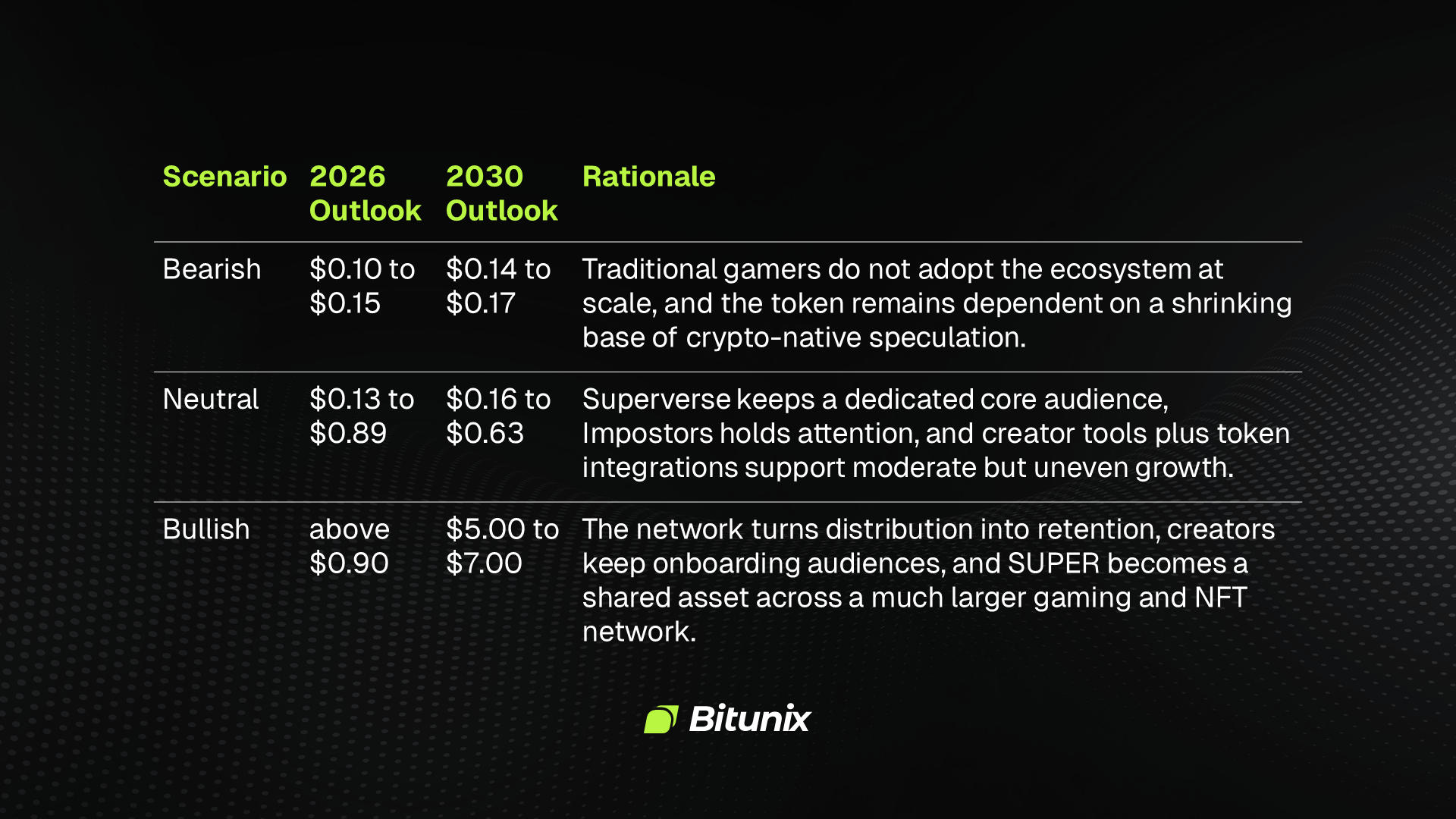
Superverse scenario table comparing bearish, neutral, and bullish price outlooks for 2026 and 2030.
Conclusion: A Bet on the Creator Economy
Superverse remains an unusual crypto gaming bet because it aims to address distribution and liquidity alongside gameplay. The ecosystem has a recognizable founder, a token with real staking and governance functions, a flagship social game in beta, and an official strategy centered on shared users, integrated utility, and buyback-linked liquidity. That makes it more interesting than a one-game token, even if it still has plenty to prove.
The hard part is that Web3 gaming still has to overcome skepticism, and creator-led attention still has to turn into durable player behavior. If Superverse manages that, SUPER has room well beyond the cautious exchange models now clustered around the mid-teens in cents. If it does not, the token can stay trapped as a small-cap gaming asset with periodic spikes and weak long-term follow-through. For readers tracking the sector directly, Bitunix supports the SUPER/USDT trading pair, and the platform also offers a mobile app that you can download and register for, if you want to monitor the token while the Superverse story continues to develop.
FAQ
What is Superverse (SUPER)?
Superverse is a Web3 gaming ecosystem built to connect games, NFT marketplaces, and token utility inside one shared network. It evolved from SuperFarm and now centers on cross-game value, creator tools, and products like Impostors and its NFT marketplace, all powered by the SUPER token.
Who founded Superverse?
Superverse was founded by Elliot Wainman, better known as EllioTrades. He launched the project as SuperFarm in 2021, then later repositioned it as Superverse with a stronger focus on Web3 gaming, NFTs, and a broader cross-game ecosystem.
What is the difference between SuperFarm and Superverse?
SuperFarm was the earlier brand, and Superverse is the expanded version built around gaming, integrations, liquidity, and token utility. Official docs also confirm there is no new replacement token, because SUPER ERC-20 remains the token of the ecosystem.
What is the Impostors game?
Impostors is Superverse's flagship social-gaming metaverse. It is a bridge between Web2 gaming culture and Web3 tech, with creator monetization tools and social gameplay that is already in beta.
What is the utility of the SUPER token?
SUPER is used for governance, staking, rewards, and broader cross-game ecosystem utility. It is also connected to Blackhole buybacks, DAO participation, and ETH rewards for stakers, which gives it more practical use.
How do creators use the Superverse platform?
The current creator pitch centers on distribution, monetization, and access to a gaming community rather than on a single standalone tool. Impostors gives creators tools to build and monetize original content inside its metaverse.
Can I stake SUPER tokens?
Yes. SUPER holders can use the DAO Staker to stake tokens and earn ETH rewards generated by the decentralized network, while token holders also vote on proposals.
What is the Superverse NFT marketplace?
The Superverse NFT marketplace is GigaMart, a platform for buying, selling, and minting gaming NFTs and digital collectibles. It was designed with cross-chain support, analytics, social features, and SUPER-based fees, though reports say operations have been paused while Superverse focuses more heavily on gaming expansion.
What are the risks of investing in SUPER?
The main risks are weak mainstream gamer adoption, heavy reliance on creator attention, supply overhang, and the possibility that token utility grows more slowly than expected.
Where can I buy SUPER tokens?
You can buy SUPER on major centralized exchanges such as Bitunix, Binance, KuCoin, Gate.io, HTX, Kraken, and Revolut, many with fiat options like card or SEPA. If you prefer on-chain trading, SUPER is also available on decentralized exchanges such as Uniswap and PancakeSwap.
Glossary
- SUPER token: The ERC-20 asset used for governance, staking, rewards, and broader ecosystem utility across Superverse.
- Superverse ecosystem: The wider network of games, liquidity tools, integrations, and community channels built around SUPER.
- Impostors game: Superverse's flagship social-gaming metaverse, designed to connect Web2 gaming culture with Web3 features.
- Web3 gaming: A gaming model that uses tokens, wallets, NFTs, or on-chain ownership as part of the user experience.
- NFT marketplace: A platform where users buy, sell, and manage digital assets, such as in-game items and collectibles.
- DAO: A decentralized governance structure where token holders vote on proposals and treasury direction.
- DAO Staker: Superverse's staking interface and contract structure for SUPER holders who want ETH-denominated rewards.
- Governance: The voting process through which SUPER holders can participate in ecosystem decisions.
- ETH rewards: Rewards paid to stakers through the DAO staking system described in Superverse docs.
- Blackhole DEX: Superverse's first liquidity protocol, which the site says uses part of fees to buy back SUPER.
- Buyback: A mechanism where protocol fees are used to purchase tokens from the market, potentially supporting demand.
- Circulating supply: The amount of SUPER currently tradable on the market, listed by CoinMarketCap at roughly 640 million.
- Max supply: The total cap on SUPER issuance, shown near 1 billion tokens in current token data and docs.
- Creator economy: The audience-driven model where creators use their communities, content, and platforms to drive product adoption and monetization.
- Social deduction: The game genre behind Impostors, chosen because Superverse docs see it as social, accessible, and large enough to serve as a Web3 onboarding lane.
Disclaimer
This article does not provide:
(i) investment advice or investment recommendations;
(ii) an offer or solicitation to buy, sell, or hold digital assets;
(iii) financial, accounting, legal, or tax advice.
Digital assets, including stablecoins and NFTs, involve high risk and may fluctuate significantly. Consider whether trading or holding digital assets is appropriate for you given your financial situation. Consult a qualified legal, tax, or investment professional when needed. You are responsible for understanding and complying with applicable local laws and regulations.
About Bitunix
Bitunix is a global cryptocurrency derivatives exchange trusted by over 3 million users across more than 100 countries. At Bitunix, we are committed to providing a transparent, compliant, and secure trading environment for every user. Our platform features a fast registration process and a user-friendly verification system supported by mandatory KYC to ensure safety and compliance. With global standards of protection through Proof of Reserves (POR) and the Bitunix Care Fund, we prioritize user trust and fund security. The K-Line Ultra chart system delivers a seamless trading experience for both beginners and advanced traders, while leverage of up to 200x and deep liquidity make Bitunix one of the most dynamic platforms in the market.
Bitunix Global Accounts
X | Telegram Announcements | Telegram Global | CoinMarketCap | Instagram | Facebook | LinkedIn | Reddit | Medium