
Article Summary
- This article explains that cryptography is the practice of using mathematical techniques to secure communication and information.
- It uses the analogy of sending a secret message in a locked box; only someone with the correct key can open the box and read the message.
- It breaks down the three core pillars of cryptography: Encryption (protecting confidentiality), Hashing (verifying integrity), and Digital Signatures (ensuring authenticity).
- The guide provides a detailed comparison table explaining the difference between Symmetric Encryption (one shared key) and Asymmetric (Public Key) Encryption (two separate keys).
- It explains how these cryptographic principles are the fundamental building blocks that make cryptocurrencies like Bitcoin possible, securing transactions and protecting user funds.
If you have ever sent a message, logged into your bank, or bought Bitcoin on Bitunix, you have already relied on cryptography. A modern crypto exchange uses it to protect logins, secure transactions, and verify that data has not been altered. Most people never see it working, but it underpins much of daily online life.
Cryptography is the science of hiding information, checking that data stays unchanged, and proving who created it. Those three jobs are called confidentiality, integrity, and authenticity. The terms sound technical at first, but the idea is simple. You want your messages to stay private, your data to stay clean, and your sender to be real.
This guide breaks the subject into three practical parts: encryption, hashing, and digital signatures. Once you understand those, the topic becomes much easier to follow. And you start to see how the same tools protect everything from chat apps to your crypto wallet.
The Three Pillars of Cryptography
If you want to understand modern security, start with the three basic jobs cryptography performs. On platforms such as Bitunix, these ideas show up in account protection, secure connections, and Proof of Reserves verification. At the internet scale, they matter even more. Cloudflare reported that global internet traffic grew 19% year over year in 2025, and post-quantum encryption protected 52% of all human traffic on its network by the end of that year.
These are the main elements involving cryptography nowadays:
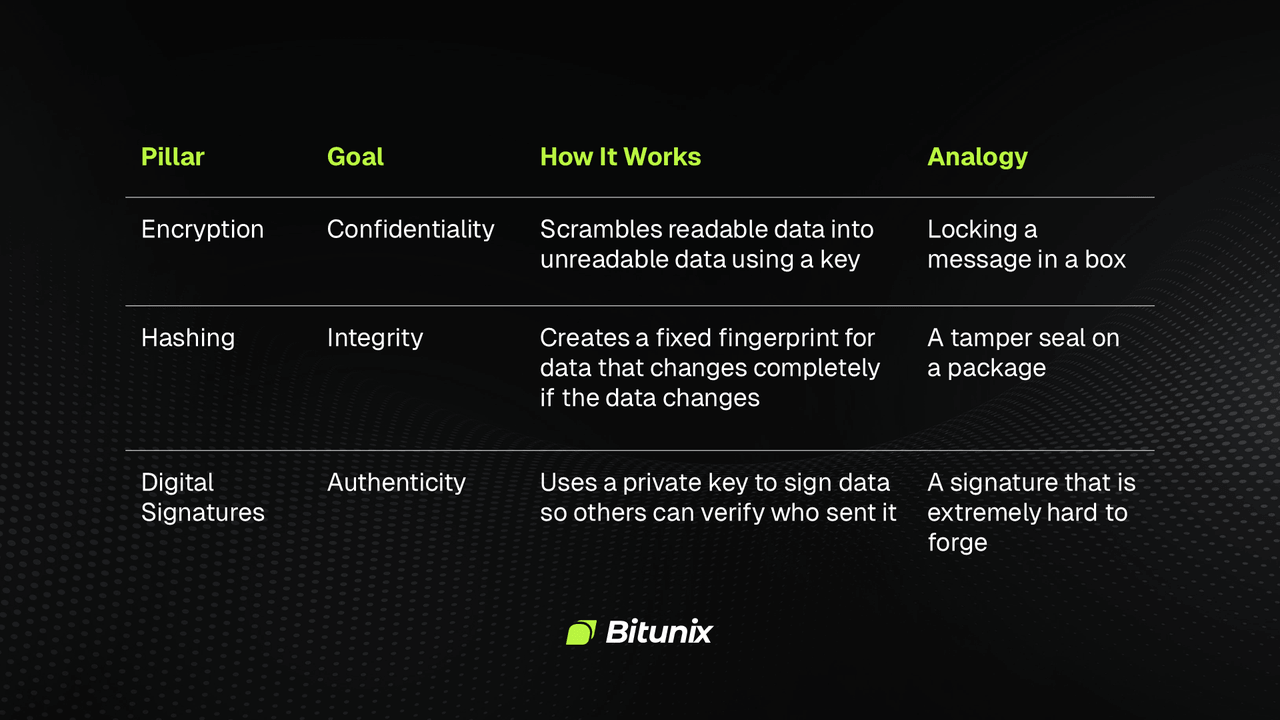
Encryption protects privacy, hashing checks integrity, and digital signatures verify identity, together forming the core tools of modern cryptography.
When people ask what is cryptography, this three-part model is the cleanest place to start. However, these are not the only types of cryptography, but they are the ones you meet first in real life. They also work together. A secure app often encrypts your traffic, hashes passwords or records, and uses digital signatures to verify identities or software updates.
Encryption: The Lock and Key
Encryption is the part most people picture first. You take readable data, called plaintext, and scramble it into ciphertext so outsiders cannot understand it. This is the piece you rely on when you log into a website, send a private message, or use a trading platform like Bitunix. MIT Press noted in 2025 that AES underpins much of today's digital infrastructure, which tells you how common modern encryption really is.
Symmetric Encryption: The Single Key
Symmetric encryption uses a single key for both encryption and decryption. It is fast, efficient, and heavily used in real systems once two devices already trust each other. Stanford's 2026 review describes this as the model where both sides share the same secret key, and it is a major modern example used across digital systems.
The downside is the key exchange problem. If the same key unlocks the message, how do you safely share that key in the first place? That is the weak point. It is a bit like mailing someone a locked box while also needing to mail them the only key.
Asymmetric Encryption: Public Key Cryptography
Asymmetric encryption solved that exchange problem. Instead of a single shared key, it uses two: a public key that anyone can know and a private key that only the owner keeps. A message encrypted with the public key can only be opened with the matching private key. That idea made secure internet communication practical on a large scale.
Stanford summed it up neatly in 2026: “This uses two keys: a public key, which anyone can use to encrypt a message, and can be distributed over insecure channels."
That is the heart of public key cryptography. It also answers the beginner question how does cryptography work on the open internet. Your browser, a website, and other systems can exchange information securely even when strangers are listening to the network. They do it by combining public-key tools with faster symmetric keys for the actual session.
You can see this idea outside crypto, too. A certificate request contains a public key and a signature from the matching private key, and the certificate authority verifies those signatures before issuing a certificate. FIDO's 2025 government guidance also notes that passkey systems rely on phishing-resistant standards tied to public key infrastructure. So when you unlock an app with a passkey or visit a secure website, you are already using cryptography.
And the field keeps moving. NIST selected HQC in March 2025 as another post-quantum encryption algorithm for standardization, while Cloudflare reported that post-quantum encryption already protected more than half of its human traffic in 2025. That matters because quantum computing is pushing cryptography to evolve before the threat fully arrives.
How Cryptography Secures Cryptocurrency
Cryptocurrency would not work without cryptography. On Bitunix, for example, cryptographic methods also appear in Proof of Reserves through Merkle-based verification, which lets users verify inclusion in a published dataset without exposing everyone else's balances.
First, cryptography protects your wallet through digital signatures. When you send crypto, your wallet uses your private key to sign the transaction. Other participants can verify that the signature using the matching public key, without learning your private key. The sender hashes the message, signs that hash with a private key, and the receiver checks that the result matches. That proves the message came from the right sender and was not altered on the way.
Second, hashing protects transaction integrity. A blockchain can be visualized as a chain of blocks where each block includes a cryptographic hash of the previous block. That structure makes retroactive tampering easy to spot because changing one block breaks the links that follow it. In normal language, every block leaves fingerprints on the next one. If someone edits history, the fingerprints stop matching.
Third, crypto gives you pseudonymity, not perfect anonymity. Public blockchains are transparent enough that investigators can often trace funds, especially when addresses connect to services, hacks, or exchange activity. Chainalysis showed in 2025 and 2026 that investigators followed stolen funds across chains and that crypto theft remained a huge problem, with more than $2.17 billion stolen by mid 2025 and North Korean hackers alone stealing $2.02 billion in 2025.
Public traceability is one reason cryptography matters so much in cybersecurity. If you lose control of a private key or sign the wrong transaction, the network will still accept the valid signature. It cannot tell the difference between you and someone who stole your key. That is why secure storage, phishing resistance, and careful account habits matter just as much as clever math. Bitunix's 2026 security guide makes the same practical point by stressing official access, verification hygiene, and fast action if suspicious activity appears.
The same lesson shows up across cybersecurity more broadly. CISA's 2025 ransomware guide defines ransomware as malware that encrypts files and makes systems unusable. Chainalysis then reported in 2026 that on-chain ransomware payments still reached about $820 million in 2025, even as claimed attacks rose 50%. Good cryptography protects honest users, but criminals can misuse the exact same mathematics.
Conclusion: The Unsung Hero of the Digital World
Cryptography is the bedrock of digital security. Encryption hides data, hashing checks integrity, and digital signatures prove authenticity. Together, they help secure websites, apps, certificates, wallets, and blockchains. After working through the basics, what is cryptography stops sounding like a niche computer science term and starts looking like the quiet system that keeps modern digital life from falling apart.
In cryptocurrency, these tools are the whole foundation. Public key cryptography lets you control funds without a central authority. Hashing helps connect blocks and reveal tampering. Digital signatures prove that a transaction came from the person who owns the key. Without those ingredients, decentralized money does not function.
Every time you use Bitunix, you are relying on the same family of ideas, from layered account security to cryptographic Proof of Reserves checks. To review the platform's security setup, visit Bitunix's security measures. And if you want to get started, download the Bitunix app and register.
FAQ
What is the difference between cryptography and encryption?
Cryptography is the wider field. It includes encryption, hashing, digital signatures, key management, and other methods for protecting information. Encryption is just one part of that system. It focuses on turning readable data into unreadable data, so unauthorized people cannot understand it.
What is a hash function?
A hash function takes input data of any size and produces a fixed-length output, often called a hash or fingerprint. Even a tiny change in the input creates a very different result. That makes hashes useful for checking integrity, passwords, signatures, and blockchains.
What is SHA-256?
SHA-256 is a widely used cryptographic hash function that produces a 256 bit output. SHA-256 is still a reference point when discussing security strength categories. In practice, it is famous for blockchain use, checksums, and integrity verification.
How are my private keys generated?
Private keys are generated from random bits with enough entropy. Cryptographic keys need proper generation rules and sufficient entropy from random bit generators. If the randomness is weak, the security of the key drops with it.
What is end-to-end encryption?
End-to-end encryption means only the sender and intended recipient can read the message content. The service moving the message should not be able to read it in transit. It protects message confidentiality, but it does not solve every security problem around devices, backups, or phishing.
Is quantum computing a threat to cryptography?
Yes, especially for many current public key systems. NIST continues to standardize post-quantum algorithms because future quantum computers could break widely used public key methods. That does not mean current security collapses tomorrow, but it does mean the migration work has already started.
What is a digital certificate?
A digital certificate binds a public key to an identity, such as a website domain. Certificate requests include a public key and signatures tied to the corresponding private key, and the certificate authority verifies them before issuing the certificate.
Who invented public key cryptography?
Whitfield Diffie and Martin Hellman introduced the core idea in the 1970s, and later RSA made it practical for broader use. Stanford's 2025 and 2026 reviews credit Diffie and Hellman with the development of asymmetric cryptography, while the MIT Press explains how RSA pushed the field forward.
What is the Enigma machine?
The Enigma machine was a rotor-based cipher device used by Nazi Germany in World War II to encrypt military messages. Its changing settings made codes hard to read, but Polish and British codebreakers later cracked it, helping the Allies gain critical intelligence and shorten the war.
Can cryptography be broken?
Yes, but usually through weak keys, bad implementation, stolen credentials, or poor system design rather than magic math. Cryptography alone cannot secure everything, and poor key management can undermine even strong algorithms.
Glossary
- Cryptography: The science of protecting information by hiding it, checking it, and proving who created it.
- Encryption: The process of scrambling readable data into unreadable ciphertext using a cryptographic key.
- Plaintext: The original readable message before encryption.
- Ciphertext: The scrambled, unreadable result after encryption.
- Key: A secret or public value used by a cryptographic algorithm to lock or unlock data.
- Symmetric encryption: Encryption that uses the same key for both encryption and decryption.
- Asymmetric encryption: Encryption that uses a public key and a private key instead of one shared key.
- Public key cryptography: A system where anyone can use the public key, but only the owner controls the private key.
- Private key: The secret key that decrypts data or creates a digital signature.
- Hash function: A function that creates a fixed-length fingerprint from data.
- Hash: The fingerprint produced by a hash function.
- Digital signature: A cryptographic proof that a message came from the holder of a private key.
- Integrity: Confidence that data was not changed without permission.
- Authenticity: Confidence that data came from the claimed sender or source.
- Digital certificate: A signed digital file that links a public key to an identity, such as a website.
Disclaimer
This article does not provide:
(i) investment advice or investment recommendations;
(ii) an offer or solicitation to buy, sell, or hold digital assets;
(iii) financial, accounting, legal, or tax advice.
Digital assets, including stablecoins and NFTs, involve high risk and may fluctuate significantly. Consider whether trading or holding digital assets is appropriate for you given your financial situation. Consult a qualified legal, tax, or investment professional when needed. You are responsible for understanding and complying with applicable local laws and regulations.
About Bitunix
Bitunix is a global cryptocurrency derivatives exchange trusted by over 4 million users across more than 100 countries. At Bitunix, we are committed to providing a transparent, compliant, and secure trading environment for every user. Our platform features a fast registration process and a user-friendly verification system supported by mandatory KYC to ensure safety and compliance. With global standards of protection through Proof of Reserves (POR) and the Bitunix Care Fund, we prioritize user trust and fund security. The K-Line Ultra chart system delivers a seamless trading experience for both beginners and advanced traders. At the same time, leverage of up to 200x and deep liquidity make Bitunix one of the most dynamic platforms in the market.
Bitunix Global Accounts
X | Telegram Announcements | Telegram Global | CoinMarketCap | Instagram | Facebook | LinkedIn | Reddit | Medium