Canada's Solana spot ETFs have given investors a way to access SOL through traditional brokerage accounts while potentially earning staking rewards. The products launched on April 16, 2025, after Canadian regulators approved four issuers' offerings. Their introduction was an important development for crypto investment products, but the market implications are more nuanced than the initial headlines suggested.
The key question is no longer whether Canada has Solana ETFs with staking. It is how these products work, what staking contributes to their returns, and whether ETF demand can translate into sustained demand for SOL.
What Happened When Canada Approved Solana Spot ETFs?
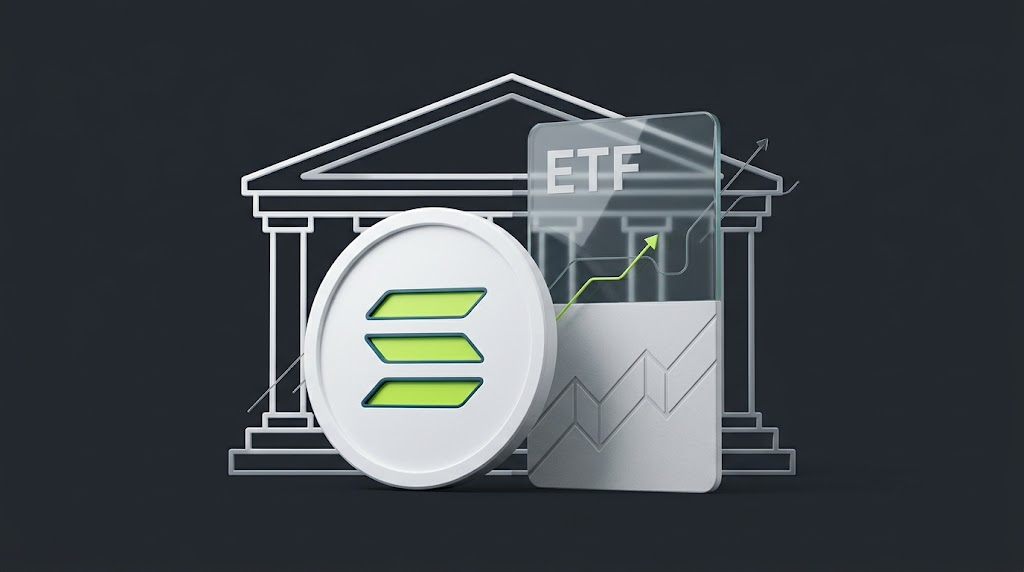
Canada's Solana spot ETFs began trading in April 2025, expanding access to SOL through exchange-traded products.
The Four ETF Issuers and the April 2025 Launch
In April 2025, four Canadian asset managers introduced spot Solana ETFs with staking capabilities:
The funds began trading on April 16, 2025, giving investors access to SOL exposure through exchange-traded products listed in Canada. The launch was notable because the products combined spot exposure to Solana with the potential to earn staking rewards.
The Cboe ETF Market Canada overview of Solana ETFs provides additional background on the launch and the role of staking in these products.
The available listings include different fund names, currency classes, and tickers. For example, 3iQ's Solana Staking ETF trades under SOLQ and SOLQ.U, while Evolve's Solana ETF includes SOLA and SOLA.U. Investors should check the relevant exchange listing and current fund documents because tickers and unit classes can differ by currency and hedging arrangement.
How Do Spot SOL ETFs Differ From Futures-Based Products?
A spot Solana ETF generally holds SOL directly, with a custodian safeguarding the underlying assets. Its net asset value is therefore designed to reflect the value of its holdings, less applicable liabilities and expenses.
A futures-based product, by contrast, obtains exposure through futures contracts rather than simply holding the underlying token. Its performance can be affected by futures-market pricing, contract rolls, and other factors in addition to changes in SOL's spot price.
For investors, the distinction affects how exposure is delivered and what can influence returns. A spot ETF with staking adds another consideration: the fund may earn rewards from participating in Solana's proof-of-stake network.
How Do Canadian Solana ETFs With Staking Work?
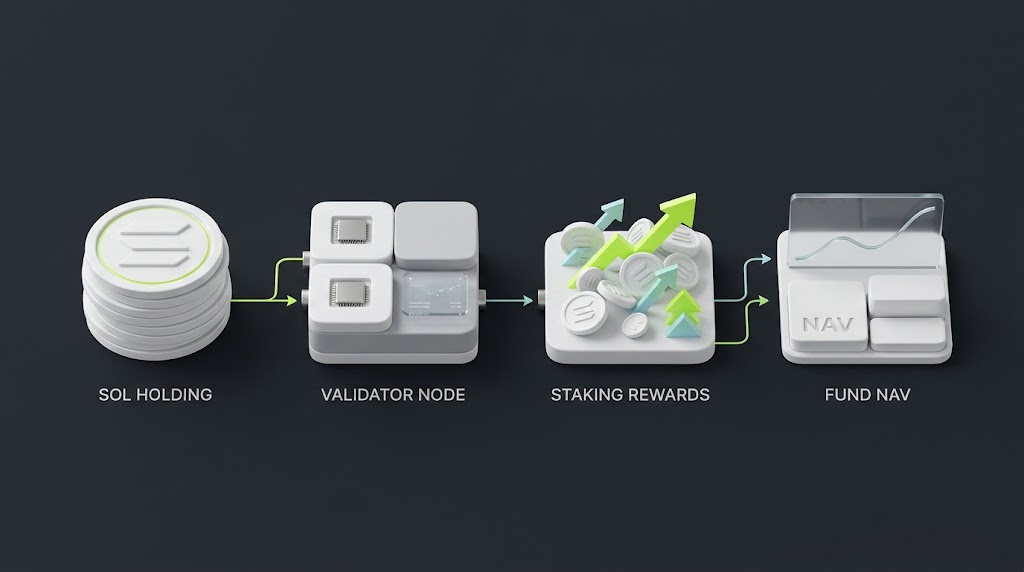
Staking can generate network rewards for eligible fund holdings, but returns vary and are not guaranteed.
How Spot SOL Exposure Works
When investors buy units of a spot Solana ETF, they own fund units rather than SOL directly. The fund holds the underlying cryptocurrency according to its investment mandate, and its unit price generally reflects the value of its holdings and other fund-level factors.
This structure can make crypto exposure more accessible to investors who prefer brokerage accounts over managing a crypto wallet. It also means investors do not directly control the fund's SOL holdings or personally participate in staking through their ETF units.
The distinction matters when comparing an ETF with buying SOL on a crypto exchange. Direct SOL holders control their own custody and staking choices, subject to the method they use. ETF investors instead rely on the issuer, custodian, and other service providers operating under the fund's terms.
How ETF Staking Generates Network Rewards
Solana uses a proof-of-stake consensus mechanism. SOL holders can delegate tokens to validators that participate in securing the network and processing its operations. In return, delegated SOL may earn staking rewards.
An ETF can arrange staking through its designated providers or validator infrastructure. If the fund earns rewards, those rewards may increase the fund's SOL holdings or otherwise be reflected in its net asset value, depending on the fund's structure and policies.
Staking does not create a fixed interest payment. Rewards can change with network conditions, validator performance, the amount of SOL being staked, and the fund's own arrangements and expenses. Some risks, such as validator penalties or periods when assets cannot be readily unstaked, may also apply depending on the implementation.
Consequently, a quoted staking yield should not be treated as a guaranteed annual return. Investors should look for the fund's current disclosures explaining how rewards are calculated, what costs are deducted, and how the resulting value reaches unit holders.
Fees, Custody, and Fund-Specific Staking Arrangements
Not all Solana ETFs are identical. Before investing, compare the following details in the latest prospectus and fund facts:
Management fees and expenses: These reduce investor returns. Promotional fee arrangements may also change after a specified period.
Staking policy: Check whether the fund stakes its holdings, how much may be staked, and how rewards are handled.
Custody and validator arrangements: Review who holds the underlying SOL and which parties are responsible for staking.
Currency exposure: CAD and USD unit classes may be available. Currency hedging, where offered, can affect returns for investors whose spending currency differs from the fund's underlying exposure.
Trading liquidity and tracking: Compare bid-ask spreads, trading volume, and how closely the fund follows its stated benchmark.
For example, 3iQ's official Solana Staking ETF page publishes fund information, trading symbols, custody details, and documents for investors to review. These details should be checked directly rather than assuming that every Canadian Solana ETF has the same fee structure or staking policy.
What Could Solana ETF Approval Mean for the SOL Market?
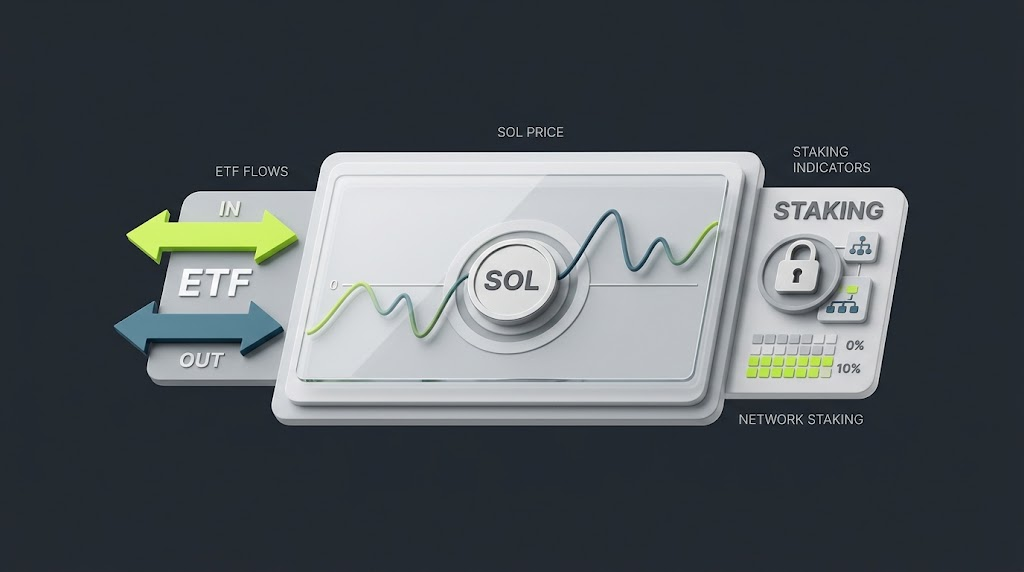
ETF flows may influence SOL demand, but market prices also depend on broader conditions and network activity.
Access Through Traditional Brokerage Accounts
An ETF can broaden access to SOL by allowing eligible investors to gain exposure through an investment account instead of buying and storing tokens themselves. This may appeal to investors who already use brokerage platforms or prefer a regulated fund structure.
Easier access, though, does not automatically create new demand on a scale large enough to move the market. The effect depends on how much capital enters the funds, whether investors maintain their positions, and how ETF demand compares with selling elsewhere in the market.
ETF availability is therefore best understood as an expansion of investment access, not as a standalone price catalyst.
Potential Effects on Fund Flows and Staking Participation
Spot ETFs can influence the market through their creation and redemption activity, which can affect demand for the underlying asset. Staking adds a second dimension: funds that stake part of their SOL holdings may direct more tokens into network staking than they otherwise would.
The actual effect depends on fund size, staking participation, redemption needs, and each issuer's operating arrangements. Fund flows can also reverse. Positive inflows over a short period do not establish a lasting trend, and a fund can experience outflows even when SOL's price rises.
For context, Cboe ETF Market Canada's Solana ETF coverage has reported periods when Canadian Solana funds attracted weekly inflows while their year-to-date net flows remained negative. This illustrates why investors should distinguish short-term activity from longer-term demand.
Why Approval Does Not Guarantee SOL Price Gains
The launch of a new ETF can strengthen market attention, but SOL's price continues to depend on several factors:
Broader crypto-market conditions: Bitcoin's direction, liquidity, and risk appetite can affect altcoins, including SOL.
Solana network activity: Demand for applications, transactions, and ecosystem services can influence interest in the network and its token.
Supply and staking dynamics: Staking participation, token issuance, and changes in circulating supply can affect market conditions.
ETF demand: Persistent net inflows may support demand, while redemptions can have the opposite effect.
Regulatory and competitive developments: Changes in crypto investment products and the regulatory environment can alter investor access and preferences.
A rally should not be attributed to ETF approval without evidence that supports the connection. Similarly, a price decline does not necessarily mean that the products have failed; broader market conditions may outweigh fund-specific demand.
For a separate discussion of long-term scenarios, valuation assumptions, and potential price drivers, see Bitunix's Solana Price Prediction 2026: The Ultimate Guide to Predictions and Market Analysis. ETF adoption is one factor to consider, not a reliable basis for predicting a particular price target.
How Do Canadian Solana ETFs Compare With Other Markets?
Canada's Early Move Into Spot SOL ETFs With Staking
Canada's April 2025 launch gave investors access to spot Solana ETFs with staking capabilities before the subsequent expansion of US-listed Solana investment products. The Canadian products established an early model for combining direct SOL exposure with potential network rewards within an exchange-traded fund.
The significance of that development should be understood in its historical context. The ETF market has continued to evolve since April 2025, so it would be inaccurate to describe Canada as the only market offering Solana investment products or to assume that all competing products have the same features.
How US-Listed Solana Products Have Evolved
US-listed Solana products have expanded since the Canadian launch, including products that offer staking-related exposure. Product structures, launch dates, regulatory arrangements, and staking policies vary by issuer.
Investors comparing markets should focus on the terms of the specific product rather than relying only on its listing country. A product's name or marketing description does not by itself establish whether it stakes assets, how rewards are treated, or what risks and costs apply.
For cross-market comparisons, verify the latest prospectus, official product page, exchange listing, and applicable regulatory disclosures. Product availability and eligibility can also vary depending on the investor's jurisdiction and account type.
Why Product Structure and Regulatory Status Matter
A fund listed on an exchange is not the same as direct ownership of SOL. ETF investors are exposed to the fund's structure, service providers, expenses, and operating policies, as well as the underlying token's market risks.
Regulatory approval or listing should not be interpreted as a guarantee of investment performance, principal protection, or the absence of risk. Investors should confirm that a product is available to them and review its legal documents before making a decision.
Readers interested in Solana's broader ecosystem can also explore Bitunix's Solana Launchpad Guide and Solana vs. XRP Comparison for related background.
What Risks Should Investors Know About Solana ETF Staking?
Staking may add potential rewards, but it does not remove the main risks of holding SOL exposure.
SOL price volatility: The value of the underlying token can fall sharply. Staking rewards may be too small to offset a substantial decline in SOL's price, so positive staking returns do not guarantee a positive total return.
Variable staking rewards: Rewards are not fixed. They can change as network conditions, staking participation, validator performance, and fund policies change. A yield observed at one point should not be assumed to continue.
Fees and tracking differences: Management fees, fund expenses, trading spreads, and the difference between a fund's benchmark and realized performance can reduce returns.
Custody and operational risks: Investors rely on the fund's custody, security, and operating arrangements. Staking introduces additional considerations around validator performance and the availability of staked assets.
Liquidity and redemption risks: ETF units trade in the market, where prices and bid-ask spreads can vary. Underlying crypto-market liquidity and fund operations may also affect trading conditions.
Regulatory and product-specific risks: Rules and product terms can change. Investors should read the latest fund documents and confirm local eligibility rather than assuming that all Solana products are available under the same conditions.
The practical takeaway is straightforward: evaluate a Solana ETF based on its total exposure, costs, staking policy, and risk profile—not on a staking-yield figure alone.